

Mine profile · Indonesia
Grasberg Mine: Output, Reserves and Restart Status
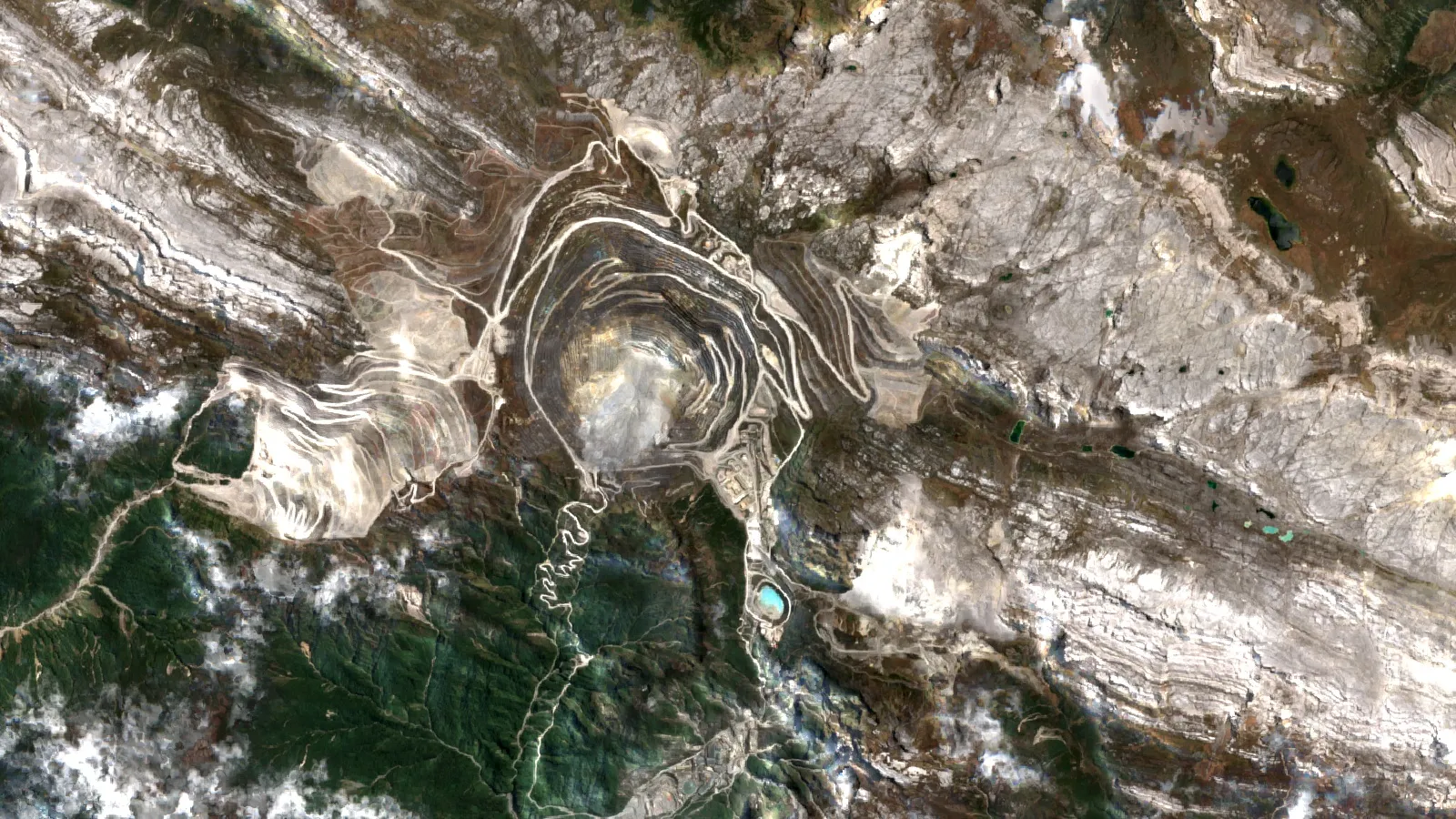
The Grasberg mine in Central Papua, Indonesia, produced 1.0 billion lb of copper and 0.9 million oz of gold in 2025 after a fatal mud rush; Freeport targets near-full capacity by the end of 2027.
Key takeaways
- Grasberg produced 1,015 million lb of copper and 937,000 oz of gold in 2025, down from 1,800 million lb and 1.86 million oz in 2024 (Freeport 10-K, 2025).
- A mud rush on 8 September 2025 killed seven workers; the block cave restarted in phases from March 2026 and the mill ran at 67% of capacity in the third quarter of 2026 (Freeport, October 2026).
- Freeport-McMoRan owns 48.76% of PT Freeport Indonesia; MIND ID and a Papua-linked company hold 51.24%.
- Reserves totalled 1,338 million tonnes across four ore bodies at 31 December 2025, led by the Grasberg Block Cave (472 Mt at 1.04% copper and 0.66 g/t gold).
- Grasberg ranked third among copper mines worldwide in 2025 at 460.4 kt (MINING.COM, 2026).
In this article
- Where is the Grasberg mine in Indonesia?
- Who owns the Grasberg mine?
- A short history: from Ertsberg to the Grasberg discovery
- Grasberg copper and gold production by year
- How Grasberg compares with the world's biggest copper mines
- Geology of the Grasberg copper-gold deposit
- Inside the Grasberg mine: the underground operations
- Grasberg reserves by ore body
- The mud rush incident and the restart timeline
- Smelting, gold exports and the mining rights extension
- Tailings, water and environmental management
- Communities and workforce
- What consultants and investors should watch next
- Frequently asked questions
The Grasberg mine is a copper-gold mining district in the Sudirman Range of Central Papua, Indonesia, run by PT Freeport Indonesia (PTFI). It produced 1.0 billion pounds of copper and 0.9 million ounces of gold in 2025, down from 1.8 billion pounds and 1.9 million ounces in 2024, because a mud rush on 8 September 2025 killed seven workers and stopped its largest underground mine (Freeport-McMoRan 10-K for 2025). At normal rates its three underground mines produce about 1.7 billion pounds of copper and 1.3 million ounces of gold a year.
This guide is for consultants, analysts and investors who need the numbers in one place: where the mine is, who owns it, output by year, reserves by ore body, how the restart is going and what to watch next. Every figure carries its source and date.
Where is the Grasberg mine in Indonesia?
Grasberg sits in the remote highlands of the Sudirman Mountain Range, in Mimika Regency, Central Papua province, on the western half of the island of New Guinea. Freeport gives the project site as latitude 4.08 degrees south and longitude 137.12 degrees east (WGS 84). The operating area covers about 24,600 acres (roughly 9,950 hectares).
Access is by the Timika airport and a coastal portsite on the Arafura Sea, linked to the mill complex by a 70-mile (about 113 km) service road. The ore bodies lie at high elevation: the DMLZ ore body sits below the 2,590-metre level and Kucing Liar near the 2,605-metre level. The area is in an active seismic zone and receives about 200 inches (around 5,000 mm) of rain a year, which shapes everything from road maintenance to how the underground caves are managed (Freeport 10-K, 2025).
- Nearest town and airport: Timika, Mimika Regency.
- Province: Central Papua (Papua Tengah), Indonesia.
- Ports and processing: concentrate goes to smelters in Gresik, East Java (see below).
- Operator since 1967: Freeport and its predecessors have been the only explorer and miner in the operating area.
Who owns the Grasberg mine?
Since a deal with the Indonesian government closed on 21 December 2018, Freeport-McMoRan (NYSE: FCX) holds 48.76% of PT Freeport Indonesia and manages the operation. The other 51.24% is held by PT Mineral Industri Indonesia (MIND ID), a state-owned enterprise, and PT Indonesia Papua Metal Dan Mineral, which is expected to be owned by MIND ID and the provincial and regional government of Central Papua (Freeport 10-K filed with the SEC, 2025). PTFI’s results are consolidated in Freeport’s accounts.
The mining right is a special mining business licence called an IUPK, which replaced the old contract of work in 2018 and runs to 2041. In February 2026 Freeport, PTFI and the government signed a memorandum of understanding to extend operating rights for the life of the resource. Under it, Freeport would keep 48.76% through 2041 and hold about 37% from 2042. PTFI filed its extension application in June 2026; the extension still needs an amended IUPK from the government (Freeport third-quarter 2026 results, 27 October 2026).
For a wider view of Freeport’s other mines in Arizona, Peru and Chile, see our guide to Freeport-McMoRan’s copper production and FCX stock.
A short history: from Ertsberg to the Grasberg discovery
PTFI started mining in 1972 at Ertsberg, a copper outcrop nearby. The Grasberg ore body was discovered in 1988, and open-pit mining of it began in 1990 (Freeport, Indonesia operations page). The pit became one of the best-known open pits in the world. Its final phase was mined in 2019, including removal of the pit ramps. Over the 30 years from 1990 to 2019, the Grasberg open pit produced more than 27 billion pounds of copper and 46 million ounces of gold.
Production then moved underground. The Grasberg Block Cave mine works the same ore body that was mined from the pit, but from below. PTFI describes the district today as containing one of the world’s largest recoverable copper and gold reserves even after decades of output (PT Freeport Indonesia).
Grasberg copper and gold production by year
The table shows Freeport’s reported output for its Indonesia operations, which is the Grasberg minerals district. “Recoverable” means the metal expected after milling and smelting losses. One billion pounds of copper is about 454,000 tonnes.
Chart
Grasberg copper production
Million pounds of recoverable copper, Indonesia operations
| Year | Copper produced (million lb) | Gold produced (thousand oz) | Ore milled (t/day) | Copper grade | Gold grade (g/t) |
|---|---|---|---|---|---|
| 2021 | 1,336 | 1,370 | 151,600 | 1.30% | 1.04 |
| 2022 | 1,567 | 1,798 | 192,600 | 1.19% | 1.05 |
| 2023 | 1,660 | 1,978 | 198,300 | 1.22% | 1.12 |
| 2024 | 1,800 | 1,861 | 208,400 | 1.27% | 1.00 |
| 2025 | 1,015 | 937 | 138,100 | 1.10% | 0.77 |
Source: Freeport-McMoRan 10-K for 2025, selected operating data. Grade is the average ore grade milled; g/t means grams of gold per tonne of ore. Recovery in 2025 was 87.9% for copper and 75.7% for gold.
2026 is a recovery year. In the first nine months of 2026, Indonesia produced 549 million pounds of copper and 505,000 ounces of gold, and Freeport expects full-year 2026 sales of about 0.7 billion pounds of copper and 632,000 ounces of gold (Freeport third-quarter 2026 results). Production is expected to run ahead of sales by about 100 million pounds of copper and 70,000 ounces of gold, because metal is held as inventory at the smelters while they ramp up.
Grasberg’s swing matters at country level too. The USGS estimates Indonesia’s mine copper output fell from 1,010,000 tonnes in 2024 to about 710,000 tonnes in 2025, and puts Indonesia’s copper reserves at 21 million tonnes (USGS Mineral Commodity Summaries 2026, copper). For gold, USGS lists Indonesia at 94 tonnes in 2024 and about 90 tonnes in 2025, with reserves of 3,600 tonnes (USGS Mineral Commodity Summaries 2026, gold).
How Grasberg compares with the world’s biggest copper mines
Even in a disrupted year, Grasberg ranked third among the world’s copper mines in 2025 by copper produced, according to the MINING.COM ranking of the 10 biggest copper mines. The ranking metric is copper metal produced in 2025, in thousand tonnes (kt); figures are the publisher’s, rounded.
Chart
World’s biggest copper mines
Copper produced in 2025, thousand tonnes, top 8 mines in the MINING.COM ranking
| Rank | Mine | Country | Copper produced in 2025 (kt) |
|---|---|---|---|
| 1 | Escondida | Chile | 1,347.6 |
| 2 | Tenke Fungurume | DR Congo | 519 |
| 3 | Grasberg | Indonesia | 460.4 |
| 4 | Las Bambas | Peru | 411.3 |
| 5 | Buenavista | Mexico | 409.4 |
| 6 | Collahuasi | Chile | 404.1 |
| 7 | KGHM operations | Poland | 401.1 |
| 8 | Cerro Verde | Peru | 391.5 |
| 9 | Kamoa-Kakula | DR Congo | 385.8 |
| 10 | Antamina | Peru | 368 |
Grasberg’s 460.4 kt matches Freeport’s own 1,015 million pounds for 2025. In 2024, at 1.8 billion pounds (about 816,000 tonnes), the district produced well over half of Escondida’s output. What sets it apart is gold: at normal rates the district also produces about 1.3 million ounces a year, alongside the copper. For the companies behind these mines, see our list of the largest copper producers.
Geology of the Grasberg copper-gold deposit
Grasberg is a porphyry copper-gold deposit with neighbouring skarn ore bodies. A porphyry deposit is a very large volume of rock around a cooled magma body (an intrusion) in which copper minerals are spread through veins and fractures. The USGS describes porphyry deposits as large-tonnage, low to moderate grade ores (0.3-2.0% copper) that supply more than 60% of the world’s mined copper (USGS Porphyry Copper Deposit Model, 2010). Grasberg’s reserve grades (0.7-1.0% copper in the caves, 2.2% at Big Gossan) sit in the upper half of that range or above it.
Freeport describes two main intrusions: the Grasberg monzodiorite and the Ertsberg diorite. They cut carbonate and clastic sedimentary rocks that form the ridge crests of the Sudirman Range.
- Igneous-hosted ore (the Grasberg Block Cave and parts of the DMLZ): copper sulphides in vein networks and disseminations, mainly chalcopyrite and some bornite.
- Skarn ore (parts of the DMLZ and Kucing Liar, and all of Big Gossan): magnetite-rich calcium-magnesium skarn, where hot fluids replaced limestone and dolomite next to the intrusions. Major faults control where these bodies sit.
Porphyry systems like this leave a wide footprint of altered rock at surface, often several kilometres across. That is why explorers screen satellite data for clay and iron-oxide alteration before drilling; our guide to remote sensing in copper prospecting explains the method, and types of ore deposits compares porphyry and skarn with other styles.
▶ What AI and data tools do in modern mining operations and exploration. · 3:52
Inside the Grasberg mine: the underground operations
Searches for “Grasberg mine inside” usually mean the underground workings. Three underground mines were operating at the end of 2025, with a fourth in development (Freeport 10-K, 2025).
Chart
Ore milled per day by underground mine
Thousand tonnes of ore per day
Grasberg Block Cave
Block caving undercuts a large column of ore so it breaks under its own weight and flows down to collection points called drawbells. At the end of 2025 the mine had 470 open drawbells. Loaders (LHDs, about 9 tonnes per bucket) feed an automated rail system with 14 locomotives and 160 ore wagons of 35 tonnes each, which delivers ore to three underground gyratory crushers. Crushed ore is conveyed to surface stockpiles. Ore milled from the block cave averaged 133,800 tonnes a day in 2024 and 78,400 in 2025.
Deep Mill Level Zone (DMLZ)
The DMLZ is a block cave below the depleted Deep Ore Zone mine, at the 2,590-metre elevation. It is the downward continuation of the Ertsberg East Skarn system and the Ertsberg porphyry. Hydraulic fracturing is used to precondition the rock and manage stresses after mining-induced seismic events. It had 174 open drawbells at end-2025 and milled 54,300 tonnes a day in 2025.
Big Gossan
Big Gossan is a tabular, near-vertical skarn body about 1,200 metres long and 800 metres deep, 20-120 metres thick. Unlike the caves, it uses blasthole stoping with paste backfill: open rooms are blasted, emptied and then filled with a cemented tailings paste. It milled 6,000 tonnes a day in 2025 and carries the highest grades in the district.
Kucing Liar (in development)
Kucing Liar lies under the southern part of the old open pit. Freeport’s plans call for a ramp-up starting in the 2030 timeframe to about 130,000 tonnes of ore a day, producing about 750 million pounds of copper and 735,000 ounces of gold a year at full rates. The start-up schedule is under review. By 30 September 2026 PTFI had spent about US$1.6 billion on it, with about US$4 billion more expected through 2033 (Freeport third-quarter 2026 results).
Grasberg reserves by ore body
Proven and probable reserves are the parts of a resource that have been shown to be economic to mine under a defined plan. Freeport reports Grasberg reserves under SEC Regulation S-K 1300. The figures below are at 31 December 2025, on a 100% basis (all owners), with recoveries net of mill and smelter losses.
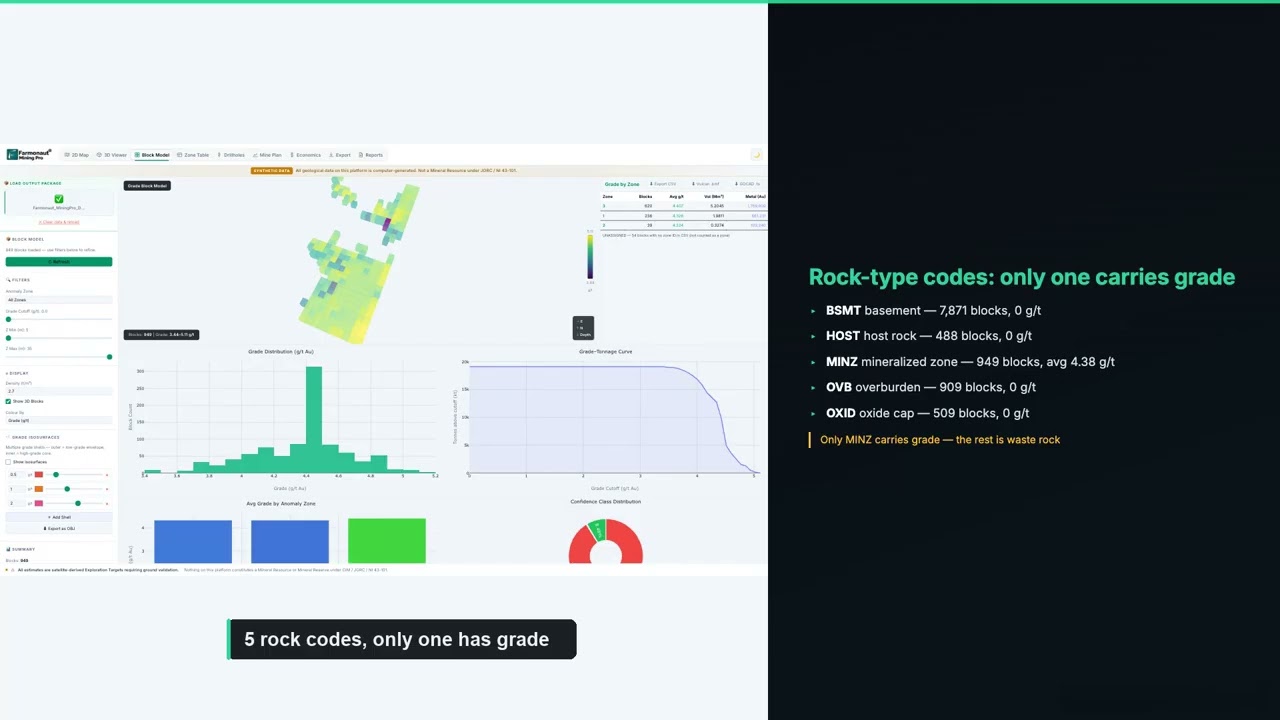
▶ How mining engineers build a block model, the data structure behind reserve tables like this one. · 17:46
Chart
Reserves by ore body
Million tonnes, proven and probable, 100% basis, 31 Dec 2025
| Ore body | Reserve (million t) | Copper grade | Gold (g/t) | Silver (g/t) | Copper recovery | Gold recovery |
|---|---|---|---|---|---|---|
| Grasberg Block Cave | 472 | 1.04% | 0.66 | 2.97 | 84.6% | 68.6% |
| DMLZ | 350 | 0.71% | 0.53 | 3.57 | 84.0% | 76.7% |
| Big Gossan | 47 | 2.23% | 0.94 | 13.69 | 91.1% | 67.6% |
| Kucing Liar | 469 | 1.03% | 0.88 | 5.26 | 79.1% | 57.0% |
| Total | 1,338 | – | – | – | – | – |
Freeport’s 48.76% share of the total is 652 million tonnes. Source: Freeport-McMoRan 10-K for 2025, estimated recoverable proven and probable mineral reserves. The block cave reserve uses a copper-equivalent cut-off grade of 0.54%, the lowest grade that pays its own way. A copper-equivalent grade folds gold and silver into a single copper figure by value.
Use the calculator below to turn a tonnage and grade into recoverable metal and a gross value at today’s prices. Gross value is before mining, processing, royalty and tax costs, so it is not a mine value.
Calculator
How much recoverable copper and gold is in an ore body?
Enter tonnes, grades, recoveries and today’s prices. Defaults are the Grasberg Block Cave reserve.
- Recoverable gold (million oz): 6.87
- Gross copper value (US$ billion): 45.8
- Gross gold value (US$ billion): 27.5
Default tonnes, grades and recoveries are the Grasberg Block Cave reserve at 31 December 2025 (Freeport-McMoRan 10-K, 2025). Prices are examples only: use today’s price. Gross value is before all costs, royalties and taxes and is not a mine valuation.
The mud rush incident and the restart timeline
On 8 September 2025 an external mud rush, a sudden inflow of wet fine material into the underground workings, hit the Grasberg Block Cave. Seven team members died. MINING.COM reports that about 800,000 tonnes of mud entered the mine. Mining was suspended to recover the workers and investigate (Freeport 10-K, 2025).
| Date | Milestone |
|---|---|
| 8 September 2025 | Mud rush at the Grasberg Block Cave; operations suspended. |
| Late October 2025 | DMLZ and Big Gossan, which were not affected, restart. |
| Fourth quarter 2025 | Investigations and remedial plans completed. |
| Late December 2025 | PT Smelting in Gresik resumes at reduced rates. |
| End of March 2026 | Initial ramp-up of Production Blocks 2 and 3 begins after mud removal, repairs and barriers. |
| Late August 2026 | PTFI’s own smelter restarts. |
| Third quarter 2026 | Mill averages 141,000 t/day (67% of capacity), including 70,000 t/day from the block cave. |
| Early 2027 (target) | Haulage-level material handling upgrades complete. |
| Mid-2027 (target) | About 80% of capacity; restart of Production Block 1S. |
| End of 2027 (target) | Approach full capacity. |
Sources: Freeport 10-K for 2025 and second-quarter and third-quarter 2026 results. Targets are company guidance, not certainties.
The cost has been large. Idle facility, direct recovery and restoration costs at PTFI totalled US$934 million in the first nine months of 2026, which Freeport excludes from its unit cash cost figures. In the third quarter of 2026 Freeport also reported dry weather at site: it helps mining but limits water for the mill, which could affect mill rates if it persists.
Smelting, gold exports and the mining rights extension
All Grasberg concentrate is now processed in Indonesia. PTFI’s own smelter in East Java can treat about 1.7 million tonnes of concentrate a year; with PT Smelting in Gresik (66% owned by PTFI), combined capacity is up to about 800,000 tonnes of copper cathode a year. A precious metals refinery treats anode slimes, the gold- and silver-rich residue from copper refining, and can process all of PTFI’s gold.
Two policy points are worth tracking. First, gold: PTFI may sell refined gold abroad if the domestic market does not take it, but it is seeking clarity because current regulations specify a 10% export duty that conflicts with its IUPK terms (Freeport third-quarter 2026 results). Second, the extension beyond 2041 described above, which would also bring more exploration, including a possible extension of mineralisation below the DMLZ. For how copper moves from mine to market, see our post on where copper is found, and for supply-chain records our product traceability page.
Tailings, water and environmental management
Tailings are the finely ground rock left after the copper and gold are recovered. Grasberg’s tailings are carried by the Aghawagon and Otomona river system to a managed deposition area in the lowlands, under a framework set with Indonesia’s environment ministry. PTFI and the environment ministry agreed a Tailings Management Roadmap; its 2018-2024 commitments were completed, and the current phase runs from 2025 to 2030. Its aims are to cut non-tailings sediment entering the area, retain and control tailings flow better, and find more uses for tailings in infrastructure (Freeport 10-K, 2025). Closure plans will need further approval to divert the river out of the tailings area at the end of operations.
Freeport says it completed implementation of, and verified conformance with, the Global Industry Standard on Tailings Management at all applicable facilities in 2025. That standard, launched on 5 August 2020, has 15 principles and 77 auditable requirements aimed at preventing catastrophic tailings failures (ICMM).
On energy, PTFI plans to move its site power from coal to natural gas, using a floating LNG storage and regasification unit. After the mud rush, the new gas-fired combined cycle plant was deferred, with start-up now scheduled for the second half of 2029 (Freeport 10-K, 2025). Companies tracking emissions from such sites can use tools like our carbon footprinting service.

▶ The main environmental impacts of mining, explained in a short clay animation. · 2:31
Communities and workforce
The operating area lies on the customary lands of Indigenous Papuan communities, so land use, compensation and local employment are long-running topics for the operator and the regional government. Freeport states commitments to respect human rights and to expand social programmes as part of the extension (Freeport 10-K, 2025). The provincial and regional government of Central Papua is also expected to hold a share of PTFI through PT Indonesia Papua Metal Dan Mineral, which ties local government revenue to the mine’s output.
Underground safety is the other social issue now in focus. The mud rush showed how water, rainfall and fine material can move through a cave. Restart work has included mud removal, repairs and protective barriers before each block returns to production.
What consultants and investors should watch next
- Quarterly mill rate: the path from 67% of capacity (third quarter 2026) to about 80% by mid-2027 is the clearest test of the ramp-up.
- Production Block 1S restart: targeted for mid-2027, after haulage upgrades in early 2027.
- Amended IUPK: the formal licence change that would confirm rights beyond 2041.
- Kucing Liar timing: the start-up schedule is under review; it is the next large source of ore.
- Gold export rules: any decision on the 10% duty affects when and where gold is sold.
- Weather: both heavy rain (mud and water inflows) and dry spells (mill water) affect output.
- Smelter rates: production and sales can differ by large amounts until the smelters reach normal rates.
Freeport realised an average of US$6.48 per pound of copper and US$4,271 per ounce of gold from Indonesia sales in the third quarter of 2026 (Freeport third-quarter 2026 results). Prices move daily, so use today’s quote in the calculator.
Frequently asked questions
Where is the Grasberg mine located?
In the Sudirman Range of Mimika Regency, Central Papua province, Indonesia, at about 4.08 degrees south and 137.12 degrees east. The nearest town and airport is Timika.
Who owns the Grasberg mine?
PT Freeport Indonesia. Freeport-McMoRan owns 48.76% and operates it; MIND ID and PT Indonesia Papua Metal Dan Mineral hold 51.24% (Freeport 10-K, 2025).
Is Grasberg the largest gold mine in the world?
It is one of the world’s largest copper and gold mines by reserves. Its output varies with the ore mined: it produced 1.9 million ounces of gold in 2024 but only 0.9 million in 2025 after the mud rush. Annual rankings of gold mines change with this.
Is the Grasberg mine still open?
Yes. DMLZ and Big Gossan restarted in late October 2025, and the Grasberg Block Cave began a phased ramp-up at the end of March 2026. In the third quarter of 2026 the mill ran at 67% of capacity, with full capacity targeted by the end of 2027.
What happened at the Grasberg mine in September?
On 8 September 2025 a mud rush flooded part of the Grasberg Block Cave, and seven workers died. Production was suspended and then restarted in phases.
Is Grasberg an open-pit or underground mine?
Today it is underground. The open pit ran from 1990 to 2019; ore now comes from block caves and a stoping mine beneath and beside the old pit.
How much copper does Grasberg produce?
At normal rates about 1.7 billion pounds (roughly 770,000 tonnes) a year. Output was 1.8 billion pounds in 2024 and 1.0 billion in 2025; Freeport expects about 0.7 billion pounds of sales in 2026.
How long will the Grasberg mine operate?
Current rights run to 2041, and reserves support production to then. A February 2026 agreement aims to extend rights for the life of the resource, subject to an amended IUPK.
What minerals are mined at Grasberg?
Copper and gold, with silver as a by-product. Reserves carry about 0.5-2.2% copper, 0.5-0.9 g/t gold and 3-14 g/t silver depending on the ore body.
Can you see the Grasberg mine from space?
Yes. The old open pit, waste dumps and tailings area show clearly in Sentinel-2 and Landsat images, which are freely browsable in the Copernicus Browser. Freeport also publishes a 360-degree virtual tour of the block cave on its Indonesia page.
More from Farmonaut: crop loan and insurance, fleet management, farmonaut satellite weather api developer docs.
This page is for information only. It is not investment advice. Production, reserve and schedule figures are the operator’s published estimates and targets.
Farmonaut mining
Map your own project area from space
Send a project boundary and we will map surface alteration and structure from satellite imagery, so you can rank ground before field work or drilling.

Mining Pro sample view, synthetic data
Keep reading
Sources
- Freeport-McMoRan, Form 10-K for 2025: s22.q4cdn.com
- US SEC EDGAR, Freeport-McMoRan Form 10-K for 2025 (filed 13 February 2026): sec.gov
- Freeport-McMoRan, Third-quarter 2026 results (27 October 2026): s22.q4cdn.com
- Freeport-McMoRan, Second-quarter 2026 results (23 July 2026): s22.q4cdn.com
- Freeport-McMoRan, Indonesia operations page: fcx.com
- PT Freeport Indonesia, About us: ptfi.co.id
- USGS, Mineral Commodity Summaries 2026: Copper: pubs.usgs.gov
- USGS, Mineral Commodity Summaries 2026: Gold: pubs.usgs.gov
- USGS, Porphyry Copper Deposit Model, SIR 2010-5070-B: pubs.usgs.gov
- ICMM, Global Industry Standard on Tailings Management (2020): icmm.com
- MINING.COM, World’s 10 biggest copper mines (2026): mining.com
Discussion
Questions, corrections or field experience? Share them below. First-time comments are reviewed before they appear, and your email is never published.
No comments yet. Be the first to add a question or your experience.

 Comfix & Engineering Limited
 Congo Mining Solutions
 Mining SARL
 SenGold Invest SAS
 Sania Corporation
 Sean Mining Limited
 NTS Group (Pty) Ltd
 Mine4Africa
 Lithspo Minerals Limited
 Tintina Mining Group
 Dalgety Minerals Pty Ltd
 Faith At Work (Pty) Ltd
 Geotech Mining Solutions plc
 Vulcan International Limited
 Kidepo Associates
 GKY Mining
 Alkimy SARL
 Double A Trading
 GemSprout Metals Limited
 Qader Group
 Ileys General Trading
 SG Gold Mining LLC

 Client & affiliate partner · Ghana · Gold










