

Copper mine profile · Facts and data
Highland Valley Copper Mine: Output, Owner, Mine Life
Highland Valley Copper, owned by Teck, made 127,100 tonnes of copper in 2025. This page gives output, grade, reserves, costs, owner and mine life, each with its source and basis.
Key takeaways
- Highland Valley Copper made 127,100 tonnes of copper in 2025 from 45.2 million tonnes of ore at 0.34% copper (Teck, fourth-quarter 2025 report).
- Reserves are 1,073.5 million tonnes at 0.28% copper at 31 December 2025 (Teck Annual Information Form).
- Teck’s board approved a mine life extension in July 2025 that runs the mine from 2028 to 2046; the provincial report says mining ends around 2043.
- Teck states that up to 80% of the water used at the mine is reused through the tailings facility (Teck fact sheet, 2022).
- Teck’s merger with Anglo American was still subject to closing conditions at Teck’s notice of 1 September 2026.
In this article
- Highland Valley Copper mine at a glance
- Where the mine is and how it started
- How much copper does Highland Valley Copper produce
- Reserves and resources at Highland Valley Copper
- What does it cost to run: revenue, costs and capital
- Calculator: how long would the reserve last
- Mine life extension: what changes
- Water, power, tailings and community: what the record shows
- Ownership and the Anglo Teck merger
- How to check the mine's numbers yourself
- Satellite data around a porphyry copper district
- Frequently asked questions
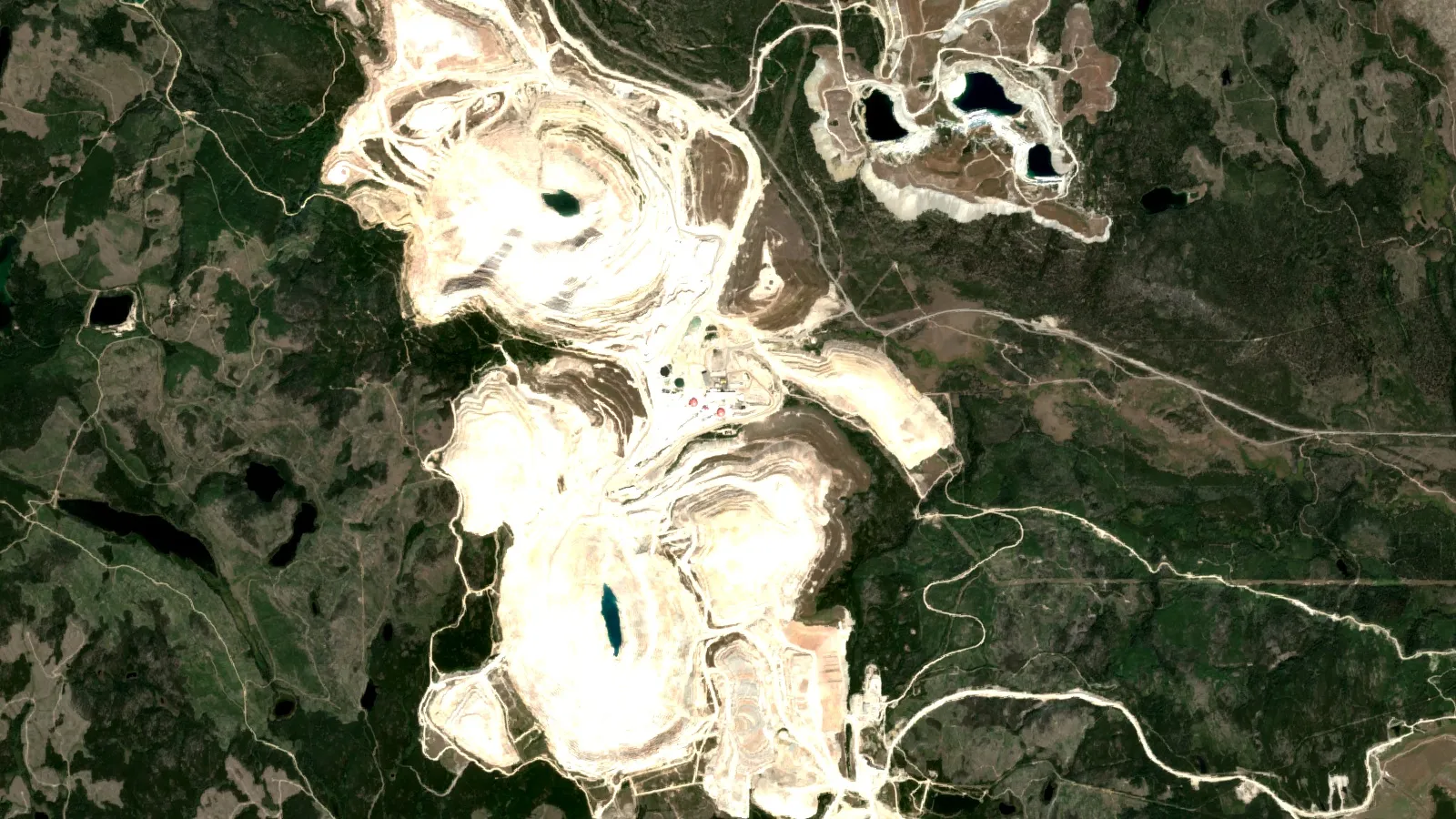
Highland Valley Copper (HVC) is an open-pit copper and molybdenum mine near Logan Lake in south-central British Columbia, owned 100% and operated by Teck Resources. Natural Resources Canada names it Canada’s largest copper mine. It produced 127,100 tonnes of copper in 2025, from 45.2 million tonnes of ore milled at an average grade of 0.34% copper (Teck fourth-quarter 2025 report). Teck’s board approved a mine life extension in July 2025 that runs the operation from 2028 to 2046. This page sets out the output, ownership, reserves, costs, environmental record and plans, with the source and date beside every figure.
Two cautions before the numbers. Teck reports in Canadian dollars, so C$ is used wherever a Teck money figure appears. And the end date of mining differs between documents: Teck’s own filings say 2046, while the provincial assessment report says mining would end around 2043. Both are explained in the mine life section below.
Highland Valley Copper mine at a glance
The table gathers the basic facts. Where the figures come from two different documents, both are named so you can see the basis.
| Item | Fact | Source |
|---|---|---|
| Owner and operator | Teck Resources, 100%, through Teck Highland Valley Copper Partnership | Teck Annual Information Form (AIF), 2025 |
| Location | About 50 km southwest of Kamloops and 200 km northeast of Vancouver, next to Highway 97C; 17 km west of Logan Lake | Teck AIF; BC Environmental Assessment Office (EAO) |
| Mining method | Open pit; ore comes from the Valley, Lornex and Highmont pits, and Teck expects more Bethlehem pit ore in late 2026 | Teck AIF; Teck Q4 2025 report |
| Processing | Autogenous and semi-autogenous grinding, then flotation; capacity up to 160,000 tonnes of ore a day | Teck AIF |
| Products | Copper concentrate and a molybdenum concentrate | Teck AIF |
| Property size | About 50,000 ha of leases, claims and Crown grants; permitted mine area 11,160 ha | Teck AIF; EAO |
| Workforce | About 1,320 staff and contractors (EAO, 2025); about 1,500 direct jobs (Teck, July 2025) | EAO; Teck news release |
| Power | BC Hydro, through a 138-kilovolt line to the Nicola substation | Teck AIF |
| Shipping | Concentrate is trucked to Ashcroft, railed to Vancouver and shipped to customers in Asia and Europe | Teck AIF; BC EAO |
A copper concentrate is the product of the mill: a powder that is mostly copper-iron sulphide minerals, sent to a smelter to make copper metal. For what concentrate grades usually look like and how smelters pay for them, see our guide to typical copper concentrate grade.
Where the mine is and how it started
Mining began in 1962 at the Bethlehem mine. Three separate operations ran side by side in the Highland Valley until they were merged into one company in 1986, according to the provincial assessment report (BC Environmental Assessment Office, May 2025). The site now has four active open pits and four inactive ones, so the mine has worked for more than six decades. Production figures in this page cover the whole complex.
The ore sits in the Guichon batholith, a large body of granite-type rock. Copper and molybdenum arrived with hot, mineral-rich fluids that moved through cracks in the rock, leaving veins of bornite, chalcopyrite (both copper minerals) and molybdenite (the molybdenum mineral) in altered host rock. That pattern is typical of a porphyry copper deposit, a large, low-grade body of copper minerals spread through an intrusion. Teck’s AIF describes this geology for the Valley, Lornex and Highmont deposits. Readers who want the general model can read our explainer on porphyry copper deposits, and the wider picture in copper deposit types and where they occur.
▶ Follows copper from a Chilean open pit to the electric car. · 6:03
How much copper does Highland Valley Copper produce
The mine made 127,100 tonnes of copper in concentrate in 2025, against 102,400 tonnes in 2024, an increase of about 24%. For scale, USGS puts Canadian mine output at an estimated 500,000 tonnes in 2025 and the world total at 23 million tonnes (USGS Mineral Commodity Summaries, 2026), so HVC alone is roughly a quarter of the Canadian figure, although the two sets of numbers are not measured in exactly the same way. Among Teck’s four copper operations it is the second largest, as the chart shows.
Chart
Teck copper output by operation
Thousand tonnes of copper, 2025 (QB = Quebrada Blanca, at 100%)
Year on year: output, grade and recovery
The gain came from more rock moved, more ore milled and better grade. Recovery, the share of the copper in the ore that ends up in the concentrate, went down, and Teck links that to mining deeper in the Lornex pit.
| Measure | 2024 | 2025 |
|---|---|---|
| Tonnes mined (million) | 71.1 | 79.8 |
| Tonnes milled (million) | 39.8 | 45.2 |
| Copper grade milled (%) | 0.29 | 0.34 |
| Copper recovery (%) | 88.1 | 82.6 |
| Copper produced (thousand tonnes) | 102.4 | 127.1 |
| Molybdenum produced (thousand tonnes) | 0.9 | 1.4 |
You can check the arithmetic: 45.2 million tonnes times 0.34% times 82.6% gives about 127,000 tonnes. Source: Teck fourth-quarter 2025 report, production and sales statistics. The calculator further down uses the same formula with your own numbers.
Teck’s guidance for the next three years
Teck’s 2025 AIF gives copper guidance for HVC of 115,000 to 135,000 tonnes in 2026, 135,000 to 155,000 tonnes in 2027 and 100,000 to 120,000 tonnes in 2028. Guidance is the company’s own forecast, not a result. Teck also says it expects lower mill throughput and recovery at HVC in the fourth quarter of 2026 because it will process less Lornex ore and more ore from the Bethlehem and Highmont pits (Teck, fourth-quarter 2025 report).
For a closer look at a related question, see our guide: Telfer Mine WA: Owner, Output and Reserves.
If this topic matters to you, read Pinto Valley Mine: Output, Water Limits, Mine Life next.
Reserves and resources at Highland Valley Copper
A mineral reserve is the part of a deposit that a company has shown can be mined at a profit with current methods, prices and costs. A mineral resource is a wider body of mineralised rock that has reasonable prospects of being mined. Teck’s reserves for HVC at 31 December 2025 are 1,073.5 million tonnes at 0.28% copper, which holds about 2.66 million tonnes of recoverable copper (Teck AIF, 2025). That is five times the previous year’s total: reserves rose 413% from 209.3 million tonnes because the new pit designs under the extension project were approved and long-term metal price assumptions were updated.
| Category at 31 December 2025 | Tonnes (million) | Copper grade (%) |
|---|---|---|
| Proven reserves | 584.7 | 0.30 |
| Probable reserves | 488.8 | 0.25 |
| Total reserves | 1,073.5 | 0.28 |
| Measured resources | 303.5 | 0.27 |
| Indicated resources | 553.7 | 0.25 |
| Inferred resources | 289.7 | 0.20 |
Source: Teck AIF, 2025, mineral reserves and resources tables. Proven means the best-known class and probable the next; inferred resources have the lowest confidence and cannot be counted as reserves. Teck estimated the reserves at US$3.80 a pound of copper and an exchange rate of C$1.31 to the US dollar, with average copper recovery of about 89% and a variable cut-off grade, which is the lowest grade that pays for mining and processing. Resources were estimated at a fixed cut-off of 0.10% copper equivalent. The reserve figure also contains about 50,000 tonnes of recoverable molybdenum at 0.008% grade. Because the reserve grade is lower than the grade milled in 2025 (0.34%), recent output reflects richer ore than the long-run average in the plan.
What does it cost to run: revenue, costs and capital
Teck publishes HVC results by segment. For 2025, copper revenue from the mine was C$1,883 million, up from C$1,303 million in 2024. Operating costs were C$975 million, transportation C$58 million and depreciation C$351 million, leaving a gross profit of C$499 million (Teck’s share, fourth-quarter 2025 report). The sums are for the mine as reported by Teck. They are not cash costs per pound.
Chart
HVC income statement lines
C$ million, 2025, Teck’s share
Looking ahead, the AIF projects 2026 cash operating costs of C$745 million to C$920 million, made up mainly of labour including contractors (C$415 to C$510 million), supplies (C$340 to C$420 million) and energy (C$140 to C$175 million). Projected 2026 capital spending is C$1,345 million to C$1,645 million, of which C$900 million to C$1,100 million is for growth, C$300 million to C$365 million is for capitalised stripping (removing waste rock to uncover ore) and C$145 million to C$180 million is sustaining capital. The mine pays British Columbia’s two-tier mineral tax, with a 2% minimum rate and a 13% maximum on operating cash flow after deductions (Teck AIF). The EAO report notes that the current mine provides nearly C$200 million a year in taxes to municipal, provincial and federal governments.
Calculator: how long would the reserve last
The calculator below turns reserves, grade and recovery into recoverable copper, then divides by an ore rate you choose. It is a simple check on the scale of the plan, not a mine schedule: real schedules vary the ore rate and grade by phase. At the default 45 million tonnes a year the reserve lasts about 24 years, which is past 2046; at about 54 million tonnes a year it lasts about 20 years, which fits a 2046 end date. The 54 million is a test value, not a Teck figure.
Calculator
How much copper is in the reserve, and for how long?
Enter your own reserve, ore rate, grade, recovery and price.
- Years of ore at this rate: 23.9
- Copper per year at this rate (t): 112,140
- Gross metal value (US$): $24,076,458,000
Defaults are Teck’s reserve (1,073.5 million tonnes at 0.28% Cu, about 89% recovery assumed, Teck AIF 2025) and 45 million tonnes a year milled in 2025; they are examples, not a forecast. The price is an example, use today’s price (US$ per tonne). A straight division ignores phasing of the mine plan.
Mine life extension: what changes
Under its current permits the mine would have stopped around 2028. The mine life extension project, called HVC MLE, pushes the Valley, Highmont and Bethlehem pits back, raises tailings storage and upgrades the concentrator to lift throughput by up to 10%, with construction from 2026 to 2028 and first extra production in 2028 (Teck AIF). The steps so far:
Chart
HVC copper guidance ranges
Thousand tonnes of copper, low and high end of Teck’s guidance
- 17 June 2025: the British Columbia government issued the environmental assessment certificate and the other permits for the project (Teck AIF).
- 23 July 2025: Teck’s board approved construction. Teck puts the project at C$2.1 billion to C$2.4 billion, spent between 2025 and 2028, and expects average output of 132,000 tonnes of copper a year over the life of the mine (Teck news release).
- End of 2025: spending on the project was C$330 million, and Teck expects C$900 million to C$1.2 billion in 2026. Detailed engineering was more than 80% complete at the time of the fourth-quarter report.
The provincial assessment report describes the same project as about 18 more years of operation, mining roughly 900 million extra tonnes of ore for about 1.95 million tonnes of copper. The same report also gives about 2043 as the date when operations end, which does not match its own 18-year figure from 2028, so treat 2043 as the regulator’s approximate date and 2046 as Teck’s plan date. Teck’s 2046 date is the end of the life-of-mine plan in its own documents. Teck’s reserves are built on its 2026 life-of-mine plan, which runs to 2046 (Teck AIF); the provincial date of about 2043 comes from the regulator’s report on the same project. The project adds 1,526 hectares of new land disturbance: 795 hectares inside the present permitted area and 731 hectares outside it. The EAO expects an average of 500 construction jobs and 350 more permanent jobs. Teck’s broader estimate is about 2,900 jobs during construction.
Water, power, tailings and community: what the record shows
Many articles describe mines as sustainable without saying what was measured. For HVC, the public record from Teck and the provincial regulator supports the points below.
Water reuse
Water from the mill goes to a tailings impoundment, where it is reclaimed and reused as process water. Teck’s water fact sheet says up to 80% of the water used at the mine is reused through the tailings storage facility (Teck, HVC water management fact sheet, 2022). The extension will need more water, which Teck expects to come partly from groundwater pumped out as the Valley pit deepens and partly from more reuse. The same fact sheet describes a plan to deal with raised sulphate levels in Pukaist Creek below the L-L dam: interception wells installed from 2017 return seepage to the tailings facility, and Teck reports that sulphate levels have started to fall.
Power and emissions
The mine runs on grid electricity from BC Hydro, and the extension’s extra demand is to be met by BC Hydro reconductoring (replacing the wires of) the transmission line to the Nicola substation. HVC estimates that the extension would emit up to 436,998 tonnes of carbon dioxide equivalent in its peak year, 2035, and the EAO proposed a condition that requires a plan to reach net-zero emissions in 2050. Teck’s own objective is net-zero Scope 1 and 2 emissions by 2050 (EAO assessment report, 2025). Current measures include working with suppliers to raise the share of renewable diesel in fuel blends.
Autonomous haulage
The AIF reports that 32 autonomous-capable haul trucks run in the Lornex pit. An autonomous truck follows a programmed route without a driver in the cab, which can raise equipment use and reduce some safety risks. The AIF gives no figure for fuel or emissions savings from them.
Tailings and reclamation
The site has three reclaimed tailings storage facilities, and the extension raises the capacity of the existing Highland tailings facility. Teck’s wider goal, cited by the EAO, is a nature-positive future by 2030, meaning it aims to conserve or rehabilitate at least three hectares of land for every hectare its mining affects. That is a corporate goal for the company as a whole, not a measured result at HVC.
First Nations and local communities
The provincial assessment involved Nlaka’pamux and Secwepemc nations. The report records that the Citxw Nlaka’pamux Assembly supported the project, and that the Kanaka Bar and Lower Nicola bands gave consent. The Stk’emlupsemc te Secwepemc Nation did not consent, and the Nicola Nlaka’pamux Tribal Council first asked for dispute resolution and later withdrew the request. Indigenous staff at the mine rose from 136 in 2018 to 226 in 2022, according to the EAO report. Mine staff live mainly in Logan Lake, Kamloops, Ashcroft, Cache Creek and Merritt (Teck AIF).

▶ Explains the main environmental impacts of mining in plain words. · 2:31
Ownership and the Anglo Teck merger
HVC is wholly owned by Teck. On 9 September 2025 Teck and Anglo American announced a merger of equals to form Anglo Teck. Shareholders of both approved it on 9 December 2025, and the Government of Canada approved it under the Investment Canada Act on 15 December 2025 (Teck second-quarter 2026 results). Teck’s second-quarter report says the merger remains subject to customary closing conditions, including regulatory approvals, and Teck’s notice of 1 September 2026 refers to conditions still to be met (Teck, 1 September 2026). Teck expects it to close within 12 to 18 months of the announcement. If it completes, Highland Valley Copper would become part of Anglo Teck, which Teck describes as headquartered in Canada. China’s competition review was still open in early October 2026, according to Reuters. For background on deal activity in the sector, see our note on mining deal trends.
How to check the mine’s numbers yourself
Consultants and analysts often need current figures rather than a summary. A sound route takes five steps:
- Start with Teck’s latest quarterly report. The production statistics table gives tonnes mined, tonnes milled, grade, recovery and metal produced.
- Open the Annual Information Form for reserves, resources, guidance and the list of permits. Check the assumed copper price, because reserves change when it changes.
- Read the provincial assessment report for the extension for land, water, air and Indigenous matters. It also lists the draft conditions.
- Compare with government data. USGS and Natural Resources Canada publish country totals that let you see how a single mine fits in.
- Record the basis for each figure: contained or payable metal, 100% or Teck share, calendar or fiscal year, and the currency.
Satellite data around a porphyry copper district
Satellite images do not show ore at depth directly, but they can map surface clues around a porphyry district such as the Highland Valley: iron-oxide staining and clay alteration, land cover, drainage and the footprint of pits, dumps and tailings. Farmonaut produces satellite mineral detection reports from a licence boundary that rank surface targets for further field work. Results of that kind are exploration targets, not a resource estimate. Our note on the Golden Triangle of British Columbia shows how the method applies to another copper-gold district in the province, and Canadian exploration spending shows where companies are putting money.

▶ Shows satellite imagery and soil geochemistry used on copper and gold targets in British Columbia. · 3:11
Frequently asked questions
Where is Highland Valley Copper mine located?
It is in south-central British Columbia, Canada, 17 km west of Logan Lake and about 50 km southwest of Kamloops. Vancouver is roughly 200 km to the southwest (Teck AIF; BC EAO).
Who owns Highland Valley Copper mine?
Teck Resources owns 100% of the mine through Teck Highland Valley Copper Partnership. Teck’s proposed merger with Anglo American had not completed as of Teck’s notice of 1 September 2026.
How much copper does the mine produce a year?
It produced 127,100 tonnes of copper in 2025 and 102,400 tonnes in 2024. Teck guides to 115,000 to 135,000 tonnes in 2026 (Teck AIF).
Is it the largest copper mine in Canada?
Yes. Natural Resources Canada describes it as Canada’s largest copper mine, and the BC assessment report gives the same description.
When did the mine open?
Mining began in 1962 at the Bethlehem mine. Three operations in the valley were merged into Highland Valley Copper in 1986 (BC EAO).
How long will the mine operate?
Under its older permits it would have stopped around 2028. Teck’s board approved an extension in July 2025 to 2046, while the provincial assessment report says mining would end around 2043.
How many people work at the mine?
The provincial report counts about 1,320 staff and contractors, and Teck’s July 2025 release says about 1,500 direct jobs. The numbers use different counting bases.
What else does the mine produce besides copper?
It also makes a molybdenum concentrate. Molybdenum output was 1,400 tonnes in 2025, up from 900 tonnes in 2024 (Teck).
Is Highland Valley Copper an open-pit or underground mine?
It is an open-pit mine. Ore comes from the Valley, Lornex and Highmont pits, and the extension adds pushbacks of the Valley, Highmont and Bethlehem pits.
How much copper is left in the reserves?
Teck reports 1,073.5 million tonnes of reserves at 0.28% copper at 31 December 2025, holding about 2.66 million tonnes of recoverable copper.
Does the mine use autonomous trucks?
Yes. Teck’s AIF reports 32 autonomous-capable haul trucks operating in the Lornex pit.
This page is for information only. It is not investment advice. Figures are as reported by Teck and the regulators and may be revised.
Farmonaut mining
Map your mining site from space
Send your licence boundary for a satellite mineral detection report on your copper ground.

Mining Pro sample view, synthetic data
Keep reading
Sources
- Teck, 2025 Annual Information Form: teck.com
- Teck, 2025 fourth-quarter report: teck.com
- Teck, second-quarter 2026 results: teck.com
- Teck, Anglo special dividend and merger notice (1 September 2026): teck.com
- Teck, construction of HVC mine life extension to proceed (July 2025): teck.com
- Teck, HVC water management fact sheet (2022): teck.com
- BC Environmental Assessment Office, HVC MLE assessment report (May 2025): projects.eao.gov.bc.ca
- Natural Resources Canada, Copper facts: natural-resources.canada.ca
- USGS, Mineral Commodity Summaries 2026: Copper: pubs.usgs.gov
- Teck, environmental assessment certificate for HVC MLE (June 2025): teck.com
Discussion
Questions, corrections or field experience? Share them below. First-time comments are reviewed before they appear, and your email is never published.
No comments yet. Be the first to add a question or your experience.

 GKY Mining
 Alkimy SARL
 Double A Trading
 GemSprout Metals Limited
 Qader Group
 Ileys General Trading
 SG Gold Mining LLC
 VRV Global Pte Ltd
 Omsri International FZE
 G.I.T.T.
 Jaunita Erss Ltd
 Almosi SARL
 SRK Consulting
 Berks Gold Limited
 Mwerezi Minerals Company Limited
 Mining SARL
 SenGold Invest SAS
 Sean Mining Limited
 NTS Group (Pty) Ltd











