

Mine profile · Owner, output and reserves
Telfer Mine WA: Owner, Output and Reserves
Greatland Resources owns Telfer, which made 328,987 oz of gold and 14,594 t of copper in the year to June 2026. This page gives the owner, location, history, reserves, guidance and a calculator.
Key takeaways
- Greatland Resources owns 100% of Telfer; it bought the mine from Newmont on 4 December 2024 (Greatland).
- Telfer produced 328,987 oz of gold and 14,594 t of copper in the year to 30 June 2026, at an AISC of A$2,179 per oz (Greatland, 29 July 2026).
- Guidance for the year to June 2027 is 260,000 to 300,000 oz of gold at A$2,900 to A$3,330 per oz, lower because of poorer stockpile feed (Greatland).
- The Telfer Ore Reserve is 1.8 million oz of gold at 31 March 2026, up 1.1 million oz; a further 6.1 million oz sits in resources outside the reserve (Greatland).
- The mine is 400 to 485 km south-east (EPA) or east-south-east (Greatland) of Port Hedland in the Great Sandy Desert.
In this article
- Telfer mine WA at a glance: owner, output and status
- Where is the mine located?
- History: from first mining to the Greatland sale
- How much gold and copper does it produce?
- Ore reserves and resources explained
- Output quarter by quarter
- Costs, margin and cash
- Open pit, underground and plant: how the site works
- Havieron and the next stage of the Telfer complex
- Power, tailings and water at a remote site
- Gold mining in Western Australia in context
- Calculator: what a mill feed like this recovers
- Watching a remote site from space
- How to follow the mine's status
Telfer mine WA at a glance: owner, output and status
The Telfer gold-copper mine in Western Australia is owned 100% by Greatland Resources Limited (ASX and AIM: GGP), which bought it from Newmont on 4 December 2024 (Greatland, Telfer asset page). In the year to 30 June 2026 it produced 328,987 ounces of gold and 14,594 tonnes of copper at an all-in sustaining cost (AISC) of A$2,179 per ounce of gold, according to the company’s June 2026 quarterly report. It is an operating mine, not a project.
Newcrest, the earlier owner, is no longer the operator. Newmont bought Newcrest in November 2023, listed Telfer for sale in February 2024 and completed the sale in the fourth quarter of 2024 (Newmont annual report on Form 10-K, 2025).
| Item | Current answer | Source and date |
|---|---|---|
| Owner | Greatland Resources Limited, 100% | Greatland, acquired 4 December 2024 |
| Products | Gold doré, copper-gold concentrate, gold middlings concentrate | Greatland Telfer page |
| Gold produced, year to June 2026 | 328,987 oz (about 10.2 tonnes) | Greatland quarterly report, 29 July 2026 |
| Copper produced, same year | 14,594 tonnes | Same report |
| AISC, same year | A$2,179 per oz of gold, net of copper credits | Same report |
| Guidance, year to June 2027 | 260,000 to 300,000 oz of gold at A$2,900 to A$3,330 per oz | Same report |
| Ore Reserve at Telfer | 119 Mt at 0.46 g/t gold for 1.8 million oz | As at 31 March 2026, same report |
AISC means all-in sustaining cost: the mine’s operating cost plus the capital it must spend to keep going, shown per ounce of gold after crediting by-product copper. Mt is million tonnes and g/t is grams of gold per tonne of rock.
Where is the mine located?
Telfer sits in the Paterson Province of the East Pilbara region, about 1,300 km north-east of Perth and 485 km east-south-east of Port Hedland, according to Greatland. The WA Museum also gives 485 km from Port Hedland (Western Australian Museum), while the state Environmental Protection Authority (EPA) describes the site as 400 km south-east of Port Hedland in the Great Sandy Desert region. The sources give different distances, 400 km and 485 km; Greatland’s 485 km is the company figure. It is a desert site, reached by fly-in fly-out.
The mine is a fly-in fly-out operation. The EPA’s description of the Telfer-Havieron proposal includes a 440 km natural gas pipeline corridor from Port Hedland and a 160 MW gas-fired power station, as set out on the EPA’s Telfer-Havieron project page. The same page places the Havieron deposit about 55 km east of Telfer. Copper-gold concentrate is stored and exported through Port Hedland (Mining Technology).
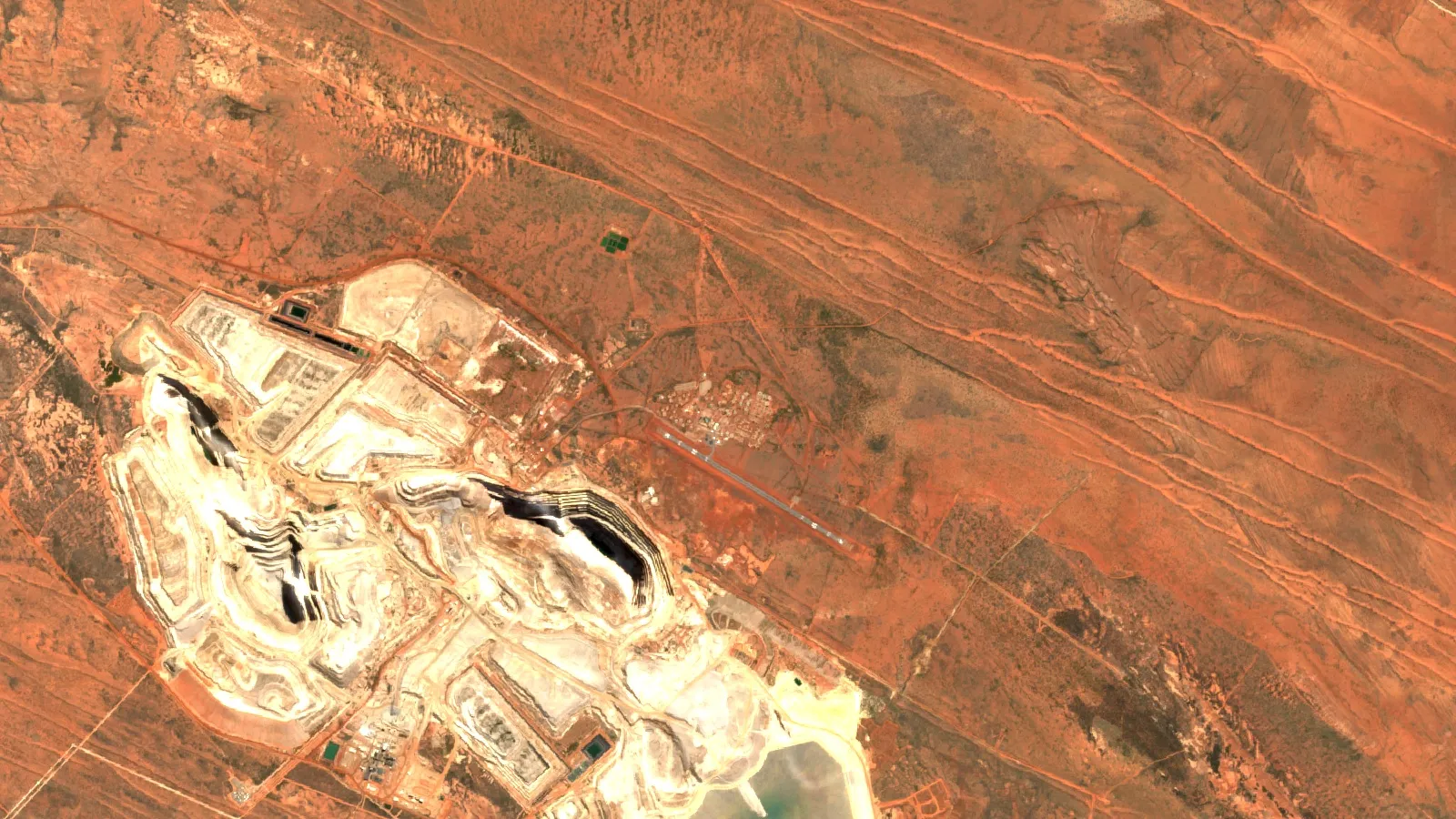
Coordinates for a map search are roughly 21.71 degrees south, 122.23 degrees east. The satellite image at the top of this page is a Sentinel-2 composite of that area.
History: from first mining to the Greatland sale
Mining began at Telfer in 1977, and the operation produced almost 6 million ounces of gold up to 2000 (WA Museum). Geoscience Australia reported that Telfer was Australia’s second-largest gold producer in 2009, with almost 0.58 million ounces, behind the Kalgoorlie Super Pit (Australia’s Identified Mineral Resources 2010).
- 1977 to 2000: first mining period, almost 6 million oz of gold (WA Museum).
- 2009: about 0.58 million oz of gold, second in Australia (Geoscience Australia).
- November 2023: Newmont completes its purchase of Newcrest, then the owner of Telfer.
- February 2024: Newmont names Telfer as a non-core asset to sell.
- 10 September 2024: Greatland signs a binding agreement for 100% of Telfer and 70% of Havieron.
- 4 December 2024: Greatland completes the acquisition (Greatland announcement, 2 December 2024).
One condition of the sale was fixing Tailings Storage Facility 8 (TSF8), the dam-like store for processing waste. Greatland reported on 15 November 2024 that Newmont had completed the repair, that the engineer of record had confirmed it, and that the plant had run 14 consecutive days (Greatland update). The same sale gave Greatland a further 70% of Havieron, and the company now describes Havieron as 100% owned.
How much gold and copper does it produce?
Telfer produced between 79,100 and 86,300 ounces of gold in each of the four quarters to June 2026. The mill treated 19.2 million tonnes of ore in the year at an average head grade of 0.58 g/t gold and recovered 88.0% of the gold (Greatland, Table 1). Head grade is the average grade of the ore fed to the plant; recovery is the share of that gold the plant captures.
Chart
Telfer gold output by quarter
Thousand ounces of gold produced, September 2025 to June 2026 quarters
Revenue for the year was A$2,271 million, of which gold was A$2,034 million and copper A$219 million. The average gold price received was A$6,223 per ounce; the June quarter average was A$6,468 per ounce. Those are realised prices from one company, not a benchmark.
Guidance for the year to June 2027 is lower, at 260,000 to 300,000 ounces. Greatland says the reason is that higher-grade stockpiles processed in FY26 are replaced by lower-grade stockpiles, and gold recovery is budgeted at 85% against 88% achieved. Output is expected to rise later as underground ore from West Dome and Havieron comes in.
For a closer look at a related question, see our guide: Florida Canyon Mine, Nevada: Owner, Output, Reserves.
If this topic matters to you, read Bagdad Arizona Mine: Output, Reserves, Expansion next.
Ore reserves and resources explained
An Ore Reserve is the part of a deposit that a company has shown can be mined at a profit with current plans. A Mineral Resource is a wider estimate that has not yet passed that test. Inferred resources have the lowest geological confidence. Telfer’s Ore Reserve rose by 1.1 million ounces to 1.8 million ounces of gold at 31 March 2026, after depletion (Greatland).
Chart
Telfer gold in reserve and in resources outside it
Million ounces of gold, Telfer only, as at 31 March 2026
- West Dome open pit reserve: 90.6 Mt at 0.46 g/t gold for 1.4 million oz.
- Main Dome underground reserve: 3.6 Mt at 1.33 g/t gold and 0.31% copper for 0.2 million oz, previously nil.
- Stockpiles: 22.5 Mt at 0.36 g/t for 0.3 million oz.
- Not in the reserve: West Dome open pit resource of 244 Mt at 0.45 g/t for 3.5 million oz, mostly inferred, and an underground resource of 53.9 Mt at 1.53 g/t gold and 0.37% copper for 2.6 million oz.
Whole-company reserves, including Havieron, are 5.0 million ounces of gold at 0.99 g/t. A reserve is a company estimate reported under the JORC Code; it is not a promise of output, and the figures change with each update.
Output quarter by quarter
| Quarter | Ore milled (kt) | Head grade (g/t Au) | Gold recovery | Gold (oz) | Copper (t) |
|---|---|---|---|---|---|
| Sep 2025 | 4,680 | 0.58 | 88.6% | 80,890 | 3,366 |
| Dec 2025 | 4,513 | 0.65 | 88.4% | 86,273 | 3,528 |
| Mar 2026 | 4,815 | 0.59 | 88.4% | 82,723 | 4,128 |
| Jun 2026 | 5,186 | 0.53 | 86.8% | 79,100 | 3,573 |
Chart
Telfer gold output: last year and guidance
Thousand ounces of gold; FY27 shown as guidance range ends
The table is from Table 1 of the June 2026 quarterly report. The pattern is clear: the plant processed more ore each quarter from December, but the grade fell from 0.65 to 0.53 g/t, so gold output slipped. Higher throughput did not offset a lower grade, which is the same reason FY27 guidance is lower.
Costs, margin and cash
For the year to June 2026 Greatland received an average A$6,223 per ounce of gold (A$ throughout) against an AISC of A$2,179 per ounce, a gap of A$4,044 per ounce on company figures. AISC leaves out some items, such as stockpile inventory movements, so the gap is not a profit margin. FY27 guidance puts AISC at A$2,900 to A$3,330 per ounce, as Greatland expects to produce fewer ounces (260,000 to 300,000) from lower-grade feed.
Greatland closed June 2026 with A$1,289 million in cash and no debt, and holds gold put options. A put option sets a minimum sale price for part of the output; it does not cap the upside. These are company statements at the date of the report, not forecasts. The calculator below lets you test your own price and cost assumptions.
Open pit, underground and plant: how the site works
Telfer mines the West Dome open pit by conventional truck and shovel and the Main Dome underground by longhole open stoping, using contractors, and also rehandles stockpiles and runs a dump leach (Greatland). The plant has two processing trains of 10 Mtpa each, a nominal 20 Mtpa.
In the June 2026 quarter the open pit mined 3.53 Mt of mill feed at 0.44 g/t gold and 0.05% copper. The underground mined 0.32 Mt at 1.74 g/t gold and 0.49% copper. Underground ore is far richer, which is why Greatland is studying West Dome Underground, where a drill hole at the Pinnacles prospect crossed 58.7 m at 6.5 g/t gold from 1,754 m.
Open pit ore has a thin margin; at 0.44 g/t each tonne holds only about 0.014 oz of gold. That is why head grade, recovery and cost per ounce matter more at Telfer than the headline tonnes.
Havieron and the next stage of the Telfer complex
Havieron is a gold-copper deposit 55 km from Telfer that will send ore to the Telfer plant. Greatland’s board has approved the final investment decision, with pre-production capital of A$1,065 million; first gold is expected about 2.5 years after construction starts, in FY29. As of the 29 July 2026 report, construction spending was to begin once certain secondary approvals arrived, which the company expected within weeks (Greatland). The state approval under Part IV of the Environmental Protection Act and the federal approval were both received in the June quarter, and the EPA page, last updated on 25 May 2026, shows a Ministerial Statement published.
FY27 spending is guided at A$315 to A$335 million of growth capital at Telfer and A$365 to A$435 million at Havieron. Telfer’s list includes the West Dome Underground study, a new paste plant, a power station upgrade and tailings expansion.
Power, tailings and water at a remote site
A mine this far from a grid has to make its own power, store its own waste and manage its own water. The EPA’s Telfer-Havieron proposal includes a 160 MW gas power station, tailings storage facilities, waste rock landforms and borefields for water, listed on the EPA’s assessment page. An earlier approval allowed up to 23 Mtpa of ore and an accommodation village for 650 people (EPA assessment 1445).
Tailings are the main engineering item. In 2024 TSF8 needed repairs before the sale could close, and in FY27 Greatland plans to finish Stage 4 and start Stage 5 of the TSF8 lifts, plus a paste plant that mixes tailings with binder for underground backfill.
▶ Farmonaut video: the seven environmental impacts of mining, explained in clay with satellite maps. · 2:31
Gold mining in Western Australia in context
Telfer’s 10.2 tonnes of gold in the year to June 2026 compares with 284 tonnes for all of Australia in 2024 (Geoscience Australia) and 209 tonnes for Western Australia in 2024-25 (WA Department of Mines, Petroleum and Exploration). The periods differ, so the comparison is for scale only. Western Australia produced 72% of Australian gold in 2024-25, and gold sales reached A$29 billion.
For other projects, the same digest lists gold and copper projects in the pipeline as of September 2025, among them Gold Fields’ Gruyere Underground and Rio Tinto’s Winu copper-gold project, and records the Mungari gold mill expansion of Evolution Mining as completed. For more on Australian gold, see gold exploration in Australia by state and Victoria’s gold fields.
Calculator: what a mill feed like this recovers
Use the calculator below with your own tonnes, grade, recovery and prices to see recovered gold and margin per year. The June 2026 quarter figures (5.19 Mt at 0.53 g/t and 86.8% recovery) give about 77,000 oz from the mill, close to the 79,100 oz reported once dump leach ounces are added.
Calculator
How much gold does a mill feed recover?
Enter your own tonnes, grade, recovery, price and cost.
- Revenue at your price (A$): $1,538,412,076
- Price less AISC, all ounces (A$): $615,364,830
Example values only, not benchmarks or forecasts. Prices are inputs: example, use today’s price in A$ per oz. Ounces use 31.1035 g per troy oz. Dump leach ounces and by-product copper are not included.
Watching a remote site from space
Sites like Telfer are large, and tracking pits, waste dumps and tailings from the ground takes time. Sentinel-2 images are taken regularly, so a consultant can compare pits, waste landforms and tailings footprints between dates, but satellites show surface change only and do not replace surveys, drilling or the regulator’s data. To see how a licence area looks from orbit, read about satellite-based mineral detection, or send a polygon through the mining query form. For exploration ideas, see how gold deposits are found.
▶ Farmonaut video: remote sensing for mining explained in plain words. · 2:01
How to follow the mine’s status
The most reliable sources are the company’s quarterly reports, its stock exchange announcements and the state regulator. Quarterly reports come about four weeks after each quarter ends; the June 2026 report was published on 29 July 2026. The EPA page shows the approval status of the Telfer-Havieron proposal, and the WA digest gives state totals each year. If you need a quote or help, contact Farmonaut.
Infographic
Check Telfer’s status in 4 steps
- 1Read the quarterly reportGreatland publishes production, cost and guidance each quarter.
- 2Check exchange noticesReserve and resource updates appear as ASX announcements.
- 3Check the regulatorThe EPA page shows approval status for the proposal.
- 4Compare periodsMatch financial years to calendar years before comparing.
Frequently asked questions
Who owns the Telfer mine?
Greatland Resources Limited owns 100% of Telfer. It completed the purchase from Newmont on 4 December 2024. Newmont had acquired the earlier owner, Newcrest, in November 2023.
Is the Telfer mine still operating?
Yes. It produced 328,987 ounces of gold in the year to 30 June 2026 and Greatland guides to 260,000 to 300,000 ounces for the year to June 2027.
Where is Telfer mine in Western Australia?
It is in the Paterson Province of East Pilbara, in the Great Sandy Desert region, about 400 to 485 km south-east to east-south-east of Port Hedland, depending on the source.
How much gold does Telfer have left?
Telfer’s Ore Reserve is 1.8 million ounces of gold at 31 March 2026. Further resources outside the reserve add 3.5 million ounces in the West Dome open pit and 2.6 million ounces underground, but those have not been shown to be economic.
How much copper does Telfer produce?
It produced 14,594 tonnes of copper in the year to June 2026. Copper is sold as a copper-gold concentrate through Port Hedland and is credited against gold costs.
Why is Telfer’s gold output guided lower for the next year?
Because FY27 mill feed has more low-grade stockpile ore and less high-grade stockpile ore than FY26, and recovery is budgeted at 85% against 88%. Greatland expects primary ore from the pit and underground to rise.
What is the Havieron project?
Havieron is a gold-copper deposit about 55 km from Telfer. Its ore will be processed at the Telfer plant. Pre-production capital is A$1,065 million and first gold is targeted in FY29.
Is Telfer open pit or underground?
Both. The West Dome open pit and the Main Dome underground mine feed the same plant, and a West Dome Underground project is in study.
When did the Telfer mine open?
Mining started in 1977, according to the WA Museum. Geoscience Australia shows it producing again in 2009, when it was second in Australia.
Is this investment advice?
No. Company figures here are facts from public reports with their dates. They are not a recommendation to buy or sell any security.
This page is for information only. It is not investment advice. Company figures are as reported on the dates shown and may change.
Farmonaut mining
Map your own site from space
Send your licence polygon to get a satellite view of surface minerals, structures and land change for planning.
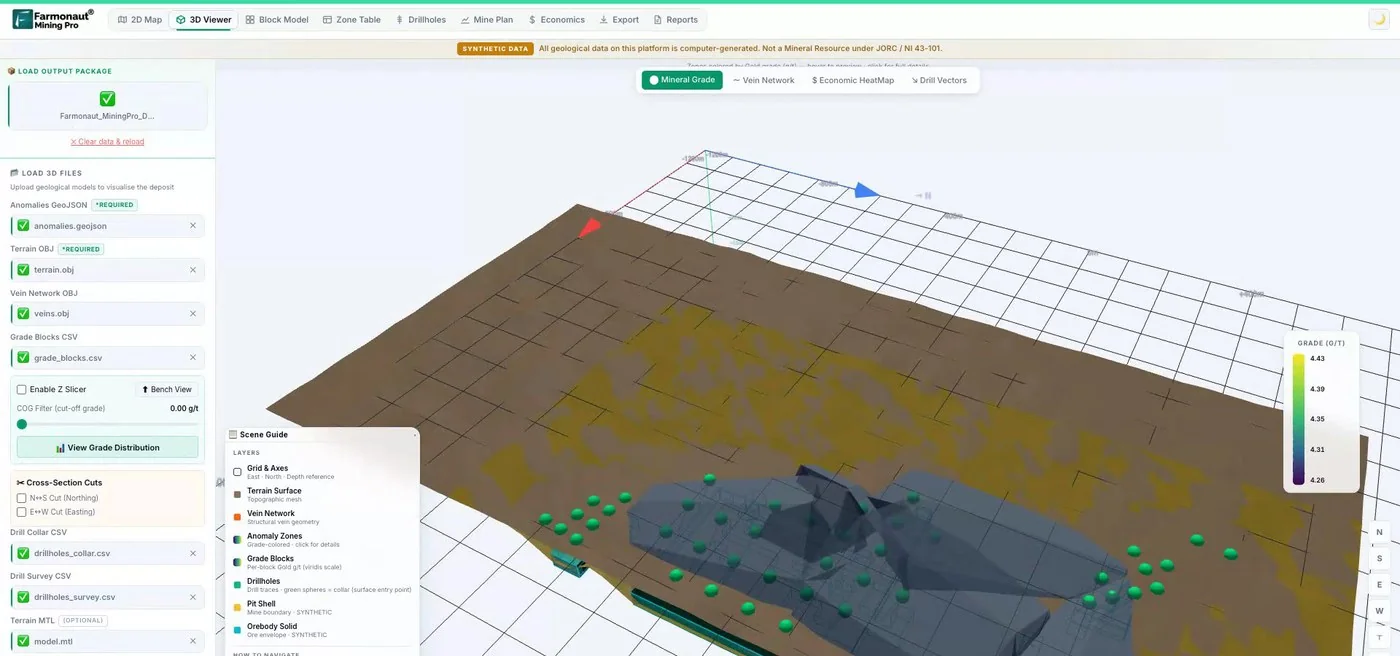
Mining Pro sample view, synthetic data
Keep reading
Sources
- Greatland Resources, June 2026 Quarterly Activities Report (29 July 2026): investegate.co.uk
- Greatland Gold, Acquisition of Havieron & Telfer – Completion date (2 December 2024): investegate.co.uk
- Greatland Gold, Acquisition of Havieron & Telfer – Update (15 November 2024): investegate.co.uk
- Greatland Resources, Telfer asset page: greatland.com.au
- WA Department of Mines, Petroleum and Exploration, Statistics Digest 2024-25: wa.gov.au
- Geoscience Australia, Australia’s Identified Mineral Resources 2010: ga.gov.au
- Geoscience Australia, Australia’s Identified Mineral Resources 2025, commodity summaries (gold): ga.gov.au
- Newmont Corporation, Form 10-K for 2025: s24.q4cdn.com
- EPA Western Australia, Telfer – Havieron Gold Mining Project: epa.wa.gov.au
- EPA Western Australia, Telfer Project, Expansion of Telfer Gold Mine, Great Sandy Desert: epa.wa.gov.au
- Western Australian Museum, Gold Crystal from the Telfer Mine: museum.wa.gov.au
- Mining Technology, Greatland Gold to acquire two non-core assets of Newmont: mining-technology.com
Discussion
Questions, corrections or field experience? Share them below. First-time comments are reviewed before they appear, and your email is never published.
No comments yet. Be the first to add a question or your experience.

 VRV Global Pte Ltd
 Omsri International FZE
 G.I.T.T.
 Jaunita Erss Ltd
 Almosi SARL
 SRK Consulting
 Berks Gold Limited
 Mwerezi Minerals Company Limited
 Mining SARL
 SenGold Invest SAS
 Sean Mining Limited
 NTS Group (Pty) Ltd
 Mine4Africa
 Lithspo Minerals Limited
 Tintina Mining Group
 Licence holder · Nigeria · Gold + lithium










