
Mine valuation · Method guide
Mine Valuation: 3 Approaches, Real NPV Case, Calculator
Mine valuation uses three approaches: income (discounted cash flow), market (comparable deals) and cost (past exploration spend). The stage of the project decides which fits. A real 2026 gold feasibility study shows NPV moving from US$1.2 billion to US$4.3 billion with price.
Key takeaways
- CIMVAL (2019) and VALMIN (2015) both name income, market and cost approaches; exploration ground suits market and cost, mines with reserves suit income (DCF).
- Gross in situ value is not an acceptable method: Black Pine’s 4.04 Moz reserve at US$3,250/oz is about US$13.1 billion in situ, against a US$2.397 billion after-tax NPV (Liberty Gold, September 2026; our arithmetic).
- The same study’s after-tax NPV(5%) runs from US$1.215 billion at US$2,500/oz to US$4.336 billion at US$4,500/oz.
- US metals and mining firms had a cost of capital of 8.20% and an EV/EBITDA of 11.39 in January 2026 (Damodaran, NYU Stern).
- Reviews of past projects report average capital cost overruns of 14% (63 projects) and 37% (78 projects) (University of Oviedo paper).
In this article
- How to value a mine: the three approaches
- Which valuation method fits each stage of a mining project
- Valuing a mineral property before any mine exists
- Discounted cash flow for a mine: a real feasibility study
- Discount rates and gold price: what moves a valuation
- Sensitivity, capital cost and other inputs a valuation can get wrong
- Mine valuation calculator
- Valuing a mining company, not just one mine
- Market comparables: how buyers price mines and claims
- Red flags in a mine valuation report
- Where satellite data fits in a valuation
- Frequently asked questions
Mine valuation means putting a defensible dollar figure on a mineral property, a mining project or a whole mining company. Professional codes name three approaches: income (discounted cash flow), market (comparable deals) and cost (what was spent exploring). The right one depends on how far the project has advanced. An exploration licence is normally valued from comparable deals or past spending, while a mine with proven reserves is valued from its future cash flow (CIMVAL Code, 2019; VALMIN Code, 2015). This guide covers mining asset valuation method by method, shows one real feasibility study with its gold price sensitivity, and ends with a calculator for your own project numbers.
It is written for licence and claim owners who want to know what their ground might fetch, consultants who must choose a method, and investors who compare mining valuations across developers and producers. Nothing here is investment or valuation advice. A formal valuation for a deal, a filing or a court needs a qualified valuator.
How to value a mine: the three approaches
The CIMVAL Code, the Canadian standard adopted by CIM Council on 29 November 2019, lists three approaches: income, market and cost. The Australasian VALMIN Code (2015 edition) uses the same three. VALMIN says a valuation report should use at least two approaches and explain how the results compare, and the 2003 CIMVal standards said the market approach and one other should be used.
- Income approach. Estimate the cash the mine will earn over its life, then discount it back to today’s money. The standard method is discounted cash flow (DCF). Its main output is net present value (NPV): the sum of all future cash flows, each reduced for the time you wait for it, minus the money spent up front.
- Market approach. Compare the property with what buyers paid for similar properties in an open market. Methods include comparable transactions, the terms of option or farm-in agreements, and the market capitalization of a listed company that owns one main asset.
- Cost approach. Treat past exploration spending as evidence of value. The appraised value method reviews each dollar spent and keeps only what added to the property’s potential. The multiple of exploration expenditure method applies a multiplier to that base.
The CIMVAL Code ranks the methods. Discounted cash flow, real options, comparable transactions, option agreement terms, appraised value and the multiple of past exploration expenditure are primary methods. Market capitalization and the geoscience factor method are secondary (CIMVAL Code, Table 2).
| Approach | Method | CIMVAL ranking | Plain-words test |
|---|---|---|---|
| Income | Discounted cash flow (DCF) | Primary | What is the mine’s cash flow worth today? |
| Income | Real options | Primary | What is the right to wait for a better price worth? |
| Market | Comparable transactions | Primary | What did buyers pay for similar ground? |
| Market | Option agreement terms | Primary | What is a partner willing to spend to earn in? |
| Market | Market capitalization | Secondary | What does the stock market say about a one-asset company? |
| Cost | Appraised value | Primary | Which past spending really added value? |
| Cost | Multiple of past exploration expenditure | Primary | What multiple of useful spending is the ground worth? |
| Other | Geoscience factor | Secondary | How do the rating scores of the geology compare? |
One method is ruled out by both codes. CIMVAL says gross in situ metal value, meaning the amount of metal in the ground multiplied by a metal price, is not an acceptable valuation method. VALMIN gives an example of why: multiplying a US$1,500 gold price by a 100,000 ounce deposit gives US$150 million, but ignores metallurgical recovery and other modifying factors, so it is misleading. A later section puts a real project through that test.
Which valuation method fits each stage of a mining project
The approach depends on how much is known. The CIMVAL Code groups properties into four types, and VALMIN uses a table with the same pattern. VALMIN calls the second column pre-development projects. The code states that there are no clear boundaries between the types, and a property can move from one to the next.
| Approach | Exploration property | Mineral resource property | Development property | Production property |
|---|---|---|---|---|
| Income | No | In some cases | Yes | Yes |
| Market | Yes | Yes | Yes | Yes |
| Cost | Yes | In some cases | No | No |
Source for the table: CIMVAL Code (2019), Table 1, which matches VALMIN Code (2015), Table 1. The definitions matter, because they decide which row of the table you are in:
- An exploration property has no mineral reserves or mineral resources, and its economic viability has not been shown.
- A development property has reserves or resources and a positive feasibility or pre-feasibility study, but is not yet producing.
- A production property has an operating mine that is fully commissioned.
A mineral resource is mineralization with reasonable prospects of eventual economic extraction. A mineral reserve is the part of a resource that a study shows can be mined and sold at a profit with realistic costs and recoveries. Income-approach valuations may generally use all mineral reserves. Resources can be used when they are mined behind reserves in the same model, or where no reserves exist if the extra risk is recognized, for example with a higher discount rate, a smaller tonnage or a later start (CIMVAL Code, section 3.4). Exploration targets that do not meet the definitions should not be used in an income valuation at all.
Seen from the owner’s side, this explains a common surprise. A licence with drill intercepts but no resource estimate cannot be valued by DCF in a credible way, however attractive the grades. Its value comes from what a buyer would pay for the chance, and that is a market and cost question.
Valuing a mineral property before any mine exists
Most claims and licences sold are exploration or early resource properties, so the market and cost approaches do the work. A mineral property valuation at this stage rests on judgement, and good reports say so.
Comparable transactions. The valuator looks for sales of similar ground in the same district and commodity. AMC Consultants notes that truly comparable deals are often scarce, so valuators work with a few close matches and a larger set of partly comparable ones. If enough data exist, they derive a value per unit of area or per unit of contained metal in resources (AMC Consultants, valuation of exploration properties). The CIMVal guidelines describe value per unit area as a secondary method used for large exploration properties.
Option and farm-in terms. When a partner agrees to spend money to earn an interest, that commitment says what they think the ground is worth. AMC describes converting the deal into a cash-equivalent “deemed expenditure” from four parts: cash, shares, exploration spending and conditional payments such as royalties. Payments that depend on a future decision to mine are discounted for time and for the chance that they happen at all.
Appraised value and exploration multiples. Under the cost approach, the valuator reviews past spending, keeps what contributed to the potential of the property, and may adjust for market conditions. The multiple of exploration expenditure method adds a multiplier, and the 2003 CIMVal guidelines describe it as more commonly used in Australia. Regulators differ on whether planned but unspent exploration can count. The TSX Venture Exchange does not generally accept warranted future spending in the appraised value method (via AMC).
AMC adds two practical points for readers of any exploration valuation. First, because the methods are subjective, it is rarely sensible to quote a value finer than the nearest US$0.1 million for a significant project or the nearest US$10,000 for a small one. Second, the result should be a range. A test AMC suggests is simple: would you pay the stated price for the property if it were your own money?
If you are preparing a property for sale, our guide to how to sell a mine covers buyers and deal types, and the sample and assay data that support a value are covered in our pages on assay services and core samples.
Discounted cash flow for a mine: a real feasibility study
For a development or producing mine, discounted cash flow is the main method because the mine plan, costs and prices are specific. The steps are the same everywhere:
Chart
Black Pine after-tax NPV at different gold prices
US$ million, 5% discount rate, all other assumptions held at the base case
- Build a life-of-mine schedule of tonnes mined and processed, grade and recovery from the reserve.
- Multiply payable metal by a price assumption, then deduct operating costs, royalties, taxes and sustaining capital.
- Add the up-front capital and the closure cost at the end.
- Discount each year’s cash flow at the chosen discount rate and add them up. The total is the NPV.
A mine has a finite life, so there is no terminal value after the last year. This is why DCF suits a mine better than a business that goes on forever, and it is the answer to the common exam-style question about valuing a business with a finite life.
A recent real example shows the scale of the numbers. On 8 September 2026, Liberty Gold Corp. (TSX: LGD) released a feasibility study for its Black Pine gold project in southern Idaho. The mineral reserve estimate in it has an effective date of 1 August 2026. The study covers an open-pit, run-of-mine heap-leach operation on a probable mineral reserve of 4.04 million ounces of gold (433.3 million tonnes at 0.29 grams of gold per tonne), a 16-year mine life, an initial capital cost of US$411.4 million and a life-of-mine all-in sustaining cost (AISC) of US$1,566 per ounce. AISC is the per-ounce cost measure that adds sustaining capital, closure and some taxes to cash operating costs. At a gold price of US$3,250 per ounce and a 5% discount rate, the study reports an after-tax NPV of US$2.397 billion, an internal rate of return (IRR) of 60.5% and a two-year payback (Liberty Gold news release, 8 September 2026). These are the company’s results from its own study, not a third-party valuation.
The study also tests the gold price. Holding every other assumption constant, after-tax NPV moves from US$1.215 billion at US$2,500 per ounce to US$4.336 billion at US$4,500. A fall of about 23% from the base price (to US$2,500) cuts NPV by about 49%, while a rise of about 38% (to US$4,500) lifts it by about 81%. Those percentages are our arithmetic on the study’s figures. They show why a mine with thin margins is far more sensitive to price than a headline price move suggests.
The same example shows why in situ values mislead. The reserve of 4.04 million ounces at the US$3,250 base price would give a gross in situ value of about US$13.1 billion (our arithmetic). The study’s after-tax NPV is US$2.397 billion, roughly 18% of that, because recovery is 70.2%, and operating costs, capital, taxes and the timing of cash all come off. This is the gap VALMIN warns about.
Our own video on mine costs walks through the pieces that feed this kind of model: all-in sustaining cost, break-even price, NPV and payback.
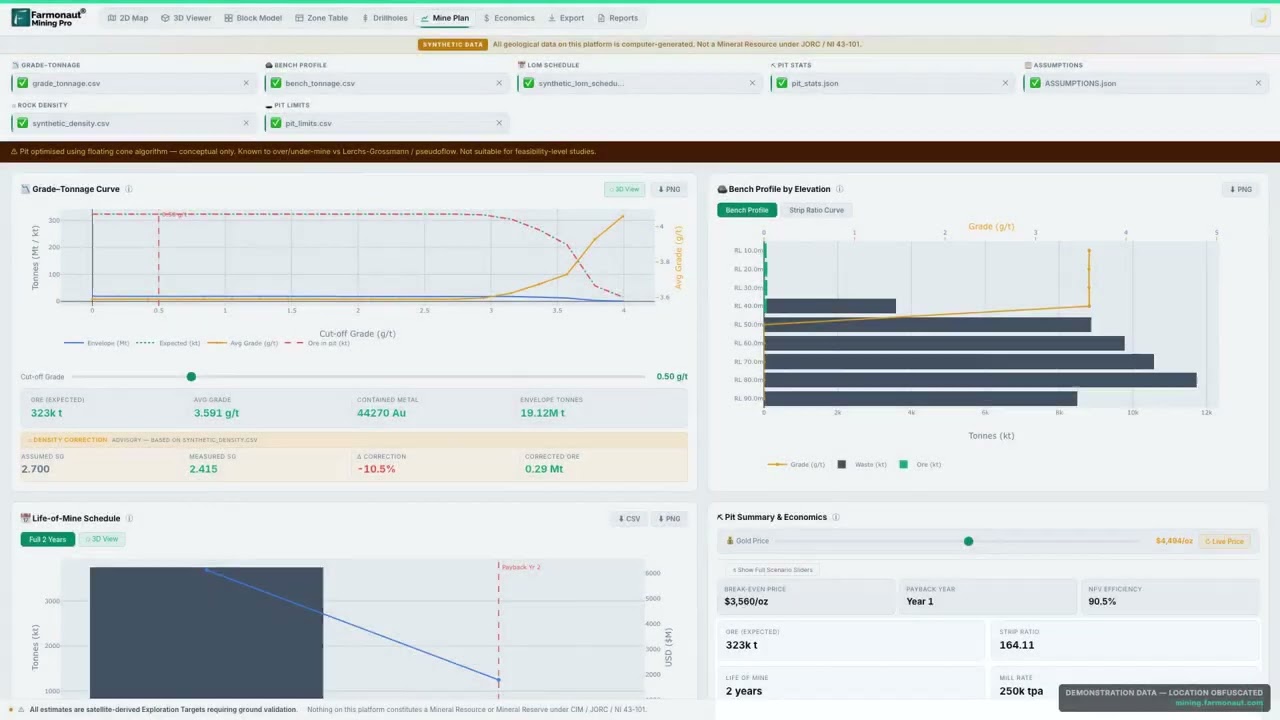
▶ Builds a cost picture with all-in sustaining cost, break-even price, NPV and payback. · 14:58
Discount rates and gold price: what moves a valuation
The discount rate turns future dollars into today’s dollars. A higher rate means future cash is worth less today, so NPV falls. Different analysts pick different rates, so results differ. The Black Pine study uses 5%. Rates for riskier projects, countries or earlier study stages are higher; the CIMVAL Code lists a higher discount rate among the ways to reflect extra risk when resources, not reserves, are used in the cash flow model.
Chart
Average gold price used as a valuation input
US$ per troy ounce, annual average
Chart
Cost of equity and cost of capital, US sectors
Percent, as of January 2026
For a market reference, Professor Aswath Damodaran of NYU Stern publishes cost of capital by US industry. As of January 2026, his data show a cost of equity of 8.60% and a cost of capital of 8.20% for 73 US metals and mining firms, and 7.68% and 7.47% for 56 precious metals firms. The whole US market sits at 8.02% and 6.96% (Damodaran, Cost of Capital by Sector, January 2026). These are rates for listed US companies, not for a single project in a remote jurisdiction, so treat them as a floor for thinking, not a rule.
The price assumption matters as much as the rate. The US Geological Survey reports an average gold price of US$1,801 per troy ounce for 2021, US$1,802 for 2022, US$1,945 for 2023, US$2,388 for 2024 and an estimated US$3,300 for 2025 (USGS Mineral Commodity Summaries, 2026, gold). A valuation built on a price deck from 2021 would be far below one built on 2025 prices. A valuation must state its price deck and its date, and show results at several prices, which is what the Black Pine table does.
Sensitivity, capital cost and other inputs a valuation can get wrong
VALMIN says a public report must state a range of values (high, most likely and low) and should include a sensitivity analysis showing the effect of changing the most important assumptions. In practice a valuator tests at least these inputs:
Chart
Average capital cost overrun by metal
Percent above the feasibility estimate, 78 projects over US$50 million, 1995 to 2015
- Price deck. Spot, consensus forecast or contract price, and the date of the source.
- Grade and recovery. Reserve grade is an average; mill and heap recovery come from test work, and the CIMVAL Code lists metallurgical test work among the parameters to disclose.
- Capital cost. Overruns are common. A University of Oviedo paper on copper project cost estimates summarizes earlier work: Bertisen and Davis (2008) reviewed 63 projects and found as-built capital cost 14% above the bankable feasibility estimate on average, with about half falling outside a 15% band. It reports a study of 78 projects (each over US$50 million, 1995 to 2015) with a 37% average overrun, and by metal: nickel 45%, copper 40%, gold 40% and zinc 34% (Suárez Nieto et al., University of Oviedo).
- Timing. A year’s delay in first production moves every cash flow back and lowers NPV.
- Permits, closure and land access. The CIMVAL parameter list includes permitting, reclamation and rehabilitation, closure plan and political risk. Our guide to mining reclamation versus restoration explains how closure work differs from site repair.
Some valuators go one step further and run a Monte Carlo simulation, which draws thousands of combinations of price, grade and cost and reports a spread of outcomes (P10, P50 and P90) instead of one number. The video below explains how to read those figures.
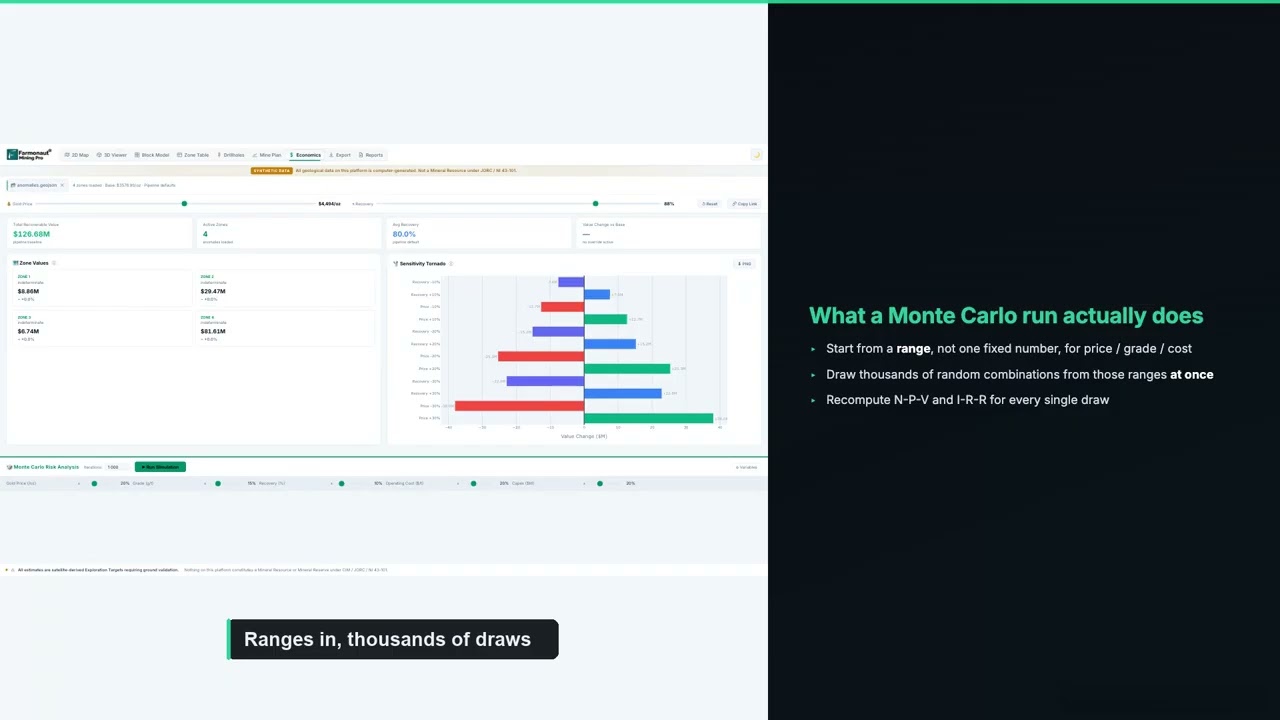
▶ Explains how a Monte Carlo P10, P50 and P90 spread differs from a single estimate. · 14:59
Mine valuation calculator
The calculator below runs a simple DCF with even annual cash flow. It is a teaching tool: it ignores tax timing, ramp-up, inflation and closure, and uses the same discount rate for every year. Replace the example numbers with your own study figures.
Calculator
What is my mine’s NPV at a given discount rate?
Enter your own cash flow, mine life, capital cost and discount rate.
- NPV at a rate 2 points higher: $522
- NPV to capital ratio: 1.26
- Undiscounted cash minus capital: $1,300
Example values only, not a benchmark or a forecast. Simple DCF: level annual after-tax cash flow, capital spent at the start, no ramp-up, inflation or closure cost, same discount rate each year. Use cash flow from your own study at today’s price deck; prices are not inputs here, so rerun the numbers at several prices.
Valuing a mining company, not just one mine
A company is more than its mines: it also holds cash, debt, other projects, corporate costs and, if it explores, a pipeline of unproven targets. The CIMVal standards cover the valuation of mineral properties but not of corporations (Roscoe and McCombe, CIM, 2008), so analysts use finance tools for companies and mining standards for the assets underneath.
Chart
EV/EBITDA multiples, US-listed firms
Enterprise value divided by EBITDA, firms with positive EBITDA, January 2026
- Net asset value (NAV). Value each mine by DCF, add other assets and subtract debt and corporate costs. The ratio of the share price to NAV per share is the P/NAV multiple. A figure below 1.0 means the market values the company below the analyst’s model. That can signal risk the model misses, such as permits, financing or jurisdiction. It is a prompt to investigate, not proof of a bargain.
- Enterprise value to EBITDA. Enterprise value is market capitalization plus debt minus cash. EBITDA is earnings before interest, tax, depreciation and amortization. The ratio suits companies that already produce.
- Enterprise value per ounce or tonne of resource. Common for developers and explorers, which have no earnings. It lets you compare projects of different size, but only if resource quality and jurisdiction are similar.
Damodaran’s January 2026 data for US-listed firms with positive EBITDA show enterprise value to EBITDA multiples of 10.68 for precious metals (56 firms), 11.39 for metals and mining (73 firms), 11.59 for steel and 10.37 for coal and related energy, against 19.73 for the whole US market (Damodaran, EV/EBITDA by sector, January 2026). Mining multiples sit well below the broad market figure. They describe US-listed firms only and change every year, so use them as a cross-check, not as a price for a private property.
To judge how analysts evaluate mining stocks or exploration companies, read the project study behind the NAV: its reserve or resource category, stage (preliminary economic assessment, pre-feasibility or feasibility), capital cost, AISC, permits and the price and discount rate used. This page gives facts and methods only, and none of it is a recommendation to buy or sell any security.
Market comparables: how buyers price mines and claims
For an owner with an unproven property, market evidence is usually the most useful check. Good comparables share the commodity, the stage, the jurisdiction and the date. A deal from a boom year says little about a flat market, and a transaction that includes a royalty, a streaming deal or share payments needs the same conversion to cash described above.
Sources of comparables include company filings and news releases for option agreements, securities filings in Canada, the United States and Australia, and public land records for claim transfers. The 2003 CIMVal standards also asked the valuator to state a valuation date and discuss earlier valuations of the property from the previous 24 months (Roscoe and McCombe, 2008). Our guide to types of ore deposits helps match deposit styles when you pick comparables.
A listed company’s market capitalization can also act as a market test. CIMVal ranks it as secondary because it suits a single-asset junior company better than a single property inside a larger company.
Red flags in a mine valuation report
Whether you commission a report or receive one from a seller, check for these:
- An in situ dollar value. Metal in the ground times price is not a valuation (CIMVAL and VALMIN).
- One number with no range. VALMIN says a public report must state a high, most likely and low value and should include a sensitivity analysis.
- Only one method. VALMIN expects at least two approaches, with an explanation of differences.
- Exploration targets in a cash flow model. Mineralization that does not meet resource definitions should not feed an income valuation.
- No valuation date or price deck. Values change with prices, so the date and sources must be stated.
- A valuator who is not independent or qualified. The CIMVAL Code (2019) asks for a qualified valuator with demonstrated extensive experience who belongs to a professional association, and expects technical data to be verified by a qualified person. The 2003 standards set a five-year minimum (Roscoe and McCombe, 2008).
- Precision that is not believable. A value to the nearest dollar for an exploration property signals false accuracy.
Valuations are used for many purposes: mergers and acquisitions, initial public offerings, audited financial statements, fairness opinions, litigation, tax and insurance claims (Roscoe and McCombe, 2008). The purpose shapes the definition of value used, so state it up front.
Where satellite data fits in a valuation
Satellite imagery does not produce a reserve or a resource, and it cannot go into an income approach on its own. What it can do is help an owner or consultant screen ground and rank targets before spending on drilling, which is the stage where the cost and market approaches apply. Our satellite mineral detection reports deliver exploration targets for a licence boundary, and the output is never a mineral resource or reserve estimate.
The land question matters just as much. A survey can show anomalous ground that sits under a town or a protected area, and that ground cannot be mined however good the rock is. The video below shows one such survey in which 59% of the anomalous ground sat under a town.
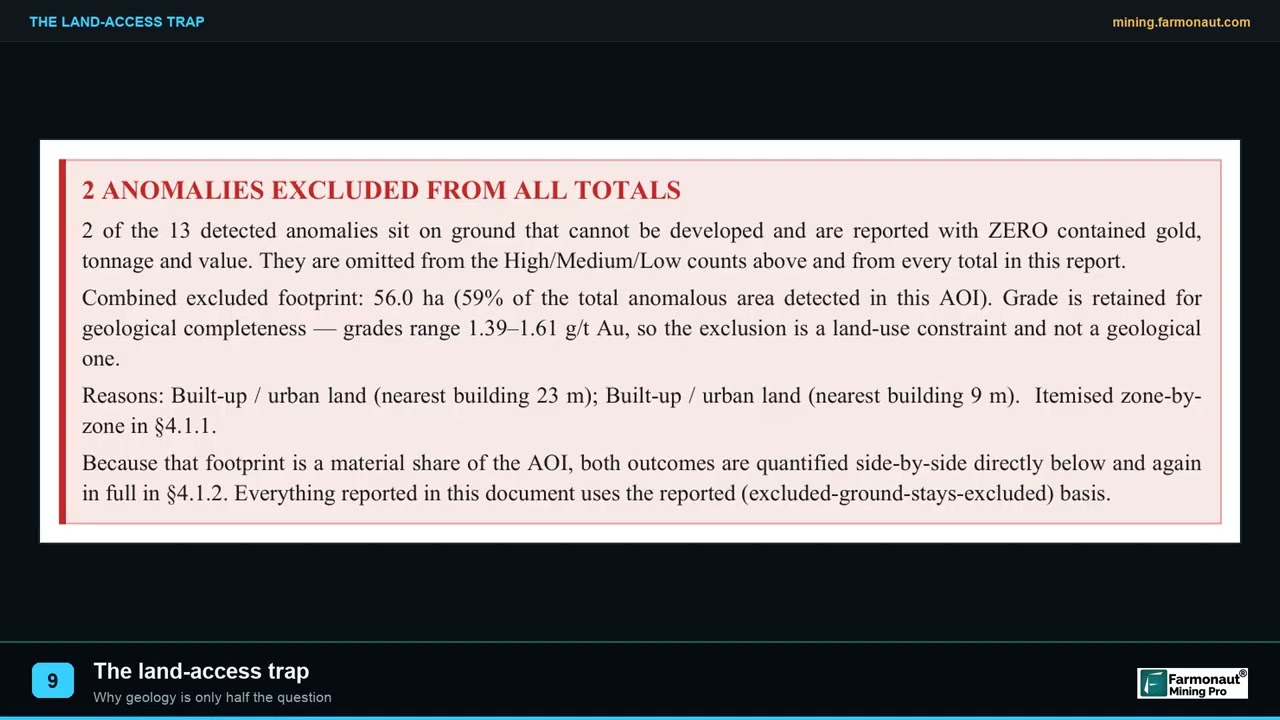
▶ Shows a survey where 59% of the anomalous ground sat under a town, blocked by land access. · 2:05
Frequently asked questions
What is the best method for mine valuation?
No single method is best. Discounted cash flow suits mines with reserves and a mine plan, while exploration properties are valued by market and cost methods. VALMIN expects at least two approaches, and CIMVal ranks several methods as primary.
Which valuation methodology is used to value a mine or other business with a finite life?
Discounted cash flow. Cash flows are projected for the life of the mine, discounted to today and summed, with no terminal value because the mine ends. The net present value is compared with other methods.
How do you value a gold mine?
A producing or developed gold mine is valued by DCF using reserves, recovery, price, AISC, capital, tax and royalties. Liberty Gold’s Black Pine study is a worked case: US$2.397 billion after-tax NPV at US$3,250 per ounce and a 5% rate, falling to US$1.215 billion at US$2,500 (company figures, September 2026). A gold exploration property is valued from comparable deals or past spending.
How do you value a mining company?
Analysts use NAV (a DCF of each asset plus other assets minus debt), enterprise value to EBITDA for producers and enterprise value per ounce of resource for developers. The standards for mineral properties do not cover corporations.
How do you value an exploration property with no resource?
Use the market approach (comparable sales, option and farm-in terms) and the cost approach (appraised value of useful past spending). Express the answer as a range and avoid false precision.
What is the difference between mineral resource and mineral reserve in a valuation?
A reserve has passed a pre-feasibility or feasibility study for economic extraction. A resource has reasonable prospects of economic extraction but less proof. Income valuations can generally use all reserves, but resources need justification and an extra risk adjustment.
Why is in situ value not accepted?
It ignores recovery, cost, capital, tax and time. VALMIN calls reporting an in situ value for a gold deposit misleading. In the Black Pine case the in situ figure is more than five times the study’s NPV.
What discount rate should I use for a mining project?
There is no standard rate. Feasibility studies often show several, for example Black Pine uses 5%, and valuators raise the rate for higher risk. NYU’s January 2026 data put the US metals and mining cost of capital at 8.20%. Show results at more than one rate.
How much do mining project costs overrun?
A University of Oviedo paper summarizes studies finding average capital cost overruns of 14% (63 projects) and 37% (78 projects), with nickel at 45% and copper and gold at about 40%. Test your valuation with higher capital cost.
How is a mining project evaluated before investing?
Check the study stage, the reserve or resource category, capital cost, operating cost, price and discount rate, permits and land access, then test the NPV at lower prices and higher costs. A mining investment assessment should list the risks that a model leaves out.
Who can carry out a formal mineral property valuation?
Under the CIMVAL Code (2019), a qualified valuator is a professional with extensive experience in valuing mineral properties, relevant to the property, who is a member in good standing of a professional association; all material technical data must be verified by a qualified person. The older 2003 standards set a five-year minimum.
Can I use this page to price my claim or licence?
It explains the methods and tests. Pricing a real asset needs the deal purpose, the data package, comparable transactions and, for a formal opinion, a qualified valuator.
This page is for information only. It is not investment, valuation or legal advice. A formal valuation needs a qualified valuator. Listed companies are named as facts, not recommendations.
Farmonaut mining
Screen your licence from space before you spend on drilling
Licence owners and consultants can request a quote for a satellite mineral detection report that ranks exploration targets inside a licence boundary.
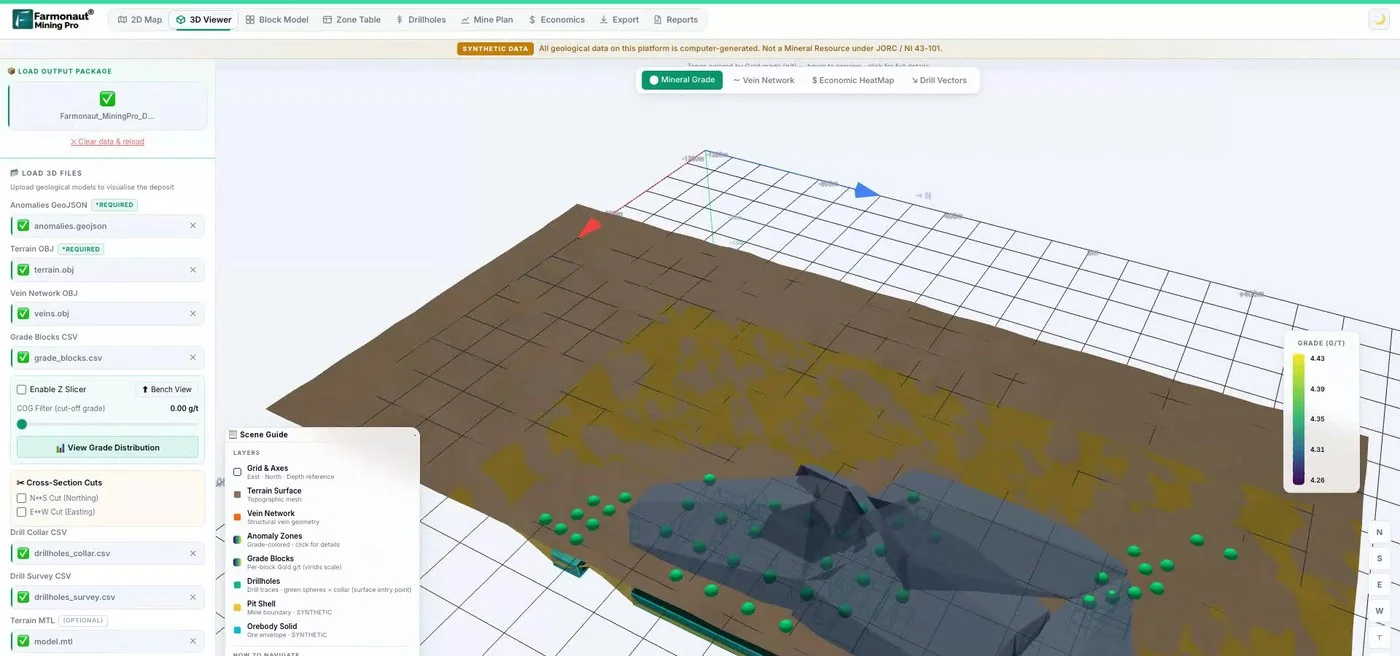
Mining Pro sample view, synthetic data
Keep reading
Sources
- CIM, CIMVAL Code for the Valuation of Mineral Properties (2019): mrmr.cim.org
- CIM, CIMVal Standards and Guidelines (2003): mrmr.cim.org
- CIM, Valuation Standards and Guidelines for Mineral Properties: mrmr.cim.org
- Roscoe and McCombe, Canadian standards for valuation of mineral properties (CIM, 2008): mrmr.cim.org
- AusIMM and AIG, VALMIN Code (2015 edition): valmin.org
- AMC Consultants, Valuation of Mineral Exploration Properties: amcconsultants.com
- Liberty Gold, Black Pine Feasibility Study news release (8 September 2026): bnnbloomberg.ca
- Damodaran, Cost of Capital by Sector, US (January 2026): pages.stern.nyu.edu
- Damodaran, Value to Operating Income (EV/EBITDA) by Sector, US (January 2026): pages.stern.nyu.edu
- USGS, Mineral Commodity Summaries 2026: Gold: pubs.usgs.gov
- Suárez Nieto et al., University of Oviedo, capital cost estimation in copper mining projects: digibuo.uniovi.es
- CIM MES, CIMVal: Standards and Guidelines for Valuation of Mineral Properties: cimmes.org
Discussion
Questions, corrections or field experience? Share them below. First-time comments are reviewed before they appear, and your email is never published.
No comments yet. Be the first to add a question or your experience.

 SenGold Invest SAS
 Sania Corporation
 Sean Mining Limited
 NTS Group (Pty) Ltd
 Mine4Africa
 Lithspo Minerals Limited
 Tintina Mining Group
 Dalgety Minerals Pty Ltd
 Vortex Minerals Pty Ltd
 Faith At Work (Pty) Ltd
 Geotech Mining Solutions plc
 Vulcan International Limited
 Kidepo Associates
 GKY Mining
 Alkimy SARL
 Double A Trading
 GemSprout Metals Limited
 Qader Group
 Ileys General Trading
 SG Gold Mining LLC
 VRV Global Pte Ltd
 Omsri International FZE
 G.I.T.T.
 Jaunita Erss Ltd
 Client · Tanzania · Gold
 Client & affiliate partner · Ghana · Gold