

Gold mining costs · Cost guide
Gold Production Cost per Ounce: Mining Cost Curve
Global average all-in sustaining cost hit a record US$1,785 per ounce in Q1 2026 (World Gold Council). This guide shows the mining cost curve, six large producers ranked, what drives gold production cost, and a calculator for your own mine.
Key takeaways
- The global average all-in sustaining cost (AISC) was US$1,785 per ounce in Q1 2026, up 16% on a year earlier and the 28th yearly rise in a row (World Gold Council, August 2026).
- Six large producers guide 2026 AISC midpoints from US$1,475 (Agnico Eagle) to US$1,900 (Gold Fields); the five with a full-year 2025 figure all guide higher (company filings, 2026).
- Royalties were about 6% of AISC in Q1 2021 and 12% of the average operation’s cost base in Q1 2026 (World Gold Council, 2026).
- Cash cost understates AISC: the 2025 gap was US$360 to US$467 per ounce at Agnico Eagle, Barrick and AngloGold Ashanti (company filings, 2026).
- Cost per ounce = (site costs + sustaining capital + royalties) divided by ounces sold; the calculator returns it with your break-even gold price.
In this article
- What the mining cost curve is and how to read it
- Cash cost, AISC and AIC: which cost number to use
- Gold mining cost per ounce: the industry average and its trend
- Mini cost curve: six large producers ranked
- What makes up the cost of mining gold
- Why gold mining costs keep rising
- How to estimate your own cost per ounce
- Cut-off grade and break-even gold price
- Where satellite screening fits
- What to check before you rely on a cost curve
- Frequently asked questions
Gold production cost is usually quoted as all-in sustaining cost (AISC) per troy ounce. The World Gold Council (WGC) put the global average at a record US$1,785 per ounce in the first quarter of 2026, up 16% on a year earlier. Among six large listed producers, their own 2026 guidance midpoints run from US$1,475 to US$1,900 per ounce. If you own or run a mine, the useful question is where your own cost sits against that spread and against the gold price.
This guide explains the mining cost curve, ranks six producers on a small curve built from their filings, breaks a mine’s cost into parts, shows why costs keep rising, and ends with a calculator for your own cost per ounce and break-even gold price. All figures carry a source and a date.
What the mining cost curve is and how to read it
A mining cost curve ranks mines from the lowest to the highest unit cost. Cost per ounce (normally AISC) runs up the vertical axis. Cumulative yearly output runs along the horizontal axis, so each mine is drawn as wide as its production. The cheapest ounces sit on the left and the dearest on the right.
The gold price is a horizontal line across the chart. Mines below the line earn a margin per ounce. Mines above it lose money on every ounce unless they have other income. That is why owners watch where they sit by quartile: the lowest-cost quarter of world output is the first quartile, and the highest-cost quarter is the fourth.
The WGC publishes the global average and the margin each quarter. Its data comes from Metals Focus’ Gold Mine Cost Service, and the Goldhub page shows the quarterly average global AISC from 2012. The cost figures arrive with a lag, because companies report on different dates. For Q1 2026 the WGC reported an average AISC margin of US$3,076 per ounce, and a margin of US$2,363 per ounce at the 90th percentile of the curve. Margin here is the realised price minus AISC. It is not profit, because tax, interest, non-sustaining capital and working capital sit outside it.
Cash cost, AISC and AIC: which cost number to use
Three cost measures are in use, and they answer different questions. Compare like with like.
- Total cash cost (TCC): on-site mining and processing, royalties, refining and transport, less by-product credits. It shows how cheaply the plant runs.
- All-in sustaining cost (AISC): cash cost plus corporate overhead, reclamation accretion, sustaining exploration and the capital needed to keep output steady, including sustaining stripping and underground development. The WGC set out the definition in a guidance note dated 26 June 2013, for use from 1 January 2014.
- All-in cost (AIC): AISC plus non-sustaining items such as growth capital and exploration for new ounces.
The gap between cash cost and AISC is large. For 2025, Barrick reported a cash cost of US$1,199 and an AISC of US$1,637 per ounce (a gap of US$438). AngloGold Ashanti reported US$1,242 and US$1,709 (a gap of US$467). Agnico Eagle reported US$979 and US$1,339 (a gap of US$360). A cash-cost headline alone can make a mine look US$360 to US$470 per ounce cheaper than its AISC.
Check the basis too. Newmont reports on a by-product basis, where copper, silver, lead and zinc revenue is treated as a cost reduction. Its 2025 AISC was US$1,358 per ounce by-product and US$1,609 per ounce co-product. Kinross quotes AISC per gold-equivalent ounce sold. These choices move the number by hundreds of dollars.
Gold mining cost per ounce: the industry average and its trend
The WGC’s quarterly series shows a steady climb. Average AISC was US$1,578 per ounce in Q2 2025 (up 12% on a year earlier) and US$1,605 in Q3 2025. It reached US$1,706 in Q4 2025 and then the Q1 2026 record of US$1,785, which was 5% above the previous quarter and the 28th year-on-year rise in a row.
Chart
Global average gold AISC, four quarters
US$ per troy ounce, quarterly
Prices rose faster than costs, so margins widened. The WGC reports a spot peak of US$5,595 per ounce in January 2026, and a Q2 2026 average that was 7.2% lower than Q1 but still above US$4,000. For earlier years, the USGS estimates the average gold price rose from US$1,801 per ounce in 2021 to US$3,300 in 2025 (estimate).
The lag matters. The WGC says its latest cost data comes with a delay, and the Q2 2026 Gold Demand Trends supply review gives no new cost figure. It adds that the first signs of higher energy prices tied to the Middle East conflict showed up in Q1 2026, with a larger effect expected from Q2.
Mini cost curve: six large producers ranked
The global curve is a paid dataset, so the table below is something smaller and fully checkable. It ranks six large listed gold producers by the midpoint of their own 2026 AISC guidance. We chose them because each publishes AISC, a 2026 range and a gold price assumption in filings on SEC EDGAR. It is not the industry curve, and the companies do not use identical definitions.
Chart
AISC: 2025 result against 2026 guidance midpoint
US$ per ounce; five producers with a full-year 2025 figure
Chart
A mini cost curve: 2026 AISC guidance midpoints
US$ per ounce; midpoint of each company’s own 2026 range; definitions differ
| Producer | 2025 AISC (US$/oz) | 2026 AISC guidance (US$/oz) | Basis and assumptions |
|---|---|---|---|
| Agnico Eagle | 1,313 (revised definition; 1,339 on the earlier one) | 1,400 to 1,550 | Gold price assumption US$4,500; 2026 cash cost guidance US$1,020 to 1,120 |
| Newmont | 1,358 | 1,680 (plus or minus 5%) | By-product basis; co-product about US$1,935 |
| Kinross | 1,571 | 1,730 (plus or minus 5%) | Per gold-equivalent ounce sold; gold price assumption US$4,500 |
| Barrick | 1,637 | 1,760 to 1,950 | Per ounce sold; gold price assumption US$4,500; 2026 cash cost guidance US$1,330 to 1,470 |
| AngloGold Ashanti | 1,709 | 1,780 to 1,990 | Gold price assumption about US$4,250 |
| Gold Fields | Not compared (H1 2025: 1,682) | 1,800 to 2,000 | H1 2026 AISC expected at US$1,900 (trading statement, unaudited) |
Sources: Agnico Eagle, Newmont (Form 8-K above), Kinross, Barrick (6-K above), AngloGold Ashanti and the Gold Fields trading statement of 11 August 2026. Agnico’s 2026 guidance uses its revised cost definition, so the table gives its 2025 AISC on that basis.
Three things stand out. First, the spread between the lowest and highest guidance midpoint is US$425 per ounce. Second, every one of the five producers with a full-year 2025 figure guides higher for 2026: Newmont by about 24%, Barrick by about 13%, Agnico Eagle by about 12%, and Kinross and AngloGold by about 10%. Third, all five 2025 figures sat well below the USGS 2025 average price estimate of US$3,300 per ounce.
The companies give their own reasons. Barrick lists a higher gold price assumption, slightly higher sustaining capital per ounce, lower open-pit grades, dearer consumables and a higher cost base at Loulo-Gounkoto as it ramps up, in its 2025 annual report. Newmont guides output of about 5.3 million ounces for 2026 against 5.9 million in 2025. Agnico attributes its 2025 overrun mainly to royalties on a realised price of about US$3,450 per ounce against a US$2,500 assumption.
What makes up the cost of mining gold
Every dollar in AISC comes from a handful of buckets: mining (drilling, blasting, loading, hauling), processing, site services and administration, royalties and taxes tied to revenue, refining and transport, then the sustaining items added by AISC. The mix changes with the deposit.
Chart
Where the money goes: one heap-leach project
Estimated operating cost, US$ per ton of ore (Soledad Mountain study; total US$23.66; items may not sum because of rounding)
A real feasibility study shows the proportions. The Soledad Mountain heap-leach project (NI 43-101 report dated 12 January 2024, published by Andean Precious Metals) estimates operating costs of US$23.66 per ton. Mining is 54.7% of that, because the plan moves 6.09 tons of waste for each ton of ore. The report’s gold price assumption was only US$1,850 per ounce, so use it for the cost mix and not as a current benchmark.
AngloGold Ashanti groups its operating costs into salaries and wages, stores and consumables, fuel, power and water, and contractors. Its 2025 annual report says operating costs rose by US$566 million, driven by labour, consumables, fuel, power and water, and mining contractors.
From cost per tonne to cost per ounce
Mines budget per tonne of ore, but the market compares per ounce. The link is grade and recovery. Recovered ounces per tonne equal grade (g/t) times recovery divided by 31.1035 grams per troy ounce. A worked example, for illustration only: at 2 g/t and 90% recovery a tonne yields 0.0579 ounces. If all site costs are US$60 per tonne, site cost is about US$1,037 per ounce before sustaining capital, corporate costs and royalties. Halve the grade and the same US$60 becomes about US$2,074 per ounce. Grade is the strongest lever on the curve, which is why drilling and ore-control accuracy pay back. Our guide to how mining projects are funded covers the funding side.

▶ Follows gold from rock to ring through drilling, crushing, leaching, refining, the steps that make up the cost per ounce. · 5:27
Why gold mining costs keep rising
Royalties follow the gold price
The WGC says royalties were about 6% of AISC in Q1 2021, and that share had doubled to 12% of the average operation’s cost base by Q1 2026, with payments up 85% year on year. Governments have added price-linked scales. Ghana replaced its flat 5% rate with a sliding scale that can reach 12% above US$4,500 per ounce. Burkina Faso charges 10% between US$4,000 and US$4,500. Mali charges 9.5% at US$4,100. At IAMGOLD’s Essakane mine in Burkina Faso, royalties were 35% of cash costs. AngloGold Ashanti reports that a US$100 move in the gold price changes its royalties by about US$5 per ounce. Agnico Eagle said higher royalties, about US$42 per ounce above plan, pushed its 2025 costs just above the top of guidance, because it realised about US$3,450 per ounce against a US$2,500 assumption.
Fuel and power
The WGC reports that US diesel rose 54% over Q1 2026 and Perth wholesale diesel 96%. The WGC cites OceanaGold as saying diesel is about 6% of its AISC, with about 80% of annual use hedged. Open-pit fleets burn the most fuel, so a hedge or a lower haul distance can change a curve position. Fleet fuel use is one place to look; Farmonaut lists fleet management among its tools.
Lower grades, dearer consumables and labour
Lower mined grades, tariffs on consumables and higher labour costs all push cost per ounce up, as Barrick’s report shows. AngloGold Ashanti said average realised inflation was 3.4% in 2025, against 6.6% in 2024, and that the 2025 rise in its cash cost came from royalties (about 6%) and inflation (about 3%), partly offset by exchange rates (about 2%).
Environment, closure and emissions
Reclamation accretion sits inside AISC under the WGC definition, and permit conditions differ by metal and country. Our guide to environmental regulations and compliance in copper mining shows how permit conditions turn into costs. For emissions reporting, Farmonaut has a carbon footprinting page.
How to estimate your own cost per ounce
- Work out yearly ounces sold: tonnes of ore times grade times recovery, divided by 31.1035.
- Add all site operating costs for the year: mining, processing, site services and administration.
- Add sustaining capital, corporate overhead and sustaining exploration.
- Add royalties: the royalty rate times price times ounces.
- Divide the total by ounces sold. That is your AISC.
- Subtract AISC from your gold price to get the margin per ounce, and compare it with the quarter’s average in the WGC data.
Use the calculator below with your own numbers. The default values are round examples, not benchmarks, and the gold price is an input.
Calculator
What is your AISC and break-even gold price?
Enter your own tonnes, grade, costs and royalty. Results update as you type.
- Ounces sold per year: 57,871 oz
- Margin per ounce at your price: $2,072
- Break-even gold price (per ounce): $1,819
- Cut-off grade, site cost only (g/t): 0.52
Example values only, not benchmarks or forecasts. Gold price is an input: use today’s price. AISC here = (site operating cost + sustaining capital and corporate cost) divided by ounces sold, plus royalty per ounce. 31.1035 grams per troy ounce is the standard conversion. Money is in US$. Assumes all recovered ounces are sold. The cut-off line uses site operating cost only.
Cut-off grade and break-even gold price
Cut-off grade is the lowest grade at which a tonne of rock pays for its own processing and overhead. A simple version is cost per tonne divided by the recovered value of a gram of gold. As an example, at US$30 per tonne, a gold price of US$4,000 per ounce (US$128.60 per gram) and 90% recovery, the break-even is about 0.26 g/t. A drop in price or a rise in cost lifts that figure and takes ore out of the plan, which is how a rising cost curve shrinks reserves.
Break-even gold price is the price at which margin is zero. In the calculator it is total cost divided by ounces, adjusted for the royalty. If your break-even sits close to today’s price, a small fall wipes out the margin. If it sits near the bottom of the curve, you can wait out a price dip.
Where satellite screening fits
Cost per ounce starts with the ore body. Finding better grade, or ruling out poor ground early, cuts the spend before a drill turns. Farmonaut is a US-based company that screens a licence area from satellite images before ground crews go in, taking KML, KMZ or polygon input. The company says this can lower early-exploration cost by up to 80-85%. It produces exploration targets, not a resource estimate. Our guides on finding gold deposits and US gold deposits by state cover the geology side.
▶ Explains that satellites cannot see gold but can map the alteration halo around a gold system. · 2:00
What to check before you rely on a cost curve
- Basis: by-product or co-product, per ounce sold or produced, per gold-equivalent ounce.
- Date: WGC cost data lags by a quarter or more, and company guidance is set against a stated gold price (US$4,250 to US$4,500 in the filings above).
- Currency: most costs are paid in local currency, so exchange rates move the US-dollar figure (AngloGold Ashanti cites a favourable exchange rate of about 2% in 2025).
- Sustaining versus growth capital: only the first belongs in AISC.
- One-offs: care and maintenance, ramp-ups and stoppages distort a single quarter.
- Your own mine: a company average hides the spread between its best and worst pit.
Frequently asked questions
How much does it cost to mine an ounce of gold?
The WGC’s global average AISC was US$1,785 per ounce in Q1 2026. Large producers guide to US$1,475 to US$1,900 per ounce for 2026. Your own figure depends on grade, strip ratio, power, royalties and sustaining capital.
What is the average gold production cost?
The global average AISC was US$1,578 in Q2 2025, US$1,605 in Q3 2025, US$1,706 in Q4 2025 and US$1,785 in Q1 2026 (WGC). Cash cost is lower, because it leaves out sustaining capital and corporate overhead.
What is a mining cost curve?
It is a chart that ranks mines from lowest to highest unit cost against cumulative output. The gold price line shows which mines earn a margin and which do not.
What is the difference between cash cost and AISC?
Cash cost covers site operating costs, royalties and refining net of by-product credits. AISC adds corporate overhead, reclamation, sustaining exploration and sustaining capital. In 2025 the gap was US$360 to US$467 per ounce at Agnico Eagle, Barrick and AngloGold Ashanti.
Why are gold mining costs rising when the gold price is high?
Royalties are tied to price, so they rise with it. The WGC puts royalties at about 12% of the average operation’s cost base in Q1 2026, up from about 6% of AISC in Q1 2021. Fuel, consumables, labour and lower grades add to it.
How does the gold price affect cost per ounce?
Mainly through royalties and taxes. AngloGold Ashanti reports about US$5 per ounce of royalty for each US$100 move in the price. Agnico Eagle said royalties added about US$42 per ounce above its plan in 2025.
Which large gold miner has the lowest AISC?
Among the six compared above, Agnico Eagle has the lowest 2026 guidance midpoint (US$1,475 per ounce) and the lowest 2025 AISC (US$1,313 on its revised definition). Definitions differ between companies, so treat the ranking as indicative.
What is a break-even gold price?
It is the price at which revenue equals AISC plus the royalty on that revenue. Below it the mine loses money on each ounce. The calculator on this page returns it from your own inputs.
How much does it cost to start a small-scale gold mining operation?
No sourced average exists, and costs vary with the deposit, the country and the process route. Break the question into licence and permit fees from your regulator, sampling and test work, plant and equipment quotes, and the operating cost per ounce from the calculator above.
How big a part does diesel play in gold mining costs?
It varies by mine. OceanaGold says diesel is about 6% of its AISC. The WGC notes US diesel rose 54% in Q1 2026, so an unhedged open-pit fleet feels it first.
Where can I find the full global gold cost curve?
The WGC publishes the quarterly global average AISC and margin on Goldhub, built on Metals Focus’ Gold Mine Cost Service. Full mine-by-mine curves are sold by data firms. Company filings give the figures for individual producers.
This page is for information only. It is not investment advice. Company figures are on each company’s own cost definition and are not directly comparable.
Farmonaut mining
Get a quote to screen your licence area from space
Farmonaut screens an area of interest from satellite images before ground crews go in, and takes KML, KMZ or polygon input.
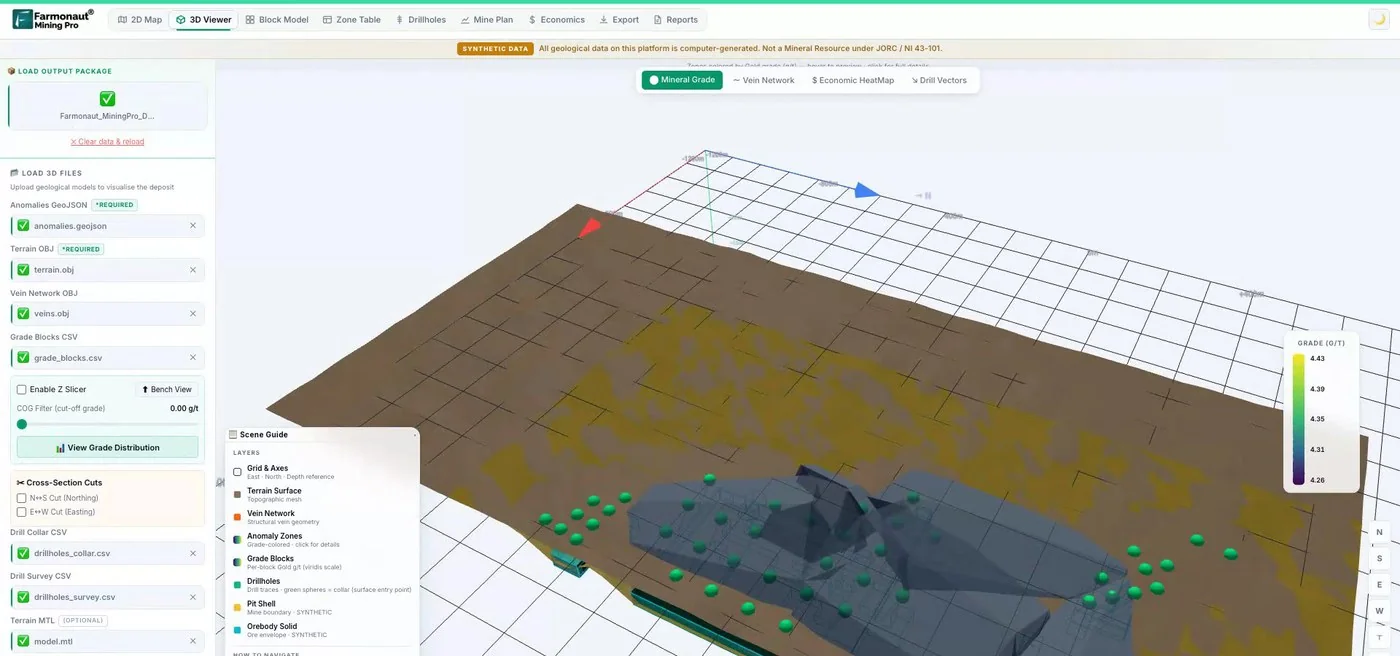
Mining Pro sample view, synthetic data
Keep reading
Sources
- World Gold Council, Record gold prices outpace rising mining costs in Q1’26 (24 August 2026): gold.org
- World Gold Council, Guidance note on non-GAAP metrics: all-in sustaining costs and all-in costs (26 June 2013): gold.org
- World Gold Council, Goldhub AISC of gold production data page: gold.org
- World Gold Council, Gold Demand Trends Q2 2026, Supply: gold.org
- World Gold Council, Gold Demand Trends Q1 2026, Supply (Q4 2025 AISC): gold.org
- World Gold Council, Gold Demand Trends Full Year 2025, Supply (Q3 2025 AISC): gold.org
- World Gold Council, Gold Demand Trends Q3 2025, Supply (Q2 2025 AISC): gold.org
- USGS, Mineral Commodity Summaries 2026: Gold (February 2026): pubs.usgs.gov
- Newmont, Form 8-K: Q4 and full-year 2025 results and 2026 guidance (19 February 2026): sec.gov
- Barrick Mining, Form 6-K: full-year 2025 results (February 2026): sec.gov
- Barrick Mining, Annual Report 2025, Management’s Discussion and Analysis: sec.gov
- Agnico Eagle, Form 6-K: Q4 and full-year 2025 results: sec.gov
- Kinross Gold, Form 6-K: 2025 fourth quarter and full-year results: sec.gov
- AngloGold Ashanti, Form 6-K: Q4 and full-year 2025 earnings release: sec.gov
- AngloGold Ashanti, Integrated Report 2025: financial review of costs: reports.anglogoldashanti.com
- Gold Fields, Form 6-K: H1 2026 trading statement (11 August 2026): sec.gov
- Andean Precious Metals, NI 43-101 technical report for Soledad Mountain (31 January 2024): newsfilecorp.com
Discussion
Questions, corrections or field experience? Share them below. First-time comments are reviewed before they appear, and your email is never published.
No comments yet. Be the first to add a question or your experience.

 Vortex Minerals Pty Ltd
 Faith At Work (Pty) Ltd
 Geotech Mining Solutions plc
 Vulcan International Limited
 Kidepo Associates
 GKY Mining
 Alkimy SARL
 Double A Trading
 GemSprout Metals Limited
 Qader Group
 Ileys General Trading
 SG Gold Mining LLC
 VRV Global Pte Ltd
 Omsri International FZE
 G.I.T.T.
 Jaunita Erss Ltd
 Almosi SARL
 SRK Consulting
 Berks Gold Limited
 Mwerezi Minerals Company Limited
 Mining SARL
 SenGold Invest SAS
 Exploration consultancy · South Africa · Gold










