

Pilbara iron ore · Rehabilitation guide
Pilbara Mine Rehabilitation: 7 Methods and the Data
Pilbara mine rehabilitation is hard because rain is rare and mine soils are poor. This guide gives the scale, the WA closure and levy rules, seven methods with trial results, and a levy calculator.
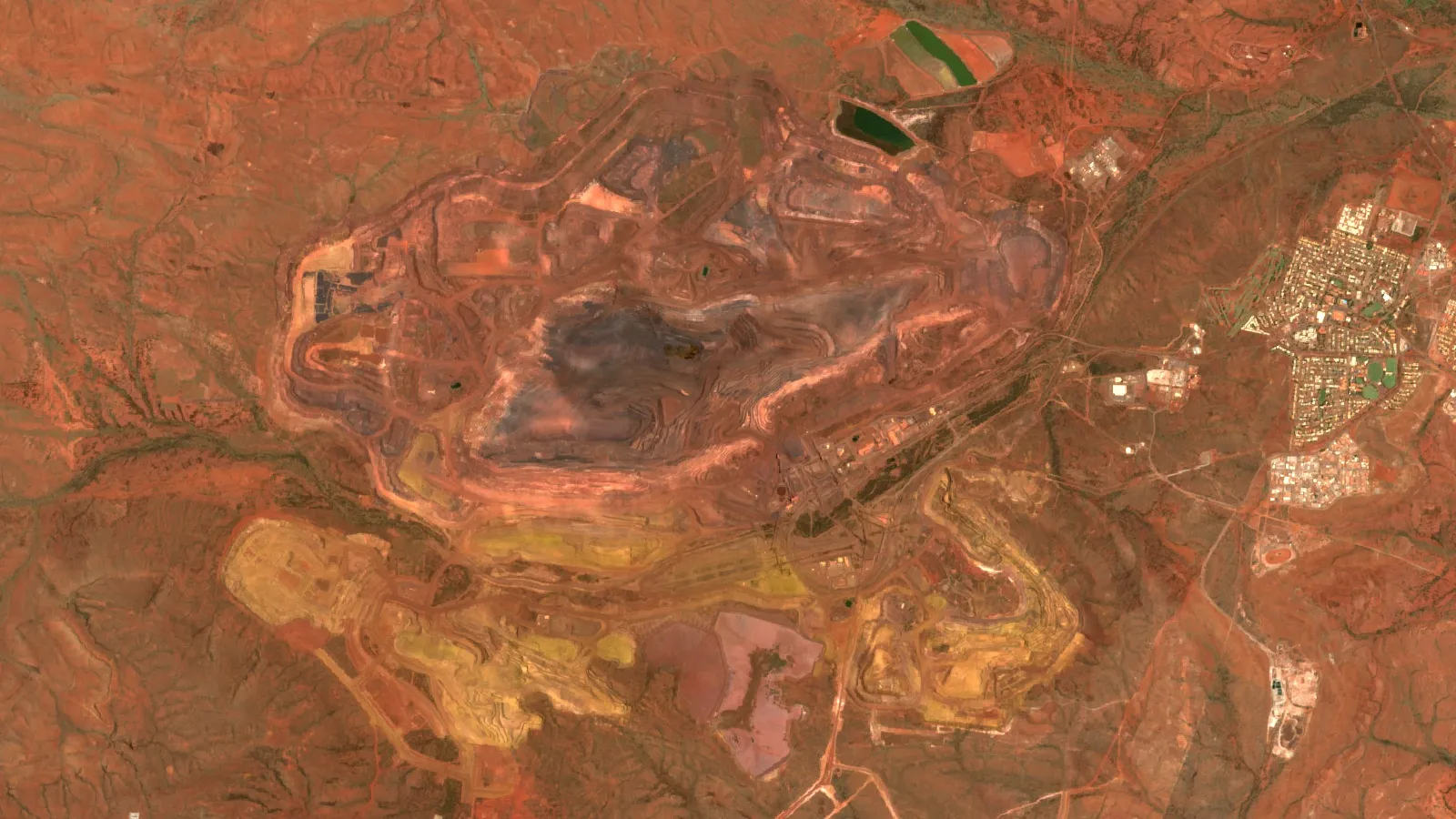
Key takeaways
- A field study cites an EPA figure of at least 3,000 km² of mined land needing rehabilitation in the Pilbara, about 1.7% of a region of roughly 179,000 km² (Frontiers, 2020; ratio calculated).
- WA-wide, the 2025 Mining Rehabilitation Fund release reports 200,035 ha disturbed and 52,375 ha under rehabilitation across all minerals (DMPE, November 2025).
- Surface-sown seed gave under 2% emergence in field studies; extruded pellets reached 10% for spinifex in a Mt Whaleback plot trial, but few seedlings survived (Frontiers, 2020).
- The WA levy is 1% of a liability estimate built from rates of A$50,000 per hectare for class 1 tailings storage down to A$2,000 for land under rehabilitation (WA regulations).
- In October 2025 the EPA said it wants evidence that the gap between cleared and rehabilitated land in the Pilbara is narrowing (EPA media statement).
In this article
- Pilbara mining region: scale and rehabilitation numbers
- Why rehabilitation is hard in the Pilbara climate
- 7 rehabilitation methods and what the trials show
- Seedling data from a Pilbara field facility
- Closure plans, the levy and the EPA test
- Using satellite data to track rehabilitation
- How to read a Pilbara rehabilitation claim
- Frequently asked questions
Pilbara mine rehabilitation is the work of returning cleared iron ore land in north-western Western Australia (WA) to a stable surface with native plants. It is hard, and the evidence is still thin. A 2020 field study cites a 2017 Environmental Protection Authority (EPA) figure of at least 3,000 km² of mined land in the Pilbara that needs rehabilitation (Frontiers in Ecology and Evolution, 2020). In October 2025 the WA EPA said it wants proof that the gap between cleared and rehabilitated land is narrowing (EPA media statement, 6 October 2025). This guide sets out the scale, the rules, seven methods and what trials have measured, with the source and date next to each number.
It is written for consultants, licence holders and planners who need figures they can check. It covers iron ore, the main Pilbara mining activity, and it uses published levy rates in place of guessed cost tables.
Pilbara mining region: scale and rehabilitation numbers
The Pilbara is the centre of WA iron ore. Rio Tinto alone reported Pilbara iron ore shipments of 326.2 million tonnes (Mt) and production of 327.3 Mt in 2025, both on a 100% basis that includes its joint-venture partners’ shares (Rio Tinto, fourth quarter 2025 production results). BHP’s Yandi mine illustrates how old the industry is: it became the second WA iron ore mine to produce one billion tonnes over its life in 2017 and is now nearing its end (Australian Mining).
Chart
WA mining land disturbed and under rehabilitation
Thousand hectares, all minerals and regions in WA, by MRF reporting year
The Pilbara region covers about 179,000 km², and the recorded disturbance footprint is at least 3,000 km², according to the 2020 study above. That is roughly 1.7% of the region (our calculation: 3,000 divided by 179,000). The share is small, but the land is spread across many mines, haul roads and rail lines, and each hectare has to be handled one site at a time. Note that 3,000 km² is 300,000 ha, more than the WA-wide MRF total of 200,035 ha quoted below. The two figures are not comparable: the first is a 2017 EPA estimate of the recorded Pilbara mining footprint, while the MRF counts only disturbance reported by Mining Act tenement holders in a reporting year, and DMPE excludes most State Agreement tenements, which include many large iron ore operations.
The MRF release headlines give state-wide totals, not a Pilbara-only count of hectares rehabilitated. The WA Department of Mines, Petroleum and Exploration (DMPE) publishes state-wide figures from the Mining Rehabilitation Fund (MRF). These cover every mineral and region in WA, not only the Pilbara. In the 2025 data release, 200,035 ha were reported as disturbed and 52,375 ha as land under rehabilitation (DMPE, MRF data release, 3 November 2025). That is 26% of the disturbed total, by our calculation (52,375 divided by 200,035).
“Land under rehabilitation” is a reporting category. It means rehabilitation work has been done and is being monitored. It does not mean the land has been signed off as finished, so the figure should not be read as completed closure.
Why rehabilitation is hard in the Pilbara climate
Rain in the Pilbara falls in short, irregular bursts. The 2020 study reports average rainfall of about 235 mm from December to April and about 81 mm from May to November, with potential evaporation about ten times higher than rainfall. Seeds mainly establish after cyclonic rain (more than four events of 20 to 25 mm in the summer), when maximum temperatures are about 32°C and often pass 45°C. Winter rain is too little to support new plants (Frontiers in Ecology and Evolution, 2020).
The soil is the second problem. The same paper notes that mining leaves modified soils, waste rock and tailings that have low water-holding capacity, toxic pH, low organic matter, few nutrients and little microbial life. The native ecosystem is spinifex (Triodia, a spiky perennial grass) with scattered shrubs such as Acacia. The practical effect is that a rehabilitation crew gets only a few good seasons to get seeds and soil right.
The result is that results vary by site, year and method, and any page that gives one fixed “success rate” or “cost per hectare” for the whole region is guessing.
▶ A plain-language claymation on the seven environmental impacts of mining. · 2:31
7 rehabilitation methods and what the trials show
The list below is ordered by how much measured evidence we found, from strongest to weakest. Each method states what a source measured and where it stops being proven.
1. Reuse fresh topsoil as soon as possible
Topsoil holds the native seed bank and soil life. An arid-environment study in Restoration Ecology compared freshly harvested topsoil with stockpiles stored for 1 and 3 years in 2-metre-high piles. Emergence of perennial plants was more than four times greater from fresh topsoil than from the 1-year stockpile, and twice as great as from the bottom 50 cm of the 3-year stockpile. The top 50 cm of the 3-year stockpile did not differ from fresh topsoil (Golos, Dixon and Erickson, University of Western Australia repository, 2016). Total emergence from the 1-year pile was higher, but it was mostly annual plants that are common on disturbed ground.
Limit: the best result needs land ready to receive soil at the time it is stripped, which is rarely true on a working mine.
2. Build stable, safe landforms
Before any plant grows, the surface has to stay put. DMPE’s closure objectives state that mine sites must be rehabilitated so they are physically safe to humans and animals, geotechnically stable, geochemically non-polluting and capable of sustaining an agreed post-mining land use (DMPE, Guideline for Preparing Mine Closure Plans). Landform design (slopes, drainage, cover over waste rock) is how a plan meets that test.
Limit: there are no published Pilbara-wide measurements known to us that compare comparing landform designs, so this page does not rank slope or drain designs.
3. Grow seed on site in seed production areas
Wild seed is scarce, and collecting it can damage the ecosystem it comes from. At Yandi, BHP trialled a seed production area in 2023 with three spinifex species. The trial showed spinifex can produce hundreds of kilograms of seed per hectare using existing mine infrastructure, and the project won an Australian Mining Prospects Award (Australian Mining).
Limit: the trial reports seed yield, not how many plants later establish on rehabilitated land.
4. Place seed in pellets or protected microsites
Spreading seed over the surface works poorly. The 2020 study reports seedling emergence below 2% in field studies of surface sowing. Its trial used extruded pellets made of soil, seed and optional organic material, placed in a rain-exclusion facility at BHP’s Mt Whaleback mine near Newman. The trial ran for 16 weeks (October 2018 to February 2019) with 216 pellets. Each held 65 seeds and produced an average of 7.3 seedlings, about 11% emergence (Frontiers in Ecology and Evolution, 2020).
Limit: survival was low. No Acacia seedlings survived to the end, and first-round spinifex survival averaged only 0.15 to 0.59 seedlings per pellet, depending on pellet type. This was a plot trial, not a mine-scale result.
5. Match the soil mix to the plant
In the same trial, spinifex emergence was highest in pellets made from a 50:50 blend of topsoil and waste rock (6.5 and 7.6 seedlings per pellet at 60 mm and 120 mm of simulated rain). Adding dried spinifex leaf material (the paper calls it Triodia biomass) to 100% topsoil pellets gave the lowest spinifex emergence (1.6 and 1.4 seedlings); the authors call this unexpected and suggest resins may inhibit spinifex seedlings. So adding organic matter did not help here, even though the paper cites other studies where organic amendments raised water-holding capacity. The trial involved one pellet design, three species and a short time.
Limit: one facility and one season; other waste types and amendments may behave differently.
6. Time sowing to the wet season
Because recruitment follows summer cyclonic rain, the 16-week experiment in the 2020 study ran from October to February, which the authors describe as the natural recruitment window. Winter rain is too little to support recruitment. This is a planning rule rather than a technique, and it limits when crews can work.
Limit: a dry summer can still lose a whole year’s sowing. In the trial, a second round of seedlings emerged after a second simulated rain event, so some seed stays viable and can germinate later.
7. Measure progress against written completion criteria
Monitoring turns activity into evidence. In WA, rehabilitation and monitoring against completion criteria are reported to DMPE through environmental reporting, and once closure outcomes are met an operator can lodge a Mine Closure Completion Report to start relinquishment, the release from environmental obligations (DMPE, Prepare a Mine Closure Plan). DMPE points to a WA Biodiversity Science Institute framework for writing completion criteria.
Limit: criteria differ by mine, so results are hard to compare across operators.
Seedling data from a Pilbara field facility
The chart below plots the first-round emergence from the Mt Whaleback pellet trial, set against the upper bound reported for surface sowing in earlier field studies. Spinifex, the main target species, had 10% emergence (4 of 40 seeds); Acacia had 20% (2 of 10 seeds) and Indigofera had 8%. Emergence is not survival: by the end of the 16 weeks no Acacia seedlings had survived and few of the other species had.
Chart
First-round seedling emergence, Mt Whaleback pellet trial
Per cent of seeds that emerged; surface sowing shown as the reported upper bound (under 2%)
The lesson for planners is to ask a supplier or operator for establishment numbers (plants alive after one to two summers per hectare), not seed weights or “seeds applied”.
Closure plans, the levy and the EPA test
Three rules shape what a Pilbara operator must do. First, a Mine Closure Plan is required for operations approved under the Mining Act 1978. DMPE says that from 9 September 2025 all plans must follow its Guideline for Preparing Mine Closure Plans and that accepted plans are published on Resources Online (DMPE, Prepare a Mine Closure Plan). Progressive rehabilitation is expected as areas stop being needed, and exploration disturbance approved under a Programme of Work is handled under that approval’s conditions instead.
Chart
MRF levy unit rate by land category
A$ thousand per hectare in the liability estimate (levy is 1% of the total)
Second, tenement holders on Mining Act 1978 tenure pay the MRF levy. Most tenements covered by State Agreements are excluded, and many large Pilbara iron ore operations sit under State Agreements, so check your tenure. The levy is 1% of a rehabilitation liability estimate (RLE), worked out by multiplying hectares in each category by a fixed rate. Tenements with an RLE of A$50,000 or less report but do not pay (DMPE, About the Mining Rehabilitation Fund). In 2024-25, levies of A$51.6 million were assessed, up 8.17% on the year before (DMPE, MRF yearly report announcement, December 2025).
The rates come from Schedule 1 of the Mining Rehabilitation Fund Regulations 2013, in the compilation on the WA legislation site that lists amendments to July 2021 (Mining Rehabilitation Fund Regulations 2013). They are levy rates, not what rehabilitation costs a hectare. The levy goes into a pooled fund used for abandoned mines, and DMPE states the fund does not remove an operator’s legal duty to rehabilitate.
The rates show what the state treats as high-risk land. A hectare of class 1 tailings storage, a class 1 waste dump or a heap leach facility counts at A$50,000; plant sites, class 2 tailings and waste dumps, and mining voids deeper than 5 m below the water table count at A$30,000, and roads, pads, borrow pits and other cleared land at A$18,000. Land under rehabilitation and topsoil stockpiles count at A$2,000. Moving a hectare from the A$18,000 category to rehabilitation therefore lowers the annual levy by A$160 (1% of A$16,000). The calculator below applies the rates.
Third, the EPA now looks at rehabilitation when it assesses a new Pilbara mine. For BHP’s Jimblebar Hub expansion it recommended approval with conditions that demonstrate the timing and hectares of rehabilitation over the life of the proposal. It said the technical and practical feasibility of proposed rehabilitation will be considered in future Pilbara assessments (EPA media statement, 6 October 2025). The Minister for the Environment makes the final decision on such proposals.
Calculator
What would the WA rehabilitation levy be for my tenement?
Enter the hectares on one tenement (mining authorisation) in each category at the assessment date.
- Rehabilitation liability estimate (A$): $8,180,000
- Levy saved (A$) if 10 ha of category C moves to category E: $1,600
- Total hectares entered: 510 ha
Example hectares for one tenement (mining authorisation), not any mine’s figures. Land that has met completion criteria (rehabilitated land) carries no rate and is not entered. Unit rates are fixed in the formula from Schedule 1 of the Mining Rehabilitation Fund Regulations 2013 (A$50,000, A$30,000, A$18,000, A$2,000, A$2,000 per hectare); levy rate 1%; no levy is payable when the estimate is A$50,000 or less (DMPE). Check the current regulations before relying on the result.
Using satellite data to track rehabilitation
An EPA or DMPE reviewer wants hectares: hectares cleared, hectares reshaped, hectares sown and hectares with a measured plant cover. Satellite images are one way to produce a consistent record of those areas over time. Optical sensors such as Sentinel-2 show vegetation cover and bare ground, and a series of summer images lets a consultant compare a rehabilitated block with nearby undisturbed spinifex. A single vegetation index can mislead in sparse arid cover, so the satellite record needs field plots (counts of live plants) beside it.
Farmonaut’s mining work is on the exploration side. It screens a licence area for mineral targets from Sentinel-2 and other satellite data, ahead of any resource estimate. It does not certify rehabilitation or land clearance. Consultants who work across both tasks can use the same imagery set to map an area before and after disturbance; satellite-based mineral detection describes the screening side, and you can request a quote for a site map.

▶ Explains what satellites can and cannot show about ground and rock, in plain words. · 4:25
How to read a Pilbara rehabilitation claim
Use these checks when a company report, tender or news item quotes a rehabilitation result:
- Which hectares? Ask whether the number means land under rehabilitation (monitored) or land that has met its completion criteria (ready to relinquish).
- Which measure? Seed applied, seedlings emerged and plants alive after two summers are different results.
- Which scale? Plot trials in a research facility, like the Mt Whaleback one, do not predict a 500 ha block.
- Which period? One wet season can look good or bad. Ask for several years of data.
- Which baseline? Compare cover and species against nearby undisturbed land, not against bare ground.
Frequently asked questions
What is mine rehabilitation in the Pilbara?
It is the work of making cleared or mined land safe, stable and able to carry an agreed land use, usually native vegetation. In WA it is a legal requirement for all mine sites under the Mining Act 1978 (DMPE, Prepare a Mine Closure Plan).
How much land has been disturbed by mining in the Pilbara?
A 2020 field study cites a 2017 EPA figure of at least 3,000 km² of mined land requiring rehabilitation in the Pilbara. The WA-wide MRF 2025 data release reports 200,035 ha disturbed, but it covers a different scope (Mining Act tenements only, mostly excluding State Agreements), so the two numbers cannot be compared.
How much of the disturbed land has been rehabilitated?
The MRF release headlines give state-wide totals only, not a Pilbara-only figure. State-wide, 52,375 ha were reported as land under rehabilitation in the MRF 2025 data release. That category is not the same as completed and relinquished land.
What plants are used in Pilbara rehabilitation?
Trials target native spinifex (Triodia) and shrubs such as Acacia and Indigofera, because they define the local ecosystem. The 2020 study tested three of these species.
Why is it so hard to establish plants on Pilbara mine land?
Rain is short and irregular, evaporation is about ten times rainfall, summer temperatures often pass 45°C, and mine soils hold little water or organic matter. Surface-sown seed produced under 2% emergence in the field studies cited.
Does topsoil storage matter?
Yes. In an arid-zone study, perennial emergence was more than four times greater from fresh topsoil than from topsoil stored for one year, though the top 50 cm of a three-year pile matched fresh soil.
What is the Mining Rehabilitation Fund?
It is a pooled WA fund paid into by tenement holders. It pays to rehabilitate abandoned mines when the operator has failed to do so, and it does not replace the operator’s own duty to rehabilitate.
How is the MRF levy calculated?
Levy = 1% of the rehabilitation liability estimate. The estimate multiplies the hectares in each category by a set rate, from A$50,000 per hectare for class 1 tailings storage to A$2,000 for land under rehabilitation. Use the calculator on this page for an example.
Is a mine closure plan public?
From 9 September 2025, accepted Mine Closure Plans lodged through Resources Online are made publicly available through its public search (DMPE).
Who regulates Pilbara mine rehabilitation?
DMPE regulates closure plans and rehabilitation under the Mining Act 1978. The EPA assesses larger proposals and now looks at how much rehabilitation proponents can demonstrate.
Can satellites prove that rehabilitation has worked?
They can document cleared area, bare ground and vegetation cover over time, which supports reporting. They cannot replace field counts of live plants and species, which completion criteria usually require.
This page is for information only. It is not legal advice. Confirm the rules and levy rates with the regulator (DMPE), because regulations and guidelines change.
Farmonaut mining
Map your mining site from space
Consultants can request a quote for a satellite map of a licence area, used to screen for exploration targets ahead of a resource estimate.

Mining Pro sample view, synthetic data
Keep reading

Sources
- Frontiers in Ecology and Evolution (2020), field-deployed extruded seed pellets for arid-zone mine rehabilitation: frontiersin.org
- Australian Mining, Planting a sustainable future at Yandi: australianmining.com.au
- DMPE, About the Mining Rehabilitation Fund: wa.gov.au
- Mining Rehabilitation Fund Regulations 2013 (WA legislation compilation): legislation.wa.gov.au
- DMPE, Mining Rehabilitation Fund 2025 data release: wa.gov.au
- DMPE, Mining Rehabilitation Fund 2024 data release: wa.gov.au
- DMPE, Mining Rehabilitation Fund 2023 data release: wa.gov.au
- DMPE, Mining Rehabilitation Fund yearly report now available (December 2025): wa.gov.au
- EPA Western Australia, media statement on the Jimblebar Hub (6 October 2025): epa.wa.gov.au
- Rio Tinto, fourth quarter 2025 production results: riotinto.com
- Golos, Dixon and Erickson (2016), topsoil stockpile age and seed bank, Restoration Ecology (UWA repository): research-repository.uwa.edu.au
- DMPE, Prepare a Mine Closure Plan: wa.gov.au
- DMPE, Guideline for Preparing Mine Closure Plans: wa.gov.au
Discussion
Questions, corrections or field experience? Share them below. First-time comments are reviewed before they appear, and your email is never published.
No comments yet. Be the first to add a question or your experience.

 G.I.T.T.
 Jaunita Erss Ltd
 Almosi SARL
 SRK Consulting
 Berks Gold Limited
 Mwerezi Minerals Company Limited
 Mining SARL
 SenGold Invest SAS
 Sean Mining Limited
 NTS Group (Pty) Ltd
 Mine4Africa
 Lithspo Minerals Limited
 Tintina Mining Group
 Dalgety Minerals Pty Ltd
 Vortex Minerals Pty Ltd

 Licence holder · Nigeria · Gold + lithium










