

Diamonds · Market data
Russia Diamond Mining Market: Output, Mines and Sanctions
Russia mined 31.5 million carats worth US$2.72 billion in 2025, about 32% of world volume and first by value (Kimberley Process). ALROSA expects to cut its own output again in 2026.
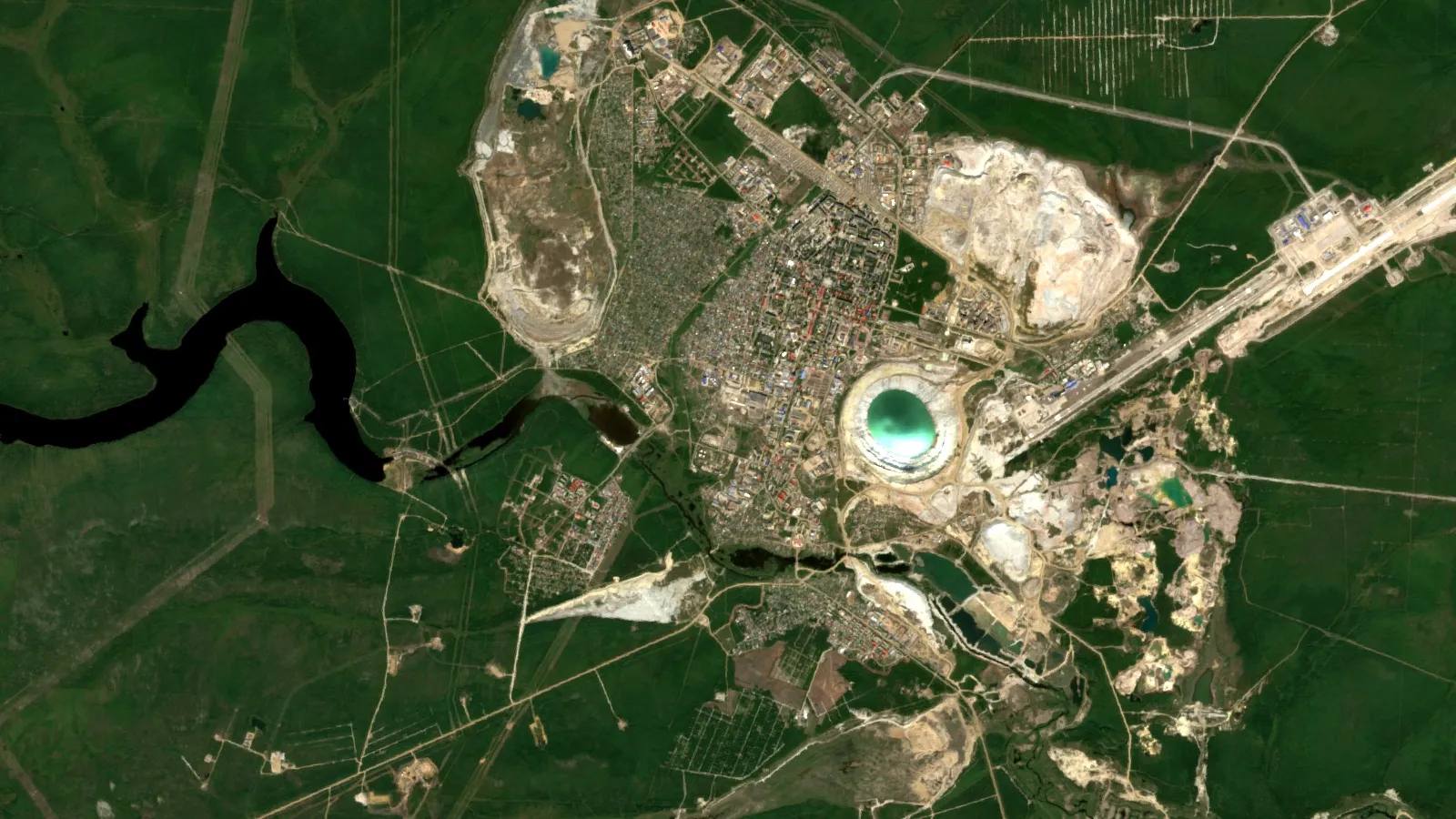
Key takeaways
- Russian output fell 15.6% to 31.5 million carats in 2025; world output fell 8.4% to 98.8 million (Kimberley Process).
- Value averaged US$86.46 per carat in Russia in 2025, against US$127.66 in Botswana (Kimberley Process).
- ALROSA mined 29.8 million carats in 2025 and guides to 25-26 million for 2026 (Reuters, August 2026).
- AGD Diamonds, at the Grib mine, is the main producer outside ALROSA, reporting 4.16 million carats for 2025.
- The US sanctioned ALROSA in 2022; the EU banned direct imports from January 2024.
In this article
- Russia diamond mining market in numbers
- Russian diamond output over time
- Where Russia ranks among diamond producing countries
- Does Russia have diamond mines, and where are they?
- ALROSA and other diamond producers in Russia
- ALROSA production cuts and financial results
- How sanctions changed the Russian diamond trade
- The Mir restart and Russia's deep mines
- Diamond value calculator for a kimberlite project
- Environmental and operating issues at Russian diamond mines
- What to check in Russian diamond market data
- Frequently asked questions
The Russia diamond mining market is the largest in the world by carats and by value. Russia mined 31.5 million carats worth US$2.72 billion in 2025, according to Kimberley Process statistics. That is about 32% of world volume and 30% of world value, yet it is also one of Russia’s weakest years since 2015.
Three forces now shape this market: one dominant miner, Western import bans, and a deliberate cut in output. ALROSA has guided to 25-26 million carats for 2026, down from 29.8 million in 2025. This guide gives the official numbers, names the mines and the producers beyond ALROSA, and shows what a consultant or investor should check. Mined diamonds, sometimes called “born mine” diamonds, are the natural stones covered here; laboratory-grown stones are not.
Russia diamond mining market in numbers
The most reliable public record is the Kimberley Process public statistics. The Kimberley Process (KP) is the international certification scheme for rough diamonds, and each participant reports its output and trade each year. Rough means uncut and unpolished. A carat is a unit of weight equal to 0.2 grams.
| Measure | 2024 | 2025 |
|---|---|---|
| Russian production, carats | 37.3 million | 31.5 million |
| Russian production value | US$3.34 billion | US$2.72 billion |
| Average production value per carat | US$89.37 | US$86.46 |
| Russian rough exports, carats | 30.2 million | 29.8 million |
| Russian rough export value | US$2.61 billion | US$2.54 billion |
| World production, carats | 107.9 million | 98.8 million |
| World production value | US$9.53 billion | US$9.23 billion |
Russian volume fell 15.6% in 2025 and its value fell 18.3%, while the world total fell 8.4% by volume and 3.2% by value. Russia therefore lost share in a shrinking market, but it stayed first on both measures in the KP global summary for 2025.
Note that a KP value is a production value reported by each government. It is not a mine’s revenue, and it is not a polished price. Use it to compare countries and years, and do not read it as a company’s sales.
Russian diamond output over time
Over the eleven KP years from 2015 to 2025, output peaked at 45.3 million carats in 2019. It dropped to 31.2 million in 2020, recovered to 41.9 million in 2022, and then held at 37.3 million in both 2023 and 2024. The 2025 figure is the second lowest in that period, just above 2020.
Chart
Russian rough diamond production
Million carats a year, 2018-2025
Value does not follow the same line. Russia’s output was worth US$4.12 billion in 2019, US$2.25 billion in 2020 and US$3.61 billion in 2023, so from 2019 to 2025 the average carat moved between US$67.56 (2021) and US$96.64 (2023). When a report quotes a single price for Russian diamonds, ask which year and which product mix it covers.
Where Russia ranks among diamond producing countries
Russia leads on volume and value, but its stones sit in the middle of the value table. In 2025 Russian production averaged US$86.46 per carat, against US$127.66 in Botswana and US$343.88 in Namibia. The DRC reported just US$5.01 per carat, which reflects a high share of low-value goods.
Chart
Average value per carat, selected producing countries
US$ per carat of production, 2025
Chart
Rough diamond production value by country
US$ billion, 2025, seven largest countries by value
Botswana recorded 15.5 million carats worth US$1.98 billion in 2025, and Angola 15.2 million carats worth US$1.81 billion. Canada produced 14.1 million carats worth US$0.89 billion. These three are the main alternatives a buyer would look at, and each has a very different value per carat, which matters more than carat volume for any market comparison.
For a wider view, see our guide to who owns the most diamond mines.
Does Russia have diamond mines, and where are they?
Yes. Russian diamond mining sits in two regions: the Republic of Sakha (Yakutia) in eastern Siberia and the Arkhangelsk region in the northwest. ALROSA says it operates more than 20 primary and placer deposits in those two regions. A primary deposit is the original kimberlite pipe, a carrot-shaped body of volcanic rock that carried diamonds up from deep in the Earth. A placer, or alluvial, deposit is river gravel where erosion has concentrated stones.
The first Russian kimberlites were found in Yakutia in the 1950s, and the Arkhangelsk pipes were first identified in the 1960s through airborne surveys, as the Gemological Institute of America’s Lomonosov study describes. That study also notes that Lomonosov was the first Russian diamond mine outside the Siberian craton, the ancient core of the continent that hosts the Yakutian pipes.
| Mine or group | Region | Type and method | Status or note |
|---|---|---|---|
| Internatsionalny | Mirny, Yakutia | Kimberlite, underground since open pit ended in 2011 | Very high grade: proved reserves at 6.48 carats per tonne |
| Mir | Mirny, Yakutia | Kimberlite, open pit to 2001, then underground from 2009 | Flooded in 2017; deep rebuild is the Mir-Gluboky project |
| Nyurba pipes | Nakyn, Yakutia | Kimberlite, open pit | Nyurbinskaya mined since 2001; Botuobinskaya since 2015 |
| Udachny | Yakutia | Kimberlite, open pit to 2015, now underground | Deep-level project continuing (Interfax, December 2025) |
| Aikhal | Yakutia | Kimberlite, underground since 2005 | Proved reserves at 4.95 carats per tonne |
| Jubilee | Near Aikhal, Yakutia | Kimberlite, open pit since 1989 | One of ALROSA’s largest primary deposits |
| Verkhne-Munskoye | North of the Arctic Circle, Yakutia | Four kimberlites, open pit | Industrial operations since 2018; end of production expected in 2042 |
| Almazy Anabara placers | Northwest Yakutia | Alluvial | ALROSA subsidiary, several placers |
| Lomonosov | Arkhangelsk | Six kimberlites, open pit since 2005 | ALROSA subsidiary Severalmaz; includes pink and purple stones |
| Grib | Arkhangelsk | Kimberlite, open pit | AGD Diamonds, the main producer outside ALROSA |
The mine descriptions above come from ALROSA’s resources and assets page, apart from Grib. For the history of the best-known pit, read our Mir diamond mine profile. Our guide to kimberlite and alluvial diamond exploration explains how each deposit type is found.
What grade means in these deposits
Grade is how many carats each tonne of ore holds. ALROSA reports 628 million carats of ore reserves and 1,064 million carats of mineral resources under the JORC reporting code, at a stated grade of 1.01 carats per tonne. Individual deposits vary widely: Internatsionalny’s proved reserves are above 6 carats per tonne, while one of the placers holds probable reserves at only 0.41.
Grade alone does not decide a mine’s worth. A high-grade pipe deep underground can cost much more per tonne than a shallow, lower-grade pit, and the value per carat can differ just as sharply. The calculator below lets you test that for your own inputs.
ALROSA and other diamond producers in Russia
ALROSA dominates the market. It says it accounts for 30% of global and about 90% of Russian production, employs 33,000 people and pays taxes and dividends equal to about one-third of Yakutia’s budget revenues. Its shares trade on the Moscow Exchange under the ticker ALRS, and the Russian Federation, Yakutia and its municipalities hold 66%. Older articles that put its share at “over 25%” understate the current company figure.
Chart
Carats mined by the seven largest producing countries
Million carats, 2024 and 2025
Other diamond producers in Russia besides ALROSA
The main one is AGD Diamonds, which mines the Grib deposit in the Arkhangelsk region. It was formerly part of Lukoil, which agreed to sell Grib for US$1.45 billion. The company reported 2025 output of 4.16 million carats, about 1.5% more than 2024, from 5.4 million tonnes of ore. It also recovers large stones: a 228.62-carat diamond was announced in February 2026.
A caution for analysts: ALROSA’s 29.8 million carats plus AGD’s 4.16 million comes to about 34 million, more than the 31.5 million carats in the KP table. Company totals and government filings can use different bases, so never subtract one from the other to estimate a third producer’s output. The Arkhangelsk regional ministry separately estimated 8.2 million carats for the region in 2024, with Lomonosov and Grib both in that total.
ALROSA production cuts and financial results
The biggest change in this market is that the largest miner is choosing to mine less. ALROSA cut production by 10% to 29.8 million carats in 2025 and expects 25-26 million in 2026. It also temporarily suspended low-margin assets, those producing under 1 million carats a year. Chief executive Pavel Marinychev told Russian television that the cut is meant to manage global stocks, and that output should return to 29-30 million carats once the market adjusts.
First-half 2026 results show the pressure. Reuters reported a net loss of 9.5 billion roubles, against a profit of 40.6 billion a year earlier, and revenue down 33% to 91.7 billion roubles. Inventories stood at 150.8 billion roubles at mid-year. Those stocks are worth tracking, because any later release could weigh on rough prices even if mine output stays low.
ALROSA is also adding to its base: TASS reported that its proven reserves rose by 57 million carats in 2025. It is diversifying too, with gold at the Degdekan project in Magadan targeting a design capacity of 3.3 tonnes a year by 2030.
▶ How mining feeds an economy through exports, jobs and revenue · 5:03
How sanctions changed the Russian diamond trade
The US sanctioned ALROSA in 2022. The EU’s ban on direct imports took effect on 1 January 2024, and two days later the EU added ALROSA and its chief executive to its sanctions list. The G7 then moved on to stones cut elsewhere. In the US, importers have had to self-certify non-Russian origin for loose polished diamonds of 1 carat or more since 1 March 2024, a rule extended to 0.5 carats and to finished jewelry from 1 September 2024.
The KP scheme is a separate matter. Its core document defines conflict diamonds as rough stones used by rebel movements or their allies to finance wars against legitimate governments. Russia remains a participant, so a KP certificate does not say whether a parcel may lawfully enter a G7 market. Anyone handling Russian-origin goods needs legal advice on the sanctions rules in their own country.
Exports did not collapse in the KP data: rough exports were 29.8 million carats in 2025. Trade has shifted, though. ALROSA has said it is building sales in China, the Persian Gulf and Asia, including Indonesia and Vietnam. It stopped publishing sales data after 2022, which makes the KP tables more useful.
State support and export duties
The state repository Gokhran began buying ALROSA diamonds again in March 2024. By May 2026, Deputy Finance Minister Alexei Moiseev said the ministry saw no need for further purchases. He also said Russia planned lenient export duties on stones that are cost-effective to cut at home, in order to support domestic cutting.
The Mir restart and Russia’s deep mines
Russia’s long-term supply depends on going deeper. Marinychev has linked the Udachny deep-level project to depletion and harder mining conditions. Mir is the clearest test. Water broke into the mine in August 2017 and eight workers died; the workings and equipment were destroyed.
Reports about Mir need careful reading. In May 2025 press reports said that production had resumed at the site, with a target of 2 million carats a year, alongside the 468-carat stone ALROSA announced that month. ALROSA’s own assets page, which is undated, still describes the field as on conservation and says it is considering resuming mining, so confirm the current status before relying on it. The deep rebuild is a separate and larger step. A March 2026 report on ALROSA’s 2025 results says a final investment decision on Mir-Gluboky was due in 2026, with about 2 million tonnes of ore a year, or around 5.6 million carats, and full capacity in 2034.
Diamond value calculator for a kimberlite project
Consultants often need a quick order-of-magnitude check on a parcel of ground or a mine plan. Enter your own ore tonnage, grade, recovery and value per carat. For scale, KP’s 2025 average for Russia was US$86.46 per carat, but real parcels can differ greatly from any national average.
Calculator
What could your ore tonnage be worth in rough value?
Enter your own ore, grade, recovery, value and cost per tonne.
- Gross rough value (US$): $90,000,000
- Operating cost (US$): $40,000,000
- Value less operating cost (US$): $50,000,000
Example values only, not a benchmark or a forecast. Gross value before royalties, taxes and capital. Value per carat is an input: example, use today’s price for your own parcel.
Environmental and operating issues at Russian diamond mines
Most reliable information here comes from the company itself, so treat it as a company claim. ALROSA says it has verified carbon neutrality for 2025, stating that its facilities absorbed 126,000 tonnes of CO2 equivalent more than they emitted, because kimberlite can take up carbon dioxide. Readers doing due diligence should ask for the verifier’s report and its boundaries.
Operating conditions are the other issue. Several ALROSA deposits are in the far north; Verkhne-Munskoye lies 135 km north of the Arctic Circle. Mir shows the specific risk of mining beneath a depleted pit filled with water. Any technical review of a northern project should cover water control, ground stability and the access season.
Monitoring tools can support this work. Farmonaut’s general pages cover carbon footprinting, product traceability, fleet management and a satellite and weather API. More about the company is on the Farmonaut home page.

▶ The seven main environmental impacts of mining, explained in clay · 2:31
What to check in Russian diamond market data
- Separate volume from value. Russia’s share is 32% by carats and 30% by value, and the gap changes each year.
- Check the date and basis. Company output, KP production and KP exports are three different numbers.
- Watch inventories. ALROSA’s stock level may matter as much as its mine plan for rough prices.
- Follow the 2026 guidance. Compare actual output with the 25-26 million carat range when the next results appear.
- Track Mir-Gluboky and Udachny. Investment decisions on deep projects set supply for the next decade, not the next year.
- Read the sanctions rules for your own jurisdiction. Thresholds and proof requirements differ, and they can change.
- Avoid old forecasts. Many online tables still show rising Russian output and values above US$5 billion, which the KP record does not support.
USGS offers another check on the resource base. Its Mineral Commodity Summaries 2026 lists Russia with 16 million of the 38 million carats of natural industrial diamond mined in 2025, and 750 million of the 1,700 million carats of world reserves. Those figures cover industrial diamond only, so they do not compare directly with the KP totals. To see who is searching for new deposits worldwide, read our list of diamond exploration companies.

▶ What an AI mining app does and who makes one · 3:52
Frequently asked questions
What are born mine diamonds?
The term means natural diamonds formed in the Earth and recovered from kimberlite pipes or alluvial gravels, as opposed to stones grown in a laboratory. “Mined” or “natural” is the more common wording.
Does Russia have diamond mines?
Yes. They are in Yakutia and the Arkhangelsk region. ALROSA alone operates more than 20 primary and placer deposits, and AGD Diamonds runs the Grib mine.
How big is the Russia diamond mining market?
Kimberley Process data show 31.5 million carats worth US$2.72 billion in 2025, about 32% of world volume and 30% of world value.
Is Russia the largest diamond producer?
Yes on both measures in 2025 KP data. Botswana was second by value with US$1.98 billion, and also second by volume with 15.5 million carats.
Who are the other diamond producers in Russia besides ALROSA?
AGD Diamonds is the main one. It reported 4.16 million carats from Grib in 2025. ALROSA’s own figure of about 90% of Russian output leaves limited room for others.
Which is the biggest diamond mine in Russia?
The answer depends on the measure, and mine-level output is not published uniformly. ALROSA’s tables list reserves and grade deposit by deposit: Udachny holds about 128 million carats of ore reserves, Jubilee about 105 million, Aikhal about 66 million and Internatsionalny about 50 million, at a much higher grade.
How is a diamond mined in Russia?
Most production starts as an open pit on a kimberlite pipe, then moves underground as the pit deepens. Mir, Udachny and Aikhal all followed this path. Placers are worked by surface methods or dredges. The ore goes through processing plants, and ALROSA’s Yakutian stones then go to its sorting center in Mirny.
Are Russian diamonds banned?
The EU and G7 countries agreed to ban direct imports of Russian diamonds from January 2024, and restrictions on stones cut elsewhere followed. Other countries set their own rules, so the answer depends on where the goods are going. Get legal advice before trading.
Why is ALROSA cutting production?
The company says weak demand and high global stocks are the reason. It plans 25-26 million carats in 2026 and intends to return to 29-30 million once the market adjusts.
Is ALROSA a listed company?
Yes, on the Moscow Exchange under the ticker ALRS. It is under US and EU sanctions, so access for many foreign investors is restricted. This page gives facts only and is not investment advice.
This page is for information only. It is not investment or legal advice. Confirm sanctions rules with a qualified adviser. Prospecting and mining need the proper licences and trained, safe field practice.
Farmonaut mining
Map your own mining site from space
Consultants can screen a licence area with satellite data before planning field work.

Mining Pro sample view, synthetic data
Keep reading
Sources
- Kimberley Process, Russian Federation participant page, 2025 data: kimberleyprocess.com
- Kimberley Process, public statistics area: kimberleyprocessstatistics.org
- Kimberley Process, Annual Global Summary 2025: kimberleyprocessstatistics.org
- alrosa.ru: about: alrosa.ru
- gia.edu: summer 2017 lomonosov deposit: gia.edu
- alrosa.ru: resources and assets: alrosa.ru
- lukoil.com: lukoil concludes agreement to sell grib diamond: lukoil.com
- rough-polished.expert: 144588.html: rough-polished.expert
- interfax.com: 116273: interfax.com
- interfax.com: 114263: interfax.com
- kitco.com: alrosa posts h1 loss due weak diamond market strong rouble: kitco.com
- kitco.com: alrosa flags smaller expected decline annual diamond output: kitco.com
- interfax.com: 115424: interfax.com
- tass.com: 2123299: tass.com
- themoscowtimes.com: eu sanctions russias largest diamond producer alrosa: themoscowtimes.com
- nationaljeweler.com: 13682 eu once again pushes back deadline on diamond traceability: nationaljeweler.com
- kimberleyprocess.com: faq: kimberleyprocess.com
- mining.com: russia confirms deal to buy part of alrosas output: mining.com
- kitco.com: russia impose duties some diamond exports year: kitco.com
- interfax.com: 94213: interfax.com
- themoscowtimes.com: alrosa discovers russias largest ever diamond as mir mine reopens a890: themoscowtimes.com
- www1.ru: stroika veka alrosa gotovit vozvrashhenie rudnika mir v iakutii k doby: www1.ru
- alrosa.ru: alrosa confirms its operations and diamonds to be carbon neutral for 2: alrosa.ru
- pubs.usgs.gov: mcs2026 diamond.pdf: pubs.usgs.gov
Discussion
Questions, corrections or field experience? Share them below. First-time comments are reviewed before they appear, and your email is never published.
No comments yet. Be the first to add a question or your experience.

 SenGold Invest SAS
 Sania Corporation
 Sean Mining Limited
 NTS Group (Pty) Ltd
 Mine4Africa
 Lithspo Minerals Limited
 Tintina Mining Group
 Dalgety Minerals Pty Ltd
 Vortex Minerals Pty Ltd
 Faith At Work (Pty) Ltd
 Geotech Mining Solutions plc
 Vulcan International Limited
 Kidepo Associates
 GKY Mining
 Alkimy SARL
 Double A Trading
 GemSprout Metals Limited
 Qader Group
 Ileys General Trading
 SG Gold Mining LLC
 VRV Global Pte Ltd
 Omsri International FZE
 G.I.T.T.
 Jaunita Erss Ltd

 Client · Tanzania · Gold










