

Strip Mining 2025: Powerful Solutions for Ecological Impact
“By 2025, over 70% of strip mining operations are projected to implement advanced reclamation techniques for land restoration.”
Table of Contents
- Introduction: Strip Mining 2025 – An Insightful Overview
- The Process of Strip Mining: Methods & Machinery
- Ecological Impacts and Environmental Challenges
- Sustainable Reclamation & Restoration in 2025
- Farmonaut: Satellite Technology for Mining & Ecological Impact
- Regulatory Frameworks and Global Mining Policies in 2025
- Economic and Social Aspects of Strip Mining
- Future Technologies and Evolving Mining Practices
- Comparison Table: Traditional vs Sustainable Strip Mining
- Frequently Asked Questions about Strip Mining
- Conclusion: The Path Forward
Introduction: Strip Mining 2025 – An Insightful Overview
Strip Mining remains a dominant mining technique globally for the extraction of essential minerals like coal, lignite, and other valuable resources. As we move further into 2025 and beyond, ecological issues, environmental regulation, reclamation, and sustainability now define its operational backbone. Understanding this mining process, its environmental impacts, evolving technologies, and the future direction of reclamation is crucial for all stakeholders—industry, governments, local communities, and technology solution providers.
Strip mining practices have played a crucial role in meeting global energy demands and raw material requirements, especially where deposits lie close to the surface. However, the challenges of soil erosion, vegetation removal, water pollution, and habitat loss have compelled regulatory bodies and companies to shift toward sustainable and innovative frameworks. In this post, we explore:
- The mining process with latest machinery and technologies
- Ecological and environmental challenges in 2025
- Best practices in reclamation and restoration
- Role of satellite monitoring and Farmonaut in supporting sustainable mining
- Legal and regulatory frameworks
- Socio-economic and community impacts
- Comparison between traditional and future-facing sustainable mining practices
By providing an in-depth insight into strip mining in the context of 2025, we contribute to ongoing discussions surrounding sustainable mineral extraction, environmental impacts, and the next generation of practices for an ecologically balanced future.

The Process of Strip Mining: Methods & Machinery
Strip mining involves removing large strips of soil and rock to expose underlying mineral seams. The process often begins with the removal of topsoil and vegetation—a stage known as overburden removal. Heavy machinery, including draglines, bulldozers, power shovels, and specialized excavators, is systematically used by miners to clear this overburden, creating long, wide trenches that sequentially expose the desired mineral deposit.
- Step 1—Site Preparation: Clearing vegetation and topsoil, marking areas for excavation
- Step 2—Overburden Removal: Using draglines and bulldozers to systematically remove the upper layers
- Step 3—Extraction: Accessing the exposed mineral seam; excavating mineral-rich material (coal, lignite, etc.)
- Step 4—Backfilling: After resource extraction, trenches are often backfilled with the removed overburden to create a level landscape (if reclamation is intended)
- Step 5—Reclamation (where required): Restoring land by adding topsoil, replanting vegetation, and contouring for drainage and erosion control
This technique is especially viable where deposits lie in horizontal seams near the earth’s surface. Globally, coal continues to be the dominant industry for strip mining due to its efficiency compared to underground mining.

Ecological Impacts and Environmental Challenges of Strip Mining in 2025
Despite the economic benefits of strip mining, the environmental and ecological impacts are significant and often long-lasting. The removal of vegetation and topsoil disrupts entire ecosystems, leading to habitat loss, biodiversity decline, and increased soil erosion. These challenges have become central to industry debates and regulatory oversight as we enter 2025.
- Soil Erosion: Loss of stabilizing vegetation and topsoil increases erosion rates, potentially leading to sedimentation in local water bodies.
- Water Pollution: Runoff from exposed soils and spoil piles may carry suspended sediments and contaminants, impacting nearby rivers and aquatic life. Risks include acid mine drainage when sulfide minerals oxidize upon exposure to air and water.
- Air Quality Issues: Dust and particulate matter generated by heavy machinery and excavation pose health hazards as well as ecological stress on flora and fauna.
- Land Degradation: Post-mining landscapes often remain scarred, affecting the land’s ability to support agriculture, forestry, or natural ecosystems unless reclamation is effectively implemented.
- Biodiversity Decline: Habitat loss from vegetation and soil removal leads to a decline in local plant and animal populations.
Mining companies, regulatory bodies, and technology pioneers are now under pressure to address these impacts via improved environmental management and adoption of sustainable mining practices.

“Sustainable strip mining practices could reduce soil erosion rates by up to 40% compared to traditional methods by 2025.”
Sustainable Reclamation & Restoration in 2025
Reclamation is now a core requirement for strip mining operations worldwide. Regulations in 2025 mandate comprehensive reclamation plans from mining companies, driving significant advances in restoration practices, technologies, and monitoring.
Reclamation Best Practices
- Landform Reconstruction: Contouring the landscape to mimic natural landforms and minimize runoff and erosion.
- Soil Replacement: Applying nutrient-rich topsoil (often stockpiled during the initial overburden removal) to encourage vegetation regrowth and accelerate ecological succession.
- Replanting Native Vegetation: Selection and planting of indigenous species to restore habitat and stabilize the soil.
- Water Management: Engineering proper drainage systems and wetlands to control water pollution, and in some cases, to restore aquatic habitats.
- Mine-to-Forest Transitions: Some leading mining companies convert reclaimed land into forests, contributing to carbon sequestration and ecosystem services.
- Remote Monitoring: Use of drone and satellite technologies—including AI-driven assessment via platforms such as Farmonaut—for tracking reclamation success, vegetation recovery, and long-term ecosystem health.

Advanced reclamation techniques not only mitigate strip mining’s environmental impact, but also facilitate the return of land for agricultural, forestry, or community uses. As of 2025, advances in resource management, blockchain traceability, and carbon footprint monitoring are supporting improved sustainability and compliance.
Learn more about Farmonaut’s carbon footprinting tools for mining and agriculture: Carbon Footprinting Platform
Farmonaut: Satellite Technology for Mining, Resource Management, and Environmental Monitoring
The integration of remote sensing and AI-driven monitoring is revolutionizing how strip mining operations address ecological impacts and reclamation. Farmonaut, as a pioneering satellite technology company, is contributing powerful solutions for mining companies, communities, and governments in 2025.
How Farmonaut Supports Strip Mining and Ecological Management
- Satellite-Based Monitoring: We offer near real-time imagery for mining sites, enabling systematic tracking of vegetation, soil, water resources, and exposed land before, during, and after strip mining.
- Jeevn AI Advisory System: Our platform delivers actionable insights for operational efficiency and sustainable practices in mining and ecological restoration.
- Blockchain Traceability: We empower companies to track mineral resources securely, from extraction to reclamation, supporting transparency and regulatory compliance. More about traceability: Product Traceability
- Environmental Impact Tracking: With tools such as carbon footprint monitoring, users can quantify emissions and resource use for legal and ESG compliance.
- Resource and Fleet Management: Our solutions optimize logistics, mining equipment usage, and reduce inefficiencies with data-driven decision support. Explore Fleet Management for Mining & Infrastructure
- Accessible Platform: Farmonaut’s tools are available for web and mobile app users as well as through robust APIs, supporting integrated mining site monitoring worldwide:
-



- For API & Developer Integration: Farmonaut Satellite API | API Developer Docs
-
Through these digital platforms, we are making affordable and advanced satellite insights accessible for mining operators, businesses, and regulators worldwide—increasing transparency, sustainability, and operational efficiency across the mining sectors.
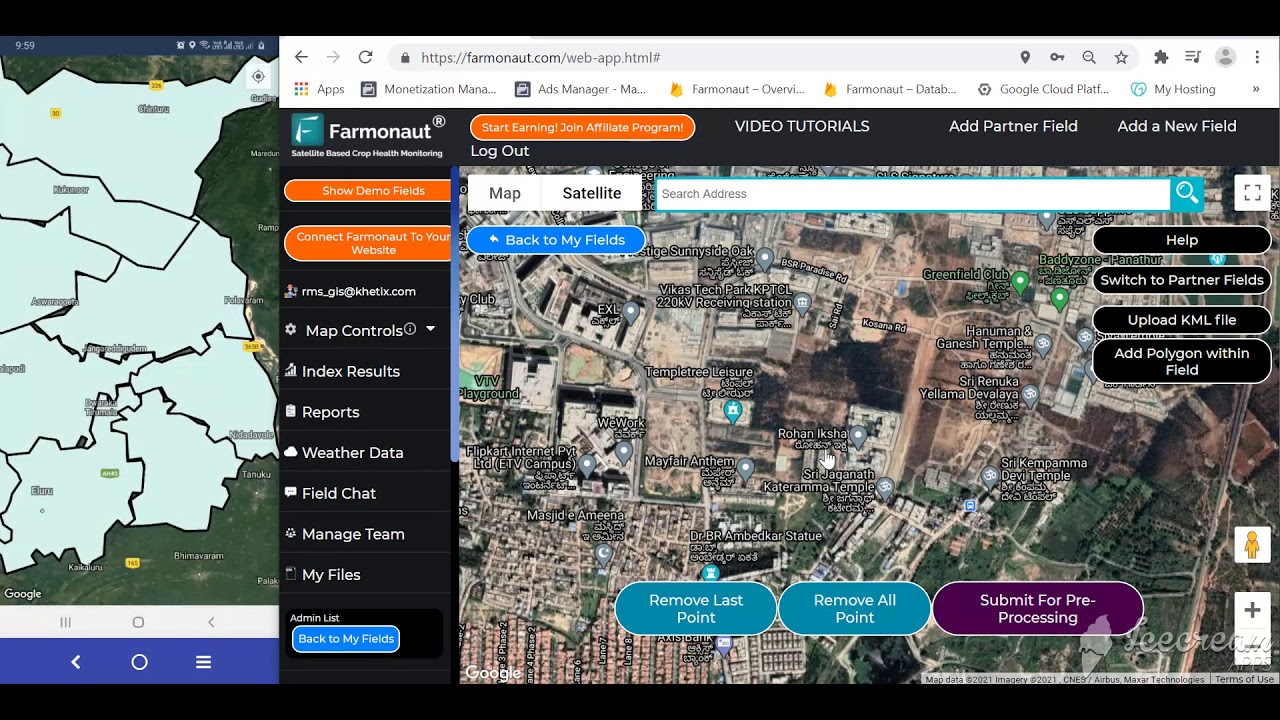



For mining enterprises and large landholders, we recommend our Large Scale Field Mapping & Monitoring solution (Learn about Large Scale Farm Management)—this platform delivers robust capabilities for mapping, tracking reclamation across multiple sites, and eco-restoration progress via satellites.
Regulatory Frameworks and Global Mining Policies in 2025
Regulatory frameworks for strip mining in 2025 are stricter than ever, focusing on environmental impact, reclamation, and community engagement. Governments across resource-rich nations are mandating:
- Comprehensive EIAs (Environmental Impact Assessments): Required before mining licenses are approved. Operators must provide detailed plans for handling soil, vegetation, water, runoff, and biodiversity impacts.
- Rehabilitation Bonds: Companies must deposit funds to ensure land reclamation even if a mine closes abruptly.
- Post-Mining Land Use Commitments: Binding agreements for restoring land for agriculture, forestry (advisory for forestry/crop plantation), or wildlife corridors.
- Community Consultation: Indigenous rights and community stakeholder engagement are integral, ensuring projects meet both environmental and social standards.
- Water and Pollution Standards: Strict benchmarks for runoff, suspended sediment, and effluent.
- Monitoring and Reporting: Use of satellite, drone, and remote technologies is increasingly required by law for transparency and compliance.
These evolving frameworks not only protect natural ecosystems, but also ensure the mining sector’s operations are sustainable, transparent, and accountable to governments, communities, and future generations.
Economic and Social Aspects of Strip Mining in 2025
Strip mining continues to provide crucial economic benefits for local and regional communities—supporting jobs, infrastructure, and development. Yet, these advantages are balanced by social and environmental challenges:
- Employment and Infrastructure: Mining stimulates local economies through job creation and infrastructure investment (roads, power, community facilities).
- Community Health: Dust and water pollution can lead to public health issues if not properly managed and monitored.
- Land Use Transition: Changing land landscapes from agriculture or forest to mining—and back via reclamation—demands careful engagement with local stakeholders.
- Social License to Operate: Companies increasingly require community support and ongoing engagement to sustain operations.
Farmonaut’s blockchain-based traceability solutions support transparency, fostering trust among community members, regulators, and mining companies. Learn about Traceability for Mining Supply Chains
Furthermore, mining and agricultural operators can leverage our Crop Loan & Insurance Platform—enabling satellite-verified loan and insurance processing, thereby improving access to finance and reducing fraud.
Future Technologies and Evolving Mining Practices: Strip Mining 2025 and Beyond
The future of strip mining is closely linked to technological advancements and sustainable frameworks. In 2025, several innovative trends are emerging:
- Precision Mining: AI and satellite-guided machinery enable highly efficient, targeted extraction with minimal land disturbance.
- Automation: Autonomous trucks, excavators, and mineral processing systems help minimize accidents and environmental error.
- Remote Sensing & Analytics: From real-time NDVI to soil and vegetation monitoring, platforms like Farmonaut deliver actionable insights for mine planning, reclamation, and environmental stewardship.
- Blockchain Traceability: Resource movement is secured and transparent, reducing illegal extraction and supporting ESG reporting.
- Carbon Management: Mining companies are investing heavily in carbon emission controls, sequestration, and landscape restoration.
- Restoration Ecology: New research focuses on restoring post-mining landscapes for forest regeneration, wildlife, or agricultural productivity.
- ESG and Circular Economy Integration: Environmental, Social, and Governance (ESG) metrics drive investment, and the emergence of a circular mining economy emphasizes resource reuse and reclamation.
Adoption of these technologies is transforming the strip mining industry to become more sustainable, efficient, and aligned with global ecological goals.
Comparison Table: Traditional vs. Sustainable Strip Mining Practices (2025)
| Mining Process Aspect | Traditional Strip Mining (Estimates) | Sustainable Strip Mining (2025) | Potential Future Improvements |
|---|---|---|---|
| Land Disturbance | High—up to 80% land alteration per site | Reduced to 30% land alteration with precision methods | AI-guided site minimization, restoration of 90%+ post-mining land |
| Water Usage | ~2000 m³/day/site | Below 800 m³/day/site through recycled use & rain capture | Closed-loop water systems with smart monitoring |
| Biodiversity Loss | Severe habitat loss; slow natural recovery | Proactive native species planting; 20-50% faster recovery | Gene-driven restoration, smart seed dispersal drones |
| Soil Erosion | Annual rates up to 80 t/ha | Reduced up to 40%; annual rates below 45 t/ha | Erosion sensors, adaptive plant covers, AI irrigation |
| Reclamation Techniques | Overburden backfilling only, minimal vegetation restoration | Topsoil replacement, native species, wetland creation | Full ecological restoration, precision soil amendments |
| Carbon Emissions | High; up to 0.5–1.2 tCO₂ emitted/ton of mineral | Reduced up to 35% using green machinery & sequestration | Net zero mining through operational renewables, offsets |
| Operational Monitoring | Field checks, manual reporting | Real-time satellite & drone monitoring; digital records | Autonomous AI monitoring & self-reporting sensor networks |
Farmonaut Subscription Plans
Choose an affordable satellite monitoring plan for your mining, infrastructure, or agricultural needs.
Frequently Asked Questions about Strip Mining in 2025
What is strip mining and where is it primarily used?
Strip mining is a surface mining technique involving the removal of large strips of overlying soil, rock, and vegetation to access underlying mineral deposits. It is primarily used for minerals found close to the earth’s surface, such as coal, lignite, and some metal ores.
What are the major environmental impacts of strip mining?
Major environmental impacts include soil erosion, vegetation and habitat loss, biodiversity decline, water pollution from runoff, and air quality issues due to dust. Reclamation practices aim to mitigate these effects.
How have regulations changed in 2025?
In 2025, stricter regulations require comprehensive environmental impact assessments, reclamation bonds, detailed land restoration plans, and ongoing monitoring—including use of satellite technology. Community consultation and biodiversity protection are also prioritized.
How does technology like Farmonaut benefit strip mining reclamation?
Satellite and AI-driven technology from providers like Farmonaut allows for real-time monitoring of soil health, vegetation regrowth, water quality, and overall landscape changes—making it easier for operators and regulators to ensure successful and efficient reclamation.
Can reclaimed strip mining land support agriculture or forestry?
Yes, with advanced reclamation practices—such as soil replacement, native vegetation planting, and proper water management—mined land can be restored for agricultural, forestry, or wildlife use.
Is strip mining expected to decline with the rise of renewables?
While strip mining for coal is declining in some regions due to renewable energy adoption, it remains essential for extracting other minerals critical to infrastructure, technology, and defense sectors.
Conclusion: The Path Forward for Strip Mining in 2025
Strip mining in 2025 is at a pivotal crossroads. The industry’s ongoing evolution—guided by advances in technology, stricter regulatory frameworks, and a global demand for sustainability—reflects a commitment to balancing economic necessities with environmental and community wellbeing.
- Adoption of AI, satellites, and blockchain is empowering mining operators to meet compliance, optimize resource extraction, and reclaim land more effectively than ever before.
- Modern reclamation strategies—ranging from mine-to-forest projects to soil and ecosystem restoration—are demonstrating that responsible mining is not only possible, but increasingly cost-effective and societally demanded.
- The shift toward transparency, community engagement, and ecological restoration positions strip mining to contribute positively—where critical minerals and resources remain essential—for sectors like infrastructure, technology, and defense.
- With digital platforms and real-time environmental monitoring from companies like Farmonaut, we can collectively drive operational excellence and a greener legacy for future generations.
Ultimately, as we move through 2025 and look toward the future, the challenge—and opportunity—for strip mining lies in responsible management, continuous technological innovation, and a holistic commitment to reclamation and restoration for ecological resilience and community benefit.
Discussion
Questions, corrections or field experience? Share them below. First-time comments are reviewed before they appear, and your email is never published.
No comments yet. Be the first to add a question or your experience.

 Kidepo Associates
 GKY Mining
 Alkimy SARL
 Double A Trading
 GemSprout Metals Limited
 Qader Group
 Ileys General Trading
 SG Gold Mining LLC
 VRV Global Pte Ltd
 Omsri International FZE
 G.I.T.T.
 Jaunita Erss Ltd
 Almosi SARL
 SRK Consulting
 Berks Gold Limited
 Mwerezi Minerals Company Limited
 Mining SARL
 SenGold Invest SAS
 Sean Mining Limited
