

Uranium · Ore mineral guide
Uraninite: Ore Grades, Uses, Price and Buying Rules
Uraninite is a black, very dense oxide of uranium (UO2) and the main ore mineral behind world uranium supply; its massive form is pitchblende.
Key takeaways
- Fresh uraninite has a specific gravity of 10.63-10.95 and hardness 5-6 (Handbook of Mineralogy).
- World mines produced 60,213 tonnes of uranium in 2024; Kazakhstan 39%, Canada 24%, Namibia 12% (World Nuclear Association, Oct 2026).
- Grades range from about 20% U in Athabasca ore to 0.05-0.35% U in sandstone deposits (World Nuclear Association).
- Spot U3O8 was US$91.55/lb and long-term US$98.00/lb at the end of October 2026 (Cameco, UxC/TradeTech average).
- In the US, unrefined, unprocessed ore is exempt from NRC licensing if it is not processed (10 CFR 40.13(b)).
In this article
- What uraninite is, in plain terms
- Uraninite properties and how to identify it
- Where uraninite ore is found: deposit types and grades
- Uranium production by country
- The largest mines producing uraninite ore
- How uraninite ore is mined and processed
- Uraninite price: how uranium ore is valued
- Uraninite for sale: rules for buying a specimen
- What uraninite is used for
- Radiation, radon and safety around uraninite
- What consultants should check on a uraninite prospect
- Frequently asked questions
Uraninite is the main ore mineral of uranium: a black, very heavy, radioactive oxide that is mostly uranium dioxide (UO2). Its massive, fine-grained form is called pitchblende. The Handbook of Mineralogy gives fresh uraninite a specific gravity of 10.63 to 10.95, which makes it heavier than lead ore, and most of the uranium that feeds nuclear power plants is mined from deposits where uraninite or pitchblende is the primary mineral.
This guide is written for consultants, licence holders and investors who need the practical side: how to recognise the mineral, which deposit types carry it and at what grades, who mines it, how uranium ore is priced (it is not sold as raw rock on an exchange), what the rules are if you want to buy a specimen, and what to check before you spend money on a uranium prospect. A calculator lets you turn tonnes and grade into pounds of U3O8 and a value at the price you enter.
What uraninite is, in plain terms
Chemically, uraninite is uranium dioxide. In nature the uranium partly oxidises, so most samples also hold some U3O8 and UO3, plus lead that forms as the uranium decays, and often thorium and rare earth elements. An analysis from Placer de Guadalupe in Mexico, listed in the Handbook of Mineralogy, shows about 70% UO2 and 23% UO3; another analysis in the same entry carries 14% ThO2 and 14% PbO. That variability matters: two black, heavy samples can contain very different amounts of uranium.
The industry reports uranium in two ways. Miners quote grades and output as U3O8 (the oxide in “yellowcake” concentrate) or as contained uranium (U). One per cent U3O8 equals about 0.848% U, and one tonne of ore at 1% U3O8 holds about 22 pounds of U3O8. Prices are quoted in US dollars per pound of U3O8.
A short history
The type locality is Jáchymov (once Joachimsthal) in the Czech Republic. Martin Klaproth identified the element uranium in 1789 from pitchblende from Johanngeorgenstadt in Germany, and Marie Curie later processed tonnes of pitchblende to isolate radium and polonium, according to the Wikipedia summary of the mineral’s history. The name pitchblende comes from its pitch-black colour and the old German miners’ word “blende” for a heavy mineral whose metal they could not yet use.
Uraninite properties and how to identify it
In the field, uraninite is recognised by a combination of weight, colour, lustre and radioactivity. No single property is enough, because magnetite, cassiterite, wolframite and some black tourmaline can look similar in hand specimen.
| Property | Uraninite / pitchblende |
|---|---|
| Formula | UO2, partly oxidised toward U3O8 |
| Crystal system | Cubic (isometric); crystals are uncommon, cubes or octahedra |
| Usual habit | Massive, botryoidal (grape-like), banded or granular |
| Colour | Steel-black to velvet-black, brownish black; grey or green when altered |
| Streak | Brownish black, grey or olive-green |
| Lustre | Submetallic, greasy or dull (pitch-like) |
| Hardness (Mohs) | 5 to 6 |
| Specific gravity | 10.63 to 10.95 when fresh; falls to as low as 6.5 when oxidised |
| Radioactivity | Strong; alpha, beta and gamma from uranium and its decay products |
| Forms a series with | Thorianite (ThO2) |
Source for the table: Handbook of Mineralogy (Mineral Data Publishing). The density figure is the most useful single test: a fist-sized piece feels about twice as heavy as an iron oxide of the same size. A handheld gamma scintillometer confirms the radioactivity, and a laboratory assay is the only reliable way to get a uranium grade.
Uraninite vs pitchblende
Mineralogists treat pitchblende as a variety of uraninite rather than a separate mineral. “Uraninite” is usually used for crystalline material formed at higher temperature, for example in pegmatites and granites, while “pitchblende” refers to the massive, colloform (rounded and banded) material found in veins and many unconformity deposits. The World Nuclear Association’s geology guide names uraninite and pitchblende as the major primary ore minerals, with coffinite, brannerite, davidite and carnotite important in certain deposits.
Related uranium minerals you will meet
- Coffinite: a uranium silicate found with uraninite in sandstone-hosted deposits.
- Brannerite and davidite: uranium titanates that are harder to leach, which lowers recovery.
- Carnotite: a bright yellow uranium-vanadium mineral formed near the surface, typical of the Colorado Plateau.
- Autunite and torbernite: yellow and green secondary minerals that form when uraninite weathers; they are often the first sign of uranium at surface.
Where uraninite ore is found: deposit types and grades
Grade is the share of uranium in the rock, and it varies by more than a thousand times between deposit types. The World Nuclear Association gives these reference points: very high-grade Canadian ore around 20% U, high-grade ore around 2% U, low-grade ore around 0.1% U and very low-grade Namibian ore around 0.01% U, against 3 to 5 parts per million in ordinary granite.
| Deposit type | Main uranium minerals | Typical grade | Examples |
|---|---|---|---|
| Unconformity-related | Uraninite, pitchblende | Up to about 20% U in the richest Canadian ore | Athabasca Basin (Canada); Alligator Rivers (Australia) |
| Sandstone (roll-front and tabular) | Uraninite, coffinite | About 0.05 to 0.35% U | Kazakhstan, Uzbekistan, Wyoming and Texas (USA), Niger |
| Iron oxide breccia complex | Pitchblende (with copper and gold) | Low, recovered as a by-product | Olympic Dam (Australia) |
| Intrusive (alaskite, granite) | Uraninite | Low, mined in very large open pits | Rössing and Husab (Namibia) |
| Vein (granite-related) | Pitchblende | Variable | Jáchymov (Czech Republic); Great Bear Lake (Canada) |
| Breccia pipe | Pitchblende | Variable | Arizona Strip, near the Grand Canyon (USA) |
| Quartz-pebble conglomerate | Detrital uraninite | Low, often with gold | Witwatersrand (South Africa); Elliot Lake (Canada) |
Source: World Nuclear Association, Geology of Uranium Deposits. That guide says unconformity-related deposits make up about one-third of the western world’s uranium resources, while sandstone deposits hold about 28% of world reasonably assured resources and 40% of inferred resources. For a world map of these deposit types see our map of uranium deposits in the world, and for how they compare with other metal deposits, our guide to types of ore deposits.
Detrital uraninite in the old quartz-pebble conglomerates is a geological curiosity worth knowing: uraninite oxidises easily, so it could only be carried by rivers as grains while the early atmosphere had little oxygen. The World Nuclear Association dates these conglomerates to between about 3,070 and 2,300 million years ago.
Uranium production by country
Almost all mined uranium comes from deposits where uraninite, pitchblende or coffinite is the ore mineral. The World Nuclear Association’s production table (updated 23 October 2026) shows world mine output of 60,213 tonnes of uranium in 2024, or about 71,000 tonnes of U3O8, which covered about 90% of world reactor demand. Kazakhstan produced 39% of the total, Canada 24% and Namibia 12%.
Chart
World uranium mine production
Tonnes of uranium per year
Chart
Uranium mine production by country, 2024
Tonnes of uranium (tU)
Canada’s output more than tripled between 2020 and 2024 as Cameco’s McArthur River mine and Key Lake mill restarted. Niger fell from 2,991 tonnes in 2020 to 962 tonnes in 2024, and US output stayed small at 260 tonnes in 2024 after near-zero years in 2020 and 2021. For the African picture, see our post on the African countries with the highest uranium reserves; for Canadian resource holders, see our overview of nickel and uranium resources by country.
Resources tell a different story from output. The OECD-NEA and IAEA “Red Book”, as summarised by the World Nuclear Association production page, lists Australia with 27% of identified resources recoverable at up to US$130 per kg U as of 1 January 2025, ahead of Kazakhstan (16%), Russia (10%) and Canada (8%). Australia mines far less than its share of resources because several states restrict uranium mining.
The largest mines producing uraninite ore
Ten mines produced 62% of world uranium in 2024, according to the World Nuclear Association. Canada’s two Athabasca operations lead because their grades are so high, while Kazakhstan’s mines use in situ leaching on low-grade sandstone ore spread over large areas.
Chart
Largest uranium mines by output, 2024
Tonnes of uranium
| Mine | Country | Main owner | Method | Output 2024 (t U) |
|---|---|---|---|---|
| McArthur River / Key Lake | Canada | Cameco | Underground | 7,808 |
| Cigar Lake | Canada | Cameco / Orano | Underground | 6,501 |
| Husab | Namibia | Swakop Uranium (CGN) | Open pit | 4,437 |
| Karatau (Budenovskoye 2) | Kazakhstan | Uranium One / Kazatomprom | In situ leach | 3,299 |
| Inkai, sites 1-3 | Kazakhstan | Kazatomprom / Cameco | In situ leach | 2,992 |
| Akdala and South Inkai 4 | Kazakhstan | Uranium One / Kazatomprom | In situ leach | 2,803 |
| Olympic Dam | Australia | BHP | Underground, by-product | 2,693 |
| Moinkum and Tortkuduk | Kazakhstan | Orano / Kazatomprom | In situ leach | 2,388 |
| Rössing | Namibia | CNNC | Open pit | 2,205 |
| Khorassan 1 | Kazakhstan | Kazatomprom / Uranium One | In situ leach | 2,030 |
Source: World Nuclear Association, World Uranium Mining Production (updated October 2026). Cameco’s 2025 Annual Information Form describes Cigar Lake as the world’s highest-grade uranium mine, and explains that McArthur River ore is blended down with low-grade material to a nominal 5% U3O8 mill feed at Key Lake. The same filing says the McClean Lake mill, which treats Cigar Lake ore, has at times processed ore above 28% U (33% U3O8).
By company, Kazatomprom (21%), Cameco (17%), Orano (11%), Uranium One (10%) and CGN (10%) were the five largest producers in 2024. Over half of mine output comes from state-owned companies.
How uraninite ore is mined and processed
The method depends on depth, grade and the rock around the ore. The World Nuclear Association gives the 2024 split as 55% in situ leach, 40% conventional underground and open-pit mining, and 5% by-product recovery.
- Open pit. Used for large, shallow, lower-grade bodies such as Husab and Rössing in Namibia. Ore is drilled, blasted, hauled and crushed.
- Underground. Used for deep, high-grade bodies such as McArthur River and Cigar Lake. At Cigar Lake the ground is frozen first and ore is cut by high-pressure water jets so that miners are not exposed to the richest ore.
- In situ leach (ISL, also called in situ recovery). No rock is dug. Wells pump a solution through a permeable sandstone orebody; the solution dissolves uraninite and coffinite and is pumped back to a plant.
- By-product. At Olympic Dam, uranium is recovered alongside copper, gold and silver.
The World Nuclear Association’s ISL guide explains that the method uses native groundwater fortified with a complexing agent (sulfuric acid or an alkaline carbonate) and, in most cases, an oxidant such as hydrogen peroxide or oxygen. The oxidant matters because uraninite’s uranium is in the reduced +4 state; it must be oxidised to the +6 state before it dissolves. Kazakh ISL mines generally skip the oxidant and use stronger acid instead.
Conventional mills crush and grind the ore and leach it with sulfuric acid. Uranium is then separated by ion exchange or solvent extraction, precipitated and dried into a uranium oxide concentrate, usually U3O8. That concentrate, not the raw uraninite, is what trades between producers and utilities. Ores rich in brannerite or davidite leach poorly, so mineralogy tests belong early in any project.
Uraninite price: how uranium ore is valued
There is no exchange price for uraninite rock. Uranium does not trade on an open exchange like copper or gold; buyers and sellers negotiate contracts privately, and price reporters such as UxC and TradeTech publish their judgment of where trades could be made. Cameco’s price page, which averages UxC and TradeTech month-end figures, put the spot price at US$91.55 per pound of U3O8 and the long-term contract price at US$98.00 per pound at the end of October 2026.
Chart
Uranium spot and long-term price, month-end
US$ per lb U3O8, January to October 2026
Spot is the price for delivery within about a year and reflects a small share of the market. Most uranium is sold to utilities under long-term contracts, which is why the long-term price matters more to a mine plan. TradeTech defines its daily spot indicator as its judgment of the price for significant quantities of natural uranium concentrates on that weekday. Contract-led pricing like this is also common in battery metals; see our note on the Benchmark Mineral Intelligence lithium price outlook for a comparison.
For ore in the ground, value depends on grade, tonnage, recovery and costs, not on the concentrate price alone. A resource at 0.1% U3O8 holds about 2.2 pounds per tonne; one at 15% holds about 330 pounds. Mining, milling, transport, royalties and closure costs come out of that value before anything reaches a project owner, so the in-ground figure in the calculator below is a ceiling, not a sale price.
Price history in brief
Cameco’s series shows how volatile the market has been: the spot price averaged under US$25 per pound at the start of 2017 after the post-Fukushima slump, then climbed to US$100.25 at the end of January 2024 and stood at US$94.28 at the end of January 2026. Through 2026 the month-end spot price stayed between about US$84 and US$94 while the long-term price climbed steadily from US$89 to US$98.
Calculator
How much U3O8 is in my ore?
Enter tonnes, grade, recovery and a price to estimate pounds of U3O8 and their gross value.
- Contained U3O8 (lb): 1,102,310
- Recoverable U3O8 (lb): 1,047,194
- Contained uranium (t U): 424.0
Example values only, not benchmarks. 1 tonne = 2,204.62 lb. The price is an input: example, use today’s price (Cameco publishes month-end spot and long-term averages). Gross value is before mining, processing, royalty and transport costs and is not what a buyer pays for raw ore.
Uraninite for sale: rules for buying a specimen
Collectors’ specimens of uraninite and pitchblende are sold by mineral dealers, and the rules depend on where you live. In the United States, the Nuclear Regulatory Commission’s rule 10 CFR 40.13(b) exempts people who receive, possess, use or transfer “unrefined and unprocessed ore containing source material”, provided they do not refine or process it. A natural mineral specimen falls under that exemption; crushing it, dissolving it or extracting uranium from it does not.
Once material has been processed, the general licence in 10 CFR 40.22 sets limits, for example no more than 1.5 kg of uranium and thorium in dispersible forms at any one time and no more than 7 kg received in a calendar year under that paragraph. Other countries apply their own atomic-energy and transport rules, and many postal and courier services restrict radioactive material. Check the importing country’s regulator and the carrier’s rules before you buy across a border.
Practical points for buyers of specimens:
- Ask the seller for the locality, the weight and a gamma reading taken at a stated distance.
- Keep the specimen in a closed container away from living and sleeping areas, and air the storage area, because uranium decay produces radon gas.
- Never grind, cut or polish it; dust is the main hazard.
- Wash your hands after handling and keep it away from children.
- Plan for disposal: you cannot put it in household waste in many jurisdictions.
Buying uraninite ore in bulk, or a uranium property, is a different matter. Mining, processing, export and sale of uranium concentrate are licensed activities everywhere, and non-proliferation safeguards apply to every shipment of concentrate.
What uraninite is used for
Nearly all mined uraninite ends up as nuclear fuel. The chain runs from ore to U3O8 concentrate, then conversion to uranium hexafluoride, enrichment of the uranium-235 isotope (natural uranium holds about 0.7% U-235), fuel fabrication and use in power reactors. Smaller uses include research reactors and medical isotope production.
Other uses are historical or minor. Pitchblende residues were the first source of radium, and uranium compounds once coloured glass and ceramic glazes yellow and green. Depleted uranium, left over from enrichment, is used where very high density is needed. Lead isotopes in uraninite are also used to date rocks, because uranium decays to lead at a known rate.
Radiation, radon and safety around uraninite
The US Environmental Protection Agency’s uranium fact page notes that uranium emits mainly alpha particles with some gamma, that its decay chain includes radium, and that radium decays to radon gas. In underground uranium mines, radon is a greater radiation hazard to miners than the uranium itself, which is why modern mines rely on ventilation, monitoring and, for the richest ore, remote mining.
All uraninite contains a little radium as a decay product, so radioactivity in a specimen comes from the whole decay chain, not only from uranium. For sites and projects, the main issues are radon, dust, water management in tailings and wellfields, and closure planning. Regulators in uranium-producing countries require radiation protection plans, groundwater restoration for ISL wellfields and financial assurance for reclamation.

▶ The environmental impacts of mining, explained in clay. · 2:31
What consultants should check on a uraninite prospect
Most uranium projects never reach production, so checks before drilling save money. A short list for a licence holder or adviser:
- Deposit model. Is the target unconformity, sandstone, intrusive, vein or breccia pipe? The model sets the expected grade, depth and mining method.
- Mineralogy. Uraninite and coffinite leach well; brannerite and refractory titanates do not. Get mineralogy and leach tests on early samples.
- Grade and units. Confirm whether reports quote % U, % U3O8 or “eU3O8” (equivalent grade from a gamma probe), and check probe data against chemical assays.
- Permitting. Check whether uranium mining is allowed in the state or province and what the approval steps are; some jurisdictions ban it outright.
- Hydrogeology. ISL needs a permeable, confined aquifer; open pits and underground mines need a water plan.
- Access and land. Map roads, power, water, protected areas and communities across the licence.
Satellite imagery is useful at the screening stage. It can map alteration, structures, old workings and access over a whole licence before a field crew is sent, and helps decide where ground radiometric surveys and sampling should go. Farmonaut offers satellite-based mineral detection that screens a licence polygon for target zones; results are exploration targets, not a resource estimate. You can send project details through our mining query form.
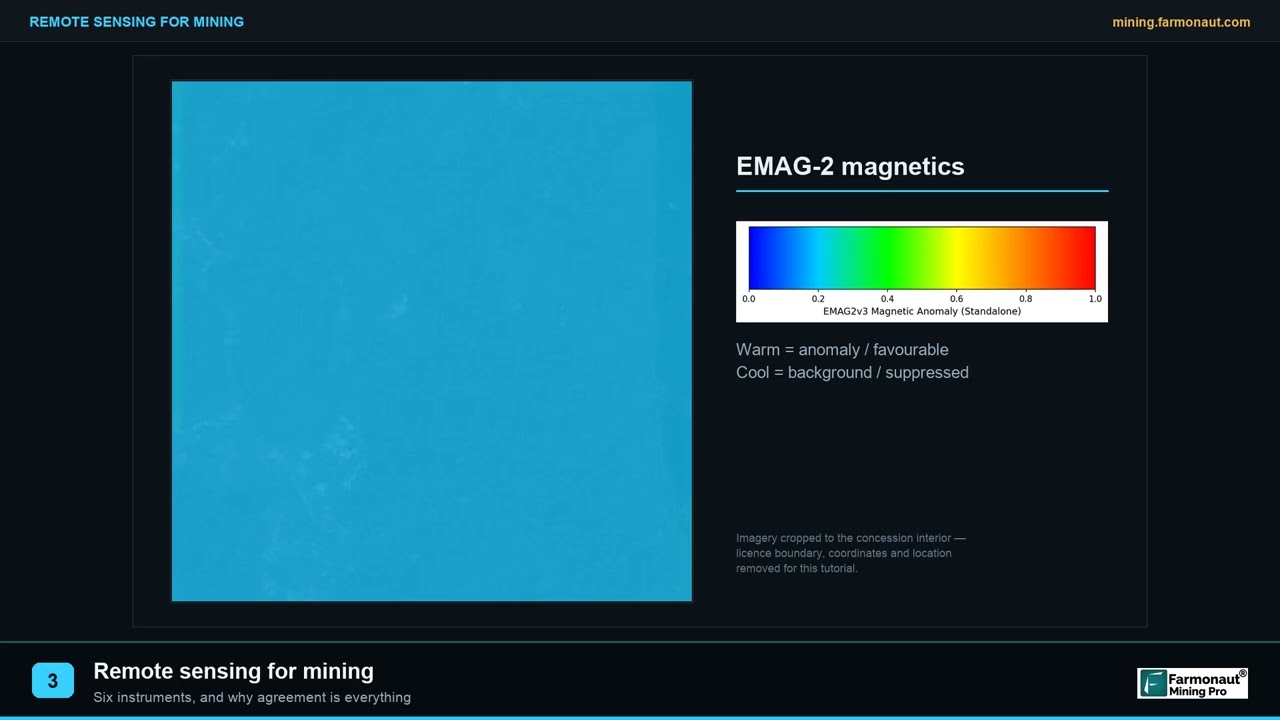
▶ Remote sensing for mining explained in plain words. · 2:01
Frequently asked questions
What is uraninite?
Uraninite is a black, very dense, radioactive mineral made mostly of uranium dioxide (UO2). It is the main ore mineral of uranium; its massive form is called pitchblende.
Is uraninite the same as pitchblende?
Pitchblende is a variety of uraninite: the massive, banded or botryoidal form, usually found in veins and unconformity deposits. Crystalline material, often from pegmatites, is normally just called uraninite.
What is uraninite used for?
Almost all mined uraninite is processed into uranium oxide concentrate (U3O8), which is converted, enriched and made into fuel for nuclear power reactors. It was also the original source of radium.
How much is uraninite worth?
Raw uraninite has no exchange price. Its value depends on the uranium grade and the price of U3O8, which Cameco’s UxC and TradeTech average put at US$91.55 per pound spot and US$98.00 per pound long-term at the end of October 2026. Specimen prices from mineral dealers depend on size, crystal form and locality.
Is it legal to buy uraninite?
In the United States, unrefined and unprocessed ore containing uranium is exempt from licensing under 10 CFR 40.13(b) as long as you do not refine or process it. Other countries set their own rules, and carriers often restrict radioactive shipments.
Is uraninite dangerous to touch?
Brief handling of a small specimen gives a low dose, but it should not be kept on the body or in living spaces. The main risks are inhaling dust and radon from the decay chain, so never grind it, store it in a closed, ventilated place and wash your hands after handling.
Where is uraninite found?
The main producing regions are the Athabasca Basin in Canada, the sandstone basins of Kazakhstan and Uzbekistan, the Erongo region of Namibia, Olympic Dam in South Australia, and sandstone and breccia pipe deposits in the western United States.
How can you identify uraninite?
Look for a black, pitch-like or submetallic mineral that is unusually heavy (specific gravity about 10.6 to 10.9 when fresh), with a brownish-black streak and hardness of 5 to 6, that registers on a gamma scintillometer. Yellow or green coatings of secondary uranium minerals are another clue. Confirm with a laboratory assay.
What grade of uranium ore is considered high?
The World Nuclear Association treats about 2% U as high grade and about 0.1% U as low grade. Canada’s Athabasca Basin has ore around 20% U, while many sandstone deposits mined by in situ leach run 0.05 to 0.35% U.
How much U3O8 is in a tonne of ore?
Multiply the grade in % U3O8 by about 22.05 to get pounds per tonne. Ore at 0.5% U3O8 holds about 11 pounds per tonne before recovery losses.
More from Farmonaut: contact us.
This page is for information only. It is not investment or legal advice. Confirm the rules with your regulator before buying, shipping or prospecting for radioactive minerals, and prospect only with the landowner’s permission and the licence your jurisdiction requires.
Farmonaut mining
Map your uranium licence from space
Farmonaut screens a licence polygon with satellite imagery for alteration, structures and access, so consultants can choose where to run ground surveys and sampling first.

Mining Pro sample view, synthetic data
Keep reading
Sources
- Handbook of Mineralogy, Uraninite (Mineral Data Publishing): handbookofmineralogy.org
- Wikipedia, Uraninite: en.wikipedia.org
- World Nuclear Association, Geology of Uranium Deposits: world-nuclear.org
- World Nuclear Association, World Uranium Mining Production (October 2026): world-nuclear.org
- World Nuclear Association, Supply of Uranium: world-nuclear.org
- World Nuclear Association, In Situ Leach Mining of Uranium: world-nuclear.org
- Cameco, 2025 Annual Information Form: cameco.com
- Cameco, Uranium price (month-end, to October 2026): cameco.com
- TradeTech, Uranium price definitions: uranium.info
- US Code of Federal Regulations, 10 CFR 40.13 Unimportant quantities of source material: law.cornell.edu
- eCFR, 10 CFR 40.22 Small quantities of source material: ecfr.gov
- US EPA, Radionuclide Basics: Uranium: epa.gov
Discussion
Questions, corrections or field experience? Share them below. First-time comments are reviewed before they appear, and your email is never published.
No comments yet. Be the first to add a question or your experience.

 Jaunita Erss Ltd
 Almosi SARL
 SRK Consulting
 Berks Gold Limited
 Mwerezi Minerals Company Limited
 Mining SARL
 SenGold Invest SAS
 Sean Mining Limited
 NTS Group (Pty) Ltd
 Mine4Africa
 Lithspo Minerals Limited
 Tintina Mining Group
 Dalgety Minerals Pty Ltd
 Vortex Minerals Pty Ltd
 Faith At Work (Pty) Ltd

 Licence holder · Nigeria · Gold + lithium










