

Tungsten ore · Mineral guide
Wolfram Mineral: What Wolframite Is, Its Uses and Price
Wolfram mineral usually means wolframite, (Fe,Mn)WO4, a main ore of tungsten. Carbide products take 65% of tungsten use (ITIA), and China mined about 79% of world tungsten in 2025 (USGS, 2026).
Key takeaways
- Wolframite is a mineral; wolfram is another name for the metal tungsten.
- Wolframite has a Mohs hardness of only 4 to 4.5. The famous hardness belongs to manufactured tungsten carbide (Handbook of Mineralogy; ITIA).
- World mine output was an estimated 85,000 tonnes of tungsten in 2025, with 67,000 tonnes from China (USGS, 2026).
- Rotterdam APT rose from US$331 to US$675 per mtu during 2025 (USGS, 2026).
- One mtu is 10 kg of WO3 and holds 7.93 kg of tungsten (USGS, 2026).
In this article
- What is wolfram mineral? Wolframite, wolfram and tungsten explained
- Wolfram rock: how to identify wolframite in the field
- Where wolframite forms and which deposits matter
- Wolfram mines: which countries produce tungsten
- Wolframite mining: open pit, underground and alluvial
- Ore processing: from wolfram ore to tungsten metal
- Wolframite uses: what is wolfram used for?
- Wolfram price: how concentrate and APT are quoted
- Supply risk, recycling and substitutes
- What to check before you buy a wolframite claim or parcel
- Frequently asked questions
A wolfram mineral is an ore mineral of tungsten, and the usual one meant is wolframite, an iron-manganese tungstate with the formula (Fe,Mn)WO4. “Wolfram” is also simply the other name for tungsten, which is why the element’s symbol is W. Most wolframite ends up as tungsten carbide: the International Tungsten Industry Association puts carbide products at 65% of global tungsten use.
This guide is for consultants, licence holders and investors who need more than a definition. It covers how to tell wolframite from look-alikes, where it forms, who mines tungsten, how a rock becomes a priced concentrate, and what a parcel of ore or concentrate could be worth on your own numbers.
What is wolfram mineral? Wolframite, wolfram and tungsten explained
Three words get mixed up, and buyers, assayers and geologists use them differently.
- Tungsten or wolfram is the metal, element 74. English uses “tungsten”; German and several other European languages use “Wolfram”. The symbol W comes from the German name.
- Wolframite is the mineral, a mix between two end members: iron-rich ferberite and manganese-rich hübnerite.
- Scheelite is the other main tungsten ore mineral, a calcium tungstate. It is a different mineral, though the two can occur together.
So “wolfram ore” in a sales document may mean wolframite, or it may just mean tungsten ore of any kind. If you are reviewing a deal, ask which mineral the assays and the processing tests refer to, because the recovery route differs.
Wolframite against its end members and scheelite
| Mineral | Formula | Hardness (Mohs) | Measured density (g/cm3) | Crystal system |
|---|---|---|---|---|
| Ferberite | FeWO4 | 4 to 4.5 | 7.58 | Monoclinic |
| Hübnerite | MnWO4 | 4 to 4.5 | 7.12 to 7.18 | Monoclinic |
| Scheelite | CaWO4 | 4.5 to 5 | 6.10 | Tetragonal |
The figures come from the Handbook of Mineralogy entries for ferberite, hübnerite and scheelite. Note one point that many pages get wrong: the mineral is not especially hard. A Mohs hardness of 4 to 4.5 is far below quartz, which is 7. The hardness people talk about belongs to tungsten carbide, a manufactured material, and not to the ore.
Wolfram rock: how to identify wolframite in the field
Wolframite is a dark, heavy mineral, and weight is the first clue. A piece feels far heavier than its size suggests, since quartz, its usual vein partner, is much lighter. These checks help before you send a sample to a laboratory:
- Colour: greyish to brownish black, and usually opaque, per the standard mineral description.
- Shape: bladed or tabular crystals, often striated.
- Cleavage: one perfect direction, so broken faces can look flat and bright.
- Lustre: submetallic. Ferberite is described as slightly magnetic.
- Streak: rub it on unglazed porcelain. Ferberite gives a brownish black to black streak, and wolframite is often listed as reddish brown.
- Short-wave ultraviolet light: scheelite fluoresces bright bluish white, so a UV lamp helps separate it from wolframite at night or in a dark core shed.
Field checks only suggest a name. Cassiterite and other dark heavy minerals can look similar, so confirm with a laboratory assay for WO3 (tungsten trioxide, the basis on which tungsten is reported and sold).
Where wolframite forms and which deposits matter
The Handbook of Mineralogy lists wolframite-series minerals in high-temperature hydrothermal veins, in greisens (granite altered by hot fluids) and in granitic pegmatites, and also as residual grains in alluvial and eluvial deposits. A hydrothermal vein forms when hot water deposits minerals in a crack. An alluvial deposit is one laid down by a stream, while an eluvial deposit sits close to its weathered source. For background on these styles, see our guide to types of ore deposits and their grades.
Minerals found with it vary by deposit. The Handbook names scheelite, topaz, fluorite, pyrite and hematite with ferberite, and cassiterite, arsenopyrite, molybdenite and tourmaline with hübnerite. Tin and tungsten often travel together, which is why our page on cassiterite, the main tin ore is useful reading alongside this one.
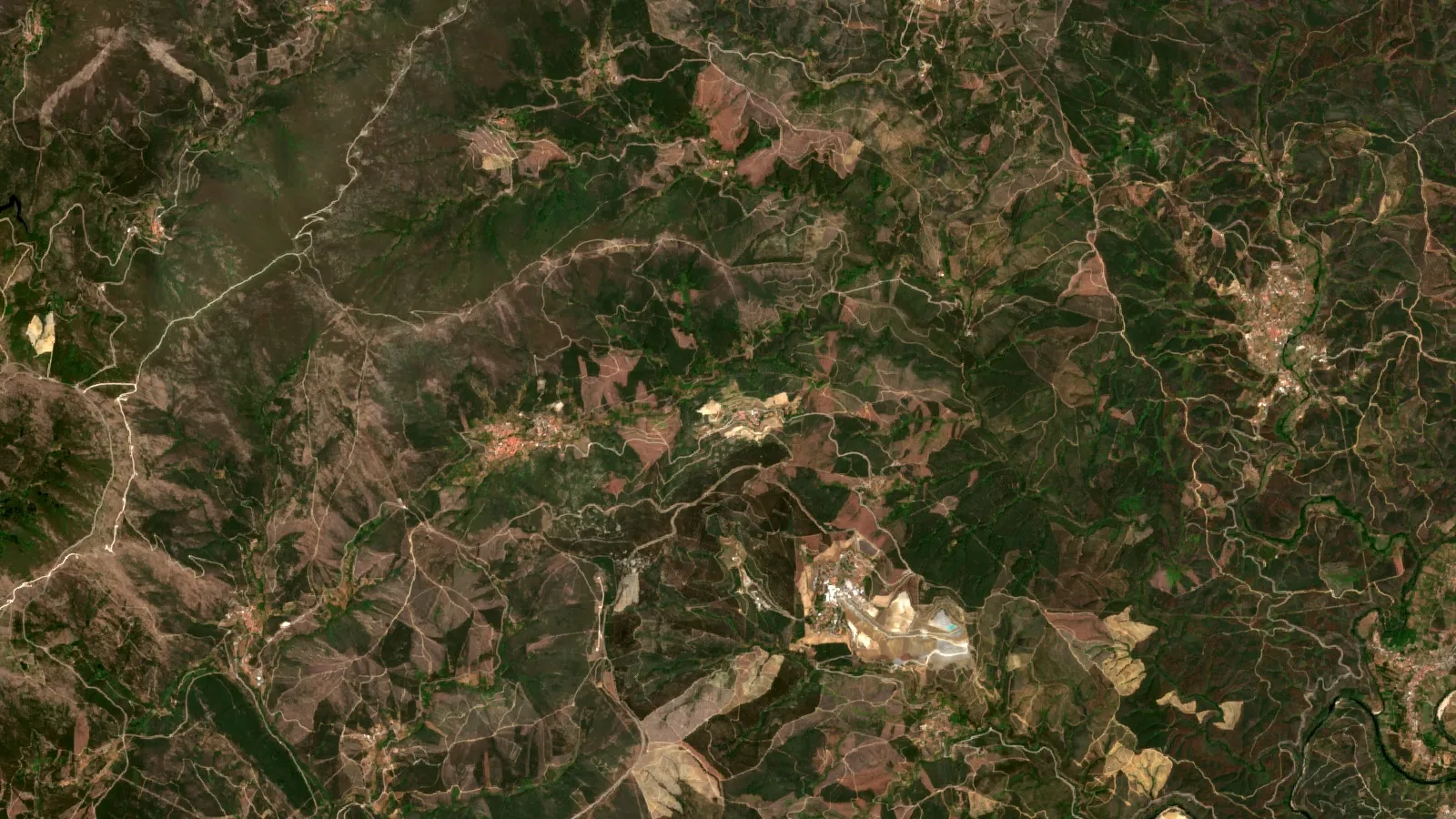
A well-known example is Panasqueira in central Portugal, the location in the satellite image at the top of this page. The Handbook lists it as a ferberite locality, and Almonty Industries reports a 100% interest in the tin-tungsten mine through its subsidiary Beralt.
Wolfram mines: which countries produce tungsten
China dominates. The USGS Mineral Commodity Summaries 2026 estimates world mine production at 85,000 tonnes of contained tungsten in 2025, with 67,000 tonnes from China, about 79% of the total. The USGS figures cover tungsten from all ore minerals, so they do not split wolframite from scheelite.
Chart
Tungsten mine production by country
Estimated tonnes of contained tungsten, 2025; selected countries, world total 85,000 t; selected countries, world total 85,000 t
Supply outside China is thin, and a single new mine can move the table. USGS credits the rise in 2025 output especially to the start of production at the Boguty deposit in Kazakhstan. It also reports that tungsten has not been mined commercially in the United States since 2015.
In South Korea, Almonty stated in September 2026 that Phase I of the Sangdong processing plant is commercially operational. That is a company statement, and output from it is not in the USGS 2025 table.
USGS puts world reserves at more than 4.7 million tonnes of tungsten. Reserves are the part judged economic to extract at the time of the estimate. China holds 2.5 million tonnes, Australia 570,000 tonnes, Russia 400,000 tonnes and Vietnam 170,000 tonnes. Canada’s projects are covered in our article on Mactung, Sisson and Cantung.
Wolframite mining: open pit, underground and alluvial
The method follows the deposit. Narrow, steep veins are usually mined underground, because digging out the barren rock around them from surface costs too much. Panasqueira is an underground operation, with Almonty describing a drilling programme begun in November 2025 to plan a new production level.
Larger, lower-grade bodies may suit open-pit mining, where the volume of ore pays for the waste removed. Residual and stream deposits can be worked with simple gravity equipment, since the heavy grains settle quickly. Grade is the key test in all three. Ore rarely holds more than 1.5% tungsten oxide, so most of what is mined is waste, and the plant has to reject it cheaply.
For a consultant reviewing a project, these are the questions that decide most early screens:
- What is the WO3 grade, and over what mining width? A high grade over a thin vein can dilute heavily once mined.
- Is the tungsten in wolframite, scheelite or both? This sets the plant design.
- Do tin, copper or other by-products add revenue, or do arsenic and sulphides add penalties?
- Has a metallurgical test confirmed recovery on this ore, and not on a neighbouring deposit?
- Who is the likely buyer, and does the concentrate meet their specification?
Satellite imagery can help before any of this, by mapping host rock, faults and altered ground across a licence so field teams know where to sample. It cannot see wolframite itself or replace assays and drilling.
▶ How remote sensing measures ground from a distance, in plain terms · 2:01
Ore processing: from wolfram ore to tungsten metal
Turning rock into metal takes several stages. Each step raises the tungsten content, and each is usually priced separately.
- Crushing and grinding. The rock is broken until the wolframite grains separate from the quartz. Over-grinding creates fines that are hard to recover.
- Gravity separation. At over 7 g/cm3, wolframite settles much faster than quartz on jigs, spirals and shaking tables.
- Magnetic cleaning. Wolframite is weakly magnetic, so gravity and magnetic steps are combined. This also helps separate it from cassiterite. Scheelite instead often goes to froth flotation.
- Concentrate. USGS price data refers to concentrate with 65% WO3, a useful reference grade for buyers.
- Chemical conversion to APT. Concentrate is dissolved and converted to ammonium paratungstate (APT), a purified chemical intermediate and the most quoted tungsten price.
- Oxide, powder and carbide. APT is heated to tungsten oxide, then reduced with hydrogen or carbon to powder. Powder is carburised to tungsten carbide or pressed and sintered into metal parts.
Pure ferberite is about 76% WO3 by the Handbook’s calculated composition, so a 65% concentrate is already mostly mineral. The final parts are made by powder metallurgy since tungsten’s melting point is so high that ordinary casting is impractical.
Wolframite uses: what is wolfram used for?
Wolframite itself is not used directly in products, apart from collectors’ specimens. It is valued as a source of tungsten. The metal has the highest melting point of all metals and a density similar to gold. It melts at 3,422 °C and has a density of 19.25 g/cm3. Those properties, and carbide’s near-diamond hardness, explain every use below.
Chart
How tungsten is first used
Share of global tungsten consumption, %
Tungsten carbide tools and wear parts
This is the largest use by far. A typical cemented carbide grade cited by ITIA is 90% tungsten carbide and 10% cobalt, combining hardness with toughness. It goes into metal-cutting inserts, rock drill bits, tunnel-boring parts, road-planing teeth and wood-cutting saws. USGS estimates that about 60% of the tungsten consumed in the United States went into cemented carbide parts, mainly for construction, metalworking, mining and oil and gas drilling.
Steels and superalloys
ITIA puts steels and superalloys at 14% of first use. Tungsten hardens high-speed tool steel and helps superalloys hold strength in jet engine and power-generation turbine blades.
Tungsten metal products
At 12% of first use, this group covers electrodes for welding, wire, heavy-alloy counterweights and radiation shielding. Light bulb filaments made tungsten famous, and USGS now lists light-emitting diodes among the substitutes for that use.
Defence uses
Dense tungsten alloys are used in armour-piercing penetrators, as an alternative to depleted uranium, and in other ammunition. Trade in these goods is restricted, so check export rules before quoting or moving material.
Chemicals and other uses
The remaining 9% or so is led by catalysts, with other chemical compounds. By final industry, ITIA’s 2021 data places transport and mining and construction at 26% each, followed by industrial use at 14%.
Wolfram price: how concentrate and APT are quoted
Tungsten is not traded on a major metals exchange in the way that copper is. It is priced by the metric ton unit (mtu), which is 10 kg of WO3 and contains 7.93 kg of tungsten. A dry tonne of 65% concentrate therefore holds 65 mtu.
Chart
Rotterdam prices across 2025
US$ per mtu, start and end of the rise reported by USGS
Chart
Tungsten concentrate price, annual average
US$ per dry mtu of WO3, in-warehouse Rotterdam; 2025 is an estimate
USGS reports that Rotterdam prices rose through 2025, from US$266 to US$551 per mtu for 65% concentrate and from US$331 to US$675 per mtu for APT. The 2025 average for concentrate was an estimated US$380, against US$252 in 2024. USGS links the rise to higher US tariffs on some Chinese tungsten products at the end of 2024 and to new Chinese export controls in February 2025. Prices can change quickly, so get a current quote from a price-reporting agency or buyer before relying on any figure.
A smelter or converter does not usually pay the full reference price. Payable percentages, treatment charges and penalties all come off, which is why the calculator below treats the payable share as your own input.
Calculator
What could your wolframite ore or concentrate be worth?
Enter your own tonnage, assay, recovery, price and payable terms.
- Contained WO3 recovered (mtu): 350.0
- Concentrate produced (tonnes): 5.38
- Tungsten recovered (kg): 2,776
Example values only, not a benchmark or a forecast. Price is an input: example, use today’s price. The 7.93 kg of tungsten per mtu is from USGS (2026). This shows gross payable value before mining, processing and transport costs.
Supply risk, recycling and substitutes
USGS includes net import reliance for the United States above 50% for every year from 2021 to 2025, and notes Defense Production Act awards in 2025 for tungsten projects in Nevada, New Brunswick and Yukon. A USGS critical-minerals report from 2025 also names tungsten among the materials China’s commerce ministry has restricted. The Mineral Commodity Summaries add that seven US companies can convert concentrate, APT, oxide or scrap into tungsten powder, carbide or chemicals.
Scrap is a real second source. ITIA describes recycling as well established in the industry, and worn carbide tools have an obvious value. USGS withholds the US secondary production figure to protect company data, so treat any precise national recycling rate with care.
Substitutes exist but are limited. USGS lists carbides based on molybdenum, niobium or titanium, along with ceramics, cermets and tool steels, and says most of these reduce rather than replace tungsten.
Environmental questions depend on the deposit. Sulphide minerals and arsenopyrite in some veins can create acid drainage or arsenic issues, so tailings design and water monitoring belong in early project reviews.

▶ The seven environmental impacts of mining, explained in clay · 2:31
What to check before you buy a wolframite claim or parcel
- Ask for the assay basis. Reports may quote W or WO3. Multiply % W by 1.26 to get % WO3, since one mtu of WO3 holds 7.93 kg of tungsten.
- Use an independent laboratory. Take your own samples and keep a chain of custody.
- Check title and permits with the regulator. A seller’s map is not proof of a valid licence.
- Check supply-chain due diligence. Some buyers ask for proof that material did not come from conflict-affected areas, so ask for origin documents.
- Do not rely on old data. Historic grades need rechecking, and a vein that showed high grades in one sample may not hold them.
Farmonaut offers satellite-based mineral detection that produces exploration targets ahead of field checks and drilling, which is not a resource estimate. To discuss a licence area, use our mining query form or contact us.
▶ What a spectral signature is and what imaging can never tell you · 1:49
Frequently asked questions
What is wolfram mineral?
It normally means wolframite, (Fe,Mn)WO4, a dense, dark ore mineral of tungsten that sits between ferberite and hübnerite.
Is wolfram the same as tungsten?
Yes. Wolfram and tungsten are two names for the same metal, element 74, with the symbol W. Wolframite is the mineral.
What is wolfram used for?
Mostly tungsten carbide for cutting tools, drill bits and wear parts. It also goes into tool steels, superalloys, welding electrodes, counterweights, radiation shielding and chemicals.
What is wolframite used for?
It is processed into concentrate and APT, then into the tungsten products above. It has no significant direct use other than as a mineral specimen.
What is wolfram ore?
Rock that holds tungsten minerals in amounts worth mining, usually wolframite or scheelite. Reports state the grade as % WO3.
What does wolfram rock look like?
Look for black to dark brown, bladed crystals in quartz veins, with a submetallic shine, one flat cleavage direction and unusually high weight for the size.
What is the difference between wolframite and scheelite?
Wolframite is an iron-manganese tungstate with density of about 7 to 7.6 g/cm3, while scheelite is a calcium tungstate at about 6.1 g/cm3. Scheelite glows bluish white under short-wave UV light.
Where are wolfram mines located?
USGS estimates that China mined about 79% of world tungsten in 2025. Vietnam, Kazakhstan, Russia, Bolivia, Rwanda and Australia follow among the producers it lists.
Does wolframite have commercial value?
Yes, once concentrated. Buyers price it per mtu of WO3 on contained tungsten, and they apply payable terms and penalties. Small parcels depend on grade, purity and documentation.
What is a wolframite concentrate?
It is the product of gravity and magnetic separation. Rotterdam reference prices reported by USGS use 65% WO3 concentrate.
More from Farmonaut: what is wolfram mineral top wolframite uses explained.
This page is for information only. It is not investment or legal advice. Confirm the rules with the regulator. Get the landowner’s permission before collecting samples, and take care around old workings.
Farmonaut mining
Map your mining site from space
Consultants can screen a licence area by satellite to choose where to sample first, ahead of field checks and drilling.

Mining Pro sample view, synthetic data
Keep reading
Sources
- USGS, Mineral Commodity Summaries 2026: Tungsten: pubs.usgs.gov
- International Tungsten Industry Association, Applications and Markets: itia.info
- International Tungsten Industry Association, home page properties summary: itia.info
- Handbook of Mineralogy: Ferberite: handbookofmineralogy.org
- Handbook of Mineralogy: Hübnerite: handbookofmineralogy.org
- Handbook of Mineralogy: Scheelite: handbookofmineralogy.org
- Almonty Industries, Projects (Panasqueira and Sangdong): almonty.com
- Wikipedia, Wolframite: en.wikipedia.org
- Wikipedia, Tungsten: en.wikipedia.org
- Wikipedia, Cemented carbide: en.wikipedia.org
- USGS, Methodology for the 2025 U.S. List of Critical Minerals (Open-File Report 2025-1047): pubs.usgs.gov
Discussion
Questions, corrections or field experience? Share them below. First-time comments are reviewed before they appear, and your email is never published.
No comments yet. Be the first to add a question or your experience.

 Klusetic Mining Investments
 Mine4Africa
 Lithspo Minerals Limited
 Tintina Mining Group
 Dalgety Minerals Pty Ltd
 Vortex Minerals Pty Ltd
 Faith At Work (Pty) Ltd
 Geotech Mining Solutions plc
 Vulcan International Limited
 Kidepo Associates
 GKY Mining
 Alkimy SARL
 Double A Trading
 GemSprout Metals Limited
 Qader Group
 Ileys General Trading
 SG Gold Mining LLC
 VRV Global Pte Ltd
 Omsri International FZE
 G.I.T.T.
 Jaunita Erss Ltd
 Almosi SARL
 SRK Consulting
 Berks Gold Limited
 Mwerezi Minerals Company Limited











