

Tractors · Buyer guide
Best Tractors for Farming: Pick by Farm Size and Job
Match the tractor to your main job: compact for acreages, utility for livestock and hay, row-crop for planting, 4WD or tracks for big grain farms. Tractors under 40 hp were about 66% of US farm tractor sales from January to July 2025 (AEM).
Key takeaways
- US dealers sold 120,354 farm tractors from January to July 2025; 79,366 were under 40 hp (AEM).
- Sales of 100+ hp two-wheel-drive tractors fell 26.7% and 4WD tractors 38.8% against the same months of 2024 (AEM).
- Auto-steer and guidance covered 58.4% of US corn acres in 2018 and 72.9% of sorghum acres in 2019 (USDA ERS).
- Machinery costs on central Illinois corn farms rose from $136 to $171 per acre between 2021 and 2024 (farmdoc daily).
- Case IH’s AFS Connect platform is now sold as FieldOps; overlap is cut by guidance and section control on the machine.
In this article
- Best tractors for farming at a glance
- How we chose
- What US farmers are buying
- The best tractors for farming, class by class
- How to match tractor size to your farm
- Precision tech that matters when you buy a tractor
- Buying a used row-crop tractor that works with your precision setup
- What a tractor costs to own
- Safety and rules for tractor buyers
- Electric and self-driving tractors: where they stand
- Where satellite crop monitoring fits
- FAQ
The best tractors for farming are the ones sized to your main job: a compact under 40 hp for acreages and chores, a 40 to 100 hp utility tractor for livestock and hay, a 100+ hp row-crop tractor for planting and tillage, and a 4WD or tracked tractor for big grain farms. Most US buyers sit at the small end: tractors under 40 hp made up about 66% of the 120,354 farm tractors sold in the US from January to July 2025, according to the AEM United States Ag Tractor and Combine Report.
This guide groups tractors by size class and job, not by brand hype. It shows what US farmers are buying, how widely GPS guidance is used, what machinery costs per acre, and a calculator that tells you whether owning a tractor beats hiring one for your hours. It also answers a common buyer question: how connected systems such as Case IH FieldOps (the platform that replaced AFS Connect) help cut overlap on large fields.
Best tractors for farming at a glance
The table sums up the five classes. Each class has its own section below with examples of current series from the main brands. Check the dealer’s spec sheet before you buy, because engine power, hydraulics and lift capacity vary inside every series.
| Class | Best for | Typical jobs | Example series |
|---|---|---|---|
| Compact, under 40 hp | Small acreages, hobby farms | Mowing, loader work, small gardens | Kubota L/LX, John Deere 1-3 Series |
| Utility, 40-100 hp | Livestock and hay farms | Baling, feeding, loader, light tillage | John Deere 5 Series, Case IH Farmall, Kubota M |
| Row-crop, 100+ hp | Corn, soybean, cotton farms | Planting, spraying, tillage, grain carts | John Deere 7R/8R, Case IH Magnum, Fendt 700 |
| 4WD articulated | Large grain farms | Heavy tillage, wide air seeders | John Deere 9R, Case IH Steiger, New Holland T9 |
| Tracked | Wet or soft soils, big farms | Tillage and seeding with less slip | Case IH Quadtrac, John Deere 8RX/9RX |
How we chose
We did not score tractors from 1 to 10. Scores like that hide the fact that a 25 hp compact and a 600 hp articulated tractor are built for different farms. Instead we grouped tractors by the horsepower classes the industry uses in its own sales reports, then matched each class to the work it does well.
For numbers we used public data only: monthly sales from the Association of Equipment Manufacturers (AEM), the US Department of Agriculture’s survey of precision technology use, machinery cost estimates from the University of Illinois farmdoc team, and the safety rules from OSHA. For independent performance data on a given model, we point you to the Nebraska Tractor Test Laboratory, the official US test station under the OECD tractor codes, which has tested 2,053 tractors since 1920. Brand names are examples, not endorsements, and we took no payment from any maker.
What US farmers are buying
Sales data shows where the market is. In the first seven months of 2025, US dealers sold 79,366 two-wheel-drive tractors under 40 hp, 29,465 in the 40 to 100 hp class, 10,093 at 100 hp and above, and 1,430 four-wheel-drive tractors (AEM, July 2025 report). Every class sold fewer units than in the same months of 2024, and the big tractors fell the most: 100+ hp sales dropped 26.7% and 4WD sales dropped 38.8%.
Chart
US farm tractor sales by class
Units sold, January to July, 2024 vs 2025
High machinery prices are one likely drag on big-tractor sales. The University of Illinois notes that tractor prices increased by 21% from 2020 to 2023, based on the USDA index of prices paid. Canada told a different story late in the season: AEM reported that Canadian sales of agricultural tractors rose 7.2% in September 2025 against a year earlier.
The best tractors for farming, class by class
Each class below lists who it suits, what to check, and where it falls short. Horsepower here means the class used in sales reports; check whether a brochure quotes engine or PTO power, because PTO power is lower.
1. Compact tractors under 40 hp
Best for: properties of a few acres up to small market gardens, horse paddocks and estate work.
Compacts are the biggest class by units. They run a front loader, a mower deck, a small tiller or a post-hole digger. Many use a hydrostatic drive, which is easy for new drivers. Look at the three-point hitch category, the loader lift height and whether the tractor can carry the implements you already own. Their limit is weight: a light tractor cannot pull wide tillage tools or carry heavy round bales safely.
2. Utility tractors from 40 to 100 hp
Best for: livestock, hay and mixed farms, and vegetable growers with field-scale beds.
This is the all-rounder class. A utility tractor handles a baler, a bale spear, a feed wagon, a disc and a manure spreader. Ask about the hydraulic flow at the rear remotes, the PTO speeds (540 and 1,000 rpm), and whether a cab is worth the cost in your climate. Many dealers now offer guidance-ready models in this class, which helps when you spread fertilizer or spray pasture.
3. Row-crop tractors of 100 hp and more
Best for: corn, soybean, cotton and sugar beet farms that plant, spray and till their own ground.
Row-crop tractors have adjustable wheel spacing to fit between rows, high-capacity hydraulics for planters, and a factory GPS receiver or a port for one. If you already run precision tools, the key question is compatibility: will the tractor talk to your planter and sprayer through ISOBUS, and will your guidance lines and field boundaries move across without re-mapping? Another common question, which tractor has the most advanced technology, has no single answer, because the major brands all sell guidance, section control and telematics. Pick the system your dealer can support.
4. Four-wheel-drive articulated tractors
Best for: grain farms of several thousand acres with wide tillage tools and air seeders.
Articulated tractors bend in the middle to steer, and they put several hundred horsepower to the ground through four equal wheels or dual wheels. They cover ground fast but are hard to justify on smaller farms. Their sales fell 38.8% in the first seven months of 2025 (AEM), a sign of how big ticket purchases react to farm income.
5. Tracked tractors
Best for: large farms on soft, wet or rolling ground where wheel slip and soil compaction are a concern.
Tracks spread weight over a long footprint. Some designs use two tracks, others four. They cost more to buy and the undercarriage wears, so compare the track replacement cost with your wheel-slip losses. Ask a neighbor or dealer who runs both on similar soil before you choose.
How to match tractor size to your farm
Start from the heaviest job, not the average one. Write down the widest implement you pull, the heaviest load you lift and the busiest week of the year. A tractor that handles that week will handle the rest.
- List your implements. Note the width, the weight and the power the maker asks for. Planters, balers and air seeders each have a stated power need on their spec sheet.
- Check the hitch and hydraulics. The three-point hitch category and the rear hydraulic flow must match the tools. A big tractor with too little flow cannot run a vacuum planter well.
- Count your hours. A tractor used fewer than a few hundred hours a year costs a lot per hour. Our calculator below shows when hiring is cheaper.
- Think about your soil and slope. Wet clay favors tracks or duals. Steep ground favors a lower center of gravity and wide wheel spacing.
- Plan for the next five years. If you expect to add acres or a new crop, buy for that farm, not only the one you have today.
- Talk to your dealer and a neighbor. Dealer support and real field experience on similar soil often decide which brand works best for you.
For livestock farms the loader often matters more than engine power. For grain farms the planter and the sprayer usually decide the size. For vegetable and specialty crop growers, wheel spacing, low ground pressure and a creeper gear for slow work can matter more than horsepower.
Precision tech that matters when you buy a tractor
Guidance is now the norm on row-crop farms. The USDA Economic Research Service found that auto-steer and guidance systems were used on 54.4% of planted soybean acres in 2016 and 58.4% of corn acres in 2018, rising to 64.5% of cotton and 72.9% of sorghum acres in 2019. In 2019, automated section control was used on 41% of US cotton acres, 45% of sorghum acres and 48% of barley acres (ERS, 2022).
Chart
Auto-steer and guidance use by crop
Percent of US planted acres, survey year in label
The same report found that farm size matters. At least half of larger row-crop farms use yield maps, soil maps, variable rate technology or guidance, while fewer than 25% of the smallest farms use any of the four (cotton was the exception). For a small farm, a guidance-ready tractor may be worth less than a good loader.
How Case IH FieldOps (formerly AFS Connect) helps cut overlap
Case IH now sells its connected farm platform as FieldOps; the old AFS Connect web address points to it. Overlap is cut mainly by two tools on the machine: GPS guidance, which keeps each pass next to the last one, and section control, which turns planter rows or sprayer sections off where the ground is already covered. ERS notes that guidance reduces skips and overlaps and can lower spending on fuel, seed, nutrients and pesticides. A platform such as FieldOps adds the office side: it stores field boundaries and guidance lines, shows where machines are and what they applied, and lets you share jobs across the fleet. John Deere Operations Center and the AGCO and CNH systems for other brands do similar work. The saving on your farm depends on field shape, implement width and how much overlap you had before.
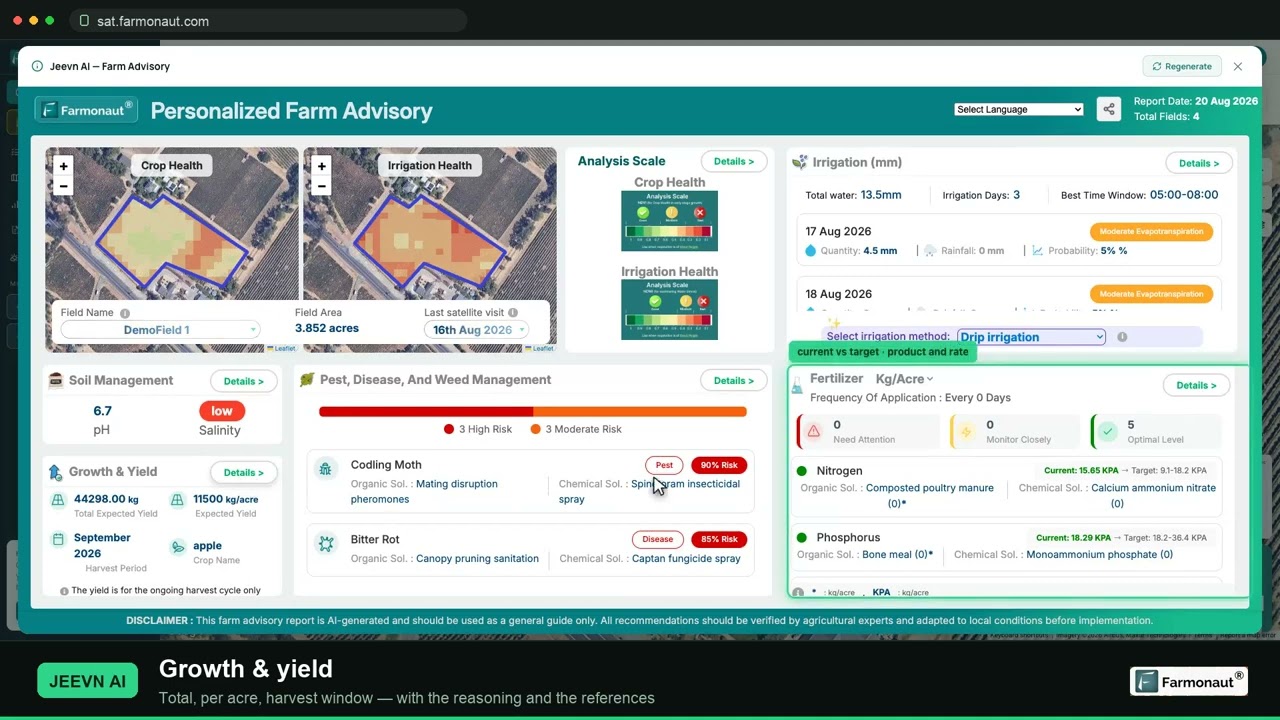
▶ A full walkthrough of satellite crop monitoring: reading NDVI maps and pulling a field report. · 19:36
Buying a used row-crop tractor that works with your precision setup
Many farms buy used to save money. With precision tools, a used tractor can be a good deal or an expensive headache. Use this checklist before you sign.
- Hours and service records. Ask for dealer service history and oil analysis if there is any. Compare hours with the tractor’s age.
- Guidance hardware and gains. Check whether the receiver, display and steering kit are included, and whether correction signals or software gains are tied to the old owner’s account and must be bought again.
- ISOBUS and implement control. Make sure the tractor can run your planter, sprayer or seeder controls through the cab display you plan to use.
- Data transfer. Ask whether your field boundaries and AB lines will import, and in which file format.
- Hydraulic capacity. Planters with vacuum fans and hydraulic drives need high flow. Check the rated flow against the implement maker’s figure.
- Independent test data. Look up the model’s Nebraska test report for drawbar and PTO power and fuel use.
- Dealer support. The US Bureau of Labor Statistics, cited in a farmdoc daily study, puts the number of farm equipment mechanics and service technicians employed in the US in 2023 at about 36,830, and industry sources report a shortage. Buy where a technician can reach you during planting and harvest.
What a tractor costs to own
Buying price is only the start. University of Illinois estimates show that machinery-related costs increased from $136 per acre in 2021 to $171 per acre in 2024 on central Illinois corn farms in the Illinois FBFM records, a 25% rise. Depreciation was the biggest piece at $87 per acre in 2024, followed by repairs at $39, fuel and oil at $23, and machine hire at $22. The authors add that a farm with two tractors under ten years old has a cost edge over a similar farm with three.
Chart
Machinery costs per acre on central Illinois corn farms
US dollars per acre, 2024, by cost item
The farmdoc team also publishes machinery cost estimates for tractors and field operations, updated in September 2025, that you can use as a check on your own numbers. These are estimates for Illinois conditions, not dealer quotes or auction results.
The calculator below compares the cost per hour of owning a tractor with hiring one. Use your own purchase price, the share of value you expect at resale, your interest rate, the hours you run it each year, and a local custom hire rate. It is a simple estimate; for a big purchase, talk to your lender or a farm business advisor.
Try the numbers for your own farm below.
Calculator
Is owning a tractor cheaper than hiring one?
Enter your own price, hours and local hire rate.
- Ownership cost per hour: $48
- Total cost per hour owned: $88
- Yearly difference at your hours: $1,000
Example values only, set near break-even; not a benchmark, quote or forecast. Ownership cost per hour = (price minus resale value) spread over the years kept, plus interest on the average value, divided by hours per year. Operating cost covers fuel, repairs and labor per hour. Insurance, housing and taxes are not included, so add them to operating cost if you want them counted. Get professional advice for a purchase decision.
Safety and rules for tractor buyers
Rollover protection is the first safety item to check, new or used. In the US, OSHA rule 1928.51 sets requirements for agricultural tractors manufactured after October 25, 1976. OSHA’s farm hazards page says an approved rollover protective structure is required on tractors over 20 hp built after that date and driven by a hired worker, and it advises keeping wheels spaced wide on slopes. It also notes that tractors can be purchased with sound reducing cabs to limit noise. Rules differ in Canada, the UK, the EU and Australia, so check your local rules and wear the seat belt whenever the frame is up.
Electric and self-driving tractors: where they stand
Battery tractors exist, mostly in the compact and utility classes, and several makers show prototypes of larger models. Self-driving kits and driverless tractors are sold or trialled in some markets, usually for tillage and orchard work with a person watching remotely. For a wider look at what is on offer, see our guide to smart tractors and autonomous farm vehicles. For most buyers now, the practical choice is still a diesel tractor with good guidance. Ask about run time, charging and dealer support before you pay for a new drive system.
▶ Seven farm technologies that save water, fuel and fertilizer, ranked in a short explainer. · 2:24
Where satellite crop monitoring fits
A tractor puts inputs on the field; it does not show you how the crop responds. Satellite images fill that gap between passes. Vegetation maps show which parts of a field are growing well and which are falling behind, so you can scout the right spot and plan the next pass. Farmonaut Satellite + AI Farm Monitoring System gives these maps for fields you draw on web, Android or iOS. Fleet tools help on the machine side: Farmonaut’s fleet management system tracks vehicle routes and task logs.
Related pages on our site: carbon footprinting, product traceability, large-farm admin app, crop loan and insurance tools, satellite data API, API developer docs and the web app.
▶ How satellite vegetation maps show crop stress across a large farm before it is easy to see from the cab. · 4:09
FAQ
What size tractor do I need for a small farm?
For a few acres with mowing and loader work, a compact under 40 hp is usually enough. If you bale hay or keep cattle, look at the 40 to 100 hp utility class. Match the tractor to your heaviest implement, not your lightest.
Which brand makes the best tractors for farming?
No single brand wins every class. John Deere, Case IH, New Holland, Kubota, Fendt and Massey Ferguson all sell strong tractors. The best choice is usually the brand with a good dealer near you, because service during planting and harvest matters more than a small spec gap.
Is auto-steer worth it?
On row-crop farms it is widely used: ERS data shows guidance on 58.4% of US corn acres in 2018 and 72.9% of sorghum acres in 2019. The payback depends on your acres, implement width and how much overlap you had before. Small farms see less gain.
Should I buy new or used?
Used tractors cost less up front but may need new guidance gains, displays or repairs. New tractors cost more and lose value fastest in the first years. Use the calculator above with real quotes for both and ask your lender for advice.
Can I compare tractors with independent data?
Yes. The Nebraska Tractor Test Laboratory publishes OECD test reports with measured PTO power, drawbar pull and fuel use. Reports from other OECD test stations are accepted across the 29 countries that follow the codes.
Farmonaut crop monitoring
See how your fields respond between passes
Draw your fields once and Farmonaut shows satellite vegetation maps for them through the season, on web, Android or iOS.




Sources
- AEM, United States Ag Tractor and Combine Report, July 2025: dev.aem.org
- AEM, U.S. and Canadian Sales of Agricultural Tractors Increase in September 2025: aem.org
- USDA ERS, Precision Agriculture in the Digital Era (EIB-248, 2022): ers.usda.gov
- farmdoc daily, Large Increase in Machinery Costs Suggests Need to Reconsider Machinery Purchase Decisions (October 2025): farmdocdaily.illinois.edu
- farmdoc daily, The People Behind the Machines: Precision Agriculture and Farm Service Technician Demand (January 2026): farmdocdaily.illinois.edu
- farmdoc, Machinery Cost Estimates Summary (September 2025): farmdoc.illinois.edu
- University of Nebraska, Nebraska Tractor Test Laboratory: tractortestlab.unl.edu
- OSHA, 29 CFR 1928.51 Roll-over protective structures for tractors: osha.gov
- OSHA, Agricultural Operations: Hazards: osha.gov
- Case IH, FieldOps Management Platform (formerly AFS Connect): caseih.com
Discussion
Questions, corrections or field experience? Share them below. First-time comments are reviewed before they appear, and your email is never published.
No comments yet. Be the first to add a question or your experience.

 Juligerm
 Inclusive Growth Chain
 AdBio
 MISE Maroc
 Drift-Sense
 NWNS
 Red August Group
 Farm Inc
 WeMe Global
 Agrotoken
 Blue BearX
 Insignito
 Croptimum
 DnCubed
 Field Capacity
 Indosistim Teknologi
 Liquify Digital
 CU Foods

 Licence holder · Niger · Gold
 Licence holder · Nigeria · Gold + lithium










