

Bore Well Cost 2025: Farming Efficiency Guide
- Summary: Understanding Bore Well Cost in Agriculture – 2025 Perspective
- Bore Well Cost Components: Detailed Breakdown
- 2025 Bore Well Cost Comparison and Technology Impact Table
- Key Factors Influencing Bore Well Cost in 2025
- Modern Drilling Trends & Irrigation Technology
- Tips to Reduce Bore Well Cost & Improve Sustainability
- How Farmonaut’s Satellite Technology Empowers Smart Bore Well Planning
- Frequently Asked Questions (FAQ)
- Conclusion
Summary: Understanding Bore Well Cost in Agriculture – 2025 Perspective
Access to a reliable groundwater source remains an absolute necessity for agriculture in 2025—especially across regions where surface water is scarce or unpredictable due to climate change. As farmers continue to prioritize irrigation efficiency, a comprehensive understanding of bore well cost and its components is crucial for economic viability and sustainable farm management. In this article, we explore bore well costs, drilling trends, and modern irrigation technologies, providing both a broad and detailed perspective for 2025 and beyond.
We will guide you through:
- The full spectrum of bore well cost components and estimated expenses
- How innovative technologies are shifting installation and maintenance practices
- Sustainable strategies for cost optimization and regulatory compliance
- Actionable tips for farmers to reduce risk and improve efficiency
Understanding bore well investment means weighing financial decisions against the increasing importance of long-term irrigation security, groundwater sustainability, and crop productivity. Let’s dive deep into every major cost driver and trend shaping agriculture’s future!

Bore Well Cost Components: Detailed Breakdown
Bore well cost in 2025 is broadly divided into several categories. Each component is critical for ensuring reliable water access, longevity of the well, and full compliance with environmental regulations.
1. Site Survey & Hydrogeological Studies
- Why It Matters: Identifying the right location is paramount. Poorly placed wells can result in dry or low-yield bores, wasting initial investment.
- Methods: In 2025, farmers increasingly invest in professional hydrogeological surveys and geophysical methods including resistivity or seismic surveys. These determine groundwater availability and depth.
- Average Cost: $300–$700 (₹25,000–₹60,000, depending on region and technology employed).
- Risk Reduction: Upfront survey dramatically reduces the chance of costly errors.

2. Drilling Charges: The Main Bore Well Cost Driver
- What’s Involved? Drilling depth varies widely based on soil layers, geography, and local water table depth (ten years of depth increases due to deeper aquifers).
-
Charges: Typical drilling rates in 2025 are **₹100–₹150 per foot** (approx $15–$50 per foot).
A 300-foot (~90m) bore well may cost ₹30,000–₹45,000 for drilling alone, but highly deep (up to 600-foot) bores are increasingly common due to falling water tables. - Trends: Inflation, fuel costs, and construction labor investments add to expenses, but **automation and modern drilling technology are reducing time and risk**.
- Environmental Impact: New rotary, sonic, and low-impact rigs reduce environmental footprint.

3. Casing and Lining
- What’s Casing? Steel or PVC casings are installed to prevent borewell collapse and contamination, especially in deeper or loose-soil areas.
- Cost: High-quality steel or corrosion-resistant casings add 15–25% to total drilling cost.
- Longevity: Advanced casings noticeably extend bore well lifespan, but require higher upfront investment.

4. Pump Installation & Irrigation Systems
- Pumps: Reliable submersible pumps are essential. Choice depends on depth, required flow rate, and modern automation or sensor integration.
- Irrigation Systems: Integration with modern drip, sprinkler, or precision irrigation increases cost but optimizes long-term water use efficiency.
- Sustainable Options: Solar-powered pumps (₹1,65,000–₹4,15,000 or $2,000–$5,000 in 2025) have higher upfront investment but reduce long-term energy costs.

5. Labor & Infrastructure Setup
- Add-on Works: Labor charges for trenching, pipe installation, wiring, water tanks, pressure sensors, and sometimes even water filtration units.
- Cost Impact: Infrastructure setup can add 10–20% to overall bore well cost.

6. Permits and Legal Compliance
- Regulations: Most local governments require water extraction permits and well registration for tracking and conservation.
- Charges: These can range from ₹500 to ₹10,000+ ($10–$200+), depending on region and regulations.
7. Maintenance and Operating Costs
- Maintenance: Annual expenses for pump servicing, cleaning, water quality testing, minor repairs.
- Typical Amount: 5–10% of initial investment, essential for longevity and consistent water supply.

8. Contingency: Unexpected or Dry Bore Expenses
- Dry Bore Risks: Even with surveys, some drilled bores are found dry or with inadequate yield. Remediation (deepening, alternative site) has additional costs.
- Recommendation: Setting aside 5–15% emergency budget is prudent.
Interested in monitoring your fields or verifying irrigation efficiency using satellite insights? Try the
Farmonaut Large Scale Farm Management Platform
for convenient, real-time decision-making and better planning around bore well investments.



Summary Table: Bore Well Cost Components (2025)
| Component | Estimated Cost Range (INR) | Remarks (2025) |
|---|---|---|
| Site Survey & Hydrogeological Studies | ₹25,000–₹60,000 | Key to avoiding dry bores; advanced geophysical tools |
| Drilling Charges | ₹100–₹150/ft (₹30,000–₹90,000 for 300–600ft) | Automated rigs, rotary, sonic tech adoption |
| Casing & Lining | 15–25% of drilling charges | Stainless, corrosion-free steel/PVC, longer life |
| Pump & System Installation | ₹45,000–₹4,15,000 | Submersible, solar, IoT-enabled pumps |
| Labor & Infrastructure | 10–20% of total cost | Trenching, wiring, distribution, tanks |
| Permits & Legal | ₹500–₹10,000+ | Varies by state/region, more strictly enforced |
| Annual Maintenance | 5–10% of total investment | Pump care, cleaning, water testing |
| Contingency/Emergency | 5–15% of total | Dry bore or reopening costs |
2025 Bore Well Cost Comparison and Technology Impact Table
To help farmers and agriculture stakeholders make smart decisions, here is a comparison of bore well types, costs, technologies, and sustainable irrigation integration in 2025:
| Bore Well Type | Estimated Drilling Depth (m) | Region/State (Example) | Estimated Cost (INR, 2025) | Modern Drilling Tech Used | Compatible Irrigation Tech | Sustainability Score* |
|---|---|---|---|---|---|---|
| Open Well | 10–20 | West Uttar Pradesh (Shallow) | ₹1,00,000–₹2,10,000 | Percussion, Manual | Drip/Sprinkler, Gravity | ★★☆☆☆ |
| Tube Well | 20–60 | Haryana, Punjab | ₹1,50,000–₹3,20,000 | Rotary, Pneumatic | Drip, Sprinkler | ★★★☆☆ |
| Deep Bore | 60–180 | South India (Tamil Nadu, Telangana) | ₹2,50,000–₹8,50,000 | Rotary, Sonic, Automated Rigs | Drip, Micro-sprinkler, IoT Integration | ★★★★☆ |
| Recharge Shaft | 15–40 | Maharashtra, Rajasthan | ₹1,80,000–₹6,00,000 | Hydro-fracturing, Rotary | Rainwater Harvest, Drip | ★★★★★ |
*Sustainability Score: ★ (Low) to ★★★★★ (Best) – Based on recharge potential, environmental compliance, long-term impact.
Key Factors Influencing Bore Well Cost in 2025
Let’s break down the factors influencing bore well cost for agriculture in 2025:
- Depth of Aquifer: An ongoing decline in groundwater levels increases the average bore well depth. Deeper drilling means higher costs, stronger casings, and heavier pumps.
- Technological Advances: Automated, rotary, and sonic drilling technologies speed up the process, reduce labor, and have less environmental impact—but may require higher upfront investment.
- Environmental Regulations: States and countries require permits and may require recharge pits, water metering, or filtration as part of sustainability compliance.
- Local Economic Conditions: Inflation, regional labor rates, material availability, and transportation continue to affect installation charges in 2025.
- Hydrogeological Variability: Quality and accuracy of site survey (hydrogeological and geophysical studies) can reduce disastrous dry well risks.
- Integration with Modern Irrigation Systems: Drip irrigation or smart pumps may increase installation costs but dramatically lower water wastage and long-term energy bills.
Modern Drilling Trends & Irrigation Technology for Improved Bore Well Efficiency (2025)
Innovation in bore well drilling and irrigation is shaping the future of agriculture in 2025. Investing in the right technologies helps reduce operational costs, supports resilience to erratic rainfall, and meets environmental regulations.
- Automated Drilling Rigs: Robotics and AI optimize depth, speed, and well trajectory, decreasing installation times and labor demands by up to 25%.
- Rotary & Sonic Drilling: Fast, efficient, and suited for variable soil/rock; often used in deep bore wells. Sonic technology shakes loose soil, allowing for more stable well walls and less casing.
- Sustainable Casing Materials: Stainless steel and high-grade PVC, now resistant to corrosion, leaching, and microbial contamination, extend well life and minimize expensive repairs.
- Solar-Powered Pumping Systems: Smart, automated solar submersible pumps (see Farmonaut’s Carbon Footprinting tools for optimization) reduce reliance on grid electricity, cut operational costs, and increase reliability even during grid failures.
- Integration with Sensor-Based Automation: Pressure, depth, and water quality sensors, with remote controls, guarantee system health and compliance.
- Drip & Precision Irrigation Technologies: Direct delivery to crops minimizes water wastage and aligns with regulatory mandates on groundwater withdrawal.
-
Satellite & AI Monitoring: Farmonaut’s satellite monitoring delivers reliable groundwater, irrigation, and soil health data in real-time, empowering smarter planning and ongoing management.
- Try Farmonaut Large Scale Farm Management and Crop Plantation & Forest Advisory for actionable insights from space!
By choosing the right mix of tech and practices, farmers in 2025 secure operational efficiency, reduce costs, and become future-ready for water challenges.
Tips to Reduce Bore Well Cost & Improve Sustainability in 2025
-
Never Skip Professional Site Assessment:
Invest in the best possible hydrogeological surveys and geophysical methods (resistivity, seismic) for your region.
This step helps avoid dry or low-yield bore wells, often saving more money than it costs. -
Use Modern, Automated Drilling Rigs:
Ask contractors for rotary, sonic, or automated rigs for faster, less risky, and more precise drilling—especially for deeper bores. -
Select High-Quality Casings:
Opt for corrosion-resistant steel or tested PVC lining to maximize investment longevity and reduce downstream contamination. - Embrace Solar Pumping Systems: Though the upfront investment is higher, solar-powered pumps often pay back within a few years by slashing utility bills.
-
Implement Smart Irrigation:
Link your bore well to drip or micro-sprinkler systems controlled via sensors and mobile apps (like Farmonaut’s monitoring tools), reducing water waste and complying with water withdrawal caps. -
Plan for Legal Compliance:
Secure all permits and follow local groundwater regulations—required for insurance, government schemes, and preventing heavy penalties. -
Schedule Regular Maintenance:
Don’t let your investment degrade. Allocate 5–10% annually for pump care, well cleaning, and water quality testing. -
Leverage Satellite-Based Monitoring:
Use Farmonaut’s satellite systems to spot groundwater depletion, assess field water coverage, and plan new bore wells with data-led intelligence.- Developers and businesses can directly integrate Farmonaut API for custom tech solutions (see detailed API Developer Docs).
For traceability and compliance in groundwater management, discover Farmonaut’s Blockchain-Based Traceability Solution.
Did you know? Satellite monitoring can alert you to unusual drops in groundwater availability or inefficient water distribution, helping you make timely, cost-saving decisions.
How Farmonaut’s Satellite Technology Empowers Smart Bore Well Planning
Farmonaut, a global leader in satellite tech for agriculture, offers AI-powered insights that fundamentally enhance precision water resource planning. Satellite-based monitoring has completely transformed how farmers and agribusinesses approach bore well cost management:
-
Access to Real-Time Groundwater Insights:
Multispectral satellite images identify groundwater trends and field moisture anomalies, driving efficient drilling placement. -
Comprehensive Farm & Resource Management:
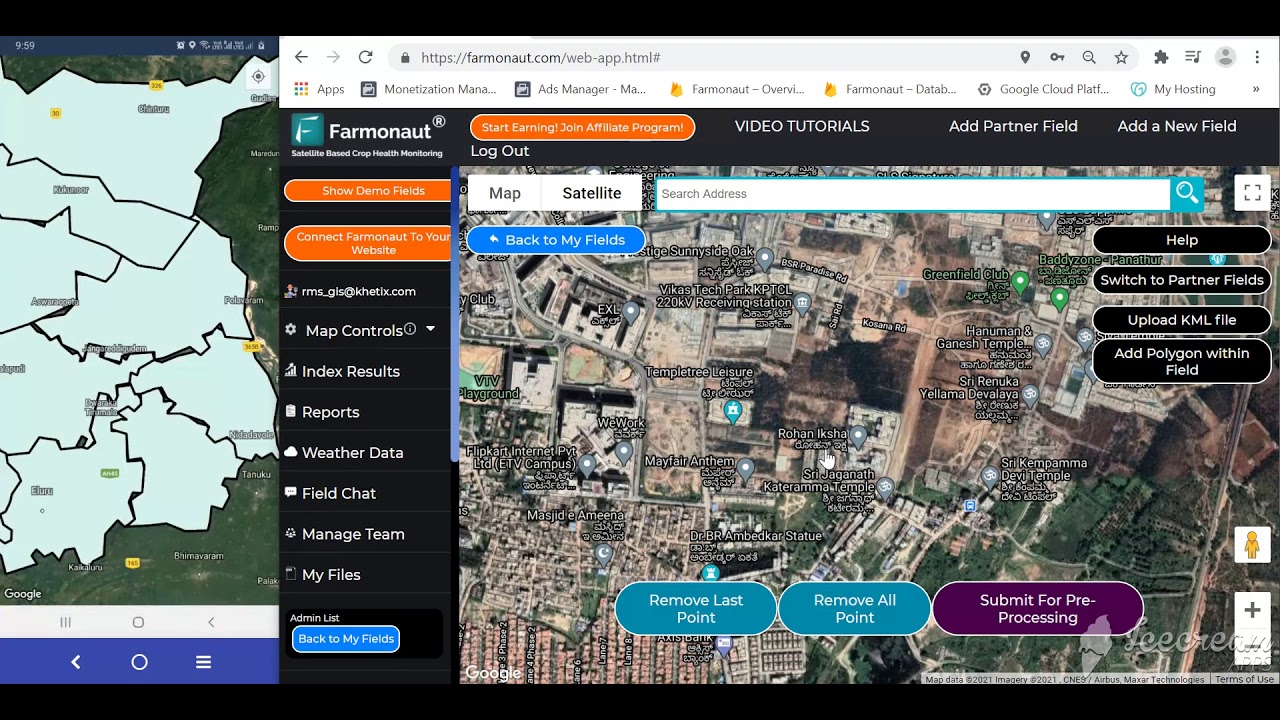
The Farmonaut web system and large-scale field mapping equip users to map, monitor, and optimize irrigation spans, catchment areas, and field infrastructure—all via simple app or API interfaces.
Try the Farmonaut Farm Management System to harness the power of satellite analytics for irrigation and bore well planning. -
Automated Advisory & Smart Alerts:
With Jeevn AI, users get actionable recommendations—from pump utilization to soil water stress conditions. -
Environmental Footprint Tracking:
Farmonaut’s Carbon Footprinting solutions help users ensure that bore well investments remain sustainable and climate-resilient. -
Increased Traceability:
Blockchain-supported traceability modules validate sustainable groundwater withdrawal and regulatory compliance. -
Easy Integration:
APIs and mobile apps provide instant access and smooth integration with other farm management tools.
Frequently Asked Questions (FAQ) – Bore Well Cost 2025
1. What is the average bore well cost for farms in 2025?
The average bore well cost in 2025 for agriculture ranges from ₹1,50,000 to ₹8,50,000, depending on depth, region, drilling technology, and supporting infrastructure. Drilling rates are ₹100–₹150 per foot, a 10% rise from 2023.
2. Which factors most influence bore well cost?
- Hydrogeological conditions and groundwater depth
- Choice of modern drilling tech (automated, rotary, sonic)
- Permits and compliance costs
- Pump choice, casing quality, local labor/material charges
- Integration with smart irrigation (drip, sprinkler, sensors)
3. Can satellite technology help reduce bore well expenses?
Absolutely. Farmonaut’s satellite platform provides insights on groundwater trends, soil moisture, field mapping, and ongoing health reporting. This enables smart placement, reduced risk of drilling dry, predicting falling water tables, and optimizing resource use.
4. How do government regulations affect bore well planning?
In 2025, tighter enforcement means almost all agriculture wells require registration and permits. Violations can trigger heavy penalties or disconnection. Smart planning, documentation, and traceability (including blockchain traceability) streamline compliance.
5. Is solar worth the extra investment for pumps?
Solar-powered submersible pumps cost more upfront but reduce energy expenses and carbon footprint. In many regions, government incentives and carbon footprinting tools (see here) accelerate returns on investment.
6. How often should we maintain a bore well system?
Annual maintenance is essential—budget 5–10% of initial investment yearly for pump, electrical, casing integrity, and water quality checks. This effort ensures long lifespan and reduces major repair risk.
7. Can Farmonaut help with crop loan or insurance verification?
Yes. Farmonaut offers crop loan and insurance verification using satellite-based data, saving farmers and lenders time and reducing the risk of fraud.
Conclusion: Making Every Bore Well Investment Count For The Future
From the initial investment in professional hydrogeological surveys to selecting advanced drilling technologies, every stage of the bore well cost journey in 2025 demands thoughtful planning and sustainability. We’ve seen how site assessment, depth optimization, choice of casing, and pump selection all play essential roles. Integrated smart irrigation and satellite monitoring usher in a new era of agriculture where water access is both efficient and environmentally responsible.
As we progress into a future marked by water scarcity and environmental challenges, the importance of smart, sustainable well management continues to grow. Leveraging technology and expert insights, farmers and stakeholders can secure both economic viability and long-term productivity. Modern irrigation and monitoring tools, especially those powered by Farmonaut, unlock new possibilities to reduce risk, optimize costs, and ensure resilient, high-yield farming.
If you’re ready to enhance your bore well planning or need real-time water monitoring solutions:
- Explore Farmonaut’s Large Scale Farm Management Platform – For complete field mapping, bore well/irrigation monitoring, and resource optimization.
- Start using Farmonaut’s Crop Plantation & Forest Advisory App for digital field intelligence and climate-resilient planning.
- Integrate Farmonaut Satellite API into your agricultural business or app for custom, real-time water and field insights.
Access to affordable, smart, and sustainable irrigation is not just a necessity—it’s the cornerstone of agricultural success in 2025 and beyond.

 YelloSkye
 GalaxEye Space
 Sun Palm Australia
 Grandstream Algérie
 XOS Realty
 Geospatial Lab Africa
 Agro La Gándara
 HIPSAC
 ZOL Zimbabwe
 Juligerm
 AdBio
AdBio MISE Maroc
 NWNS
NWNS Red August Group
 Farm Inc
 WeMe Global
 Agrotoken
 Blue BearX
 Insignito
