

Cotton pests · Southeast US field guide
Jassids in Cotton: Thresholds, Insecticides, Life Cycle
The two-spot cotton leafhopper reached nearly every cotton county in Florida, Alabama, Georgia and South Carolina in 2025. Untreated plots lost about 13% of yield on average across 18 Southeast trials (UF/IFAS Extension). Here is how to scout it, when to spray and which products worked.
Key takeaways
- Current Southeast working threshold: about 1 jassid per leaf on the main-stem leaf at the 4th node, or early injury (UF/IFAS and Alabama Extension).
- Across 18 trials in 2025, untreated infestations cut yield by about 13% on average, with a range of 1% to 46% (UF/IFAS Extension, April 2026).
- Venom, Plinazolin, Carbine and Bidrin often gave over 70% control in 2025 trials; bifenthrin and other pyrethroids were weak.
- Eggs hatch in 3 to 4 days, nymphs develop in 8 to 10 days, and a new generation appears about every 2 weeks (Alabama Extension).
- Early planting, short-season varieties, balanced nitrogen and potassium, and weekly scouting are expected to cut the number of sprays needed.
In this article
- What jassids in cotton are and why they matter now
- How to identify cotton jassid damage
- The cotton jassid life cycle
- How much yield jassids in cotton can cost
- How to scout and when to spray
- Which insecticide controls cotton jassid
- Spray or wait: check the economics
- Cultural and biological control: five strategies
- Notes for Australian cotton growers
- Using satellite maps to target scouting
- Long-term control of jassids in cotton
- FAQ
Jassids in cotton are tiny sap-feeding leafhoppers that turn leaf edges yellow, then red and brown, an injury called hopper burn. In the Southeast US, Extension entomologists now advise treating at about 1 nymph per leaf, because 18 trials in 2025 showed an average yield loss of about 13% where the pest was left alone (UF/IFAS Extension, April 2026). This guide covers how to spot the pest, its life cycle, the insecticides that worked in field trials, and a calculator to check whether a spray pays.
The species behind the 2025 outbreak is the two-spot cotton leafhopper, Amrasca biguttula, which growers call the cotton jassid. It reached Puerto Rico and the US Virgin Islands in 2023 and cotton in Jackson County, Florida, in late 2024 (Alabama Cooperative Extension, October 2025). Below we use the US research first, then add notes for Australian growers.
What jassids in cotton are and why they matter now
Jassid is an old name for a group of small leafhoppers. Adults of the cotton jassid are about 2 mm long, pale green, and wedge shaped. They have a pair of black dots on the front wings, which you can see with the naked eye. Nymphs look like adults but have no wings and move sideways when you touch the leaf.
The pest feeds on the underside of leaves. It pushes its mouthparts into the leaf veins and injects saliva that breaks down the tissue. That saliva is the main problem. A few insects can cause more harm than their numbers suggest, because the toxin keeps working after they move on.
In its native range in Asia, this leafhopper is a major pest of cotton, okra and eggplant (UF/IFAS EDIS fact sheet EENY-827). Before 2025, US cotton growers rarely sprayed for leafhoppers. That changed fast.
How fast it spread across the Cotton Belt
UF/IFAS Extension reports that the 2025 outbreak began with a localized detection in early July 2025. Within about four weeks the pest had been found in roughly 115 counties in Florida, Alabama, Georgia and South Carolina. By the end of the season it was in nearly every cotton-producing county in those four states (UF/IFAS Extension Jackson County, April 2026).
Alabama Extension adds that the pest was also detected in Louisiana, Mississippi, North Carolina and Texas in 2025. The EDIS fact sheet lists Mexico and Honduras as well. Texas grows about 40% of US cotton (USDA ERS), so how far west the pest can survive matters for the whole Cotton Belt.
Many questions remain open. Alabama Extension lists them plainly: will the jassid survive the winter, how far north, what will its winter hosts be, and how many sprays will growers need. Researchers in Alabama, Florida, Georgia and South Carolina planned joint trials in 2026 to answer them.
How to identify cotton jassid damage
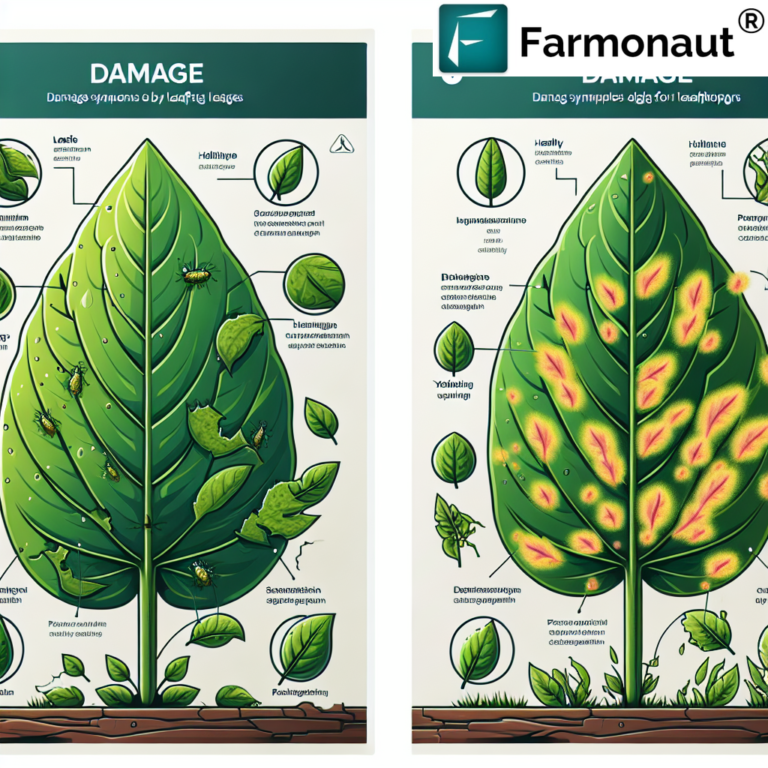
Hopper burn follows a clear order. Watch for these signs, from first to last:
- Bronzing or pale yellow patches on the leaf, often at the edges first.
- Yellow and red leaf margins that start to curl down and inward.
- Brown, dry leaf edges, the classic hopper burn.
- Leaf drop, as the whole leaf turns brown and falls.
- Stunted plants and fewer bolls if the pressure lasts.
Alabama Extension describes the same sequence: bronzing or yellowing, then curling with yellow and red margins, then brown leaves that fall. Under steady pressure whole plants can dry out. Many leafhoppers cause hopper burn, and symptoms differ between host plants, so the damage alone does not prove which species you have.
Telling it apart from other pests
Two mix-ups are common. First, nymphs can look like aphids. Aphids are pear shaped and slow; jassid nymphs are wedge shaped and run sideways. Second, the cotton jassid looks much like the potato leafhopper. Only adults show the two black spots clearly, and older nymphs show them near the wing pads. Young nymphs cannot be told apart from other leafhoppers in the field.
The EDIS fact sheet is strict on this point. Authoritative identification needs a microscope check of male specimens or a DNA test. If you find the pest in a new area, send samples to your state department of agriculture or Extension office. For a side-by-side guide to jassids and other leafhoppers, see our page on how to tell jassids and leafhoppers apart.
Other symptoms that look similar
Potassium shortage also causes leaf edges to yellow and brown. So can drought and some herbicide injury. The quick check is to flip leaves over. If you see nymphs on the underside of leaves with damage, jassids are the likely cause. If leaves are clean, test the soil and look at water records.
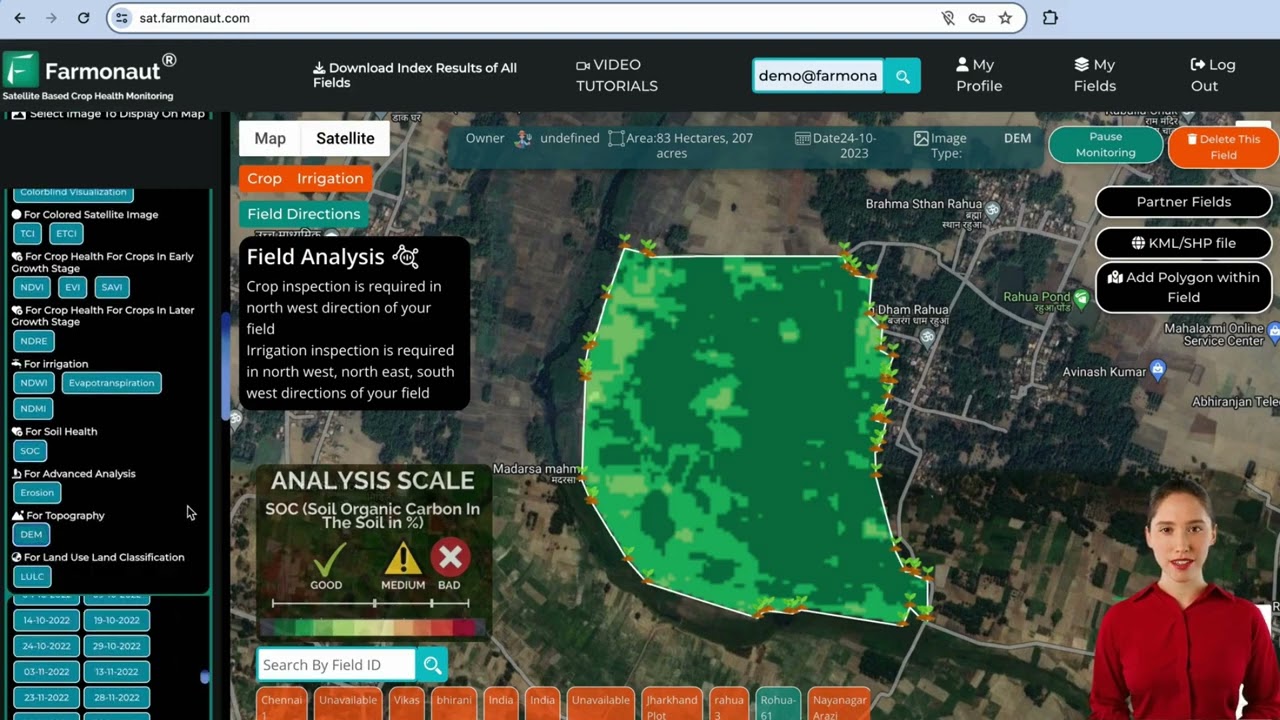
▶ A walk-through of a satellite monitoring web app, useful for marking fields and checking crop vigor between scouting trips. · 8:02
The cotton jassid life cycle
The life cycle has three stages: egg, nymph and adult. A short cycle means many generations in one season.
- Egg: females push eggs into leaf tissue, in or near the veins, so you will not see them. Eggs hatch in 3 to 4 days.
- Nymph: nymphs pass through five instars in 8 to 10 days. The first instar is about 0.7 mm long; the fifth reaches about 2 mm.
- Adult: adults live 2 to 4 weeks. One female lays 13 to 34 eggs in her lifetime.
These figures come from Alabama Extension, which draws on published studies. Lab studies summarized in the EDIS fact sheet give somewhat longer stages, about 5 to 7 days for eggs and 7 to 15 days for the whole nymph stage. Alabama Extension notes that new generations appear about every 2 weeks. That is why a field can look clean one week and show hopper burn the next. The studies did not record temperature, so the cycle in US fields may run faster or slower.
Host plants
Published host lists are long. They include cotton, okra, eggplant, hibiscus, sunflower and cowpea, and some lists add corn, soybeans, peanuts and Bermuda grass. Alabama Extension says corn, soybeans and peanuts look like incidental hosts so far: no breeding or injury had been recorded in them in the US. Okra, eggplant and hibiscus near cotton fields can carry the pest over between crops, so check them when you scout borders.
Chart
Cotton jassid life stages
Days spent in each stage, low and high end of the reported range
How much yield jassids in cotton can cost
The best US numbers come from the 2025 trials. Across 18 trials in the Southeast, untreated plots lost about 13% of yield on average, with a range from 1% to 46% (UF/IFAS Extension Jackson County, April 2026). Losses were generally larger when infestations came later in the season.
Chart
Yield loss from untreated cotton jassid
Percent yield loss across 18 Southeast US trials, 2025
Older data from Asia show a similar scale. The EDIS fact sheet cites historical annual yield losses in cotton of 19% to 49% from Pakistan. Australia’s Cotton Pest Management Guide 2025-26 (CRDC) notes that the exotic Indian green jassid can cause yield losses of up to 25% overseas. The EDIS fact sheet lists its old name, Amrasca devastans, as a synonym of Amrasca biguttula, so this is the same species now in the US.
Damage is not only a yield issue. Leaf loss before cut-out cuts the sugars that fill bolls, which can lower lint quality. Extra sprays also add to cost per acre. That is why the threshold, not the calendar, should decide each spray.
How to scout and when to spray
Thresholds for jassids in cotton fell fast during 2025. The first advice, taken from older studies, was 5 nymphs per leaf. It dropped to 3, then 2, then 1 to 2, and finally to 1 per leaf (Alabama Extension, October 2025). UF/IFAS gives the current working advice as about 1 jassid per leaf, or early injury in the field.
Chart
How the treatment threshold fell in 2025
Nymphs per leaf at which Southeast Extension advised treatment, in order of each revision
Some county advice from Georgia still quotes the earlier figure. University of Georgia Extension notes in Evans County and Tattnall County give 3 nymphs per leaf in the top six inches of the plant, together with visible injury. Ask your state Extension office which threshold applies to your area this season.
A simple scouting routine
- Scout at least weekly. Alabama Extension says growers should not plant cotton without trained scouts checking fields at least once a week.
- Start at the borders. Jassids build up first on field edges and on single plants there. Use these as indicator plants.
- Then move in. UGA advises sampling at least 8 to 10 rows in from the edge for the field count.
- Pick the right leaf. Turn over the main-stem leaf at the 4th node below the terminal. Jassids were most common on nodes 3 to 5 in 2025.
- Count nymphs and adults on the underside, and note any bronzing or yellow edges.
- Adjust for your sprayer. If you can only cover a field every 10 to 14 days, Extension suggests treating once 30% to 50% of sampled plants reach the threshold.
Which insecticide controls cotton jassid
In 2025, efficacy trials in Alabama, Florida, Georgia and South Carolina found that Venom, Plinazolin, Carbine and Bidrin often gave more than 70% control in the field. Bifenthrin and other pyrethroids gave limited or uneven control (UF/IFAS Extension Jackson County, April 2026). UGA trials also found that bifenthrin alone did not give acceptable control.
| Product | Active ingredient | IRAC group | 2025 trial result |
|---|---|---|---|
| Venom | dinotefuran | 4A | Higher control, often over 70% |
| Plinazolin | isocycloseram | 30 | Higher control, often over 70% |
| Carbine | flonicamid | 29 | Higher control, often over 70% |
| Bidrin | dicrotophos | 1B | Higher control, often over 70% |
| Bifenthrin | bifenthrin | 3A | Limited or uneven |
Group numbers follow the IRAC mode of action classification. Each group works on a different target in the insect, so switching groups slows resistance. Product names are given because Extension trials used them. They are not an endorsement, and which ones carry a label for cotton jassid changes by state.
Check the label and local rules. Use only products registered for cotton in your state, follow the label rate, pre-harvest interval and pollinator rules, and get advice from your Extension office or a licensed crop adviser before you spray. UF/IFAS posted a table of labeled products as of April 2026.
Why rotation matters
Alabama Extension warns that the cotton jassid is resistant to nearly every class of insecticide used against it in its native range. The EDIS fact sheet says resistance to carbamates, neonicotinoids, organophosphates and pyrethroids is common in cotton there. If you use the same group twice in a row, you speed up the same problem here.
Older broad-spectrum products such as lambda-cyhalothrin also kill lady beetles, lacewings and spiders. Losing them can flare aphids and whiteflies later in the season. UF/IFAS asks growers to weigh the whole pest complex, including thrips, plant bugs, aphids and stink bugs, before choosing a product.
Seed treatments
Trials in Alabama, Georgia and Florida in fall 2025 suggest that seed treatments give moderate suppression of jassids on young cotton (Alabama Extension). They will not replace foliar sprays at threshold, but they help early in the season.
Spray or wait: check the economics
A spray pays when the yield it saves is worth more than the product and the trip across the field. The numbers that decide this are your yield, the lint price, the loss you expect without a spray, how well the product works, and the cost per acre.
For price, US farmers received 73.3 cents per pound for upland cotton in September 2026, the USDA monthly average of prices received (USDA NASS Agricultural Prices, October 2026). For a sense of margins, Texas A&M AgriLife’s 2026 budget for dryland cotton in one district assumes 400 lb of lint per acre and a break-even of $0.80 per pound on total costs (Texas A&M AgriLife, 2026).
The calculator below uses example values set close to break-even. Change them to your own field. The loss figure is the hard one: use the trial range above (1% to 46%) and your scout’s notes on how early and how heavy the pressure is.
Try the numbers for your own farm below.
Calculator
Does a jassid spray pay on your field?
Enter your own yield, price, expected loss and spray cost.
- Crop value per acre: $730 US$/acre
- Lint saved by the spray: 21 lb/acre
- Value of lint saved: $15 US$/acre
- Loss needed to break even: 2.9 %
Example values only, set near break-even; they are not a forecast. The lint price is an example (USDA NASS put the September 2026 upland price received at 73.3 cents per pound); use today’s price. Expected loss without a spray is your judgement: 2025 Southeast trials ranged from 1% to 46%. Control is the share of that loss the spray prevents. Check the label and local rules, and ask your Extension office or crop adviser before you spray.
Cultural and biological control: five strategies
Insecticides are only one part of control. Integrated pest management (IPM) adds steps that cut the number of sprays you need. These five come from US Extension advice and the EDIS fact sheet.
1. Plant early and pick short-season varieties
Alabama Extension expects jassid numbers to build slowly in spring, if the pest survives the winter. It advises planting from about April 15, as soon as conditions allow, and using short-season varieties. A shorter season means fewer weeks when cotton is exposed.
Best for: fields in the Southeast where late planting has been common.
2. Balance nitrogen and potassium
Lush plants with too much nitrogen are likely to draw more jassids. Plants short of potassium seem less able to recover from injury (Alabama Extension). Soil tests and balanced fertilizer are a cheap first step. Good soil health also helps plants cope with stress. Follow your state’s fertilizer advice and local rules.
Best for: fields with a history of rank growth or low potassium.
3. Choose hairy-leaf varieties where they fit
The EDIS fact sheet notes that tolerance to this jassid has been found in cotton, okra and eggplant, mostly linked to longer and denser leaf hairs. Ask your seed dealer how leaf hairiness trades off against other traits in varieties for your area.
Best for: growers in areas with heavy repeat pressure.
4. Manage borders and alternate hosts
Jassids build on field edges first. Keep an eye on okra, eggplant and hibiscus near fields, and remove volunteer cotton after harvest. Crop rotation with crops that do not support breeding may help, though the true host list in the US is still being worked out.
Best for: farms with gardens, okra plots or ornamental hibiscus nearby.
5. Protect natural enemies
In Asia, generalist predators feed on this jassid, and tiny wasps parasitize its eggs. The EDIS fact sheet says there is limited information so far on how much natural enemies can suppress it. Even so, avoiding early-season broad-spectrum sprays keeps lady beetles, lacewings, spiders and big-eyed bugs in the field. For gardens and small plots, UF/IFAS notes that horticultural soaps and oils may help (UF/IFAS Extension Monroe County).
Best for: fields where you also manage aphids and whiteflies, which flare when predators are lost.
What about traps?
Yellow sticky cards catch adult leafhoppers and can show when they arrive. They do not replace leaf counts, because thresholds are set on nymphs per leaf. Use cards as an early warning at field borders, not as a control method.
Notes for Australian cotton growers
Australian cotton has several native leafhoppers, often called jassids. The CRDC Cotton Pest Management Guide 2025-26 says they are occasional pests that rarely reduce yield unless stippling is extreme, for example over 50% of the leaf surface just before cut-out. It warns that needless sprays for leafhoppers can harm beneficial insects and flare other pests.
The bigger worry is biosecurity. The Indian green jassid, Amrasca devastans, is treated as an exotic pest threat to Australian cotton; EDIS lists that name as a synonym of Amrasca biguttula, the pest now spreading in the US Southeast. See Plant Health Australia’s fact sheet. A native relative, Amrasca terraereginae, is described in the NSW DPI leafhopper key. If you see hopper burn that looks unusual, report it to the Exotic Plant Pest Hotline on 1800 084 881.
Using satellite maps to target scouting
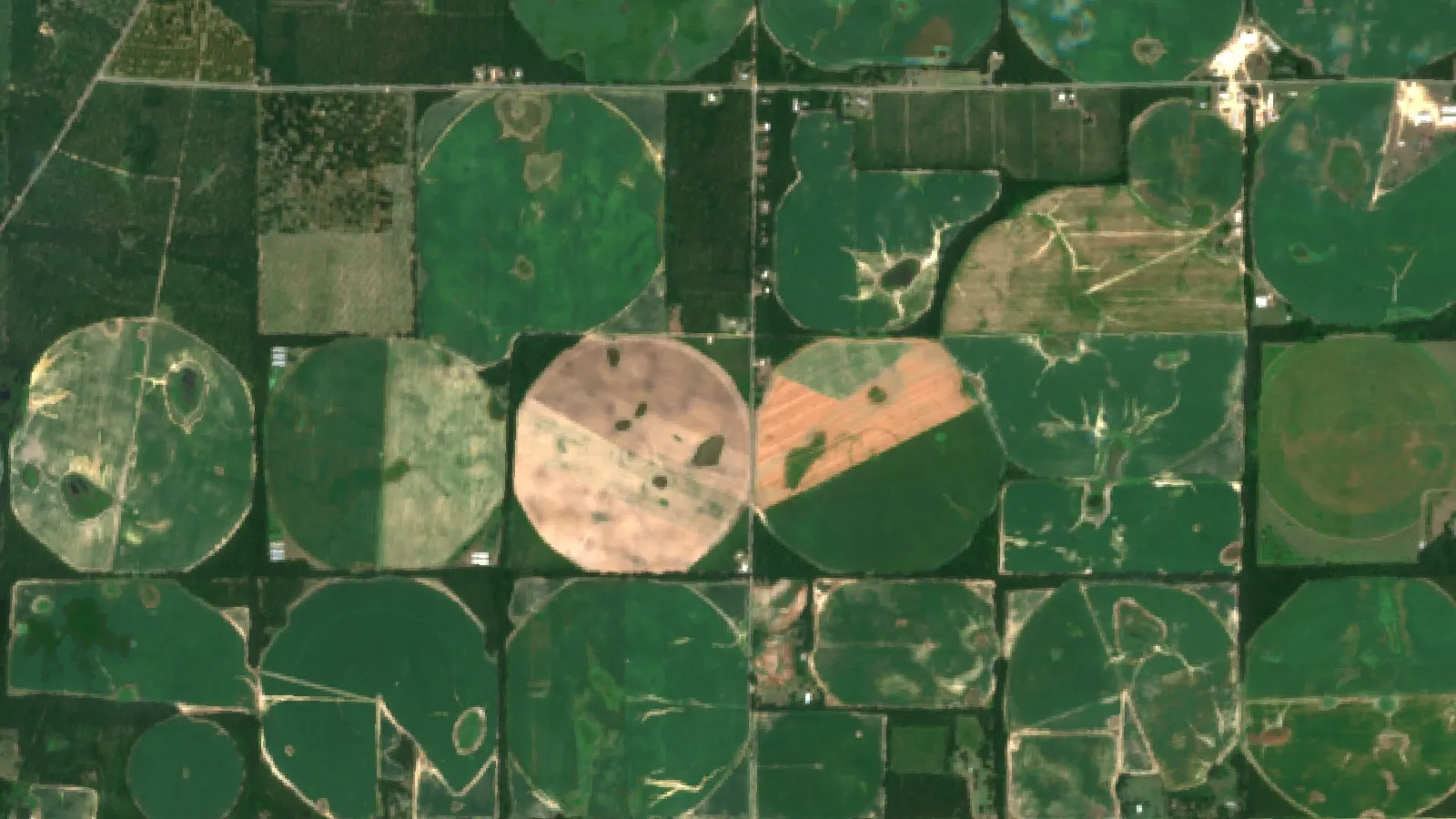
Satellites cannot see a 2 mm insect. What they can show is where the crop canopy is losing vigor. Hopper burn, leaf drop and stunting all lower vegetation index values, often in patches that start at field edges. A map of those patches tells scouts where to walk first on a large farm.
Farmonaut Satellite + AI Farm Monitoring System maps crop health for each field every few days, so you can compare this week’s map with the last one. A drop in vigor still needs a scout to confirm the cause, because drought, potassium shortage and disease can look the same from above. Used this way, maps are one of several precision agriculture tools that help a small team cover more acres. You can read about crop stress and how to respond to it on our site.
▶ How satellite crop health maps show stressed areas of a field before you walk it. · 4:09
Long-term control of jassids in cotton
The pest looks set to stay in the Southeast. Long-term control rests on a few habits that hold up whatever 2026 and later seasons bring:
- Keep good records. Note each scouting date, count, product, group and result. Over several seasons you will see which fields get hit first.
- Rotate modes of action. Never use the same IRAC group back to back on the same generation.
- Spray on counts, not the calendar. Each spray you skip below threshold saves cost and protects predators.
- Plan for weather. Warm, dry spells speed up the life cycle. Shifts in climate change may also change how far north the pest can survive.
- Share data with Extension. Thresholds are still being tested. Your field notes help refine them.
▶ Seven simple sustainable farming habits that protect soil and water, the base of long-term pest management. · 4:34
FAQ
What is the threshold for jassids in cotton?
Southeast US Extension advice in 2026 is about 1 nymph per leaf on the main-stem leaf at the 4th node, or early injury in the field. Some Georgia county notes still use 3 nymphs per leaf with visible injury. Check your state’s current advice.
What is the best insecticide for cotton jassid?
No single product is best. In 2025 trials, Venom (dinotefuran), Plinazolin (isocycloseram), Carbine (flonicamid) and Bidrin (dicrotophos) often gave over 70% control, while bifenthrin was weak. Rotate between IRAC groups and use only products labeled in your state.
How long is the cotton jassid life cycle?
Eggs hatch in 3 to 4 days, nymphs develop in 8 to 10 days, and adults live 2 to 4 weeks. A new generation appears about every 2 weeks, so populations can build fast.
What does jassid attack on cotton look like?
Leaves first bronze or yellow at the edges, then curl down with yellow and red margins, then brown and fall. This is hopper burn. Flip leaves to find wedge-shaped nymphs that run sideways.
Are cotton jassids the same as leafhoppers?
Yes. Jassid is a common name for some leafhoppers. The cotton jassid in the US is the two-spot cotton leafhopper, Amrasca biguttula, named for the two black spots on its wings.
Related pages on our site: broad-spectrum insecticide options, web app tutorial for field maps, crop monitoring app, API documentation, satellite data API, farm sector cooperation in Belarus and Algeria.
Farmonaut crop monitoring
Know which fields to scout first
Draw your cotton fields once and Farmonaut shows satellite crop health maps through the season, so agronomists and scouts can see where vigor drops and check those spots first.




Keep reading


Sources
- UF/IFAS Extension Jackson County, Preparing for Cotton Jassid in 2026: What Growers Need to Know (April 2026): blogs.ifas.ufl.edu
- Alabama Cooperative Extension System, Preparing for Cotton Jassids in 2026 (October 2025): aces.edu
- UF/IFAS EDIS, Two-Spot Cotton Leafhopper Amrasca biguttula, EENY-827: ask.ifas.ufl.edu
- University of Georgia Extension, Evans County, cotton jassid notes: site.extension.uga.edu
- University of Georgia Extension, Tattnall County, cotton jassid notes: site.extension.uga.edu
- UF/IFAS Extension Monroe County, The Two-spot Cotton Leafhopper: blogs.ifas.ufl.edu
- USDA ERS, Cotton Sector at a Glance: ers.usda.gov
- USDA NASS, Agricultural Prices (October 2026, September prices received): release.nass.usda.gov
- Texas A&M AgriLife Extension, Cotton costs and returns in 2026: agrilife.org
- IRAC, Modes of action classification: irac-online.org
- CRDC, Cotton Pest Management Guide 2025-26: crdc.com.au
- Plant Health Australia, green jassid (Amrasca devastans) technical fact sheet: planthealthaustralia.com.au
- NSW DPI, Amrasca terraereginae identification key: idtools.dpi.nsw.gov.au
Discussion
Questions, corrections or field experience? Share them below. First-time comments are reviewed before they appear, and your email is never published.
No comments yet. Be the first to add a question or your experience.

 Clubhouse OS
 Progenseed
 SkyHarvest
 Polaris Digitech
 Teledarbas
 Wild Oak Farm
 SFX
 BACF Africa
 Doodlakine
 Exurbia Geospatial
 FieldZero
 Indico Company
 Kubota
 FFBS
 Jontra
 Hayleys Agriculture
 Adinet
 Grandstream Algérie
 XOS Realty
 Geospatial Lab Africa
 Agro La Gándara
 HIPSAC
 ZOL Zimbabwe
 Juligerm
 MISE Maroc
 NWNS
 Farm Inc

 Licence holder · Niger · Gold
 Client · Somalia · Gold
 Client & affiliate partner · Ghana · Gold










