

Best Weather Station for Farmers: Full Buying Guide
Reviewed September 2026 against USDA Agricultural Resource Management Survey (ARMS) data, NOAA NESDIS, and ResearchAndMarkets industry reporting.
The best weather station for farmers is the one that measures conditions on your own field, not the nearest airport 20 miles away. An agricultural weather station for farms typically costs $170 to $1,200 for hardware alone, with mid-range multi-sensor units running $3,000 to $10,000 once soil probes, cellular telemetry, and multi-year data plans are added. This guide compares specific models by price and sensor coverage, explains what a weather monitoring station for farms actually measures versus a phone forecast app, and points you to the exact USDA and industry sources to check for updated figures.
What a Farm Weather Station Actually Does
An agricultural weather station is a ground-mounted sensor array installed directly on a field or farmstead that records local conditions — air temperature, rainfall, relative humidity, wind speed and direction, solar radiation, barometric pressure, and often soil temperature and soil moisture — at intervals ranging from every few seconds to every 15 minutes. That data feeds either an onboard display, a companion app, or a cloud dashboard the grower checks from a phone or a farm office computer.
The distinction that matters for a buying decision is this: a weather monitoring station for farms measures what is happening at your coordinates, at canopy or near-surface height, continuously. A National Weather Service forecast covers a grid cell that can span several square miles and represents a model estimate, not a field-level reading. Both have a role — the station tells you what already happened and what conditions are right now; the forecast estimates what happens next. Farmers who rely on regional forecasts alone are working from an average that may not reflect a specific valley, a low-lying frost pocket, or a field a few miles from the reporting airport.

A Short History: Why On-Farm Weather Monitoring Exists
On-farm and agriculture-specific weather monitoring in the United States is not a new idea. NOAA and USDA jointly established the Joint Agricultural Weather Facility (JAWF) in 1978 specifically to translate weather and satellite observations into crop-relevant products for growers and USDA analysts, according to NOAA’s National Environmental Satellite, Data, and Information Service (NESDIS). That partnership is the ancestor of today’s USDA crop condition reports and NOAA agricultural weather briefings — the institutional starting point that today’s on-field sensor networks and satellite platforms extend down to the level of an individual field.
This blog covers:
- What separates a farm weather station from a consumer weather station or a phone app
- Real price ranges and sensor specifications for agricultural weather stations on the market
- Verified market-size and adoption data from USDA and industry research, with links to check for updates
- How weather data for agriculture feeds irrigation timing, spray decisions, insurance, and loan verification
- A cost calculator to estimate hardware payback for your own acreage
- Where satellite-based weather monitoring, like Farmonaut’s platform, fits alongside or instead of physical hardware
Why On-Farm Weather Data Beats Regional Forecasts
Weather forecasting for agriculture has a structural limitation: public forecast models are built for regional and national coverage, not field-by-field precision. A forecast that says “30% chance of frost tonight” for a county does not tell you whether your lowest field — the one that pools cold air — will actually drop below 32°F. An agricultural weather station installed at that field reports the actual temperature at that location, in real time, which is the difference between a guess and a measurement.
Specific decisions that hinge on field-level rather than regional data:
- Irrigation timing — a rain event forecast for “the area” may deliver 0.1 inch on one field and 0.9 inch two miles away; only an on-site rain gauge tells you which happened on your field.
- Fungicide spray windows — leaf wetness duration and relative humidity drive disease pressure in orchards and vineyards; these vary by elevation and canopy density even within one farm.
- Frost protection — low-lying fields and wind patterns create frost pockets that a county-level forecast cannot resolve.
- Spray drift compliance — wind speed and direction readings at the point of application are what applicators need to document, not a regional average.
- Pest degree-day models — accumulated growing degree days for pest emergence timing require a continuous, site-specific temperature record.

What This Looks Like on a Working Farm
Consider a corn-soybean operation in the U.S. Midwest deciding whether to irrigate ahead of a forecast rain event. A weather station reporting live soil moisture and an actual rainfall total from the last 24 hours lets the operator skip an irrigation pass that a regional forecast alone would not have justified skipping — the station confirms rain already fell on that specific field rather than nearby. The same logic applies to spray decisions: a station reporting sustained wind under the label’s stated threshold at the actual field, logged with a timestamp, is documentation a regional forecast cannot provide.
Core Sensors in an Agricultural Weather Station
Not every “farm weather station” on the market measures the same things. Base-tier consumer units and higher-end agricultural-grade stations differ mainly in sensor count, accuracy specification, and connectivity. Typical components:
- Rain gauge — tipping-bucket or weighing type; resolution usually 0.01 inch per tip on ag-grade units.
- Thermometer and hygrometer — air temperature and relative humidity, usually shielded from direct solar radiation to avoid false highs.
- Anemometer — wind speed and direction, critical for spray timing and drift documentation.
- Soil moisture and soil temperature probes — often sold as an add-on rather than standard equipment; these are what separates a basic home weather station from an agricultural one.
- Pyranometer — measures solar radiation, used in evapotranspiration (ET) calculations for irrigation scheduling.
- Barometric pressure sensor — supports short-term forecasting and storm-tracking at the local level.
- Connectivity module — Wi-Fi, cellular, or LoRaWAN, determining whether the unit works on a farm with no broadband coverage.
- Solar panel and battery — most ag-grade stations are self-powered for placement in fields without electrical access.
The University of Arizona Cooperative Extension’s grower’s guide on weather station selection notes that matching sensor selection to the actual decision you need to make — irrigation scheduling versus frost warning versus spray timing — matters more than buying the highest sensor count available. See University of Arizona Cooperative Extension: Grower’s Guide on Selection and Use of Weather Stations for a decision framework organized by crop and irrigation type.

Weather Station Comparison: Price, Sensors, Accuracy
Prices below reflect the ranges reported for agricultural and farm-grade weather station hardware as of 2024, compiled from equipment retailers including Weather Shack and Ambient Weather. Hardware pricing changes seasonally and by retailer promotion, so confirm current pricing directly with the manufacturer or retailer before purchasing — see the refresh method noted below the table.
| Station / Platform | Type | Sensors Included | Connectivity | Typical Price (USD) |
|---|---|---|---|---|
| Basic automated station (entry tier) | Consumer/hobbyist-grade | Temperature, humidity, rainfall, wind, barometric pressure | Wi-Fi | $1,500 – $3,000 |
| Mid-range agricultural station | Farm-grade, multi-sensor | Above, plus soil moisture, soil temperature, solar radiation | Cellular, Wi-Fi, or LoRaWAN | $3,000 – $10,000 |
| Farmonaut satellite platform | Satellite + weather API, no field hardware required | Temperature, rainfall, humidity, wind, soil moisture, solar radiation, plus NDVI crop health | Cloud, API, web, iOS/Android | Subscription-based; no hardware cost |
The two hardware price bands above — $1,500–$3,000 for basic automated stations and $3,000–$10,000 for mid-range multi-sensor systems — come from AgriExpo and Ambient Weather equipment listings compiled via Weather Shack’s agricultural weather station category, current as of 2024. For an up-to-date quote on a specific model, check Weather Shack’s agricultural and farm weather station listings directly, since individual SKU pricing shifts with each manufacturer’s release cycle. If your operation would rather avoid hardware capital cost and installation entirely, a satellite-and-API approach like Farmonaut’s covers the same weather parameters through a subscription — see the comparison in the table above and the walkthrough in the sections that follow.
Market Size and Adoption: What the Numbers Say
The global agricultural weather station market was valued at $91.4 million in 2025 and is projected to reach $147.5 million by 2032, a compound annual growth rate of 7.1% over that period, according to ResearchAndMarkets’ industry report on agricultural weather stations. That growth trajectory reflects rising demand for precision-agriculture hardware generally, not a one-time spike — check ResearchAndMarkets’ agricultural weather station report directly for the current-year update, since this class of market forecast is typically revised annually as new sales data comes in; competing research firms including Mordor Intelligence and Global Market Insights publish comparable annual updates worth cross-checking.
Adoption of precision-agriculture technology more broadly is tracked by USDA’s Economic Research Service through the Agricultural Resource Management Survey (ARMS). Between 1996 and 2019, adoption of automated GPS guidance systems reached more than 50% of surveyed acreage for corn, cotton, rice, sorghum, soybeans, and winter wheat, while adoption of yield maps, soil maps, and variable rate technology — the technologies most directly linked to weather-and-soil-data-driven input decisions — ranged from 5% to 25% depending on the specific technology and crop, per USDA ARMS. Full survey methodology and crop-by-crop breakdowns are available at USDA ERS: Agricultural Resource Management Survey — precision agriculture adoption.
USDA has not published a specific adoption-rate breakdown for on-farm weather stations by farm size or region in its public ARMS releases — that gap sits alongside the broader precision-ag adoption figures cited above. If you need a current adoption estimate specific to weather monitoring hardware rather than GPS guidance or variable-rate technology, query USDA NASS’s Quick Stats database directly at quickstats.nass.usda.gov, which is updated quarterly and can be filtered by state, farm size, and technology category.
Weather Data Delivery: Apps, Platforms, and APIs
Raw sensor readings are only useful once they reach the person making a decision. Most agricultural weather stations pair with either a manufacturer app, a farm management platform, or an open API that lets the data flow into whatever software the operation already uses. What a weather-data delivery layer should provide:
- Live dashboards — current readings for temperature, humidity, wind, rainfall, and soil moisture, viewable on a phone in the field.
- Threshold alerts — push notifications when wind exceeds a spray-safe limit, temperature drops toward frost, or rainfall crosses an irrigation-relevant total.
- Historical logs — a queryable record for compliance documentation, insurance claims, or agronomic recordkeeping.
- Satellite overlay — combining ground station readings with satellite-derived crop health (NDVI) and soil moisture for a fuller picture than either source alone.
- API access — so weather data can be pulled into an existing farm management system rather than living in a separate silo.
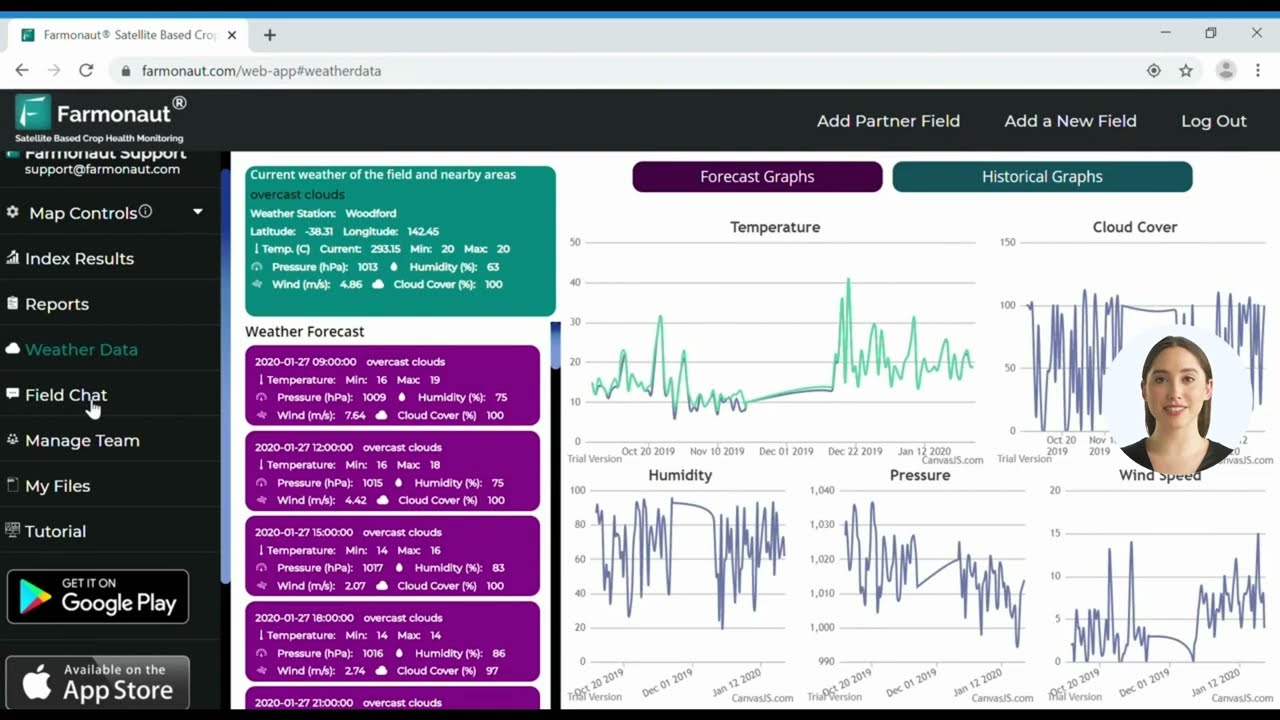
Farmonaut’s platform takes the API-and-satellite route rather than requiring farm-specific hardware: it delivers weather parameters alongside satellite-based crop health monitoring through a single subscription, accessible on web and mobile.
Try the Farmonaut satellite-powered platform—real-time monitoring, weather integration, and actionable insights for any farm size!
Microclimate Monitoring and Irrigation Timing
Microclimate variation within a single farm is the core reason on-farm weather stations exist at all. Elevation changes of even 20–30 feet can shift frost risk, low areas trap cold air and moisture differently than ridgelines, and canopy density in orchards or vineyards changes humidity and leaf wetness duration independent of what a regional forecast reports. Weather stations and the platforms that read them let growers:
- Track soil moisture directly and adjust irrigation scheduling instead of running on a fixed calendar, reducing both water use and pumping costs.
- Monitor humidity and leaf wetness duration to time fungicide applications ahead of disease-favorable windows in orchards and vineyards.
- Confirm wind speed before spraying, both for label compliance and drift-prevention documentation.
- Catch localized frost risk in low-lying fields that a county-wide frost advisory would not flag in time.
More sustainable use of resources follows directly from this kind of field-level precision — less water and fewer inputs applied only when and where conditions call for them.

What “Good” Weather for a Crop Actually Means
There is no universal optimal weather profile — it depends on crop, growth stage, and regional norms. What a weather monitoring station for farms lets you do is compare your actual, real-time readings against the known thresholds for your specific crop: a corn grower cares about growing-degree-day accumulation and silking-stage moisture stress; a wine grape grower cares about diurnal temperature swing and bloom-period humidity; a wheat grower watches for excess moisture at harvest. The station does not tell you what’s “good” in the abstract — it gives you the actual number to compare against your crop’s known thresholds, which is the durable method that outlasts any single season’s data.
Weather Station Cost & Payback Calculator
Enter your acreage and estimated seasonal input savings to see the per-acre hardware cost and a simple payback estimate based on the price bands cited above.
Result: Enter values above.
Assumes the station price entered is a one-time hardware cost with no added data-plan or install fees, and that per-acre savings are constant across the planning horizon. It excludes financing cost, sensor maintenance/calibration, subscription data fees, and any yield-side benefit beyond direct input savings. Use it as a starting estimate, not a guaranteed return — actual savings depend on crop, region, and how the data changes real decisions on your farm.
Weather Data for Insurance, Loans, and Farm Records
Documented, field-level weather data has uses beyond day-to-day management decisions:
- Crop insurance providers increasingly reference verified field-level weather data alongside regional records when assessing claims tied to drought, excess rainfall, or wind damage. See Farmonaut's crop loan and insurance tools for how satellite and weather data can support this kind of documentation.
- Lenders evaluating farm operating loans sometimes request field condition and weather documentation as part of underwriting, particularly for operations seeking financing tied to specific yield projections.
- Spray records — wind speed and direction logs at the time of application are the kind of documentation state agricultural agencies and buyers increasingly expect for drift-sensitive operations.
For national-level weather-driven crop condition tracking, USDA's crop progress and condition reports and NOAA's agricultural impact briefings remain the reference point that on-farm data complements rather than replaces — see NOAA NESDIS's reporting on how satellite data supports U.S. farming and forestry monitoring.

Efficient movement across your fields? Try Farmonaut Fleet Management for tracking vehicles, optimizing routes, and reducing operational costs through satellite-linked insights.
Combining Stations, Satellite Data, and Farm Software
A physical weather station answers "what happened here." Satellite imagery answers "what is the crop doing across the whole field." Farm management software ties both to a planting, spraying, and harvest calendar. The three data sources are complementary:
- Ground station data — precise, continuous, but a single point (or a few points) per farm.
- Satellite imagery — full-field coverage of crop health (NDVI), moisture stress, and canopy changes, but updated only as often as a satellite passes over and cloud cover allows.
- Farm management software — ties weather and imagery data to specific management actions and keeps a record for compliance and planning.
- Traceability records — a documented history of field conditions and management actions; see product traceability for how this connects farm-level data to supply chain verification.
Large operations benefit from combining these sources through Farmonaut's large-scale farm management tools, which coordinate monitoring, inputs, and logistics across multiple fields from a single dashboard.
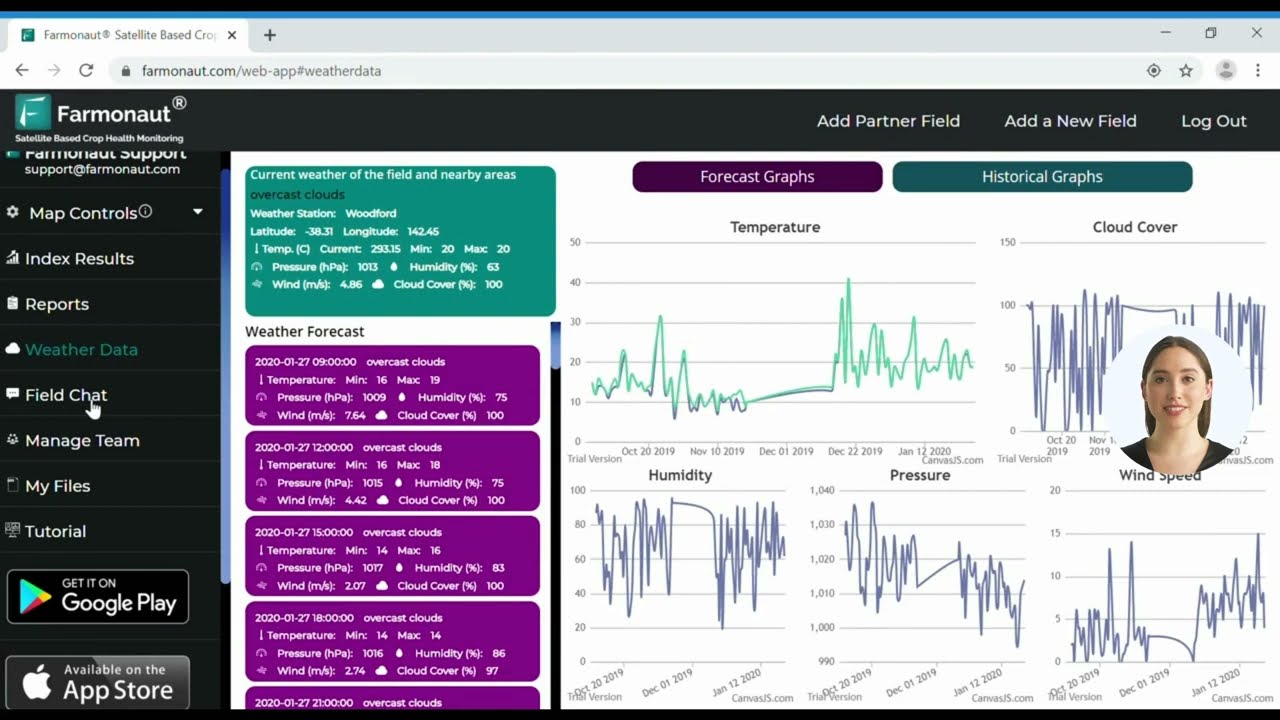
Where Farmonaut Fits: Satellite Weather Without Hardware
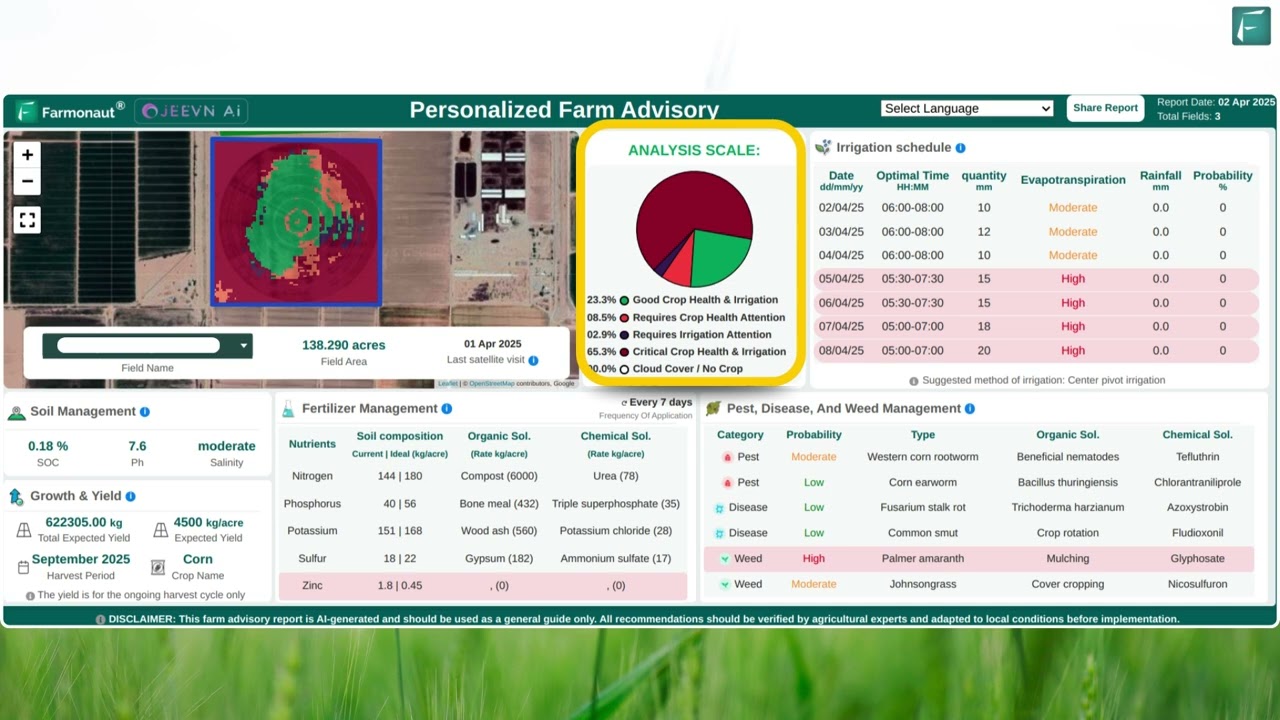
Farmonaut's platform is built as an alternative and complement to standalone hardware: rather than installing a $1,500–$10,000 physical station per field, the platform delivers weather parameters — temperature, rainfall, humidity, wind, soil moisture, and solar radiation — combined with satellite-derived crop health data (NDVI) through a subscription accessed via web, iOS, Android, or a direct API.
This matters most for operations that either can't justify per-field hardware cost, manage multiple non-contiguous fields, or want weather and crop-health data in one dashboard rather than two separate systems. It matters less for an operation that specifically needs hyperlocal microclimate readings — frost pockets, canopy-level humidity in a vineyard — where a physical station at that exact location remains the more precise source. Many operations use both: ground stations for the sites where microclimate variation is highest, and satellite-based monitoring for full-field and multi-field coverage.
Want to try Farmonaut's platform directly?
Tracking environmental impact alongside weather data? Farmonaut Carbon Footprinting Tools help monitor and manage your farm's carbon emissions.
How to Choose a Station for Your Farm
Match the equipment to the specific decision you need to make, not to the longest sensor list on a spec sheet:
- Crop and decision type — an orchard or vineyard managing disease pressure needs leaf wetness and humidity sensors; a row-crop operation managing irrigation timing needs soil moisture and rainfall above all else.
- Farm size and field count — a single-field operation may need one station; a multi-field or multi-county operation should compare the per-field hardware cost (see the calculator above) against a satellite-and-API platform that covers every field under one subscription.
- Connectivity at the site — cellular or LoRaWAN models are worth the added cost in areas without reliable Wi-Fi; check coverage before ordering a Wi-Fi-only unit for a remote field.
- Budget and total cost of ownership — hardware sticker price is only part of the cost; factor in data plan fees, sensor calibration/replacement, and installation labor.
- Data destination — confirm the station or platform can export to, or integrate with, whatever farm management or accounting software you already use via API.
Use the University of Arizona Cooperative Extension's grower's guide (linked above) as a starting framework organized by irrigation and crop type, and cross-check current hardware pricing against Weather Shack's listings before finalizing a purchase.
Frequently Asked Questions
What is the best weather station for farmers?
There is no single best model — the right choice depends on what you're deciding. For irrigation timing and disease-pressure monitoring, a mid-range multi-sensor station ($3,000–$10,000) with soil moisture and solar radiation sensors covers the most decisions. For basic frost and rainfall tracking on a smaller operation, a basic automated station ($1,500–$3,000) is usually sufficient. Operations managing multiple fields should compare that per-field hardware cost against a subscription-based satellite platform like Farmonaut, which covers weather and crop health across every field without per-site hardware.
How much does an agricultural weather station cost?
Basic automated agricultural weather stations run $1,500 to $3,000; mid-range stations with soil, solar radiation, and cellular connectivity run $3,000 to $10,000, per 2024 pricing compiled from AgriExpo and Ambient Weather listings via Weather Shack. Confirm current pricing on specific models directly with the retailer, since hardware pricing shifts with each release cycle.
How is a farm weather station different from a regular home weather station?
The core difference is sensor selection and ruggedization: agricultural units add soil moisture, soil temperature, and solar radiation sensors that consumer/home stations typically omit, and are built for continuous outdoor field placement rather than a backyard mount. Connectivity options (cellular, LoRaWAN) built for remote fields without home Wi-Fi are also more common on ag-grade units.
What weather data matters most for agriculture?
Rainfall, soil moisture, air temperature, relative humidity, wind speed, and solar radiation are the core six parameters most agricultural decisions rely on — irrigation scheduling, frost protection, spray timing, and disease-pressure forecasting all draw on some combination of these.
Can I get farm weather data without buying a physical station?
Yes. Platforms like Farmonaut deliver the same weather parameters (temperature, rainfall, humidity, wind, soil moisture, solar radiation) through satellite data and an API-based subscription, without installing hardware on the field. This trades some hyperlocal microclimate precision for full-field and multi-field coverage at a lower upfront cost.
Can I connect my own weather station to Farmonaut?
Yes, using the Farmonaut API, sensor and weather station data can often be integrated into the platform for a combined field-to-satellite view.
Where can I find updated adoption and market-size figures?
For precision-agriculture technology adoption rates, query USDA NASS Quick Stats at quickstats.nass.usda.gov, updated quarterly. For agricultural weather station market size and growth projections, check ResearchAndMarkets' agricultural weather station report directly, since these projections are typically revised annually.
How do I get started with Farmonaut?
Choose your preferred platform:
- Farmonaut Web App
- Android App
- iOS App
- API Access & Developer Docs





Conclusion
The agricultural weather station market — $91.4 million in 2025, projected to $147.5 million by 2032 per ResearchAndMarkets — reflects steady, not explosive, demand for a category of hardware that solves a specific problem: regional forecasts don't know what's happening on your field right now. Whether that gap gets closed with a $1,500 basic station, a $6,500 mid-range multi-sensor unit, or a satellite-and-API subscription that skips hardware entirely depends on your field count, budget, and the specific decisions — irrigation timing, spray windows, frost protection — you're trying to make with the data.
The durable method here outlasts any single price quote or market forecast: match sensors to decisions, verify current pricing against the retailer before buying, and check USDA ARMS and NASS Quick Stats directly for adoption data rather than relying on a static figure that ages out.
- Try the Farmonaut Web App
- Explore Carbon Footprinting Tools
- Discover Fleet Management for Agriculture
- Learn About Product Traceability Solutions
- View Crop Loan & Insurance Benefits
- Integrate APIs with Your System
Discussion
Questions, corrections or field experience? Share them below. First-time comments are reviewed before they appear, and your email is never published.
No comments yet. Be the first to add a question or your experience.

 Farmitopia
 TVS Electronics
 BW Pipelines
 WICO
WICO Gen Chayat
 Chimera Innovation
 SkyHarvest
 Polaris Digitech
 Teledarbas
 Wild Oak Farm
 SFX
SFX BACF Africa
 Doodlakine
 Exurbia Geospatial
 FieldZero
 Indico Company
 Licence holder · Niger · Gold










