

Automatic Watering System for Greenhouse: Top Automation & Innovations for 2025
Table of Contents
- Introduction: Automation Trends in Greenhouse Irrigation for 2025
- Core Components of an Automatic Watering System for Greenhouse
- How an Automatic Water Irrigation Control System Works
- Advanced Features: AI and IoT Integration in Automated Greenhouse Kits
- Comparative Table: Leading Automatic Watering Systems & Kits (2025)
- Farmonaut and the Role of Satellite Insights in Greenhouse Automation
- Key Benefits of Automatic Greenhouse Water Management
- Sustainable Futures: Precision Agriculture and Smart Greenhouses
- Best Practices, Installation Tips & Troubleshooting
- Farmonaut’s Satellite-Driven Solutions and Product Links
- Frequently Asked Questions (FAQ)
Introduction: Automation Trends in Greenhouse Irrigation for 2025
The evolving landscape of agriculture has shifted dramatically over the past decade. In 2025, the ingenuity behind the automatic watering system for greenhouse has gained significant traction among both smallholder and commercial growers. Automated irrigation kits and automatic water irrigation control systems are reshaping traditional practices by delivering water with unmatched efficiency and precision, ensuring that greenhouse crops thrive even under challenging climatic conditions.
Greenhouses provide a controlled environment for cultivating a wide variety of crops throughout the year. But as water scarcity becomes an increasingly pressing global concern, maintaining optimal soil moisture in greenhouses is no longer a simple task. Now, sophisticated, sensor-based automatic watering systems offer solutions that deliver water based on real-time environmental data and specific crop needs, minimizing wastage and ensuring every plant receives adequate hydration.
At Farmonaut, we recognize the significant impact these automation technologies have on the industry. Our goal is to empower the agricultural sector with accessible, satellite-driven insights and AI analytics, further supporting optimal irrigation strategies for greenhouses worldwide.
Why Is Automated Watering So Crucial in Greenhouse Farming?
- Water Efficiency: Automated systems can reduce greenhouse water use by up to 50%, conserving precious resources.
- Cost Reduction: Lower water bills, decreased labor costs, and minimal crop loss add up to major savings for farmers.
- Precise Irrigation: With the help of advanced sensors and microcontrollers, water is delivered at the right time, to the right place, in the right quantity.
- 24/7 Smart Control: These systems run round the clock, unmanned, and integrated with data analytics tools for continual improvement.

Core Components of an Automatic Watering System for Greenhouse
A modern automatic watering system for greenhouse typically relies on the seamless cooperation of several robust components and software modules.
Main Components
- Moisture Sensors: These are embedded in the soil or growing medium to continuously monitor the humidity levels. When the moisture drops below a predefined threshold, they activate the watering system.
- Microcontrollers: Positioned as the “brain” of the system, microcontrollers receive sensor data, process it, and determine when and how much water to dispense.
- Pumps & Valves: Pumps supply water from reservoirs, while valves manage flow to different watering zones within the greenhouse.
- Central Control Unit: Integrated with advanced software, this unit coordinates all operations—regulating watering schedules, logging data, and responding dynamically to crop needs.
- Connectivity Modules: These modules (often WiFi, GSM, or IoT-based) allow farmers to monitor and control their systems remotely via apps or web dashboards.
Optional Advanced Modules
- Climate Control Units: These manage temperature, humidity, and ventilation for complete environmental management.
- Lighting Systems: Automated grow lights can be integrated, ensuring crops receive adequate light year-round.
- Fertilization Modules: Enable precise, automated fertilizing routines alongside irrigation (see how large-scale farm management benefits).
This integrated approach forms the backbone of modern automated greenhouse kits, meeting the needs of both compact urban farms and large commercial operations.

How an Automatic Water Irrigation Control System Works
Let’s dive deeper into the processes and flows involved in an automatic water irrigation control system for greenhouses:
Step-by-Step: Irrigation System Logic
-
Sensor Data Collection:
- Soil moisture sensors and sometimes environmental sensors for temperature and humidity are embedded in the growing medium.
- These sensors continuously monitor levels and relay data to a central controller.
-
Smart Decision-Making:
- The control unit processes incoming sensor data via integrated AI or machine learning modules (in advanced systems).
- It compares current moisture and environmental conditions to preset thresholds tailored to each crop type and growth stage.
-
Activation:
- If readings indicate moisture has dropped below optimal thresholds, the controller activates pumps and opens the right valves.
- This delivers water directly to the root zone with minimal wastage.
-
Real-Time Adjustment:
- The system can adjust watering frequency and volume automatically, based on ongoing data—optimizing hydration especially during changing climate conditions.
-
Remote Access & Analytics:
- Farmers can monitor, control, and fine-tune settings via mobile apps (Farmonaut Web App, Android, iOS).
- Historical watering data is stored for future optimization, often incorporating AI-based analytics for predictive irrigation.

Advanced Features: AI and IoT Integration in Automated Greenhouse Kits
2025 is a landmark year for agricultural automation. AI-driven analytics and IoT (Internet of Things) integration are now mainstream in advanced automated greenhouse kits. These features streamline everything from scheduling to climate control and fertilization—raising productivity to new heights.
Key Innovations
-
Machine Learning Algorithms
These learn from historical environmental data and crop feedback, helping systems adjust watering cycles dynamically, reducing human guesswork and promoting crop health. -
Weather Forecast Integration
Many automatic watering systems for greenhouses are now linked to real-time weather forecasts, reducing unnecessary watering before rainfall or increasing irrigation during heatwaves. -
Comprehensive Environment Management
Automation goes beyond watering: temperature, humidity, ventilation, lighting, and nourishment can all be centralized—true “smart greenhouse” solutions. -
Analytics Platforms
Integrated platforms let growers analyze watering efficiency, crop performance, and resource use—critical for sustainable agriculture.
Farmonaut’s Web App enables drone-level and satellite-level crop monitoring, helping farmers optimize their irrigation strategies with satellite data and AI. -
Remote Access and Alerts
Through mobile and web apps, users monitor and control their automatic watering system for greenhouse remotely, with real-time alerts and system health notifications.

Popular Control Methods in 2025
- Smartphone Apps (iOS, Android, Web)
- Automated Timers
- Voice Command Integration
- Manual Backup for Emergencies
The embrace of AI, IoT, and data analytics in greenhouses is making advanced, smallholder, and large-scale farming not just possible, but accessible and scalable for everyone.

Comparative Table: Leading Automatic Watering Systems & Kits (2025)
Comparing automatic greenhouse irrigation solutions side by side is the best way to determine which technology meets your specific farming needs. Below is an informative, SEO-optimized table offering key features at a glance.
| System Name | Automation Level | Water Efficiency (% Est. Savings) |
Control Method | Coverage Area (sq. meters) |
Sensor Types | Installation Complexity | Est. Price Range (USD) |
|---|---|---|---|---|---|---|---|
| GreenSense Pro | Fully Automatic | 45–60% | App/Web Dashboard | Up to 1000 | Soil moisture, humidity, temp | Medium | $1800 – $2200 |
| AquaGrow Max Kit | Partially Automatic | 30–40% | Manual/Timer | Up to 400 | Soil moisture | Low | $400 – $600 |
| Eco-Irrigate AI | Fully Automatic (AI-Powered) | 50–65% | App/Web/Voice | Up to 3000 | Soil, weather, light, CO2 | High | $3500 – $5500 |
| HydroSys Greenhouse Lite | Partially Automatic | 28–36% | Timer/Manual | Up to 250 | Soil moisture | Low | $200 – $350 |
| AgriSmart Plus+ | Fully Automatic | 55–70% | App/Web | Up to 1500 | Soil moisture, temp, humidity | Medium | $1500 – $2100 |
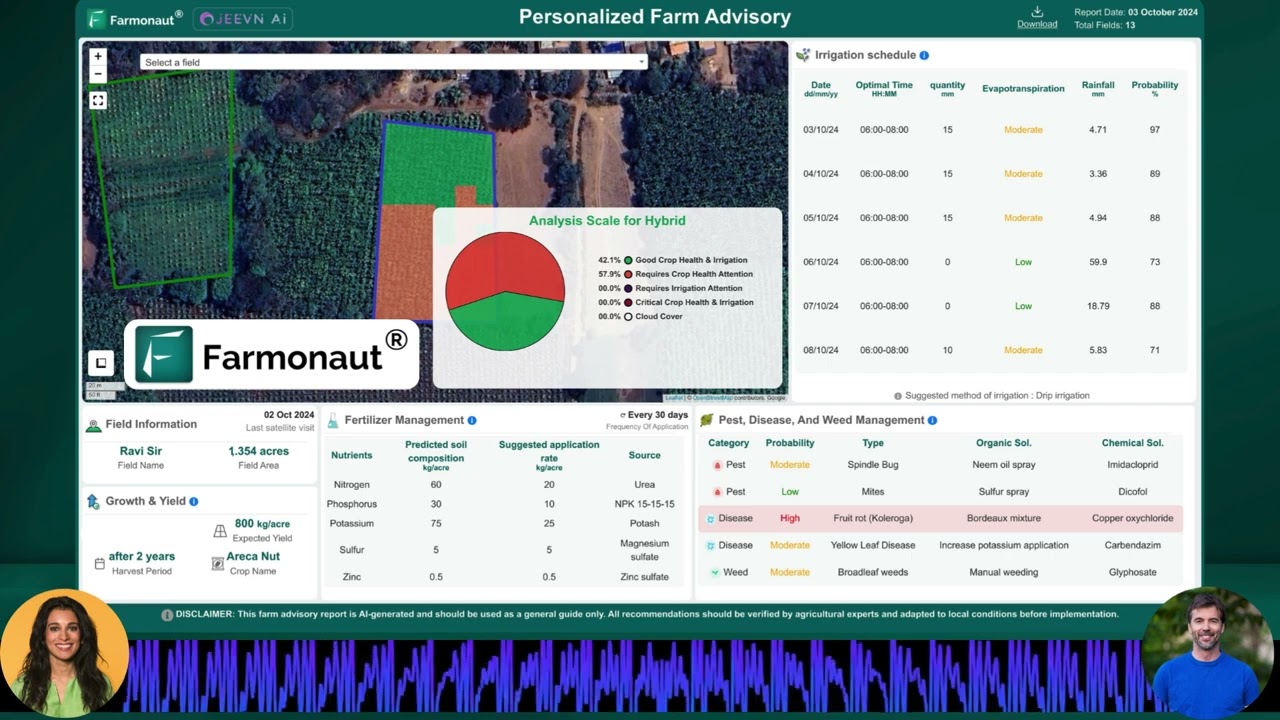
Farmonaut and the Role of Satellite Insights in Greenhouse Automation
Farmonaut is not an irrigation hardware provider; instead, our mission is to make real-time satellite and environmental data affordable and accessible, which is an essential part of fine-tuning greenhouse irrigation management. Here’s how Farmonaut’s platform supports greenhouse automation in 2025:
-
Satellite Monitoring:
- Farmonaut’s multispectral satellite data enables remote monitoring of crop health, soil conditions, and vegetation indices within greenhouses and open fields.
- NDVI (Normalized Difference Vegetation Index) and soil moisture maps inform optimal watering schedules and prevent plant stress.
-
Jeevn AI Advisory:
- Our Jeevn AI provides real-time, tailored irrigation advice by analyzing current environmental data and historic patterns—ensuring crops always receive exactly what they need.
-
Blockchain-Based Traceability:
- With blockchain traceability, every irrigation event and input is logged, improving transparency and sustainability for supply chains and premium produce verification.
-
Environmental Impact Monitoring:
- Automatic carbon footprinting tools help farmers understand the sustainability of water usage and greenhouse gas emissions, essential for modern greenhouses focused on eco-compliance.
Such synergistic use of digital data, satellite imagery, and AI—when integrated with automatic watering systems for greenhouses—marks a new era of responsive, sustainable farming.

Key Benefits of Automatic Greenhouse Water Management
-
Water Conservation (Efficient Use):
- Delivers water precisely as needed—no more, no less, minimizing wastage.
-
Labor Reduction:
- Eliminates manual irrigation and reduces workforce demands, especially for large greenhouses.
-
Optimized Yield and Quality:
- Ensures crops receive optimal hydration and consistent growing conditions.
- Reduces stress and diseases associated with inconsistent watering.
-
Cost Savings:
- Through automation, farmers lower both variable and fixed costs, resulting in better margins.
-
Environmental Sustainability:
- Reduces runoff that can degrade soil and local water supplies.
- Supports compliance with sustainable farming standards.
-
Scalability and Accessibility:
- Modern automated greenhouse kits can be scaled to suit both smallholder and commercial operations, with simple installation modules.
-
Remote Monitoring & Analytics:
- Control from anywhere; analyze historical watering data for smarter, data-driven management.
-
Climate Adaptability:
- With integrated climate sensors, systems adapt to unpredictable weather and environmental fluctuations, ensuring crop resilience.

Sustainable Futures: Precision Agriculture and Smart Greenhouses
Automatic Watering and Precision Agriculture
Automatic watering systems for greenhouses align directly with the goals of precision agriculture—maximizing output with minimal resource input. By introducing sensor-based management, automated greenhouse kits maximize yields and minimize environmental detriments.
- Smart Adaptation: Systems adjust water delivery in real-time, compensating for unexpected heat, cold snaps, or rainfall, in any climate.
- Eco-Friendly Technology: Many kits integrate solar-powered pumps and hardware, reducing reliance on grid power and boosting sustainability.
- Data-Driven Resource Management: Historical, real-time, and predictive data leads to smarter, closed-loop irrigation cycles.
What’s New for 2025?
- Machine learning and AI-powered control modules are now standard in mid-to-high-end kits.
- Seamless integration with farm management and satellite advisory platforms, like Farmonaut, means irrigation aligns with broad resource goals—including carbon management (see our carbon footprinting solution).
- Remote, app-based configuration and monitoring ensures accessibility anywhere in the world.
These trends make automated greenhouse irrigation truly accessible and pivotal for modern, sustainable farming beyond 2025.



Best Practices, Installation Tips & Troubleshooting
Installation Tips for Automatic Watering Systems for Greenhouse
-
Site Preparation:
- Verify greenhouse water pressure and access points in advance.
- Clear growing beds to facilitate sensor and pipe installation.
-
Sensor Placement:
- Position moisture sensors at varying depths for accurate readings, especially if growing root crops.
-
Power Source:
- Use solar backups where possible to ensure continuous operation during outages (trend in 2025).
-
Network Connectivity:
- Install IoT-based systems in areas with reliable WiFi or GSM signal for remote control.
-
Testing:
- Test system logic with water off, then on—ensure all zones receive correct volumes without leaks.
Irrigation System Troubleshooting
- Low Moisture Alerts: Check sensor connections and calibration; clean sensors if coated.
- No Water Flow: Check pumps, pipes, and valve states; verify water supply and power.
- Inconsistent Watering: Inspect sensor placement and software thresholds.
- Remote Access Issues: Verify internet connectivity, app login credentials, and controller firmware versions.
For large and complex setups, consult the product manual and reach out to the solution provider for ongoing support.
Farmonaut’s Satellite-Driven Solutions and Product Links
Automatic watering in greenhouses is further enhanced when integrated with wider agricultural technology platforms. Here are some standout Farmonaut solutions:
- Farmonaut Crop Monitoring Web & Mobile App: Monitor crop health, field moisture, and environmental variability using satellite imagery and AI-driven insights. Essential for optimizing irrigation and maximizing yield.
- Carbon Footprinting Solution: Quantifies the greenhouse gas emissions and resource impacts associated with irrigation and overall greenhouse operations.
- Product Traceability via Blockchain: Track every input—including water and nutrient events—across the supply chain, ensuring food safety and quality for greenhouse-grown crops.
- Satellite-Based Crop Loan & Insurance Verification: Use field health and irrigation activity records for stress-free financing and insurance in the agricultural sector.
- Fleet and Resource Management: Schedule and monitor greenhouse equipment for efficient usage, reducing downtime and operational costs.
- Farmonaut Satellite and Weather API: Integrate satellite data, NDVI, and microclimate analytics directly into your greenhouse automation platform or research systems.
- API Developer Docs: Comprehensive resources for integrating Farmonaut’s advanced data streams into custom greenhouse or irrigation control systems.
Conclusion: The Indispensable Role of Automatic Watering Systems in Greenhouse Agriculture
The automatic watering system for greenhouse, realized via advanced automated greenhouse kits and robust automatic water irrigation control systems, stands at the heart of modern, sustainable agriculture in 2025 and beyond. These solutions are more than just “smart gadgets”—they are essential for ensuring efficient water management, reducing waste, and optimizing yields.
By embracing data-driven, sensor-integrated, and AI-enabled irrigation technologies, farmers in all climates can conserve resources, cut costs, and produce higher quality crops. Greenhouse farming—once dependent on manual effort and seasonal guesswork—now operates independently of environmental whims while being responsive to crop needs. As technology continues to evolve, integrated platforms like Farmonaut will provide growers with the analytical and satellite insights crucial for climate-resilient, profitable agriculture.
Frequently Asked Questions (FAQ): Automatic Watering System for Greenhouse
What is an automatic watering system for greenhouse?
An automatic watering system for greenhouse is a sensor-driven irrigation control framework that delivers water to crops precisely when needed, using soil moisture sensors, microcontrollers, pumps, and valves. It actively adapts to real-time environmental and crop data.
How much water can I save using automated greenhouse irrigation?
Studies and commercial deployments show that automated watering systems can reduce water usage by up to 50%, compared to manual irrigation.
How is the system controlled?
Through smartphone apps, web dashboards, automated timers, or manual overrides in emergencies. Most 2025 systems also support remote monitoring and analytics integration.
Can I use an automatic water irrigation control system for any crop?
Yes. These systems allow users to set crop-specific thresholds for soil moisture, temperature, and humidity, making them suitable for vegetables, fruits, flowers, and more.
What is the typical installation complexity?
Most all-in-one kits offer straightforward installation for standard greenhouses. More advanced or large-scale systems may require professional setup for sensors and controller integration.
Can Farmonaut provide hardware for irrigation automation?
Farmonaut does not manufacture or sell irrigation hardware. Instead, we provide satellite-based data, AI analytics, and resource management solutions to help optimize irrigation strategies and monitor crop and soil health remotely.
What role does satellite data play in greenhouse irrigation?
Satellite data from platforms like Farmonaut guides smarter watering schedules by showing crop stress, vegetation health, and environmental fluctuations not visible by eye or ground sensor alone.
How can smallholder farmers benefit from automation?
Cost-effective kits and accessible software make advanced irrigation and resource management available to even small-scale or beginner greenhouse operators, driving better yields and lower input costs.
How do I access Farmonaut’s tools?
Use our Web App or download the mobile apps for Android and iOS. Developers and businesses can integrate insights through our API.
Ready to optimize your irrigation and greenhouse management? Explore Farmonaut’s crop monitoring solutions and automation-friendly insights today!
Discussion
Questions, corrections or field experience? Share them below. First-time comments are reviewed before they appear, and your email is never published.
No comments yet. Be the first to add a question or your experience.

 Atur Kuliner
 GlobalQuant
 MDCV UK
 Zerella Group
 Etech Consulting Madagascar
 Vestlandsforsking
 Agritein
 Delicio
 WB Dev
 Sama Premium
 Prochecker
 Tres Valles
 LACOS Geoinformation
 Magrifly
 LatConnect 60
 Blickwinkel
 Agricultural Credit Policy Council
 Marei Nursery
 eKGIS
eKGIS Mostas Tech
