

Herbicides · Injury guide
245T Herbicide: Ban History, 2,4-D and Acuron Damage
245T (2,4,5-T) is an obsolete herbicide: EPA canceled all US uses in 1985, and EPA says it contained high levels of dioxin. Its cousin 2,4-D is still sold and often reaches crops by drift. Acuron is a corn premix. If you suspect damage, check the label points on crop stage, rate and rotation first.
Key takeaways
- EPA canceled all US uses of 2,4,5-T in 1985. It is also not approved in the EU or Great Britain, and Australia withdrew it in the late 1980s.
- 2,4-D is not Agent Orange. Agent Orange mixed it with 2,4,5-T, and EPA says dioxins are no longer detectable in the version sold in the US.
- In an Ohio State simulation at 10 mph, 100-micron droplets drifted 17.48 ft against 0.96 ft for 200-micron droplets.
- Soybean trials reviewed by Iowa State showed losses from 2,4-D ranging from about 0% to a top of 65%, depending on dose and stage.
- Acuron rotation intervals for crops other than corn run from 4 to 18 months in a 2016 Nebraska summary. Check the current label.
In this article
- 245T herbicide, 2,4-D and Acuron compared
- What 245T herbicide was and why it was banned
- Could 245T residue still hurt a crop on old ground?
- 2,4-D: what it does and how it injures crops
- How to reduce herbicide drift
- Acuron herbicide: what it is and how damage happens
- How to tell which herbicide caused the damage
- Managing weed resistance without more risk
- FAQ
245T herbicide is 2,4,5-trichlorophenoxyacetic acid, an old brush killer that US farmers can no longer use: EPA canceled all its uses in 1985, and EPA says it contained high levels of dioxin. It is often confused with its still-sold cousin 2,4-D, and it is unrelated to Acuron, a modern corn premix.
This page separates the three. It explains why 245T went away, how to tell auxin drift from Acuron injury in the field, what old spray history means for your land, and how to weigh the cost of drift prevention with a short calculator.
245T herbicide, 2,4-D and Acuron compared
The three names turn up in one search, but they have different histories and do different jobs.
| Point | 245T | 2,4-D | Acuron |
|---|---|---|---|
| Active ingredient | 2,4,5-T | 2,4-D | S-metolachlor, atrazine, mesotrione, bicyclopyrone |
| Status | US uses canceled in 1985; not approved in the EU or Great Britain | Registered in the US | US Restricted Use Pesticide for corn |
| Main use | Mainly non-cropped areas, including woody plants | Broadleaf weeds in grass crops, turf, pasture and non-crop sites | Grass and broadleaf weeds in corn |
| Injury route | No current spraying; old history only | Drift, vapor or a dirty sprayer | Wrong crop, wrong timing, or rotating too soon |
| What to do | Check site records and ask your regulator | Control droplets, wind and sprayer hygiene | Follow the label on rate, crop stage and rotation |
What 245T herbicide was and why it was banned
The compound belongs to the chlorophenoxy family, the same family as 2,4-D. The University of Hertfordshire Pesticide Properties Database calls it obsolete and says it was used mainly on non-cropped areas. An Australian federal contaminated-site guideline adds that it was used on broad-leaved woody plants such as blackberries.
The central worry was what came with it. EPA says 2,4,5-T contained high levels of dioxin, a contaminant found to cause cancer and other health problems in people. The Australian guideline names that contaminant as TCDD. The World Health Organization classes dioxins as persistent pollutants that build up in the food chain, and estimates their half-life in the human body at 7 to 11 years.
Is 2,4-D the same as Agent Orange?
No. EPA is direct on this point. Agent Orange was a mixture of the two herbicides, plus kerosene and diesel fuel. EPA ties the dioxin to 2,4,5-T, and says dioxins are no longer found at detectable levels in the products sold and used in the United States. People with military exposure should see the US Department of Veterans Affairs page on Agent Orange, which covers eligibility for disability compensation.
Where 245T stands around the world
- United States: all uses canceled in 1985 (EPA).
- EU and Great Britain: listed as not approved in the Hertfordshire database.
- Australia: withdrawn from use in the late 1980s and no longer approved or marketed, according to the federal guideline.
- International trade: the Hertfordshire database lists it under Annex III of the Rotterdam Convention, the prior informed consent list for hazardous chemicals in trade.
If someone offers you a product with this active ingredient, do not buy or use it. Check local rules, and ask your pesticide regulator how to dispose of any old container you find in a shed. Do not pour it out or burn it.
▶ A plain explanation of how NDVI satellite maps show crop stress across a large farm. · 4:09
Could 245T residue still hurt a crop on old ground?
The Hertfordshire database gives a soil half-life of 350 days and rates the compound as persistent. On that figure, ten half-lives take a little under ten years and leave less than 0.1% of the starting amount. Real fields vary, so treat this as a rough guide and not a measurement of your land.
That arithmetic points to a practical order of checks. If a crop shows injury this season on land last sprayed with 245T decades ago, look at recent causes first: this season’s sprays, neighbors’ sprays, carryover from recent products and manure or compost brought in. Dioxin contamination is a separate question. The Australian guideline says 2,4,5-T itself is not expected to persist for long, but TCDD will remain and should be assessed where a source may have been present. It concerns health and land use, not crop symptoms, and it calls for an accredited laboratory and your state or national environment agency. Old mixing sites, spill sites and former chemical stores deserve that call before ordinary fields do.
Chart
How long these actives last in soil
Half-life in days; 2,4,5-T a lab value at 20 C; atrazine is the midpoint of 60-75 days, 2,4-D an aerobic mineral soil estimate
2,4-D: what it does and how it injures crops
EPA says this herbicide has been used since the 1940s on turf, rights-of-way, forestry sites, aquatic sites and many field, fruit and vegetable crops. It ranked fifth among conventional active ingredients in US farm use in the EPA sales and usage report (2012 estimates), at 30 to 40 million pounds of active ingredient.
It acts as a synthetic auxin. The National Pesticide Information Center explains that auxin-type herbicides make cells in a plant’s water and nutrient tissues divide and grow without stopping. In soil it fades fairly fast: half is usually gone in 1 to 14 days, with one estimate of 6.2 days in aerobic mineral soil from the NPIC technical fact sheet.
How auxin drift symptoms look
A Purdue Extension guide to herbicide injury says bending and twisting of leaves and stems shows almost immediately after an auxin herbicide lands. Later signs include misshapen leaves, stems and flowers, abnormal roots, and root formation on broadleaf stems. Mississippi State University Extension says exposure often comes from drift droplets, vapors after application or sprayer contamination, and that this kind of damage is often mistaken for disease in tomatoes.
How much yield can this drift cost?
It depends heavily on the crop, the dose and the stage. Iowa State University Extension reviewed soybean work and reports:
- A meta-analysis predicted 0 to 1% yield loss at 1% and 10% exposure (Egan et al., 2014).
- North Carolina trials recorded a top loss of 65%, with rates up to half the label rate (Johnson et al., 2012).
- Trials in Indiana and Illinois found soybean more sensitive at V5 than at V2 or R2 (Robinson et al., 2013).
Cotton is also very sensitive. A Kansas field study in Weed Technology tested rates from 1/400 to 1/100 of use rates on six- to eight-leaf cotton. It called the crop extremely susceptible to simulated drift of this herbicide, and its ester form caused the largest fiber yield reduction of the seven products tested.
Chart
2,4-D dose linked to soybean yield loss
g 2,4-D per hectare needed for each predicted yield loss, by growth stage
How to reduce herbicide drift
EPA defines spray drift as movement of droplets or dust through the air, during or soon after application, to any site other than the one intended. It warns that drift can affect people’s health and the environment and damage nearby crops.
Chart
Simulated drift distance by droplet size and wind
Feet, water droplets, 75 degrees F, 60% humidity, released 18 inches above target
Ohio State University Extension names droplet size and wind speed as the two most influential factors. In its simulation at 10 mph and 60% humidity, 100-micron droplets drifted about 18 times as far as 200-micron droplets, 17.48 ft against 0.96 ft. That is the case for coarser sprays.
- Read the label first. Follow its wind limits, nozzle rules and buffers.
- Pick a nozzle and pressure that make coarser droplets while still giving the weed control you need.
- Keep the boom low. Ohio State counts the distance from nozzle to target among the major drift factors.
- Watch the neighbors. Map sensitive crops such as soybean, cotton and tomatoes before you spray, and note wind direction.
- Clean the tank. Iowa State lists contaminated sprayers as a route of injury alongside off-target movement.
- Keep records: product, rate, time, wind and nozzle for each pass.
Weigh prevention against the crop at risk with the calculator below. A low-drift change costs money on every sprayed acre, while a drift loss hits only the injured acres.
Try the numbers for your own farm below.
Calculator
Does drift prevention pay on your farm?
Enter your own acres, yield, price and prevention cost.
- Crop value at risk, US$: $2,000
- Prevention cost, US$: $2,000
Example values only, set near break-even; not a benchmark or a forecast. Every number is your input. The sum assumes the injury would happen and that prevention stops the whole loss; neither may hold. It leaves out legal costs and any effect on neighbors’ crops.
Acuron herbicide: what it is and how damage happens
Acuron is a premix from Syngenta. University of Nebraska CropWatch lists atrazine, bicyclopyrone, mesotrione and S-metolachlor, plus the safener benoxacor. It can go on field, seed and silage corn before or after emergence. Nebraska reported excellent control of waterhemp, Palmer amaranth, velvetleaf, lambsquarters and foxtails from a 2.5 qt/acre pre-emergence application at one research site.
Chart
What is in a jug of Acuron
Percent of product by active ingredient
The label points below are the ones to check first when Acuron damage is suspected. All are set out in the CropWatch summary:
- Wrong crop stage: sweet corn and yellow popcorn may be treated only before crop emergence, or serious injury may occur.
- Wrong rate: the rate follows soil organic matter, with 2.5 qt/acre below 3% and 3.0 qt/acre at 3% or above, and no more than 3.0 qt/acre a year.
- Too much atrazine: with tank mixes or follow-ups, stay at or under 2.0 lb active ingredient per acre in one application and 2.5 lb per year.
- Rotating too soon: small grains need 4 months; dry beans, potato, soybeans and sorghum need 10 months; other crops need 18 months, with exceptions by region and soil.
The label changes over time, and these figures come from a summary published in 2016. Check the current EPA-approved label on the Syngenta product page before you act on them. That page also lists Acuron as a Restricted Use Pesticide, so check who may buy and apply it where you farm.
How Acuron injury looks
Mesotrione and bicyclopyrone block pigment formation, so affected new growth tends to look white or bleached. Purdue’s guide describes vivid white new growth, sometimes tinged pink or purple, for pigment inhibitors as a class. S-metolachlor fits Purdue’s shoot inhibitor group, where young plants show twisted, dark green shoots and leaves. Atrazine is a photosynthesis inhibitor, and Purdue says injury from that kind of product develops from the bottom of the plant upward, with older leaves hit hardest.
Atrazine in the mix
EPA says atrazine use is highest on field corn, sweet corn, sorghum and sugarcane, and it re-evaluates the chemical through periodic registration review. NPIC gives an average soil half-life of around 60 to 75 days, and slower breakdown in less acidic soil and under cool, dry conditions. That slow fade is one reason to take rotation intervals seriously.
How to tell which herbicide caused the damage
Start with the pattern across the field, then the plant. These signs help you narrow it down, though a lab test or an adviser on site is needed to confirm a cause.
| What you see | Points toward | Check next |
|---|---|---|
| Twisted stems | Auxin herbicide such as 2,4-D or dicamba | Neighbor spray dates, wind, your tank’s last load |
| White new growth | Pigment inhibitor, such as mesotrione | Crop stage at spraying, overlaps, rate |
| Dark, twisted seedlings | Shoot inhibitor, such as S-metolachlor | Crop stage, soil, weather near emergence |
| Older leaves die first | Photosynthesis inhibitor, such as atrazine | Last season’s product and rotation interval |
| Fades from one edge | Drift from that side | Wind record and who sprayed |
| Repeating straight bands | Boom overlap or a nozzle fault | Pass width and sprayer record |
Do not assume injury came from a sprayer at all. A North Carolina State Extension guide warns that picloram, clopyralid and aminopyralid can stay active for an unusually long time in hay, clippings, manure and compost, and it lists products that pair them with other actives. Ask where any bought-in manure came from.
What to do in the first week
- Stop further herbicide passes on the affected zone until you know the cause.
- Take dated photos of damaged and healthy plants, and the edges of the patch.
- Write down your own spray records, wind and any neighbor spraying you noticed.
- Collect plant and soil samples from both damaged and healthy areas, and ask your lab how to store them. Move quickly, since auxin residues can break down fast in soil.
- Call your extension office or a certified adviser. If you suspect a neighbor’s drift, ask your state or national pesticide regulator how to report it.
- Wait before you decide to replant. Iowa State reports one soybean study where 35% visual injury 14 days after exposure matched a 10% yield loss, and a North Carolina study where dicamba symptoms were only a moderate predictor and 2,4-D symptoms were poor indicators of yield.
Satellite vegetation maps can help with step 2. Farmonaut shows changes in plant cover across a field, which helps you see the shape and size of a patch and decide where to walk. The map shows that plants changed, not why, so ground checks still decide the cause.
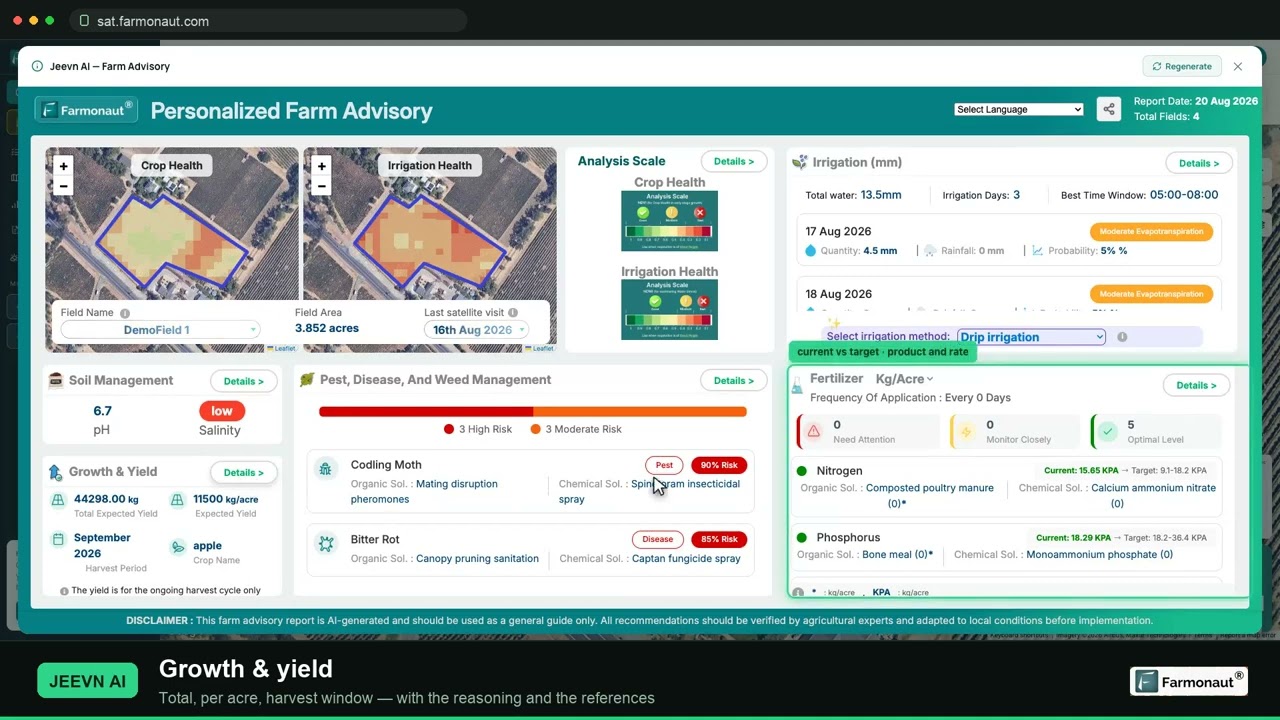
▶ A full walkthrough of reading NDVI and pulling a report for your own field. · 19:36
Managing weed resistance without more risk
Group numbers help you rotate modes of action. Mississippi State places 2,4-D, an auxin mimic, in Group 4. Acuron brings several modes in one jug, and University of Tennessee Extension describes it as a very good resistance management product with three modes of action for many broadleaf weeds. Its 2021 note suggests 1.25 qt/acre pre-emergence, followed by a planned post-emergence partner. That is half the 2.5 qt/acre rate it lists, and it may not suit your soil, so check the label rate first.
A premix does not replace the rest of the program. Vary the modes of action from year to year, use cultivation or cover where it fits, and scout after each pass to see what survived. Your local extension weed guide is worth reading too, since resistance differs by area.
All products here carry legal limits. Check the label and local rules before any application, and get professional advice on health, legal or contamination questions.
Related pages on our site: product traceability, carbon footprinting, crop loan and insurance, fleet management, farm admin tools, satellite data API and mobile app.

▶ A tutorial on monitoring crops with satellite maps in the web app. · 8:43
FAQ
What is 245T herbicide used for?
It was used mainly on non-cropped areas and on woody plants. It is obsolete, and EPA canceled all US uses in 1985.
Is 245T still legal anywhere?
It is not approved in the EU or Great Britain, is no longer approved in Australia, and is listed under the Rotterdam Convention. The Hertfordshire database notes it may still be available in some countries. Rules differ by country, so check with your national regulator before handling any old stock.
What are the side effects of 245T herbicide?
The main concern is dioxin contamination. EPA says the contaminant was found to cause cancer and other health problems in people. WHO adds that dioxins last for years in the body. See a doctor about any exposure concern.
Can 24D be sprayed on corn?
Purdue lists corn among the grass crops for auxin herbicides, but timing and rate come from the product label, which differs by formulation. Check the label for your corn stage.
Does Acuron hurt the next crop?
It can if you rotate too soon. For crops other than corn, intervals in the CropWatch summary run from 4 months for small grains to 18 months for all other rotational crops. The same summary says not to rotate to food or feed crops that the label does not list. Check the current label for your region.
Can satellite images diagnose herbicide damage?
No. They show where plant cover changed. You still need field checks, records and possibly a lab test to name the cause.
Farmonaut crop monitoring
See your own fields from space
Draw your fields once and Farmonaut shows satellite vegetation maps for them through the season, on web, Android or iOS.




Keep reading



Sources
- US EPA, 2,4-D (including 2,4,5-T cancellation note): epa.gov
- University of Hertfordshire, Pesticide Properties Database: 2,4,5-T: sitem.herts.ac.uk
- Australia, NEPM contaminated site guideline, 2,4,5-T summary (2013): legislation.gov.au
- World Health Organization, Dioxins fact sheet: who.int
- US Department of Veterans Affairs, Agent Orange exposure: va.gov
- US EPA, Pesticides Industry Sales and Usage 2008-2012 (2017): epa.gov
- NPIC, 2,4-D general fact sheet: npic.orst.edu
- NPIC, 2,4-D technical fact sheet: npic.orst.edu
- Purdue Extension, WS-23 herbicide mode of action and injury: extension.purdue.edu
- Mississippi State University Extension, Herbicide Damage in Tomatoes: extension.msstate.edu
- Iowa State University Extension, Soybean response to sublethal doses of 2,4-D and dicamba: crops.extension.iastate.edu
- Weed Technology, Cotton Response to Simulated Drift of Seven Hormonal-Type Herbicides: cambridge.org
- US EPA, Introduction to Pesticide Drift: epa.gov
- Ohio State University Extension, FABE-525 drift distances (2016): ohioline.osu.edu
- University of Nebraska CropWatch, Acuron: A New Corn Herbicide (2016): cropwatch.unl.edu
- Syngenta, Acuron product page and label: syngenta-us.com
- US EPA, Atrazine: epa.gov
- NPIC, Atrazine fact sheet: npic.orst.edu
- NC State Extension, Herbicide Carryover: content.ces.ncsu.edu
- University of Tennessee Extension, Corn Herbicide Premixes (2021): news.utcrops.com
Discussion
Questions, corrections or field experience? Share them below. First-time comments are reviewed before they appear, and your email is never published.
No comments yet. Be the first to add a question or your experience.

 Krishi GK
 Geno
 Hayleys Agriculture
 Linx Agritech
 Adinet
 Save Your Soils
 Grandstream Algérie
 XOS Realty
 Geospatial Lab Africa
 Agro La Gándara
 HIPSAC
 ZOL Zimbabwe
 Juligerm
 AdBio
 MISE Maroc
 NWNS

 Licence holder · Niger · Gold










