

Ag Drones: Agriculture & Drones Cost, Impact 2026
Meta Description: Discover how ag drones are revolutionizing agriculture in 2025 and beyond. Explore ag drone cost, benefits, challenges, and the remarkable impact on productivity, resource optimization, and sustainability.
“By 2026, the global agricultural drone market is projected to reach $6.8 billion, a significant leap from 2021.”
- Introduction: The Ag Drone Revolution
- The Role of Agricultural Drones in Modern Farming
- Core Functions & Technological Advancements in Ag Drones
- Precision Agriculture & The Power of Data Analytics
- Ag Drone Cost Analysis & Economic Impact 2025-2026
- Challenges & The Path Forward
- Farmonaut: Satellite-Driven Insights for Smart Farming
- Estimated Cost and Impact of Agricultural Drones vs. Traditional Farming Methods (2025-2026)
- Expert Tips, Highlight Boxes & FAQs
- Conclusion
- Advancements in ag drones are not only boosting yields but also cutting costs—making smart farming accessible for all scales of agriculture.
Introduction: The Ag Drone Revolution & What’s Changing in 2025-2026
In recent years, agriculture and drones have become inseparable, driven by the promise of smarter farming, data-driven management, and precision resource use. With unmanned aerial vehicles (UAVs) now an integral part of the modern farm, farmers are witnessing a transformation in their day-to-day practices—from how they monitor crop health to how they apply fertilizers and pesticides. In 2025 and as we move toward 2026, the adoption and impact of ag drones is set to increase, underpinned by ongoing technological improvements, lower ag drone cost, and the ever-growing need to optimize productivity while also ensuring positive environmental outcomes.
For those aiming to understand how drones will shape farming across continents—be it the vast cornfields of the United States, the rice paddies of Asia, or vineyards in Europe—it’s essential to explore the multi-layered influence of this technology. From initial investment to the far-reaching repercussions on yield, resource use, and sustainability, agricultural drones represent the next frontier in global food production and rural innovation.

How AI Drones Are Saving Farms & Millions in 2025 🌾 | Game-Changing AgriTech You Must See!
- The rapidly growing ag drones market is not limited to farming, but extends to sectors like mining and ESG monitoring—expanding the spectrum of UAV applications.
“In 2025, over 30% of major farms worldwide are expected to adopt ag drone technology for precision agriculture.”
The Role of Agricultural Drones in Modern Farming
Agricultural drones serve multiple vital functions on the farm. At their core, these unmanned vehicles are equipped with advanced cameras (including multispectral and thermal imaging), enabling farmers to monitor crop health in real time. Their aerial perspective complements ground-based practices, allowing for a bird’s-eye view of crop conditions, soil variability, irrigation effectiveness, and potential issues—often long before such problems are visible at field level.
Thanks to this high-resolution imagery and detailed mapping, problems like nutrient deficiencies, pest infestations, drought stress, or fungal diseases can be detected early and addressed precisely. This reduces both input waste and crop losses—translating to greater yields, less environmental damage, and higher profit margins.
Major Roles and Applications of Ag Drones
- Crop Monitoring & Stress Detection:
Capture multispectral and thermal data for real-time crop health assessment. - Soil Analysis & Topographical Mapping:
Facilitate soil variability analysis and inform variable rate applications. - Pest and Disease Detection:
Identify infestations and fungal diseases before they spread. - Irrigation & Water Management:
Optimize timing and zones for irrigation based on aerial insights. - Precision Spraying:
Deliver targeted fertilizers and pesticides to reduce input costs. - Yield Estimation:
Use collected data for yield prediction and planning.
Core Functions & Technological Advancements in Ag Drones
The core power of ag drones stems from their technology: the integration of cutting-edge cameras, onboard AI, machine learning algorithms, and the ability to process data on the fly.
How Ag Drones Work: Technology at a Glance
- ✔ High-Resolution Multispectral Cameras: Capture visible, infrared and more for detailed imaging.
- ✔ Thermal Imaging: Map differences in temperature for irrigation management and early stress detection.
- ✔ AI & Machine Learning: Automatically analyze collected data and generate actionable insights.
- ✔ Automated Flight Paths: Pre-programmed routes make it easier to operate even over larger fields.
- ✔ Increased Payload Capacities: Modern drones can carry additional sensors or spraying tanks for precision applications.
- ✔ Integration with Farm Management Software: Synchronize data with large-scale farm management platforms for seamless decision making.

Arizona Copper Boom 2025 🚀 AI Drones, Hyperspectral & ESG Tech Triple Porphyry Finds
- Choose a drone with multispectral imaging if you need to closely monitor both crop health and soil variability for maximum yield optimization.
Key Technological Advancements in 2025-2026
- 📊 Longer Flight Times & Larger Coverage: New battery tech allows drones to cover hundreds of acres per mission.
- 📊 Autonomous Operation: Minimal manual intervention needed; drones can execute tasks like mapping, spraying, and monitoring automatically.
- 📊 IoT & Weather Integration: Sync real-time sensor data for more precise AI-driven farm management (traceability).
- 📊 Cloud-Connected Analytics Tools: Instantly upload and analyze aerial maps, integrating seamlessly with platforms like Farmonaut’s crop plantation and forest advisory systems.

Saskatchewan Runway Upgrade 2025 ✈️ $1.8M for Rural Aviation, Ag-Spraying & AI Precision Farming
Precision Agriculture & The Power of Data Analytics with Ag Drones
The fundamental shift in modern agriculture is all about precision—doing the right thing, in the right place, at the right time. Ag drones are turbocharging this movement by unlocking a treasure trove of data that would otherwise be impossible or excessively costly to gather.
By leveraging multispectral imaging and advanced analytics, drones offer farmers actionable insights into field variability—all at the push of a button. This enables truly targeted management of soil, inputs, and crop interventions—minimizing waste and maximizing returns.
Visual List: Main Benefits of Data-Driven Drone Analytics
- ⚡ Early disease & pest detection for timely intervention
- 💧 Irrigation optimization addressing water scarcity and usage efficiency
- 🌱 Soil health assessment for variable-rate application of fertilizers and pesticides
- 📈 Yield forecasting and harvest planning
- 🚜 Precision spraying eliminates overapplication and reduces chemical costs
- 👏 Labor savings with automated, large-scale field surveys
- 🛰️ Seamless integration with other ag technologies and satellite data APIs

Farmonaut Web System Tutorial: Monitor Crops via Satellite & AI
- Overlooking data integration with farm management software can limit the full benefits of drone-acquired insights. Always synchronize for holistic decision making!
Visual List: Typical Data Outputs from Ag Drones
- 📷 NDVI & Vegetation Health Maps
- 🗺️ High-Resolution Topographical Field Maps
- 🌡️ Soil Moisture & Temperature Distribution Visualizations
- 🐛 Pest & Disease Hotspot Detected Zones
- 💵 Economic Analysis Reports: Cost-saving & ROI calculations

JEEVN AI: Smart Farming with Satellite & AI Insights
Ag Drone Cost Analysis & Economic Impact 2025-2026
Perhaps the biggest question on every farmer’s mind is: What will adopting ag drones cost—and what do I get in return? In recent years, both the initial investment and operational costs have fallen. Mass production, improved battery technology, and plug-and-play models are trashing old price paradigms, enabling even small and mid-sized farms to access tools once reserved for mega-farming enterprises.
How Much Do Ag Drones Cost? (2025-2026)
- ✔ Entry Level/Basic Imaging Drones: $1,500 – $5,000 USD. Basic models cover mapping and simple crop monitoring.
- ✔ Professional Multispectral/Analytical Models: $5,000 – $12,000 USD. More advanced, with thermal, multispectral, and integrated analytics.
- ✔ Top-Tier Precision Spraying/Heavy Payload Drones: $12,000 – $20,000+ USD. Designed for extensive coverage, autonomous variable rate applications, and long flight times.
Ag drone cost always varies depending on payload capacity, camera types, software integrations, and the extent of analytics built in. Service models like leasing, pay-per-use, and environmental monitoring and carbon footprinting subscriptions further lower the entry barrier—making these drones even more accessible.
Estimated Cost and Impact of Agricultural Drones vs. Traditional Farming Methods (2025-2026)
| Key Factor | Traditional Methods | Ag Drones (2025-2026 Est.) |
|---|---|---|
| Initial Investment | $500 – $2,500 (manual tools/basic machinery) | $1,500 – $20,000+ (based on drone model & sensors) |
| Annual Operating Cost | $5,000 – $20,000 (labor, machinery fuel, input overuse) | $500 – $2,500 (maintenance, batteries, software updates) |
| Data Accuracy | Moderate (sample surveys, visual checks, manual reporting) | High (real-time, detailed multispectral/thermal imagery, AI-driven analysis) |
| Average Yield Increase | 0–5% (subject to weather/luck) | 10–30% (due to precision application, early issue detection, and optimized management) |
| ROI Timeframe | 3–5+ Years | 1–2 Years (in many cases, costs recouped in the first or second season) |
| Labor Savings | Minimal; requires large labor force | 50–70% labor reduction after onboarding and workflow integration |
*Values estimated for average commercial/mid-scale farms. Actual costs and resource savings depend on geography, crop, and scale.
- The major cost benefit of ag drones lies in variable rate applications of fertilizers and pesticides—not only lowering bills but also minimizing environmental runoff.



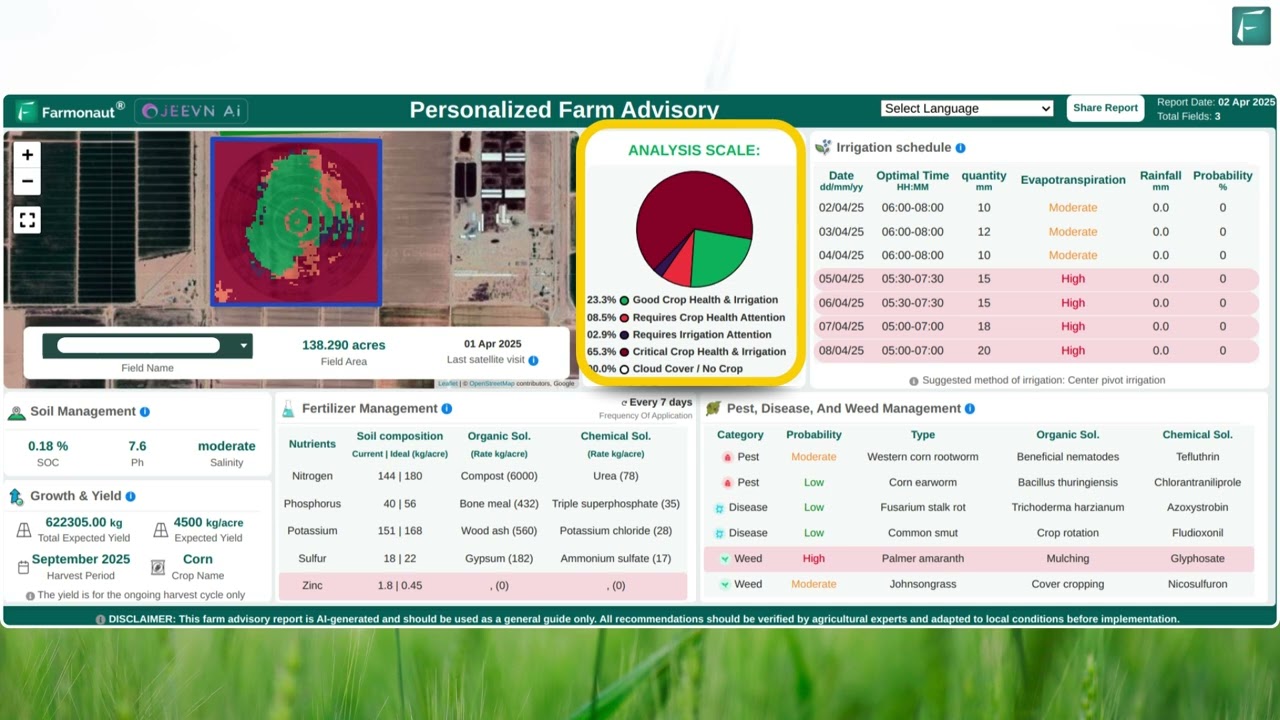
JEEVN AI: The Future of Smart Farming with Satellite & AI Insights
Challenges & The Path Forward for Ag Drones in Agriculture
Even with profound benefits, adoption of ag drones faces some critical hurdles. Regulatory concerns, such as drone airspace rules and pilot certification, differ by country and often create uncertainty. Integration of complex data workflows poses a barrier for some traditional farmers, particularly where digital literacy is limited. Furthermore, initial skepticism and adaptability issues can stall deployment or stifle fast scaling across global farmlands.
However, steady technological improvements, more user-friendly software, and expansion of drone-as-a-service or leasing models are minimizing these obstacles. By 2026, wide-ranging regulatory alignment and advancements in training and support will likely make drone integration smoother for most farms.
✔ 5 Must-Know Challenges in Ag Drone Adoption
- ⚠ Regulatory uncertainty in many regions about flight permissions, spraying chemicals, and data privacy
- ⚠ High initial investment for advanced drone models and analytics tools
- ⚠ Complex integration with existing farm management tools and workflows
- ⚠ Need for digital skills/training among older or traditional farming populations
- ⚠ Weather dependence—drones cannot fly in extreme wind, heavy rain, or poor visibility conditions

Smart Farming Future : Precision Tech & AI: Boosting Harvests, Enhancing Sustainability
Farmonaut: Satellite-Driven Insights for Smart Farming
As agritech evolves, satellite-driven platforms like Farmonaut are making it possible to integrate drone-collected data with broader, field-to-globe agricultural monitoring. Our suite of technologies blends real-time satellite imagery, AI, and blockchain solutions to equip farmers, agribusinesses, financial institutions, and governments with the most comprehensive tools for decision making, resource management, and traceability.
What Farmonaut Offers:
- Satellite-Based Monitoring: Advanced multispectral imagery for crop health, soil conditions, and infrastructure integrity.
- Jeevn AI Advisory: AI-powered insights for weather, disease detection, and operational strategies (suitable for forest and plantation management too).
- Blockchain-Based Traceability: Future-proof your agri-business by tracking products, reducing fraud, and enhancing trust with traceability tools.
- Resource & Fleet Management: Integrate fleet management for agriculture, mining, or infrastructure and lower operational costs.
- Environmental Impact Monitoring: Real-time carbon assessment to boost sustainability.
- Loan and Insurance Verification: Reduce risk and fraud by deploying satellite-based verification for credit and insurance claims.
Our platform is available via Android, iOS, and web apps, as well as APIs for business integration: Farmonaut API Developer Docs here.
By making these insights both affordable and accessible, we democratize access to advanced agriculture and drones solutions, allowing everyone from smallholder to corporate agri-business to thrive in the rapidly evolving, data-powered farm economy.

Smart Farming Future: Precision Tech & AI Boosting Harvests, Enhancing Sustainability
Ready to unlock the full power of satellite-driven ag insights?
Explore affordable subscription packages and maximize ROI with real-time data integration:
Expert Tips, Highlight Boxes & Frequently Asked Questions (FAQs)
- ✔ Ag drones can often recoup their initial cost in just two growing seasons.
- 📊 Pair ag drones with reliable satellite APIs for historical and in-season trend analysis (see Farmonaut APIs).
- ⚠ Frequent mistake: Not updating drone firmware/software before the crop season can cause compatibility issues.
- 📉 Leasing or drone-as-a-service models further decrease the ag drone cost for smaller or seasonal users.
- 🛰️ Leverage blockchain-based traceability to add transparency to your produce’s journey from field to fork.
- 🌱 Optimizing soil health is faster with integrated drone and satellite analysis than with soil sampling alone.
- 💡 Use Jeevn AI advisories to receive real-time alerts on disease, pest, or stress indicators in your farm plots.
- 📈 For enterprise-scale farm management, integrate drone flights with large-scale management consoles.
- 🌎 Monitor carbon emissions and adopt sustainability best practices—valuable for compliance and long-term branding.
Frequently Asked Questions on Ag Drones (2026 Focus)
-
How do ag drones differ from traditional crop monitoring?
Ag drones offer real-time, high-resolution, and multispectral imagery of crop fields, enabling more precise and quicker detection of issues compared with manual walking surveys or basic visual checks. They provide quantifiable data for decisions, which can lead to improved yields and lower waste. -
Are ag drones suitable for small farms, or just commercial operations?
While initial adoption was skewed toward commercial farms, falling costs and simpler drones are rapidly expanding suitability for small and mid-sized operations. Leasing and drone-as-a-service models make advanced analytics affordable even for smallholders. -
What are the regulatory requirements to fly drones for agriculture?
Requirements vary by region but often include registration, pilot certification, and adherence to no-fly zones or restricted airspace. It’s recommended to check with local aviation authorities before deployment. -
How do drones help reduce environmental impact in agriculture?
By enabling precision application of inputs (fertilizers, pesticides, water), drones significantly reduce overapplication, resulting in less chemical runoff and minimal ecological disruption. Their ability to optimize usage also contributes to sustainability goals and compliance (see Farmonaut carbon footprinting). -
What’s needed to integrate ag drone data with farm software systems?
Most advanced models offer direct integration or data exports that sync with farm management software. Platforms like Farmonaut provide easy data-integration APIs for seamless workflow management across devices and user levels. -
Can drones support crop loan and insurance processes?
Absolutely—platforms like Farmonaut help financial institutions verify crop conditions and claims using satellite and drone imagery, cutting turnaround time and reducing fraud risk for loans and insurance in agriculture.
Conclusion: Why Ag Drones Are Unstoppable for Modern Farms
The agricultural drone revolution is redefining what it means to farm in the 2020s—with 2025 and 2026 marking a tipping point in mainstream adoption, not just among tech giants but everyday growers worldwide. Ag drones offer something no other technology has yet provided: real-time, multispectral, precise monitoring and intervention across all types of farms, drastically lowering costs, reducing environmental impact, and unlocking higher yields.
From crop health assessment to pest detection, variable rate applications of fertilizers, and automated field mapping, the synergy between agriculture and drones will only grow stronger as technologies mature, costs drop, and policy frameworks stabilize. By integrating these tools with advanced satellite-driven insights—from platforms like Farmonaut—farmers, businesses, and governments have the chance to supercharge productivity and sustainability from the ground up.
As the world’s food, environment, and supply chain needs intensify through 2026 and beyond, ag drones are set to be an indispensable pillar of precision agriculture, fostering a new era of data-driven, climate-smart, and resource-optimized farming.
Ready to future-proof your farm or agri-business?
Leverage the latest in ag drone technology and satellite-powered insights for a sustainable, profitable, and resilient tomorrow.

 Godrej Agrovet
 Hayleys Agriculture
 Linx Agritech
 Adinet
 Save Your Soils
 GalaxEye Space
 Grandstream Algérie
 XOS Realty
 Geospatial Lab Africa
 Agro La Gándara
 HIPSAC
 ZOL Zimbabwe
 Juligerm
 AdBio
AdBio MISE Maroc
 NWNS
NWNS Red August Group
 Farm Inc
 WeMe Global
 Agrotoken
 Blue BearX
 Insignito
 DnCubed
 Indosistim Teknologi
 Liquify Digital
 CU Foods
 BeyondTech Global
 Rouge VC
 AgroRisk
 Oath Inc
 Esri North East Africa
 MDCV UK
 Etech Consulting Madagascar
 Vestlandsforsking
 WB Dev
 Sama Premium
 Tres Valles
 Blickwinkel
 Agricultural Credit Policy Council
 eKGIS
eKGIS Mostas Tech
 Andex
Andex Deluxe Conseil
 WICO
WICO Chimera Innovation
 SkyHarvest
 Teledarbas
 Exurbia Geospatial
 FieldZero
