

Irrigation · Drip and pivot automation
Netafim Irrigation Automation: Drip, Pivots and Payback
Netafim’s GrowSphere controllers automate valves, pumps and fertigation from a phone. Here is how drip automation compares with center pivots on efficiency, water use and cost, using USDA’s 2023 irrigation survey and university studies, with a calculator to test the payback on your field.
Key takeaways
- Netafim’s GrowSphere MAX controller handles up to 256 valves and 100+ sensors; the FLEX handles 16 valves and 12+ sensors (Netafim).
- Texas A&M assumed 97% application efficiency for subsurface drip, 95% for LEPA, 88% for LESA, 78% for MESA pivots and 60% for furrow.
- US drip and micro irrigation covered 6.43 million acres in 2023, up from 5.86 million in 2018, while total irrigated land fell to 53.1 million acres (USDA NASS).
- Drip-only US fields got 2.2 acre-feet per acre in 2023, more than sprinkler-only fields (1.2), because drip serves thirstier high-value crops.
- Automation pays when saved pumping and labor cover the upgrade; a Nebraska study found variable rate irrigation did not change grain yield.
In this article
- What is Netafim?
- How Netafim irrigation automation works
- Overhead irrigation: sprinklers and center pivots
- Drip vs overhead: water use and efficiency
- US drip irrigation: how much land and what type
- Is drip automation worth it? Costs and payback
- Proof from research: sensors and automated scheduling
- How to choose: drip, pivot or both
- Temporary irrigation systems
- Pressure tanks for irrigation systems
- Athletic field irrigation systems
- Where satellite monitoring fits
- How we checked the numbers
- FAQ
Netafim irrigation automation means running drip or sprinkler blocks from a controller that opens valves, doses fertilizer and reads sensors on a schedule, instead of by hand. Netafim’s GrowSphere controllers do this for pumps, valves and fertigation “remotely from anywhere”, with the larger MAX model handling up to 256 valves and 100+ sensors, according to Netafim’s controller page. Whether it pays depends on how much water your current system wastes, what pumping costs you, and what the upgrade costs.
This guide compares overhead (sprinkler and center pivot) irrigation with Netafim-style drip, using US survey data and university studies. It includes a calculator that tests whether better application efficiency covers the cost of an upgrade on your own field, plus notes on temporary systems, pressure tanks and sports-field irrigation.
What is Netafim?
Netafim is a drip irrigation company. It says it started in 1965 in the Negev desert in Israel, trying to grow crops in desert soil. On its About Us page the company reports 4,500 staff in 110 countries, 33 subsidiaries and 19 manufacturing plants. It also says it has irrigated over ten million hectares and produced over 150 billion drippers for more than 8.5 million farmers over 60 years. These are company figures, not independent counts.
Netafim sells three layers that matter for automation:
- Drippers and driplines that put water at the root zone, on the surface or buried below it.
- Controllers that open and close valves, run pumps and inject fertilizer.
- Software, which Netafim calls the GrowSphere operating system, linking the controller, sensors and the cloud to a phone app.
Other makers sell similar parts. The ideas below apply to any brand of drip or pivot automation.
How Netafim irrigation automation works
An automated drip system has the same parts as a manual one. The FAO drip irrigation manual lists a pump unit, a control head, main and submain lines, laterals and emitters. The control head holds the valves, filters and often a fertilizer tank. Automation adds a controller and sensors on top of that layout.
- Schedule. The grower sets run times or water volumes per valve, per day or per growth stage.
- Sense. Soil moisture probes, flow meters, pressure sensors and weather data feed the controller.
- Act. The controller starts the pump, opens valves in sequence and doses fertilizer through the line (fertigation).
- Alert. If flow or pressure goes outside a set range, the app sends an alarm, which can point to a burst pipe or a blocked filter.
- Review. Logs show what each block received, so the next schedule can be adjusted.
Netafim lists two controller sizes on its controller page. GrowSphere MAX is for medium to large farms with up to 256 valves, multiple mainlines, 100+ sensors and advanced fertigation. GrowSphere FLEX is for small to medium farms with 16 valves, a single mainline, 12+ sensors and simple fertigation. Netafim says its controllers suit open fields, orchards and greenhouses, and that the GrowSphere OS runs both irrigation and fertigation from one place.
What automation does not do
A controller only applies what it is told to apply. If the schedule is wrong, it will apply the wrong amount on time, every time. That is why schedules still need checks against soil moisture, crop stage and weather. Satellite crop maps help here too, because they show which parts of a block look stressed or lush before you can see it from the road.
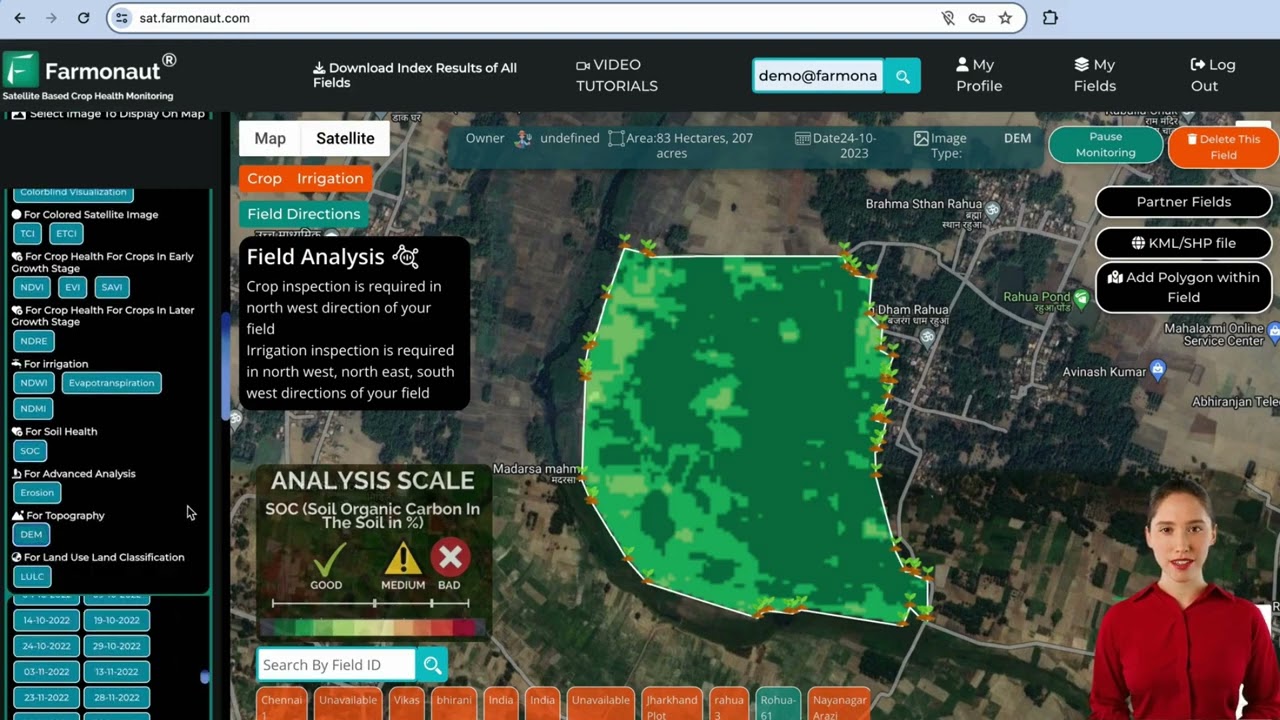
▶ A tutorial of Farmonaut’s web app for satellite monitoring of fields, useful for checking how blocks respond to irrigation. · 8:02
Overhead irrigation: sprinklers and center pivots
Overhead irrigation sprays water over the crop, much like rain. In the US it is the most common method by area. In Nebraska’s CropWatch, University of Nebraska-Lincoln engineers wrote that more than 57% of US irrigated land is equipped with center pivots, citing USDA data from 2019, and that Nebraska alone has over 80,000 center pivots (UNL CropWatch, 2022).
Pivots and linear moves suit large fields of corn, soybeans, wheat, alfalfa and pasture. They cost less per acre than buried drip on big fields and can be moved or towed between fields. Their weak points are wind drift and evaporation from spray, and leaf wetting that can raise disease risk in dense crops.
How pivots are being automated
- Remote panels let growers start, stop and reverse a pivot and set its speed from a phone.
- Variable rate irrigation (VRI) changes the amount applied in different zones of the circle by pulsing sprinklers or changing speed.
- Canopy sensors mounted on the pivot measure crop temperature, which rises when plants are short of water.
The UNL team noted that pivots apply water well, but should be paired with scientific irrigation scheduling. They added that if every field cut seasonal irrigation by one inch, it would have a large positive effect on water resources, yet adoption of scheduling tools has been low.
VRI is not a guaranteed saving. In a West-Central Nebraska study of maize and soybeans, a Landsat-based model set VRI prescriptions. In 2018 VRI prescribed less water than uniform irrigation (265 mm vs 282 mm at full rates), but in 2017 the totals were about the same, and grain yield did not differ between treatments in either year (peer-reviewed study on PubMed Central). The study did not test this, but VRI is most likely to pay where a field is truly uneven.

▶ How satellites, AI and sensors are changing farm decisions, including water management. · 13:27
Drip vs overhead: water use and efficiency
Application efficiency is the share of pumped water that ends up where the crop can use it. A Texas A&M AgriLife study compared five systems used in Texas and assumed 60% for furrow, 78% for mid-elevation spray (MESA) pivots, 88% for low elevation spray (LESA), 95% for LEPA and 97% for subsurface drip (Texas A&M bulletin B-6113). The study found that the systems with the highest application efficiency tended to have the lowest pumping costs.
Chart
Application efficiency by irrigation system
Percent of pumped water assumed available to the crop, Texas study of five systems
That does not mean drip farms use less water per acre. In the USDA 2023 Irrigation and Water Management Survey, fields watered only by drip, trickle or low-flow micro systems got 2.2 acre-feet per acre, against 1.2 for sprinkler-only and 1.7 for gravity-only fields. Drip is used mostly on thirsty, high-value crops such as orchards, vines and vegetables in dry states, so the crop mix drives the total, not the method alone.
| Question | Overhead (pivot or sprinkler) | Drip (surface or buried) |
|---|---|---|
| Best for | Large row-crop, forage and pasture fields | Orchards, vines, vegetables, high-value row crops |
| Efficiency (Texas A&M) | 78% MESA to 95% LEPA | 97% subsurface drip |
| Leaf wetting | Yes, more disease risk in dense canopies | No, foliage stays dry |
| Wind and evaporation | Losses rise with wind and heat | Small, water stays near roots |
| Fertigation | Possible, less precise | Precise, dose by block |
| Main upkeep | Nozzles, tires, gearboxes | Filters, flushing, clog checks, rodent damage |
| Automation | Remote panels, VRI, canopy sensors | Valve controllers, flow and soil sensors |
Chart
Water applied per acre by method, US
Acre-feet per acre on fields in the open watered by only one method
US drip irrigation: how much land and what type
US farms irrigated 53.1 million acres in 2023 with 81 million acre-feet of water, down from 55.9 million acres and 83.4 million acre-feet in 2018, according to the USDA NASS release of 31 October 2024. The average was 1.5 acre-feet per acre in both surveys, and ground water from on-farm wells supplied 54% of the water applied.
Drip is growing even as total irrigated land shrinks. The survey counted 6.43 million acres under drip, trickle or low-flow micro irrigation in 2023, up from 5.86 million in 2018. Surface drip covered 3.33 million acres, low-flow micro sprinklers 1.78 million and subsurface drip 1.10 million. The survey runs every five years and is described on the NASS survey guide page.
Chart
US drip and micro irrigation by type, 2023
Million acres irrigated in the open; a field can count under more than one type
Is drip automation worth it? Costs and payback
The Texas A&M study priced a quarter-section (160 acres) of each system. Gross investment ran from US$208.56 per acre for furrow to US$1,200 per acre for subsurface drip, with a quarter-mile center pivot at US$556 per acre. These are 2011 estimates for Texas, not today’s dealer quotes, so ask local dealers for current prices before you plan.
The savings come from pumping less water to meet the same crop need. If your crop needs 12 inches and your system is 78% efficient, you pump about 15.4 inches. At 95% you pump about 12.6 inches. Each inch saved cuts energy, wear and, where water is metered, the water bill. Labor savings from automation also count, but they vary too much between farms to put in a single number.
Use the calculator below with your own figures. The defaults are examples only, set close to break-even.
Financial results depend on your local prices, water rights and tax rules, so get advice from your dealer, extension office or a farm finance adviser before you buy.
Try the numbers for your own farm below.
Calculator
Does better efficiency pay for an irrigation upgrade?
Enter your field, crop water need, efficiencies and costs.
- Water pumped now: 2,462 acre-in
- Water pumped after upgrade: 2,021 acre-in
- Pumping saved per year: 3,524 US$
- Upgrade cost per year of life: 3,333 US$
Example values only, set near break-even; they are not a quote or a forecast. Efficiencies follow the Texas A&M B-6113 assumptions (78% MESA pivot, 95% LEPA, 97% subsurface drip). Pumping cost and upgrade cost are examples, use today’s price from your power bill and dealer. Labor, yield and subsidy effects are not included.
Proof from research: sensors and automated scheduling
Automated scheduling has been tested in the field. Researchers in Bushland, Texas, used a sensor feedback system called ISSCADA that read crop canopy temperature and set deficit irrigation for cotton automatically in 2021 and 2022 (Frontiers in Plant Science, 2023). They compared its plant-feedback and hybrid modes with manual scheduling on seed cotton yield and irrigation water use efficiency.
For drip, Penn State Extension explains why design matters before any controller is added. Many drip lines emit about 10% more water when pressure rises by 20%; fully pressure-compensating tubes keep the flow even but cost more. Penn State also advises irrigating most crops when about half of the available soil water is used (Penn State Extension). A controller can follow that rule automatically if soil moisture probes are set up well.
How to choose: drip, pivot or both
- Choose drip for orchards, vines, vegetables and fields with poor or saline water. FAO notes drip suits poor-quality water and water-scarce places.
- Choose a pivot for large, square fields of grain, oilseeds or forage where cost per acre matters most.
- Choose low-pressure pivot packages (LESA or LEPA) if you keep a pivot but want to cut losses.
- Choose subsurface drip for long-term row crops where water is costly and you can protect lines from rodents and roots.
- Start small: automate one block or one pivot first and compare its water and yield with a manual block.
Before you buy, test your water for sediment, iron and salts. FAO’s manual notes that screen filters and graded sand filters remove fine material. Good filtering is what keeps emitters from blocking.
Temporary irrigation systems
Temporary systems are portable sprinklers, lay-flat hose and drip tape set up for one season or one job. They suit new orchards before permanent lines go in, nurseries, field trials, reclamation sites, tree planting and drought emergencies. Most can go in or out in a day with few tools. Battery or solar timers can automate them on a small scale.
The trade-off is life span. Thin-wall drip tape is built for short use, and portable pipe and fittings wear faster than buried mainlines. Count replacement in the yearly cost.
Pressure tanks for irrigation systems
A pressure tank stores water under pressure so a well pump does not start and stop each time a valve opens. It smooths pressure and protects the pump from short cycling. On small drip systems fed by a domestic-style well, a correctly sized tank is often the cheapest way to keep emitter flow steady.
Size the tank to the pump’s flow rate and the minimum run time the pump maker gives. Larger farm systems more often use variable frequency drives (VFDs) that change pump speed to hold a set pressure. Either way, drip lines work best at the pressure their maker states, because, as Penn State notes, flow from many drip lines rises with pressure.
Athletic field irrigation systems
Sports fields use buried pop-up sprinklers on a tight grid so turf gets even water without hoses on the playing surface. Modern systems use central controllers, weather data and soil moisture sensors, the same ideas as farm automation. Groundskeepers schedule water at night or early morning to cut evaporation and keep the surface ready for play. Some fields reuse treated wastewater where local rules allow.
The lessons carry over to farms: zone by need, check sprinkler uniformity each season and let sensors stop watering after rain.
Where satellite monitoring fits
Valve logs show what was applied. They do not show how the crop responded. Satellite vegetation maps fill that gap by showing where a block is thriving or falling behind, which can point to a blocked lateral, a failed emitter row or a pivot tower that stalled. Farmonaut gives growers these field maps on web, Android and iOS, and it can sit alongside any irrigation brand.
Related pages on our site: crop monitoring app, satellite and weather data API, large farm management, product traceability, carbon footprinting, fleet management, crop loans and insurance, automated irrigation systems.

▶ Step-by-step: monitor crop health indices for each field with satellite imagery on the Farmonaut web system. · 8:43
How we checked the numbers
US irrigated area and water use come from the USDA NASS 2023 Irrigation and Water Management Survey, the latest edition. Efficiency and cost figures come from a Texas A&M AgriLife bulletin, and we label its costs as 2011 Texas estimates. Netafim product and company facts come from Netafim’s own website, as read in October and November 2026, and are stated as company claims. Research results are given for the crop, place and years each study covered. Every source is listed at the end of the article.
FAQ
What is Netafim irrigation automation?
It is the use of Netafim’s GrowSphere controllers and software to run pumps, valves and fertigation on a schedule, with sensors and a phone app. The MAX controller handles up to 256 valves and the FLEX up to 16, according to Netafim.
Does drip irrigation use less water than a center pivot?
Per inch the crop needs, usually yes: Texas A&M assumed 97% application efficiency for subsurface drip against 78% to 95% for pivot packages. But in the 2023 USDA survey drip-only fields got 2.2 acre-feet per acre, more than sprinkler-only fields, because drip is used on thirstier crops in dry areas.
How much does subsurface drip cost per acre?
A Texas A&M study put subsurface drip at US$1,200 per acre for a 160-acre field, against US$556 per acre for a quarter-mile pivot. Those are 2011 Texas estimates; current dealer quotes will differ.
Can I automate an existing pivot instead of switching to drip?
Yes. Remote panels, low-pressure nozzle packages, canopy sensors and variable rate irrigation can all be added to many pivots. A Nebraska study found VRI did not change grain yield, so it is most likely to pay on uneven fields.
What maintenance does automated drip need?
Clean filters, flush lines, check pressure and flow, and watch for clogged emitters and rodent damage. Flow and pressure alarms on the controller help catch problems early.
Farmonaut crop monitoring
See how your irrigated blocks respond
Draw your fields once and Farmonaut shows satellite vegetation maps for them through the season, on web, Android or iOS, so you can spot dry or uneven areas.




Keep reading
Sources
- Netafim, GrowSphere controllers page (read November 2026): netafim.com
- Netafim, GrowSphere OS digital farming page (read October 2026): netafim.com
- Netafim, About Us (read November 2026): netafim.com
- FAO, Irrigation Water Management training manual, Chapter 6: Drip irrigation: fao.org
- University of Nebraska-Lincoln CropWatch, Sensors on the Pivot for Automated Irrigation Scheduling in the Great Plains (2022): cropwatch.unl.edu
- Variable Rate Irrigation of Maize and Soybean in West-Central Nebraska Under Full and Deficit Irrigation (PubMed Central, 2021): ncbi.nlm.nih.gov
- Texas A&M AgriLife Extension, bulletin B-6113: Irrigation systems in Texas, costs and efficiency (2011): agecoext.tamu.edu
- USDA NASS, 2023 Irrigation and Water Management Survey (2022 Census of Agriculture special study, October 2024): nass.usda.gov
- USDA NASS, 2023 Irrigation and Water Management data now available (news release, 31 October 2024): nass.usda.gov
- USDA NASS, Irrigation and Water Management survey guide: nass.usda.gov
- Frontiers in Plant Science, Sensor feedback system enables automated deficit irrigation scheduling for cotton (2023): frontiersin.org
- Penn State Extension, Drip Irrigation for Vegetable Production: extension.psu.edu
Discussion
Questions, corrections or field experience? Share them below. First-time comments are reviewed before they appear, and your email is never published.
No comments yet. Be the first to add a question or your experience.

 Gator Blueberries
 Liquify Digital
 Ascentya
 CU Foods
 BeyondTech Global
 Rouge VC
 AgroGreen Dynamics
 AgroRisk
 Oath Inc
 Reddane Farming
 Esri North East Africa
 Cresol
 Atur Kuliner
 MDCV UK
 Zerella Group
 Etech Consulting Madagascar
 Vestlandsforsking
 Delicio
 WB Dev
 Sama Premium
 Prochecker
 Tres Valles
 LACOS Geoinformation

 Exploration consultancy · South Africa · Gold
 Licence holder · Niger · Gold
 Client · Tanzania · Gold
 Client · Somalia · Gold










