

Agtech · Projects and build guide
Smart Agriculture Projects: 10 Real Pilots, 5 DIY Builds
Ten documented smart farm projects, from Nebraska’s soil-moisture network on about 2.9 million acres to USDA-funded AI institutes and a camera-guided spraying trial that cut herbicide use by 76% on average, plus five IoT, computer-vision and satellite builds with parts lists and October 2026 list prices.
Key takeaways
- Nebraska’s water management network grew from 15 cooperators in 2005 to about 1,500 on 2.9 million irrigated acres; members cut irrigation by 2.2 inches a season on average (DTN, 2019).
- USDA NIFA funded four AI institutes for farming at about $20 million each: AIFARMS and AIFS in 2020, AgAID and AIIRA in 2021.
- Iowa State’s 2024 See and Spray trial on five soybean fields saved 43.9% to 90.6% of herbicide per field, 76% on average, or about $15.70 per acre.
- In 2023, 27% of US farms used precision agriculture practices, up from 25% in 2021; 85% had internet access (USDA NASS).
- A solar LoRa soil-moisture node can be built from about $86 of parts at October 2026 list prices; a leaf-disease AI model trained on lab photos fell to about 31% accuracy on new field photos.
In this article
- Smart agriculture projects at a glance
- University and USDA-funded smart farm projects
- Commercial pilots and field trials
- Smart farm projects that failed, and what they teach
- How many farms already use precision tools
- AI farm management software: the main types
- Smart agriculture project ideas you can build
- Build 1: soil-moisture IoT sensor node
- Build 2: LoRaWAN sensor network for a whole farm
- Build 3: computer-vision leaf disease detector
- Build 4: weed detection with a camera
- Build 5: satellite NDVI crop monitoring
- How to run a smart farm pilot in 6 steps
- How we chose these projects
Smart agriculture projects use sensors, cameras, satellites and AI to make one farm decision better: when to irrigate, where to spray or which field to scout. Real examples include Nebraska’s soil-moisture network of 1,500 cooperators on about 2.9 million irrigated acres, four USDA-funded AI institutes, and a 2024 Iowa State trial in which camera-guided spraying cut herbicide use by 76% on average across five fields.
This guide lists ten funded or field-tested projects from the US, the UK, Europe and Australia, with what each one found. It then gives five project ideas you can build yourself, from a soil-moisture IoT node to a satellite NDVI monitor, with parts lists, dated list prices and a calculator for the cost of a farm sensor network.
Smart agriculture projects at a glance
The table sums up the ten projects in this guide. Each one has its own entry below, with the source behind it.
| Project | Where and who | Technology | What it found or does |
|---|---|---|---|
| 1. NAWMN | Nebraska, University of Nebraska-Lincoln | Soil-moisture sensors, ET gauges | 2.2 in less irrigation water a season on average (network records) |
| 2. AIFARMS | Illinois, USDA NIFA AI institute | Computer vision, robots, generative AI | CropWizard advisor drawing on 200,000+ publications |
| 3. AIFS | California, USDA NIFA AI institute | AI across the food system | Breeding, production, processing and nutrition research |
| 4. AgAID | Washington State, USDA NIFA AI institute | AI for labor and water decisions | Test crops include apples, cherries, mint and almonds |
| 5. AIIRA | Iowa State, USDA NIFA AI institute | Plant digital twins | Predictive crop models across eight partner groups |
| 6. See and Spray trial | Iowa, Iowa State extension | Camera-guided spot spraying | 43.9% to 90.6% herbicide saved per field |
| 7. Hands Free Hectare | England, Harper Adams University | Autonomous tractor, combine, drones | 4.5 t of spring barley grown with no one in the field |
| 8. IoF2020 | EU, led by Wageningen Research | IoT across farm and food chains | 34 use cases, €30.0 million EU contribution |
| 9. DeepWeeds | Northern Australia, James Cook University | Weed image dataset | 17,509 labelled photos of eight weed species |
| 10. PlantVillage model | Penn State and EPFL | Leaf-disease image AI | 99.35% in lab tests, about 31% on new field photos |
University and USDA-funded smart farm projects
Public projects publish methods and results, and many share code or data that students can reuse.
1. Nebraska Agricultural Water Management Network
The network began in 2005 as a demonstration with 15 farmer cooperators. By 2019 it had about 1,500 cooperators who irrigate about 2.9 million acres, according to a DTN report on the Nebraska network. Farmers bury soil-moisture sensors at several depths and irrigate only when the root zone needs water. Network records show members cut irrigation by 2.2 inches a season on average, and pumping savings reached about $150 million from 2005 to 2016. One farm family put the value of 2 inches saved at about $2,000 on a 132-acre field. The sensor sets cost under $400 each at the time.
Best for: irrigated row-crop farms and anyone building a soil-moisture project.
2. AIFARMS, University of Illinois
In August 2020, USDA’s National Institute of Food and Agriculture (NIFA) and the National Science Foundation funded seven AI institutes at about $20 million each, as Seed World reported on the NIFA and NSF announcement. Two were for farming. The Illinois-led institute works on computer vision, machine learning and farm robots. Its CropWizard tool answers crop questions using more than 200,000 curated publications, mostly extension documents, says the AIFARMS CropWizard update of October 2025.
Best for: students in computer vision, robotics or AI chat tools for advisers.
3. AI Institute for Next Generation Food Systems (AIFS), UC Davis
The second 2020 NIFA institute, led by UC Davis, applies AI from plant breeding through farm production, food processing and nutrition.
Best for: food-science and data-science teams.
4. AgAID Institute, Washington State University
AgAID is a $20 million federal effort led by Washington State University, with Oregon State, UC Merced, Kansas State, Carnegie Mellon and others as partners, according to Oregon State University’s release on AgAID. It studies AI for water, labor and weather decisions. Its test crops include apples, cherries, mint and almonds.
Best for: specialty-crop and farm-labor projects.
5. AIIRA, Iowa State University
AIIRA (AI Institute for Resilient Agriculture) was one of two NIFA-funded institutes named in 2021, alongside AgAID, as Nextgov listed in August 2021. It builds AI “digital twins” of plants, computer models that predict how a crop will grow, with faculty from eight universities and groups, per the AIIRA home page.
Best for: crop-modelling and plant-science students.
Commercial pilots and field trials
Iowa State tested a commercial camera-guided sprayer, John Deere’s See and Spray Ultimate, on five soybean fields that totalled 415 acres in 2024. Savings per field ranged from 43.9% to 90.6%, and the average product saving was 76%, worth nearly $6,500 or $15.70 per acre, reported Iowa State’s Integrated Crop Management news in August 2024. Savings depended on how many weeds were in the field at the start. The trial covered one season and one crop.
Chart
Herbicide saved by camera-guided spraying, per field
Percent of herbicide product saved vs broadcast spraying, five Iowa soybean fields (415 acres), 2024 season
6. Camera-guided spot spraying at farm scale
Deere says the system ran on more than 1 million acres in the 2024 season and saved an estimated 8 million gallons of herbicide mix, according to AgWeb’s summary of the company’s 2024 data. The company reported an average saving of 59% across customer fields in corn, soybeans and cotton (Deere release, September 2024). These are company-reported figures from its own customers. Always follow the herbicide label and local rules when you change rates or application methods.
Best for: large row-crop farms with patchy weed pressure.
7. Hands Free Hectare, England
In 2017, Harper Adams University and Precision Decisions planted, tended and harvested a crop of spring barley using only autonomous vehicles and drones. The crop yielded 4.5 tonnes against a forecast of 5 tonnes. The whole project cost less than £200,000, and Innovate UK paid just under £160,000 of it, said the UK government’s Innovate UK release of September 2017.
Best for: robotics teams planning a small autonomy trial.
8. IoF2020, the EU Internet of Food and Farm project
This EU project ran from January 2017 to March 2021 under Wageningen Research. It cost €34.1 million, of which the EU paid €30.0 million, per the CORDIS project fact sheet. The project site lists 34 use cases, from sensors and drones in arable fields to livestock monitoring and supply-chain tracking.
Best for: European teams who want tested use cases and partner lists.
9. DeepWeeds, Australia
DeepWeeds is an open set of 17,509 labelled photos of eight weed species from eight sites in northern Australia, published in Scientific Reports in 2019. Standard deep-learning models scored 95.1% and 95.7% accuracy on it. The photos were taken in the field, not in a lab, so models trained on them are closer to real conditions.
Best for: computer-vision weed projects.
10. PlantVillage leaf-disease model
A 2016 study trained a network on 54,306 leaf photos covering 14 crops and 26 diseases. It reached 99.35% accuracy on held-out lab images, but just above 31% on photos taken in other conditions, says the study in Frontiers in Plant Science. That gap is the main lesson for any student project: test your model on new photos from real fields.
Best for: first computer-vision projects and science fairs.
Smart farm projects that failed, and what they teach
Not every high-tech farm works. Bowery Farming, an indoor vertical farm run on its own software and sensors, stopped operating in November 2024 after raising more than $700 million. AeroFarms raised more than $300 million and went through bankruptcy, and AppHarvest also filed, reported TechCrunch in November 2024. The lesson for founders: technology must cut a real cost or raise a real price. The working projects above each target one cost, such as water, herbicide or labor.
How many farms already use precision tools
Precision tools are common on large grain farms and still rare on many others. In 2023, 27% of US farms used precision agriculture practices to manage crops or livestock, up from 25% in 2021, according to USDA NASS’s Farm Computer Usage and Ownership report (August 2023). The same survey found 85% of farms had internet access, and 75% of connected farms used a cellular data plan. Use was above half of farms in North Dakota, South Dakota, Nebraska, Iowa and Illinois, and much lower in Texas and Florida.
Chart
Farms using precision agriculture practices
Percent of farms using precision practices to manage crops or livestock, US and selected states
Auto-steer and guidance systems were used on 5.3% of planted corn acres in 2001 and 58% in 2016, says USDA ERS report EIB-248 (2023). Yield maps, soil maps and variable-rate tools reached only 5% to 25% of planted acres for winter wheat, cotton, sorghum and rice.
AI farm management software: the main types
Many smart agriculture projects end in software a farmer opens every day. Farm management software falls into five broad groups:
- Field records and planning: crop plans, input logs, field maps and compliance records.
- Machine data platforms: tractor, sprayer and combine data such as yield maps and as-applied maps, mostly from equipment makers.
- Sensor dashboards: soil moisture, weather and tank levels, with alerts by text or app.
- Satellite crop monitoring: vegetation maps that show which parts of a field are changing, so you scout the right spot first.
- AI advisers: chat or rules-based tools that turn data into suggestions, such as the CropWizard project above.
When you compare tools, ask: can you export your data, does it work with your machines and sensors, what does it cost per acre each year, and who owns the data? An API lets you connect it to other software later.
Smart agriculture project ideas you can build
These five builds use hobby parts and open data. Prices are US online-store list prices checked on 16 October 2026; they change often, and tax and shipping are extra.
| Build | Skill level | Main parts | Parts cost |
|---|---|---|---|
| Soil-moisture node | Beginner | LoRa board, soil sensor, solar kit | About $86 per node |
| LoRaWAN network | Intermediate | Several nodes plus a gateway | $99 gateway plus nodes |
| Leaf-disease detector | Intermediate | Raspberry Pi 5, camera, open dataset | About $160 |
| Weed detector | Advanced | Pi or laptop, camera, DeepWeeds data | About $160 |
| Satellite NDVI monitor | Beginner to intermediate | Laptop, open Sentinel-2 images | No hardware |
Build 1: soil-moisture IoT sensor node
This is the classic smart agriculture project with IoT. A small board reads a soil sensor on a schedule you set, such as every 30 minutes, and sends the value by radio. A solar panel keeps the battery charged, so the node can sit in a field all season.
| Part | Example product | List price |
|---|---|---|
| Board with LoRa radio | Adafruit Feather RP2040 RFM95, 915 MHz | $29.95 |
| Soil sensor | Adafruit STEMMA capacitive soil sensor | $7.50 |
| Solar panel | Voltaic 6V 2W ETFE panel | $20.95 |
| Solar charger | Adafruit bq24074 charger | $14.95 |
| Battery | 3.7V 2000mAh lithium-ion | $12.50 |
| Enclosure and stake | Weatherproof box, cable gland, post | Not priced |
The priced parts add up to $85.85 per node. If the field is within Wi-Fi range, as in a greenhouse, an Arduino UNO R4 WiFi board ($27.50 list) can replace the LoRa board. Low-cost capacitive probes are good for learning and for showing trends. For irrigation decisions, calibrate them against a soil sample, or use farm-grade sensors such as the Watermark granular matrix sensor, which measures soil water tension from 0 to 200 centibars according to Irrometer’s sensor page. The University of Florida’s EDIS guide to automatic irrigation based on soil moisture explains how to set irrigation start and stop points for vegetables.
Chart
List prices of common smart-farm build parts
US dollars, single-unit retail list price, checked 16 October 2026
Build 2: LoRaWAN sensor network for a whole farm
One node shows one spot. A farm needs several nodes, one per soil type or irrigation zone, and a gateway that passes their readings to the internet. A gateway on a barn roof or pole can serve several nodes; test the range on your own land before you buy, since hills, trees and tall crops shorten it. A SenseCAP multi-platform LoRaWAN indoor gateway for the US 915 MHz band lists at $99 at Seeed Studio; it is an indoor unit, so outdoor mounting needs a weatherproof gateway or enclosure. Cellular coverage matters too: in the NASS survey, 75% of connected farms used a cellular data plan.
Before you buy, work out what the network costs per acre each year and what it must save to pay for itself.
Try the numbers for your own farm below.
Calculator
What does a farm sensor network cost per acre?
Enter your own field size, node count, prices and expected savings.
- Upfront hardware: $699
- Yearly cost of ownership: $353
- Break-even saving per acre per year: $2
- Value of savings per year: $360
- Acres per sensor node: 40.0 acres
Example values only, not a benchmark or a forecast. The defaults are round examples chosen to sit near break-even. Every value is your input: node cost should include the enclosure and spares (the solar LoRa parts listed above came to $85.85 at October 2026 list prices), and yearly costs should include data plans, software and replacement parts. Hardware is spread evenly over the lifespan you enter, with no interest or resale value. The saving per acre is your own estimate; for scale, one Nebraska family valued 2 inches of water saved at about $2,000 on 132 acres (DTN, 2019).
Build 3: computer-vision leaf disease detector
This is a common idea for smart agriculture with IoT and computer vision. Train an image model on the open PlantVillage photos, then run it on a Raspberry Pi with a camera. A Raspberry Pi 5 with 4 GB of memory listed at $130 and the Camera Module 3 at $29.25 at Adafruit in October 2026, about $160 together before a power supply and case.
- Download a labelled leaf dataset and split it into training and test sets.
- Fine-tune a small pretrained model such as MobileNet or ResNet on a laptop.
- Export the model and copy it to the Pi.
- Take 100 or more new photos in a real field and test the model on them.
- Report accuracy on those field photos, not just the dataset.
Step 4 matters most. The PlantVillage study’s accuracy fell from 99.35% to about 31% on photos taken in other conditions. A model is a scouting aid, not a diagnosis; confirm any disease with an agronomist or your extension lab before you treat.

▶ Our explainer tests four ways AI looks for crop pests, from traps and phone cameras to drones and satellites. · 6:32
Build 4: weed detection with a camera
Weed detection is the same idea as the leaf model, but the payoff can be larger, as the Iowa State spraying trial showed. Start with the DeepWeeds dataset and classify each photo as one of eight weeds or “no weed”. Then mount a camera on a cart or a quad bike and map where weeds appear along a row. Any real spraying must follow the herbicide label and local rules, and should be supervised by a licensed applicator where your state or country requires one.
Test it on photos from a field the model has never seen, and report both missed weeds and false hits on crop plants.
Build 5: satellite NDVI crop monitoring
Satellite projects need no hardware. The two Sentinel-2 satellites image land in 13 spectral bands, four of them at 10 m resolution, and revisit the equator every 5 days, according to ESA’s Sentinel-2 mission page. Copernicus makes the images available at no charge to the public, researchers and companies through the Copernicus Data Space Ecosystem.
NDVI compares near-infrared and red light: (NIR minus red) divided by (NIR plus red). For Sentinel-2, those are bands B8 and B4. Values of 0.1 and below mean bare rock, sand or snow, 0.2 to 0.3 mean shrubs and grass, and higher values mean dense green plants, says NASA Earth Observatory’s NDVI explainer. A good student project maps NDVI for one field on every cloud-free date in a season, then walks the low spots to find the cause. Clouds block these images, so expect gaps.
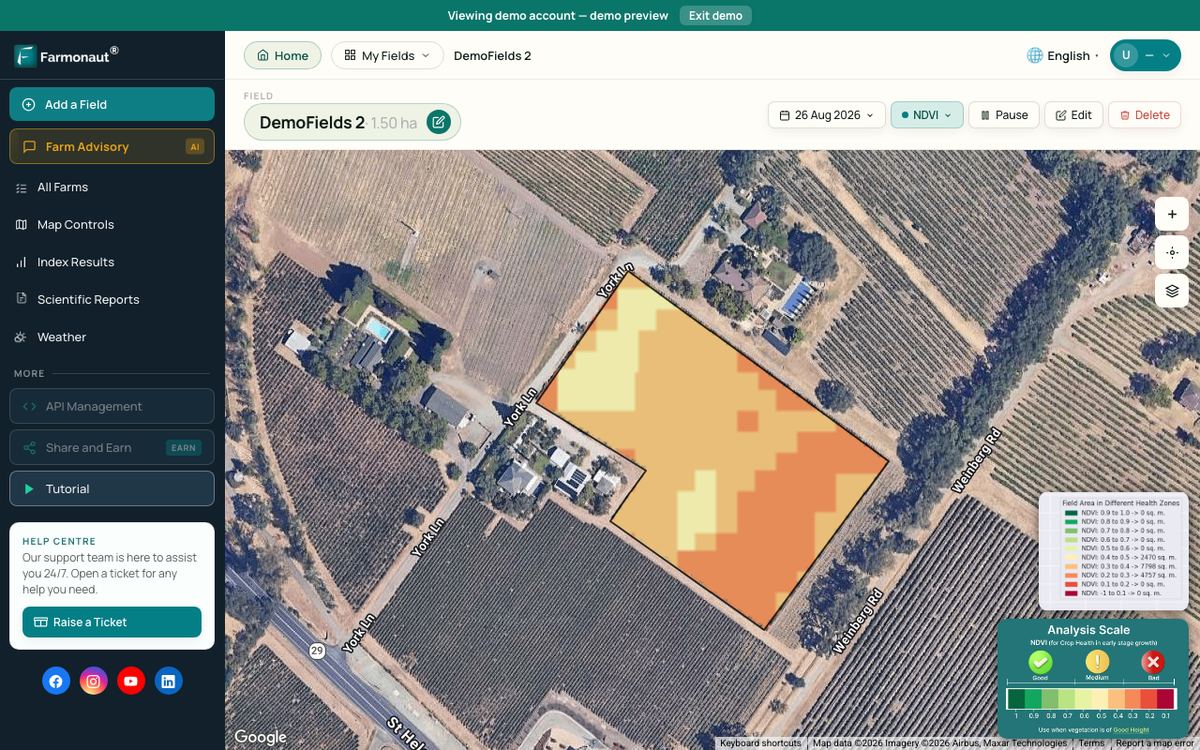
If you would rather use a ready-made tool than code one, the Farmonaut Satellite + AI Farm Monitoring System produces vegetation maps for fields you draw on a map.
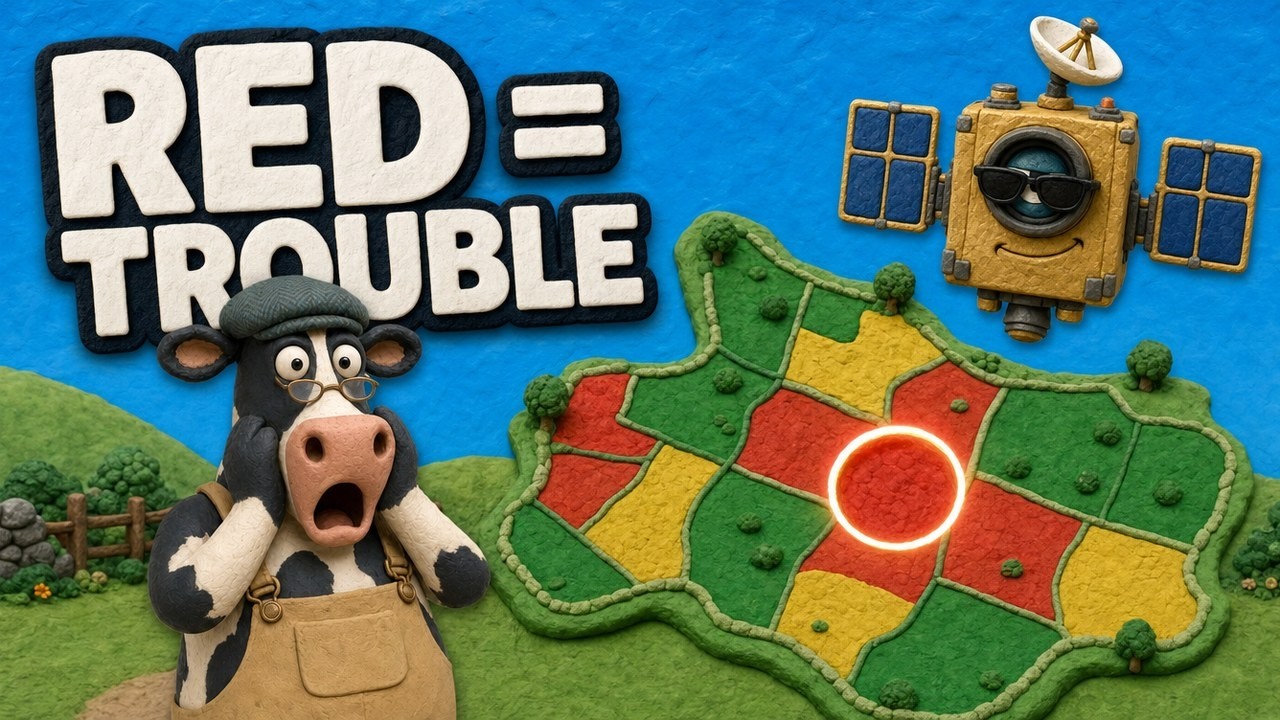
▶ How satellite NDVI maps show crop stress across a large farm before it is easy to see from the ground. · 4:09
How to run a smart farm pilot in 6 steps
- Pick one decision, such as when to start irrigating field 3. It makes success easy to measure.
- Record a baseline. Log water, herbicide, labor hours or yield for one season before the change, or keep a control strip.
- Start small. One field, one crop and two to four sensor nodes, or one satellite layer.
- Check the data against the ground. Sample soil, scout flagged spots and note errors.
- Count the full cost: hardware, data plans, software, time and spare parts.
- Scale only what paid. Add fields or features after one season of results.
For agtech startups, the faster route is often to pull field data from an existing service and spend your effort on the product. The Farmonaut agriculture API is one such option, and its satellite and weather API developer docs show the data fields; satellite data can also be reached through the API dashboard.
Related pages on our site: fleet management, product traceability, carbon footprinting, crop loan and insurance verification and the web and mobile app.
▶ Six plain steps to start precision farming without buying a robot. · 4:18
How we chose these projects
We included a project when a university, government body, journal or the company itself published its scope and results, and we date each figure. Company figures are labelled as company-reported. Build prices are store list prices checked on 16 October 2026, not quotes. Farm results vary with soil, crop, weather and management, so treat each number as one documented case, not a forecast.
For a closer look at a related question, see our guide: Agriculture Robotics: 7 Farm Systems, Real Costs & ROI.
FAQ
What are smart agriculture projects?
Projects that use sensors, cameras, satellites and AI to improve one farm decision, such as irrigation timing, spraying or scouting. Examples range from Nebraska’s soil-moisture network to USDA NIFA AI institutes.
What is a good smart agriculture project with IoT and computer vision for students?
Start with a soil-moisture node (about $86 in parts at October 2026 list prices) or a leaf-disease detector on a Raspberry Pi with the PlantVillage dataset. Test any vision model on new field photos, because lab accuracy can fall sharply in real conditions.
How much does a farm sensor network cost?
The parts for one solar LoRa soil-moisture node listed at about $86 in October 2026, before an enclosure, and a LoRaWAN gateway at $99. Farm-grade sensor sets cost more; Nebraska network sets were under $400 each in 2019. The calculator above adds data plans and lifespan.
Does camera-guided spraying really cut herbicide use?
In Iowa State’s 2024 trial on five soybean fields, savings ranged from 43.9% to 90.6% per field, with a 76% average, and depended on weed pressure. Deere reported a 59% average across its 2024 customer fields. Other crops and years may differ.
Farmonaut agriculture API
Add satellite crop data to your own product
Pull field-level satellite crop health and weather data into your app, sensor platform or student project through the Farmonaut agriculture API (farmonaut.com/farmonaut-agriculture-api).



Keep reading
Sources
- DTN Progressive Farmer, Make it Rain Only When Needed (Nebraska Agricultural Water Management Network, February 2019): dtnpf.com
- Seed World, USDA-NIFA and NSF Establish Network of AI Research Institutes (August 2020): seedworld.com
- AIFARMS, University of Illinois, CropWizard: Growing from Illinois Chat to Cultivate AI for Agriculture (October 2025): aifarms.illinois.edu
- Oregon State University, OSU part of $20M effort to develop artificial intelligence for agriculture (AgAID, July 2021): news.oregonstate.edu
- Nextgov, NSF Adds 11 New AI Research Institutes to Its Collaborative, Nationwide Network (August 2021): nextgov.com
- Iowa State University, AI Institute for Resilient Agriculture (AIIRA) home page: aiira.iastate.edu
- Iowa State University Extension, Integrated Crop Management News, Precision Spraying Technology (August 2024): crops.extension.iastate.edu
- AgWeb, See and Spray: 5 Things John Deere Learned in 2024: agweb.com
- Oklahoma Farm Report, See and Spray Customers See 59% Average Herbicide Savings in 2024 (John Deere release, September 2024): oklahomafarmreport.com
- UK Government (Innovate UK), Autonomous vehicles for farming: world first achieved (September 2017): gov.uk
- European Commission CORDIS, Internet of Food and Farm 2020 (IoF2020) project fact sheet, grant 731884: cordis.europa.eu
- SmartAgriHubs, IoF2020 project summary: iof2020.eu
- Olsen et al., DeepWeeds: A Multiclass Weed Species Image Dataset for Deep Learning, Scientific Reports (2019): nature.com
- Mohanty, Hughes and Salathé, Using Deep Learning for Image-Based Plant Disease Detection, Frontiers in Plant Science (2016): frontiersin.org
- TechCrunch, Bowery Farming is ceasing operations (November 2024): techcrunch.com
- USDA NASS, Farm Computer Usage and Ownership (August 2023): esmis.nal.usda.gov
- USDA ERS, Precision Agriculture in the Digital Era: Recent Adoption on U.S. Farms, EIB-248 (2023): ers.usda.gov
- Irrometer, Soil moisture sensors (Watermark and tensiometer): irrometer.com
- University of Florida IFAS EDIS, Automatic Irrigation Based on Soil Moisture for Vegetable Crops: journals.flvc.org
- ESA SentiWiki, Sentinel-2 mission: sentiwiki.copernicus.eu
- Copernicus Data Space Ecosystem, Sentinel-2 data collection: dataspace.copernicus.eu
- NASA Earth Observatory, Measuring Vegetation (NDVI and EVI): science.nasa.gov
- Adafruit, Feather RP2040 with RFM95 LoRa Radio 915 MHz (list price, October 2026): adafruit.com
- Adafruit, STEMMA Soil Sensor, I2C capacitive moisture sensor (list price, October 2026): adafruit.com
- Adafruit, 6V 2W Solar Panel, Voltaic P126 (list price, October 2026): adafruit.com
- Adafruit, Universal USB/DC/Solar Lithium Ion/Polymer charger bq24074 (list price, October 2026): adafruit.com
- Adafruit, Lithium Ion Battery 3.7V 2000mAh (list price, October 2026): adafruit.com
- Arduino Store USA, Arduino UNO R4 WiFi (list price, October 2026): store-usa.arduino.cc
- Seeed Studio, SenseCAP Multi-Platform LoRaWAN Indoor Gateway US915 (listed price, October 2026): seeedstudio.com
- Adafruit, Raspberry Pi 5 (4 GB and 8 GB options, list price, October 2026): adafruit.com
- Adafruit, Raspberry Pi Camera Module 3 Standard (list price, October 2026): adafruit.com
Discussion
Questions, corrections or field experience? Share them below. First-time comments are reviewed before they appear, and your email is never published.
No comments yet. Be the first to add a question or your experience.

 Aadyah Aerospace
 Kubota
 FFBS
FFBS Jontra
 Kalustyan
 Tucor
Tucor Geno
Geno Hayleys Agriculture
 Linx Agritech
 Adinet
 Save Your Soils
 Grandstream Algérie
 XOS Realty
 Geospatial Lab Africa
 Agro La Gándara
 HIPSAC
 ZOL Zimbabwe
 Licence holder · Niger · Gold










