

Farm robots · Cost guide
Agriculture Robotics Cost: When Autonomy Pays Off
A Deere autonomy kit costs $40,000 to $45,000 plus about $10,000 a year (AgWeb, 2025). Purdue found driverless tractors only beat a $30-an-hour driver once labor tops about $45 an hour in an ideal case, or $140 under today’s assumptions.
Key takeaways
- Published retrofit prices: Deere $40,000–$45,000 plus about $10,000 a year; PTx OutRun $44,000 plus $9,000 a year (AgWeb, December 2025).
- Purdue’s corn-soybean model: autonomy breaks even at about $45 an hour of labor in an ideal case and about $140 under current assumptions (2026).
- US hired farmworkers averaged $19.52 an hour gross in April 2025 (USDA NASS).
- A University of Minnesota dairy model put the milking-robot break-even against a 3X parlor on a 1,500-cow farm at $27.05 an hour for milkers (2018).
- Buyers mostly use autonomy to farm more acres and shorten long days, not to cut staff.
In this article
- What agriculture robotics costs: published prices
- When does agriculture robotics pay? Break-even wages
- Why the cost is not only about labor
- Seven types of farm robots and what they cost to judge
- How autonomous guidance paved the way
- How to check an agriculture robotics quote before you buy
- Where satellite monitoring fits
- FAQ
Agriculture robotics cost real money today: a John Deere autonomy kit for a large tractor lists at $40,000 to $45,000 plus a yearly subscription of about $10,000 for tillage, according to AgWeb’s December 2025 cost round-up. Whether that pays depends on one number above all others: what an hour of operator time costs you. This page sets the published prices side by side, shows the break-even wages that university studies found, and gives you a calculator for your own farm.
It is written for farm owners and managers in the US, Canada, the UK and Australia who are weighing a robot against hiring, and for agtech teams who need honest cost numbers.
What agriculture robotics costs: published prices
Very few makers publish prices. The table below lists only the figures that were reported on the record. All are list or quoted prices, not dealer transaction prices, and they exclude installation unless stated.
| System | Hardware | Yearly fee | What it does |
|---|---|---|---|
| Deere autonomy kit | $40,000–$45,000 plus dealer install | About $10,000, unlimited acres for tillage | Retrofit for 8R/9R tractors; driverless tillage |
| PTx OutRun tillage | $44,000 | $9,000 | Retrofit autonomy for tillage |
| OutRun tillage + cart | $55,000 | $15,000 | Adds an autonomous grain cart at harvest |
| Sabanto fleet | Not published | Not published | Autonomy for mid-size tractors run as a small fleet |
Source for all rows: AgWeb, December 2025. Ask your dealer for a written quote; prices and bundles change each season.
Deere says its second-generation kit uses 16 stereo cameras and runs up to 12 mph, and fits model-year 2022 and newer 9R/9RX and model-year 20.5 and newer 8R/8RX tractors (AgWeb, January 2025). For row crops the kits do tillage today (Deere also has an orchard sprayer kit); planting, harvest and broad-acre spraying are on the maker’s roadmap, not yet on sale.
The Sabanto fleet figure, read carefully
An older version of this page quoted Sabanto’s $6.27 per acre as a full operating cost. It is narrower than that. Sabanto’s own case study compared seeding 10,000 acres with one large 4WD tractor against three smaller autonomous tractors. It counted investment and running costs, but not labor: $18.88 per acre for the conventional setup against $6.27 for the fleet (AgWeb, December 2025). It is a maker’s case study, so treat it as a best case to test against your own farm.
When does agriculture robotics pay? Break-even wages
The cleanest way to judge a field robot is the wage at which it breaks even. If your real cost of an operator hour is above that wage, the robot wins; below it, a person is cheaper.
Purdue economists Chad Fiechter and Josh Strine modelled a Midwest 50-50 corn and soybean farm. With labor available at $30 an hour, autonomous machines were less profitable in both the ideal and the realistic case. In their “ideal” case (machines as efficient as a person, little supervision, long days) autonomy broke even at about $45 an hour. Under today’s more realistic assumptions (80% of human efficiency, six minutes of supervision per hour of running, a per-acre autonomy fee) the break-even wage was about $140 an hour (Purdue Center for Commercial Agriculture, February 2026).
For comparison, US farm operators paid hired workers an average of $19.52 an hour in the April 2025 survey week, and field workers $18.58 (USDA NASS Farm Labor, May 2025). Those are gross wages; your full cost per hour, with taxes, housing and overtime, is higher.
Dairy is a different story. A University of Minnesota extension model found robots already more profitable than a twice-a-day parlor on a 240-cow farm. On a 1,500-cow farm, 25 robots against a double-24 parlor milking three times a day broke even only when milkers cost $27.05 an hour (Progressive Dairy, 2018). The same model showed getting about 3 lb more milk from the robots than from a 3X-milking parlor would also close the gap.
Chart
Break-even labor cost for farm robots vs. what farms pay
US dollars per hour; studies and survey years differ
Why the cost is not only about labor
Makers and early buyers say the payoff often comes from timing and scale, not from cutting staff. Sabanto’s founder told AgWeb that after 50 systems he saw farmers keep their workers and use autonomy to farm more acres and work fewer 12 to 16-hour days. A Nebraska farm of 3,500 acres using an autonomous grain cart finished harvest in 20% to 25% less time, according to PTx Trimble (AgWeb, December 2025). These are company accounts, not independent trials.
The Purdue team points to the same places: farms that cannot hire at any price, farms that are expanding, and high-value jobs such as harvest, where a lost day costs more than at planting.
▶ What self-driving tractors and other farm technology mean for jobs and rural towns. · 3:50
Seven types of farm robots and what they cost to judge
Agriculture robotics is a family of machines, not one product. For a fuller tour of individual machines, see our guide to AI agriculture bots and the top robots in farming. For costing, they fall into seven groups:
- Autonomy retrofit kits for large tractors (Deere, PTx OutRun). Prices published; see the table above.
- Small autonomous fleets of mid-size tractors (Sabanto). Spread the work over several machines, so one breakdown does not stop the field.
- Autonomous grain carts. Free a driver at harvest, the busiest weeks of the year.
- Milking robots. Judge them on cost per cow and the break-even milker wage.
- Weeding robots, mechanical or laser. Carbon Robotics launched a second-generation LaserWeeder in March 2025 that kills weeds with lasers instead of herbicide (Future Farming, 2025). Prices are quoted by the maker on request.
- Harvest robots for fruit and vegetables. Still mostly in trials or small fleets; ask for picking rates on your own variety.
- Scouting and mapping robots and drones. They collect data rather than do the field work.
How autonomous guidance paved the way
Most US row-crop farmers already use part of the technology. USDA found automated guidance (auto-steer) on well over 50% of planted acres of corn, cotton, rice, sorghum, soybeans and winter wheat (USDA Economic Research Service, 2023). The same report notes there is no national adoption figures for mobile farm robots in its precision-agriculture reports, so adoption numbers you see quoted for robots come from market-research firms, not USDA.
How to check an agriculture robotics quote before you buy
1. Add up the full yearly cost
Spread the hardware price over the years you expect to use it, then add the subscription, install, repairs and insurance. A $42,500 kit over five years plus a $10,000 fee is $18,500 a year before repairs.
2. Count the hours it really frees
A driverless tractor still needs someone to move it on the road, refill it and watch alerts. Purdue assumed six minutes of supervision per running hour in its realistic case. Ask the dealer for supervision time from farms like yours.
3. Price your labor honestly
Use your full cost per hour, not just the wage. If you simply cannot hire in a key window, put a value on the acres or yield you would otherwise lose.
4. Check fit and connectivity
Kits fit specific tractor models and years. Fleet control and alerts need a mobile signal on your fields, so test coverage there, not at the dealer’s demo site.
5. Check local rules and insurance
Rules for driverless machines differ by state, province and country. Ask your insurer and the maker for their compliance papers, and get professional advice before you sign.
Try the numbers for your own farm below.
Calculator
What wage does your robot have to beat?
Enter your own quote, years of use and the operator hours it would free each year.
- Robot cost per year: $20,500
- Labor cost of those hours: $20,000
- Yearly gain (negative = loss): -$500
Example values only, not a benchmark: the $42,500 kit and $10,000 fee are midpoints of the Deere figures AgWeb reported (December 2025); hours, repairs and wage are placeholders. Excludes financing, tax and resale value.
Where satellite monitoring fits
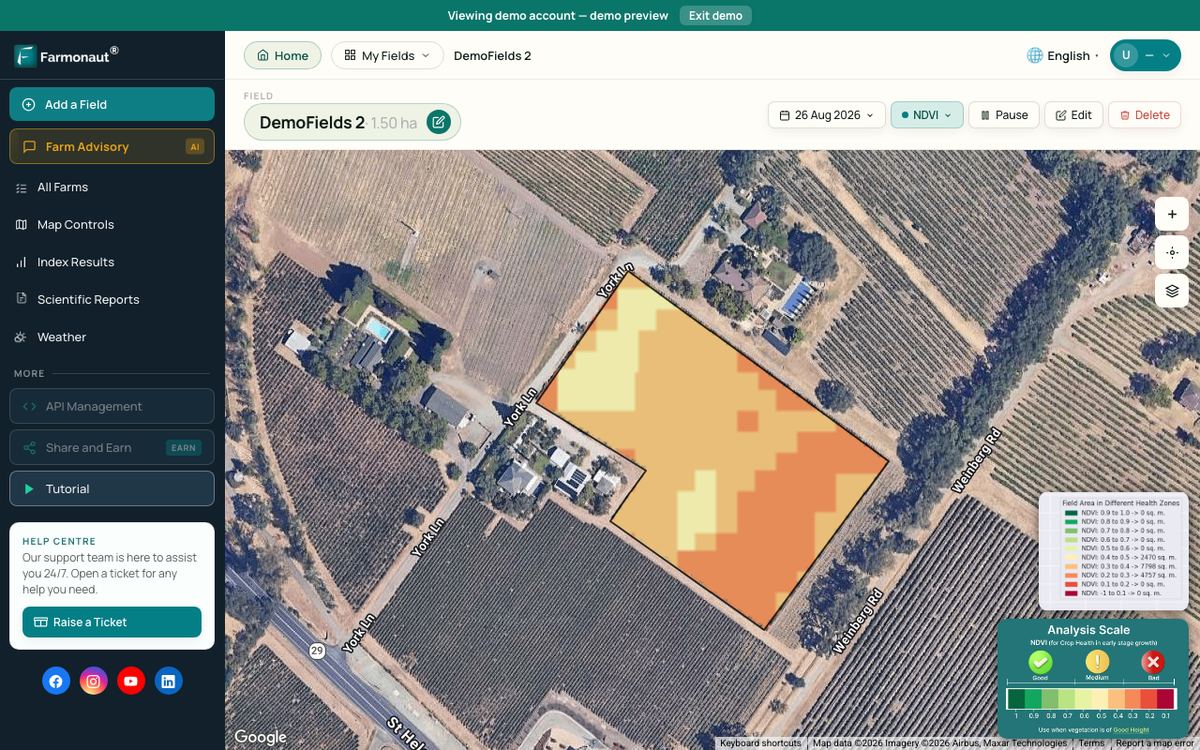
A robot does the field work; it does not tell you which fields need attention first. Satellite vegetation maps show where crop growth is lagging across all your fields, so you can send people or machines to the right place. Farmonaut provides this layer as the Farmonaut Satellite + AI Farm Monitoring System, on the web app and on Android and iOS through the app download page. Developers can pull the same data through the satellite API and its developer docs.

▶ Six plain steps to start precision farming without buying a robot. · 4:18
Related pages on our site: Farmonaut home, fleet management, agro admin app, product traceability, carbon footprinting, crop loan and insurance, biological farming methods.
If this topic matters to you, read Smart Agriculture Projects: AI & IoT Farming Systems next.
FAQ
How much does an autonomous tractor cost?
Retrofit kits are the published option. Deere’s kit costs $40,000 to $45,000 plus install and about $10,000 a year for tillage; PTx OutRun is $44,000 plus $9,000 a year (AgWeb, December 2025). That is on top of a compatible tractor.
Is the Deere subscription instead of buying the kit?
No. AgWeb reports the yearly fee is paid in addition to the kit price, not as an alternative to it.
At what wage does a farm robot pay off?
For Midwest corn and soybeans, Purdue found about $45 an hour in an ideal case and about $140 under current assumptions. For a 1,500-cow dairy milking three times a day, a University of Minnesota model found $27.05 an hour for robots versus a new parlor (2018).
Do farm robots replace workers?
Not so far, according to the makers AgWeb interviewed. Buyers mostly use them to cover more acres and cut long days; Purdue sees the clearest case where labor cannot be hired at all.
How many US farms use robots?
There is no USDA survey of mobile farm robots yet. USDA does track auto-steer, which is used on well over half of planted acres of the main row crops (ERS, 2023).
Farmonaut crop monitoring
See which fields need work first
Draw your fields once and Farmonaut shows satellite vegetation maps for them through the season, on web, Android or iOS.



Keep reading

Sources
- AgWeb, How does autonomous machinery stack up against labor costs on Midwest row crop farms? (Dec 2025): agweb.com
- AgWeb, John Deere introducing next generation perception autonomy kits (Jan 2025): agweb.com
- Purdue Center for Commercial Agriculture, When will autonomous farm equipment actually pay? (Feb 2026): ag.purdue.edu
- USDA NASS, Farm Labor (May 2025): esmis.nal.usda.gov
- Progressive Dairy, Key financial considerations in robotic milking systems (2018): agproud.com
- USDA ERS, Precision Agriculture in the Digital Era, EIB-248 (2023): ers.usda.gov
- Future Farming, Carbon Robotics introduces LaserWeeder G2 (Mar 2025): futurefarming.com
Discussion
Questions, corrections or field experience? Share them below. First-time comments are reviewed before they appear, and your email is never published.
No comments yet. Be the first to add a question or your experience.

 Abhishta Agri
 SP Farms
 Indosistim Teknologi
 Liquify Digital
 CU Foods
 BeyondTech Global
 Rouge VC
 AgroGreen Dynamics
 AgroRisk
 Oath Inc
 Reddane Farming
 Esri North East Africa
 Cresol
 MDCV UK
 Zerella Group
 Etech Consulting Madagascar
 Vestlandsforsking
 Delicio
 Exploration consultancy · South Africa · Gold
 Licence holder · Niger · Gold










