

Reviewed September 2026 against USDA Economic Research Service, IMarcGroup, and AgDroneDirectory data.
Try it: Run your own numbers →
Table of Contents
- What Agriculture Farming Technology Means Today
- How Big Is the US Agriculture Drone Market
- Agriculture Smart Technology: Adoption by the Numbers
- Drone Technology for Agriculture: What It Actually Does
- Comparison Table: Ground Rigs vs. Spray Drones
- Drone Farming Technology Costs: The $13-vs-$21 Story
- Spray Drone Cost Calculator
- Regulatory Reality: Part 137 and Operator Counts
- Where Farmonaut Fits: Data, Not Hardware
- Traceability and Farm Financing
- How to Verify These Numbers Yourself
- Getting Started: A Practical Sequence
- Farmonaut Subscription, API, and Mobile Apps
- FAQ
- Conclusion
- Try it: Run your own numbers
What Agriculture Farming Technology Means Today
Agriculture farming technology now has a price tag and an adoption rate you can look up, not just a vision statement. The US agricultural drone market was valued at $833 million in 2025, according to IMarcGroup’s United States Agriculture Drones Market report. Separately, 27% of US farms had adopted at least one precision agriculture practice as of 2023, per the USDA Economic Research Service. Those two facts sit at the center of this article: drones are one visible piece of a broader precision-ag shift that is already measurable in USDA survey data, not a speculative future.
This piece covers agriculture farming technology broadly, agriculture smart technology adoption specifically, and drone technology for agriculture and drone farming technology as their own sub-topics — because that is how people search for this information, and each deserves a straight answer with numbers attached rather than a generic overview.

How Big Is the US Agriculture Drone Market
Start with scale, because “drones are becoming popular” is not a number. IMarcGroup put the US agricultural drone market at $833 million in 2025. On the adoption side, AgDroneDirectory’s 2026 statistics guide reports that US spray drones treated 16.4 million acres in 2025 — up 58.7% year-over-year from 2024. That growth rate is the more useful number for a farm operator deciding whether to wait another season: acreage under drone spraying nearly doubled in a single year, which is a faster adoption curve than most farm equipment categories see.
Zoom out to precision agriculture as a whole, which includes drones but also GPS guidance, yield mapping, and variable-rate application. A market-research composite cited via IMarcGroup put the US precision farming market at $4.37 billion in 2025, with a projection to $15.23 billion by 2035. That decade-long projection is a forecast, not a booked figure — treat it as directional context for where investment is heading, not as a number to plan a single farm’s budget around.
The practical takeaway: this is no longer a niche. At $833 million in annual US market size and acreage growing nearly 60% year-over-year, agriculture farming technology built around drones has crossed from early-adopter territory into a category that mainstream input suppliers and custom applicators are now organizing around.
Agriculture Smart Technology: Adoption by the Numbers
“Agriculture smart technology” usually refers to the sensor-and-software layer that sits underneath drones, tractors, and irrigation systems: GPS guidance, yield monitors, soil maps, and variable-rate controllers. The USDA Economic Research Service’s 2023 Charts of Note on precision agriculture is the most concrete government dataset on this, and it breaks down adoption by farm size and technology type rather than giving one blended number:
- 27% of all US farms had adopted at least one precision agriculture practice in 2023.
- 70% of large-scale crop-producing farms used guidance autosteering systems in 2023.
- 68% of large-scale crop-producing farms used yield monitors/maps and soil maps in 2023.
- At least 50% of acreage planted to corn, cotton, rice, sorghum, soybeans, and winter wheat used automated guidance systems in 2023, per a related USDA ERS publication.
The gap between the 27% all-farm figure and the 70% large-farm figure is the real story: precision technology adoption in the US is heavily size-weighted. Large-scale crop operations adopted autosteering and yield mapping years ago; the adoption curve still climbing is among small and mid-size farms, where per-acre technology costs are harder to amortize. If you operate under a few hundred acres, that 27% figure — not the 70% one — is your more realistic peer benchmark.
These are 2023 figures, the most recent USDA ERS snapshot published at the time of writing. USDA ERS updates this data through the Agricultural Resource Management Survey (ARMS); check the ERS Charts of Note page directly for whichever year is current when you read this, since ARMS-based figures are typically refreshed on an annual cycle.

Drone Technology for Agriculture: What It Actually Does
Drone technology for agriculture splits into two functionally different jobs: sensing (multispectral, thermal, or high-resolution imaging to scout fields) and application (spraying, seeding, or spreading). They get talked about together, but they’re bought, certified, and priced separately.
Sensing drones fly multispectral or thermal cameras over a field to flag stress, disease pressure, or nutrient deficiency before it’s visible from the ground. Because the imagery is georeferenced, the output can be handed directly to a variable-rate controller or overlaid on a satellite NDVI map for a second read on the same field. Application drones — the spray drone category — are where most of the recent US growth and cost data sits, covered in more depth below.
Both categories depend on the same underlying capability: turning aerial or satellite imagery into a field map a farmer can act on same-day. That’s the layer where satellite-based technology in agriculture and drone-based sensing overlap directly — satellites give frequent, farm-wide coverage at no per-flight cost, while drones give higher spatial resolution on the specific field or block you need to inspect closely.
Comparison Table: Ground Rigs vs. Spray Drones
| Factor | Ground Rig / Manned Aircraft | Spray Drone |
|---|---|---|
| Cost per acre (2025) | Varies by contractor and region; not published in a single national figure | $13/acre average, 2025 — down from $21/acre in 2024 (AgDroneDirectory) |
| US acreage treated, 2025 | No comparable national drone-vs-rig split published | 16.4 million acres, +58.7% year-over-year (AgDroneDirectory) |
| Certified operators nationwide | Requires a pilot’s license for manned aerial application | 1,710 FAA-certificated Part 137 unmanned aircraft operators as of September 2025 (AgDroneDirectory) |
| Field access | Limited on wet, steep, or irregularly shaped fields | Operates over standing water, steep terrain, and small or oddly shaped blocks a ground rig can’t enter |
| Compaction risk | Wheel or track compaction on repeated passes | None — aerial application, no ground contact |
Note what’s missing from the left column: there is no single published national average for ground-rig or manned-aircraft cost per acre comparable to the drone figures above, because custom-application rates vary by contractor, chemical, and region and aren’t tracked in one federal or industry dataset the way drone-specific statistics now are. If you need a ground-rig baseline for your own operation, get a current quote from your local custom applicator — that number is real and local in a way a national average wouldn’t be.
Drone Farming Technology Costs: The $13-vs-$21 Story
The single most useful figure for anyone evaluating drone farming technology as a purchase or service decision is cost per acre, and it moved fast: AgDroneDirectory’s 2026 statistics guide puts average US drone-based crop spraying cost at $13/acre in 2025, down from $21/acre in 2024 — a 38% drop in one year. That’s a function of more certificated operators (1,710 nationwide as of September 2025) competing for contracts, larger payload drones spreading fixed costs over more acres per flight, and the maturing secondhand equipment market.
A falling per-acre cost changes the ROI math for on-farm ownership versus hiring a custom drone-spray operator. At $13/acre for a hired service with no capital outlay, equipment maintenance, or FAA certification burden, many mid-size operations will find contracting out spray passes cheaper than owning a drone fleet — unless acreage is high enough, or flights frequent enough, that per-flight service costs exceed ownership costs over a season. There is no published USDA payback-period dataset for drone acquisition by farm size — that’s a genuine gap in the public record right now — so run the specific comparison for your own acreage using the calculator below rather than relying on a rule of thumb.
Spray Drone Cost Calculator
Enter your own acreage and expected flights per season to compare hiring a drone-spray service against your current per-acre ground application cost, using the 2025 national drone average of $13/acre as the default (editable).
Run your own numbers
Assumptions: uses AgDroneDirectory's 2025 national average drone-service rate ($13/acre) as a default only — actual quotes vary by region, chemical, and operator availability. Excludes equipment ownership costs, FAA Part 137 certification costs, chemical costs (assumed equal across methods), and any yield-response difference between application methods. For an ownership-vs-service comparison, get a written quote from a local Part 137-certificated operator.
Regulatory Reality: Part 137 and Operator Counts
Every business applying pesticides or fertilizer by drone in US airspace operates under FAA Part 137 (agricultural aircraft operations) rules, layered on top of standard Part 107 drone pilot certification. AgDroneDirectory counted 1,710 FAA-certificated Part 137 unmanned aircraft operators nationwide as of September 2025. That operator count is your best proxy for how mature the hired-service market is in a given region: more certificated operators generally means more competitive quotes and shorter scheduling waits during peak spray windows.
There is no published roadmap for how Part 137 rules for drones will change going forward — waiver approvals for expanded operations (beyond-visual-line-of-sight, higher payload weights) have been growing case by case, but the FAA has not published a fixed expansion timeline. If regulatory scope is central to a purchase decision, check the FAA's current Part 137 guidance directly rather than relying on any secondary summary, since this is an area that changes through individual rulemakings rather than an annual update cycle.
Where Farmonaut Fits: Data, Not Hardware
Farmonaut doesn't manufacture drones. What we provide is the satellite-based data layer that drone imagery, sensor feeds, and field operations plug into — so the investment a farm makes in drone technology for agriculture produces a usable, ongoing record rather than a one-off flight report.
-
Satellite-Based Crop Monitoring: Multispectral satellite imagery tracks crop health (NDVI) and soil conditions between drone flights, so you're not paying for a flight just to check on a field that hasn't changed.

Access Farmonaut Web App -
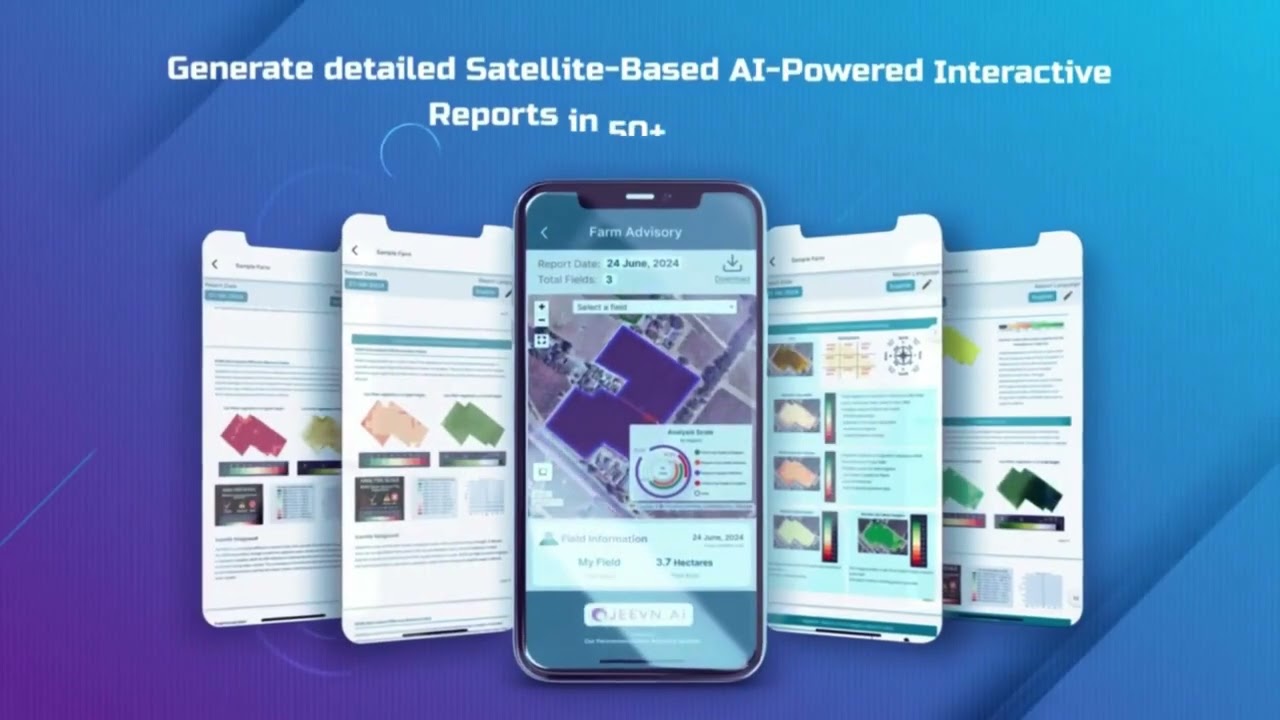
AI Advisory System: Weather forecasts, pest/disease alerts, and field-specific recommendations delivered to a phone.

Farmonaut Android App

Farmonaut iOS App - Drone and Sensor Integration: Upload drone imagery and sensor data through the web platform or the Farmonaut API, with full API developer documentation for teams building custom integrations.
- Fleet Management: Fleet management tools for coordinating spray drones, ground rigs, and support vehicles across a season.
- Large-Scale Farm Management: The large-scale farm management platform for operations running multiple fields or contracts across drone and satellite data sources.
- Carbon and Sustainability Tracking: The carbon footprinting module converts reduced input use — including from precision drone application — into a trackable emissions record.

Traceability and Farm Financing
Two adjacent areas where agriculture farming technology shows up in day-to-day operations, beyond monitoring and spraying:
- Product Traceability: Blockchain-based records of an agricultural product's journey from field to buyer support food-safety compliance and premium-market access. See Farmonaut's traceability solutions, and for related field-level pest management context, our guide to affordable pest control.
- Crop Loan and Insurance Verification: Lenders and insurers increasingly use satellite-based crop monitoring reports to verify claims and loan applications faster and with less on-site inspection.
How to Verify These Numbers Yourself
Every figure in this article carries a source and a date because every one of them will eventually be superseded. Here is exactly where each category gets refreshed, and how often:
- Drone acreage and operator counts: Updated annually by AgDroneDirectory. The next authoritative federal check will come from USDA NASS's Census of Agriculture, which runs on a five-year cycle — the current census cycle's next full release is due in 2029. Search NASS data for "drone" or "unmanned aircraft" once that release is out.
- Precision agriculture adoption rates: The USDA Economic Research Service updates these through the Agricultural Resource Management Survey (ARMS). Check the ERS Charts of Note page directly for the current annual snapshot.
- Drone market size and growth forecasts: Market research firms including IMarcGroup, Grand View Research, and Precedence Research release updated forecasts annually. A forecast published for one year will differ from the next year's revision as new sales data arrives — always check the publication date on the specific report you're citing.
This is the durable part of the article: regardless of what the specific numbers say when you're reading this, the method for getting current ones is the same — USDA ERS for adoption rates, USDA NASS for the next full census count, and the named market-research firms for market-size forecasts.
Getting Started: A Practical Sequence
For a farm or agribusiness evaluating agriculture farming technology for the first time, a workable sequence looks like this:
- Benchmark against your peer group by size. If you're a large-scale crop operation, the 70% autosteering / 68% yield-mapping adoption figures from USDA ERS are your realistic peer comparison. If you're smaller, the 27% all-farm figure is more representative — meaning roughly three in four farms your size haven't adopted precision practices yet, which is useful context either way.
- Decide between hiring and owning for drone application. At a 2025 national average of $13/acre for hired drone spraying, run the numbers in the calculator above against your own acreage and pass count before committing capital to equipment ownership.
- Check regional operator availability. With 1,710 FAA Part 137-certificated operators nationwide as of September 2025, availability is uneven by region — get quotes from at least two local operators before assuming national averages apply to your county.
- Layer in satellite monitoring for the gaps between drone flights. Drones give high-resolution snapshots; satellite data fills in daily or weekly coverage between flights at no per-acre flight cost.
- Track the input reductions. If precision application reduces chemical or fertilizer use, log it — that data feeds directly into carbon and sustainability reporting if you need it for compliance or buyer requirements.
Farmonaut Subscription, API, and Mobile Apps
Farmonaut offers scalable subscription packages, APIs for device and app integration, and mobile/web apps for farms and agribusinesses layering satellite data on top of drone and sensor investments:
- Web & Mobile App: Real-time crop and farm analytics
- RESTful API and Developer Documentation: For integrating satellite and drone datasets with existing monitoring systems.
- iOS & Android Apps for field teams and farmers
See our pricing or start a free trial:

FAQ
1. What is agriculture farming technology, in concrete terms?
It's the combined set of digital tools — GPS guidance, yield monitors, soil sensors, satellite imagery, and drones — used to manage inputs and monitor crop health with field-level precision instead of whole-farm averages. USDA ERS found 27% of US farms had adopted at least one such practice as of 2023.
2. What does agriculture smart technology adoption look like by farm size?
Sharply uneven. USDA ERS's 2023 data shows 70% of large-scale crop farms use autosteering and 68% use yield/soil mapping, against 27% adoption across all US farms — meaning small and mid-size operations are adopting this technology at a much slower rate than large operations.
3. How much does drone technology for agriculture cost per acre?
AgDroneDirectory's 2026 statistics guide puts the 2025 US average at $13/acre for drone-based crop spraying, down from $21/acre in 2024. Rates vary by region, chemical, and operator — get a local quote for your specific situation.
4. Is drone farming technology regulated differently from ground application?
Yes. Commercial agricultural drone operators need FAA Part 137 agricultural aircraft certification in addition to standard Part 107 drone pilot certification. As of September 2025, 1,710 operators held Part 137 certification nationwide.
5. Can Farmonaut integrate with drones and other field devices?
Yes. Farmonaut accepts drone imagery, sensor feeds, and other field data through the web platform or the API for combined analytics and advisory output.
6. Where can I check for more current drone or precision-ag adoption figures?
USDA NASS's Census of Agriculture (next full release 2029) and USDA ERS's annual ARMS-based updates are the two authoritative government sources; AgDroneDirectory and IMarcGroup publish updated industry figures on an annual basis.
Further reading:
Conclusion
Agriculture farming technology, agriculture smart technology, and drone technology for agriculture aren't separate trends — they're one adoption curve at different stages, measured in USDA and industry data rather than marketing claims: a $833 million US drone market in 2025, 27% overall precision-ag adoption against 70% among large-scale crop farms, and a spray-drone cost that fell from $21 to $13 per acre in a single year. The gap between those adoption figures is where the near-term opportunity sits for small and mid-size operations that haven't moved yet.
Farmonaut's role is the data layer underneath these tools — satellite crop monitoring, drone and sensor integration, fleet management, traceability, and carbon tracking — so that whatever hardware decision a farm makes, the data it generates stays usable season over season.

 Godrej Agrovet
 Hayleys Agriculture
 Linx Agritech
 Adinet
 Save Your Soils
 GalaxEye Space
 Grandstream Algérie
 XOS Realty
 Geospatial Lab Africa
 Agro La Gándara
 HIPSAC
 ZOL Zimbabwe
 Juligerm
 AdBio
AdBio MISE Maroc
 NWNS
NWNS Red August Group
 Farm Inc
 WeMe Global
 Agrotoken
 Blue BearX
 Insignito
 DnCubed
 Indosistim Teknologi
 Liquify Digital
 CU Foods
 BeyondTech Global
 Rouge VC
 AgroRisk
 Oath Inc
 Esri North East Africa
 MDCV UK
 Etech Consulting Madagascar
 Vestlandsforsking
 WB Dev
 Sama Premium
 Tres Valles
 Blickwinkel
 Agricultural Credit Policy Council
 eKGIS
eKGIS Mostas Tech
 Andex
Andex Deluxe Conseil
 WICO
WICO Chimera Innovation
 SkyHarvest
 Teledarbas
 Exurbia Geospatial
 FieldZero
