

Smart farming model 2025: 5 proven stages for ROI
“The 2025 smart farming model organizes ROI delivery into 5 sequential stages, from sensing to governance.”
“Roadmap prioritizes 4 components and 2 sustainability metrics: water and carbon.”
Meta summary (for editors): The smart farming model in 2025 is a practical, staged agriculture farming model that integrates sensing, connectivity, AI analytics, automation, and governance to maximize productivity, sustainability, and resilience. This step farming model guides adoption from manual methods toward fully integrated systems, improving water use, carbon outcomes, and profitability with clear KPIs and interoperability through open APIs.
In 2025 and beyond, the smart farming model has matured into a leading concept that turns data from sensors into actionable agronomy practices. A modern agriculture farming model is no longer a single tool or app; it is a complete system combining sensing, connectivity and edge computing, analytics and digital twins, precision automation, and governance layers. The payoff is clear: higher productivity and profitability, measurable water savings, and verified carbon reduction—while improving resilience to weather extremes and pest risk. This article introduces a practical, staged roadmap—the step farming model—with five proven stages that help estates, cooperatives, and smallholders move systematically from manual methods toward a fully integrated farming model with strong ROI. The model builds on a much longer history, traced in an overview of agriculture’s four stages from foraging onward.



Table of contents
- What is the smart farming model 2025?
- Core components of a contemporary agriculture farming model
- Step farming model: the five proven stages for ROI
- 5-Stage Smart Farming ROI Roadmap (Comparison Matrix)
- Adoption enablers, business models and APIs
- KPIs that matter in 2025 and beyond
- Governance, data privacy and risk management
- Implementation checklist and 12‑month ROI plan
- FAQ
What is the smart farming model 2025?
The smart farming model in 2025 is an end‑to‑end agriculture farming model that integrates low‑cost sensors, robust connectivity, AI‑powered analytics, automation, and strong governance. These layers translate farm data into actionable, profitable practices. The step farming model makes adoption practical by sequencing the journey into five stages—Assess, Prioritize, Pilot, Scale, Institutionalize—so farms can select the best interventions, measure metrics, and de‑risk investment.
Why it matters now:
- Efficiency and ROI: Reduced fertilizer and pesticide use (often 20–50%), water savings (20–40%), labor efficiency through automation, and better yield stability.
- Climate resilience: Digital twins and forecasting improve decision timing for irrigation, nutrient prescriptions, and disease prediction under different scenarios and climate futures.
- New revenue: Verified carbon accounting and traceable supply chains enable premiums and carbon‑credit income.
- Risk management: Faster response to weather, pest, and market shocks using AI‑enabled alerts and edge compute.
Core components of a contemporary agriculture farming model
A modern farming model has five core components. Each builds on the previous to deliver compounded value in productivity, sustainability, and resilience.
1) Sensing and Monitoring
- In‑field: Soil probes, leaf and canopy sensors, on‑farm weather stations, pheromone traps, and smart pest traps for real‑time alerts.
- Remote: UAV/drone multispectral/hyperspectral imaging and satellite data (e.g., Sentinel, Planet) for wide‑area monitoring and temporal analysis.
2) Connectivity and Compute
- Connectivity: LPWAN for power‑efficient links; 5G where available for high‑bandwidth streams.
- Edge computing: On‑site computing runs time‑critical models, reducing transfer costs and latency.
3) Analytics and Decision Support
- AI/ML models: Yield prediction, disease and pest forecasting, nutrient and irrigation prescriptions.
- Digital twins: Simulate scenarios under different inputs and futures to test plans before execution.
4) Actuation and Automation
- Precision operations: Variable‑rate applicators (VRT), precision irrigation.
- Autonomous machinery: Tractors, robotic harvesters, and guided implements for labor‑constrained operations.
5) Business and Governance
- FMIS and traceability: Farm management information systems (FMIS) with supply‑chain traceability and interoperable APIs.
- Data rules: Clear data‑ownership and privacy rules, data cooperatives, and open standards to avoid lock‑in.
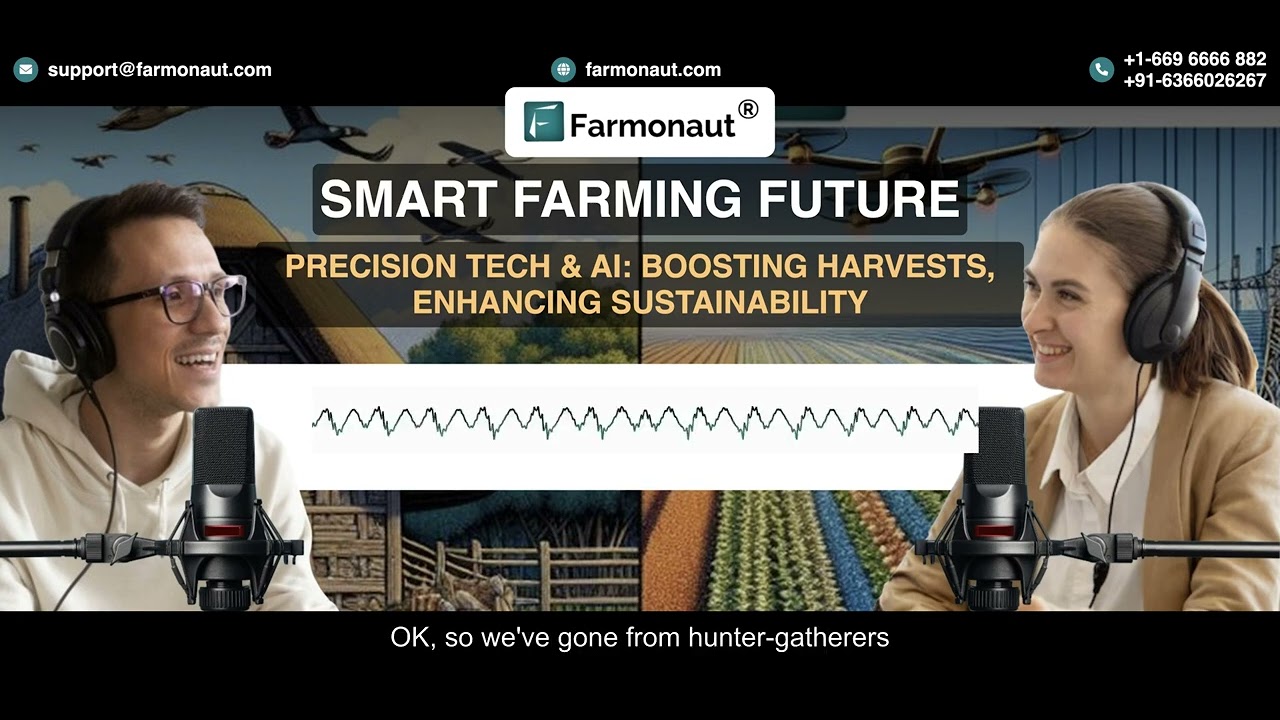
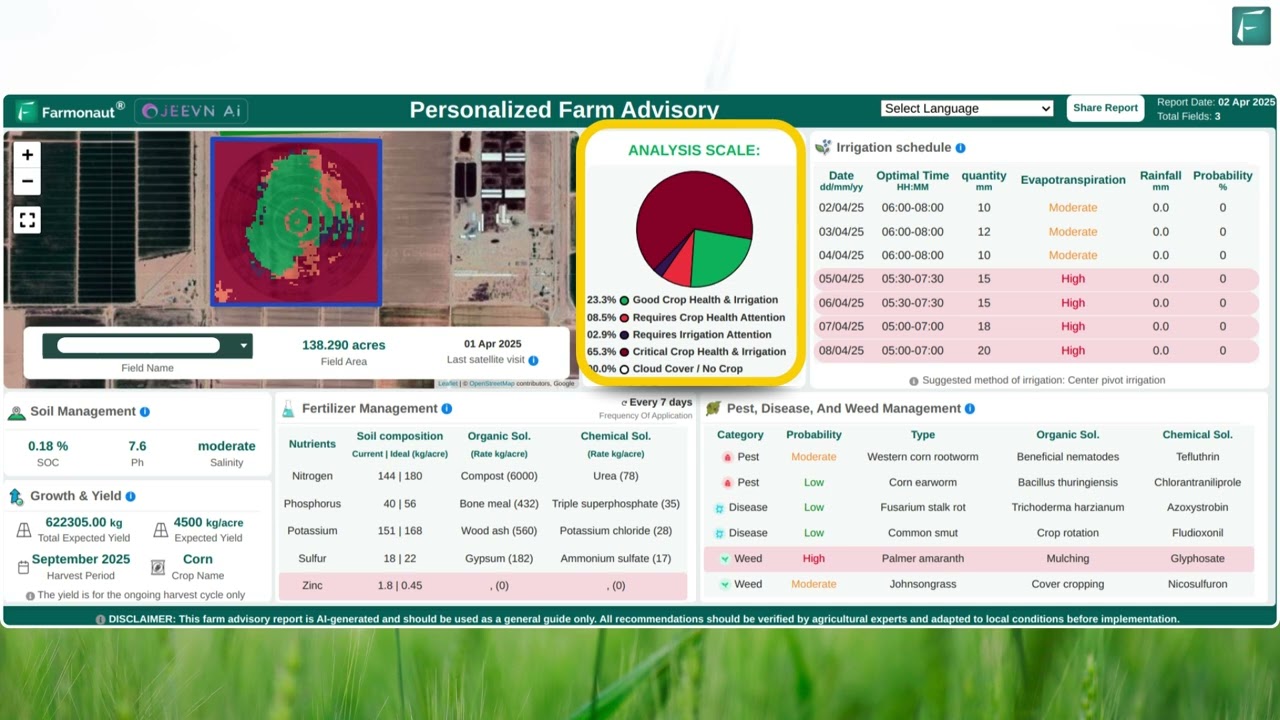
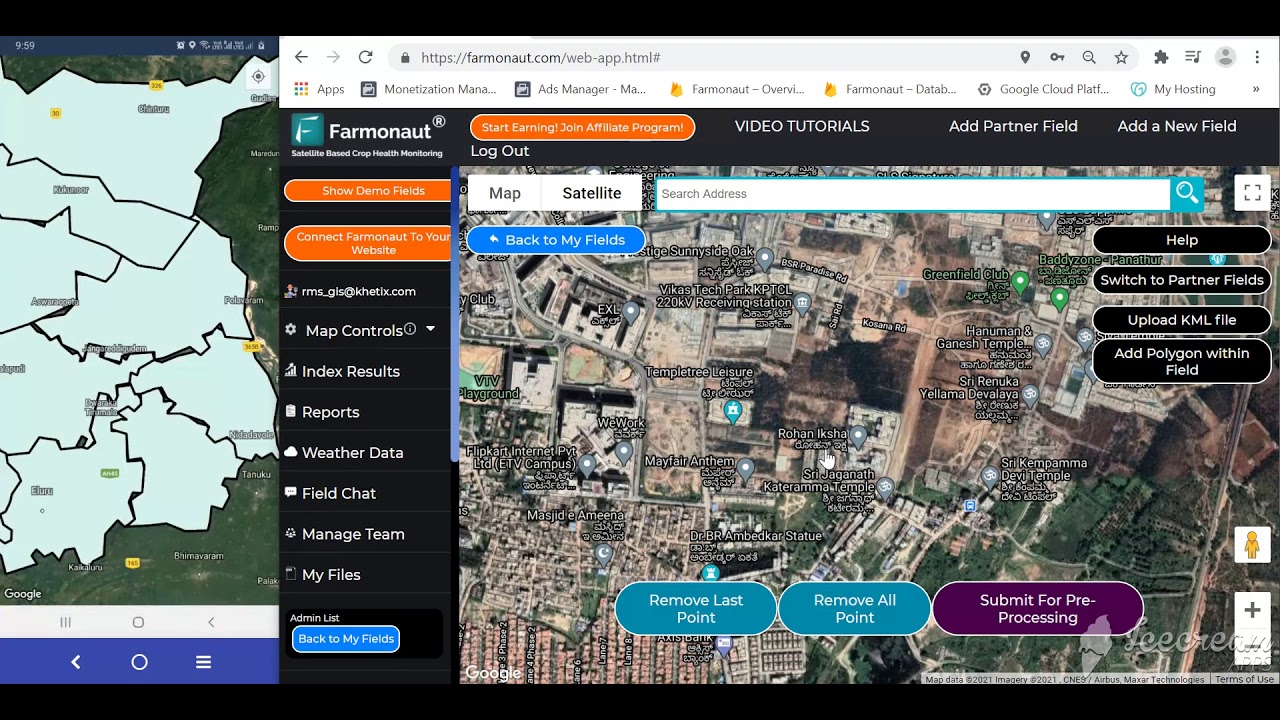
As a satellite technology company, we at Farmonaut focus on monitoring, analytics, and governance building blocks. We provide multispectral satellite insights (e.g., NDVI for vegetation and soil condition signals), the Jeevn AI advisory, blockchain‑based traceability, and an API‑first approach that feeds data into FMIS and automation stacks without vendor lock‑in.
Step farming model: the five proven stages for ROI
The step farming model prescribes five stages that help teams define objectives, run focused pilots, and scale with confidence. Each stage lists the best next actions, metrics, and common pitfalls to avoid.
Stage 1 — Assess: baseline mapping
Objective: Establish a clean baseline of soils, water resources, climate exposure, and socioeconomics to guide investment.
- Baseline mapping: Conduct mapping with soil sampling, topography, and water‑table data; ingest historical Sentinel/Planet series for trend lines.
- Field variability: Use drone/UAV multispectral imaging to detect canopy variability, stress, and weed pressure.
- Connectivity scan: Test LPWAN and 5G coverage; plan for edge compute where backhaul is weak.
- Data governance kickoff: Draft clear data‑ownership and privacy rules; choose interoperable APIs for future integration.
Farmonaut note: We support Stage 1 with satellite monitoring, vegetation indices, weather feeds, and baseline reports accessible via our Android, iOS, and web apps, plus the Farmonaut API.

Stage 2 — Prioritize: targets and interventions
Objective: Prioritize interventions with strongest profitability and efficiency potential; define KPIs and metrics.
- Set objectives: Input‑use reduction, yield stability, water productivity, carbon footprint cuts.
- Select interventions: Precision irrigation, targeted nutrient plans, pest forecasting alerts, or VRT zones.
- Decision workflows: Map how analytics flow from field and remote sensing to decision and action.
Stage 3 — Pilot: test, measure, learn
Objective: Pilot on representative plots to validate benefits, pressure‑test workflows, and prove ROI.
- Representative plots: Choose fields with typical variability and constraints.
- Sensors and models: Combine soil probes, weather stations, drone imagery, and satellite indices with AI prediction models.
- VRT trials: Run variable‑rate trials for fertilizer and irrigation; collect baseline and after‑action data.
- Measure uptime: Monitor sensor systems availability, battery, and connectivity health.

Stage 4 — Scale: integrate and automate
Objective: Scale proven practices across fields; standardize protocols; integrate traceability; deploy VRT and autonomous equipment where viable.
- FMIS integration: Connect interoperable APIs to feed prescriptions into machines and record as‑applied maps.
- Automation: Introduce applicators, guided tractors, and robotic harvesters where labor is tight.
- Traceability: Digitally record seed, inputs, field operations, and logistics for market access.

Stage 5 — Institutionalize: skills, governance, and continuous improvement
Objective: Make the model durable with maintenance routines, training, data cooperatives, and continuous learning.
- Capacity building: Upskill agronomy teams and local technicians; codify maintenance schedules.
- Governance: Implement data‑access roles, privacy rules, API stewardship, and audit trails.
- Continuous improvement: Kaizen cycles for practices, checking model drift and updating prescriptions seasonally.

5-Stage Smart Farming ROI Roadmap (Comparison Matrix)
This matrix summarizes each stage—from sensors to governance—with expected ROI, water/carbon savings, and deployment scope. Values are indicative ranges to support decision planning.
| Stage name | Primary objective | Core technologies | Deployment scope | Estimated CapEx | Estimated OpEx/mo | Estimated payback | Estimated ROI @12 mo | Water use reduction | Carbon footprint reduction | Key KPIs | Data requirements | Risk level | Change-management effort | Interoperability notes |
|---|---|---|---|---|---|---|---|---|---|---|---|---|---|---|
| Stage 1 — Sensing & Baseline | Map variability; establish benchmarks | Soil probes, canopy/leaf sensors, weather stations, Sentinel/Planet, UAV imaging | Pilot fields | $2k–$10k | $100–$500 | 3–6 months | 8–15% | 5–10% | 3–8% | System uptime, data completeness, NDVI trend | Daily to weekly; LPWAN/5G | Low | Low–Medium | Use interoperable APIs; Farmonaut API fits FMIS ingestion |
| Stage 2 — AI Analytics | Turn data into prescriptions | Yield prediction, pest/disease forecasting, irrigation/nutrient models, digital twins | Pilot to multi-field | $5k–$25k | $200–$1,000 | 4–8 months | 12–25% | 8–18% | 6–12% | Input-use efficiency, timing accuracy | Hourly to daily; edge compute | Medium | Medium | Adopt common ontologies; align with regional data rules |
| Stage 3 — VRT & Actuation | Apply inputs precisely | VRT applicators, precision irrigation, edge controllers | Field to farm | $10k–$50k | $300–$1,500 | 6–12 months | 18–35% | 15–30% | 12–20% | As‑applied vs. planned, yield/ha | Real‑time control; low latency | Medium | Medium–High | Ensure CAN/ISOBUS and API compatibility; Farmonaut data supports VRT zones |
| Stage 4 — Autonomous Operations | Scale precision with automation | Guided tractors, robotic harvesters, fleet telematics | Farm or enterprise | $30k–$200k | $500–$3,000 | 9–18 months | 25–45% | 20–40% | 18–30% | Labor productivity, fuel use | High bandwidth in zones; edge analytics | Medium–High | High | Follow regional autonomy regulations; integrate via open APIs |
| Stage 5 — Governance & Continuous Improvement | Institutionalize standards and trust | FMIS, blockchain traceability, data cooperative, privacy controls | Organization-wide | $5k–$40k | $200–$1,000 | 6–12 months | 10–25% | 5–12% | 8–15% | Traceability coverage, audit success | Routine sync; secure storage | Low–Medium | Medium | Note GDPR/DPDP/local privacy; Farmonaut blockchain traceability supports compliance |
“The 2025 smart farming model organizes ROI delivery into 5 sequential stages, from sensing to governance.”
Adoption enablers, business models and APIs
Adopting a smart farming model requires the right business structures and models. In 2025, successful deployments rely on flexible financing, service ecosystems, and strong interoperable APIs.
Financing and service models
- Equipment‑as‑a‑Service: Rent sensors, VRT, or autonomous kits to lower CapEx and de‑risk adoption.
- Subscription software: Pay only for needed analytics modules (prediction, forecasting, digital twins), scaling seats and acreage.
- Agro‑service providers: Local technicians for installation, calibration, and operations keep systems uptime high.
- Public‑private financing: Resilience grants and tax credits for water and carbon outcomes speed adoption.
Data cooperatives and open standards
- Data cooperatives: Shared analytics marketplaces let smallholders access affordable decision tools.
- Open APIs and common ontologies: Reduce vendor lock‑in and enable FMIS‑machine interoperability.
Farmonaut platform highlights: We provide accessible satellite‑driven insights via web and mobile apps, with an API‑first integration approach:
- Access programmatically via the Farmonaut API and API Developer Docs for satellite, weather, and advisory feeds.
- Use Jeevn AI for agronomic insights mapped to field variability and seasonal weather patterns.
- Apply blockchain‑based traceability for transparent supply chains.

Product links for targeted use cases
- Carbon Footprinting — Quantify emissions and removals for verified carbon programs. Benefits: compliance reporting, sustainability premiums, and access to carbon markets.
- Product Traceability — Blockchain‑backed proof of origin and input records for traceability demands. Benefits: brand trust, fraud reduction, and streamlined audits.
- Fleet Management — Track vehicles and operations, improve route efficiency, reduce fuel and downtime. Benefits: higher labor productivity and lower OpEx.
- Large‑Scale Farm Management — Manage many fields and teams with satellite monitoring, tasks, and reporting. Benefits: centralized management and consistent protocols.
- Crop Loan & Insurance — Satellite‑based verification can support lenders and insurers. Benefits: faster decisions and risk reduction for financing.
For plantation forestry and diversified landscapes, producers can explore crop plantation and forest advisory tools delivered through our apps.
KPIs that matter in 2025 and beyond
Clear, comparable KPIs are essential for management control and ROI validation. The following indicators align with smart farming models, digital twins, and VRT programs:
- Input‑use efficiency: kg fertilizer per ton of yield; pesticide active ingredient per hectare; irrigation water per kg produced.
- Yield/ha: Average yield, variance across zones, and stability under variable weather.
- Profitability per labor‑hour: Output value minus direct costs divided by labor hours (tracks automation impact).
- Soil organic carbon and GHG balance: SOC change y/y; net emissions per hectare.
- Water productivity: kg of output per m³ water; field‑level and enterprise averages.
- System uptime: Percentage uptime of sensors, edge nodes, and communication systems.
- Traceability coverage: Share of lots with complete digital records across the season.
Governance, data privacy and risk management
A resilient farming model requires a governance backbone that ensures trust, compliance, and business continuity. The governance layer balances privacy, open APIs, and interoperable systems.
Data ownership and privacy rules
- Ownership clarity: Specify who owns raw and derived data and how it can be shared or monetized.
- Access control: Role‑based permissions and audit logs within FMIS and analytics platforms.
- Regional compliance: Align with applicable privacy regulations (e.g., GDPR or local data protection laws) and retention policies.
Traceability and supply‑chain trust
- Blockchain traceability: Immutable records of inputs and field operations foster transparency and market access.
- API interoperability: Export/import to buyers, processors, and regulators via standardized schemas.
Farmonaut governance note: We support traceability with blockchain, maintain interoperable APIs, and offer environmental‑impact monitoring to quantify carbon and water outcomes for compliance reporting.
Implementation checklist and 12‑month ROI plan
Here is a concise, practical plan to go from concept to value in one season while de‑risking adoption and building toward a fully integrated system:
Quarter 1 — Assess and design
- Run Stage 1 Baseline: mapping soils, fields, and resources; confirm connectivity for LPWAN and 5G where available.
- Set objectives and choose top interventions: irrigation scheduling, nutrient VRT, or pest forecasting.
- Agree on clear rules for privacy and data access; align API integration plans.
Quarter 2 — Pilot with edge analytics
- Deploy probes, weather stations, and drone imaging on representative plots.
- Activate AI models for prediction and VRT prescriptions; run one guided irrigation trial.
- Track metrics: water use, as‑applied vs. plan, yield targets.
Quarter 3 — Scale precision operations
- Extend VRT and precision irrigation to additional fields; begin automation where ROI justifies.
- Integrate traceability and FMIS; standardize protocols for in‑season updates.
Quarter 4 — Institutionalize and optimize
- Codify routines, training, and maintenance; finalize governance artifacts and API catalogs.
- Report water and carbon outcomes; plan next season’s model refresh and automation expansions.
Get started with Farmonaut: We make satellite‑driven insights accessible to organizations of any size. Explore subscriptions below and use our apps to monitor fields and generate advisory at scale.
FAQ: Smart farming model 2025
What is the difference between a smart farming model and a traditional farming model?
A traditional farming model relies on manual observation and uniform input rates. A smart farming model fuses sensing, analytics, and automation to tailor actions by zone and timing. It uses digital twins, edge computing, and interoperable APIs to deliver higher efficiency and ROI while improving water/carbon outcomes.
How fast can farms see ROI with the step farming model?
With focused pilots and VRT in suitable fields, many organizations target a 6–12 month payback on Stage 2–3 investments. Savings often come from reduced inputs (20–50%), 20–40% water savings in irrigated systems, and labor productivity gains from automation.
Do I need 5G to start?
No. LPWAN is suitable for low‑bandwidth sensors. 5G helps with drone streams and high‑frequency controls but is not required to start. Edge compute can buffer and process locally, reducing data transfer costs.
Where do satellite and drone data fit?
Satellite time series (e.g., Sentinel, Planet) provide wide‑area monitoring and trend detection. UAV/drone multispectral/hyperspectral imaging delivers higher resolution for prescription refinement and pest/disease detection.
How does Farmonaut support this roadmap?
We at Farmonaut offer satellite monitoring, Jeevn AI advisory, blockchain‑based traceability, environmental impact tracking (including carbon footprint monitoring), and APIs to integrate insights into FMIS and automation stacks. We operate on a subscription model available on web and mobile.
What about data privacy and ownership?
Define clear rules in Stage 1, including who owns raw and derived data, and how it is shared. Use role‑based access and audit trails. Align with regional privacy requirements.
How do digital twins help under climate variability?
Digital twins simulate scenarios under different inputs and futures, supporting proactive choices for irrigation, nutrient timing, and pest defense when weather is uncertain.
Putting it all together
The smart farming model in 2025 is a hybrid of technologies and farmer‑centric design. It is practical, grounded in staged adoption, and built on governance that aligns business value with environmental stewardship. By combining low‑cost sensing, resilient connectivity, AI analytics, precise automation, and interoperable APIs, farms can maximize productivity, cut water and carbon footprints, and improve resilience. Whether for smallholders, large estates, or cooperatives, the step farming model helps teams move systematically from manual methods toward a fully integrated agriculture farming model with measurable ROI.
Start now: Explore our apps and APIs to accelerate your Stage 1–2 journey.
API quick links: API | Developer Docs
Editorial note: Farmonaut is a satellite technology company providing monitoring, advisory, traceability, and resource‑management tools via mobile, web, and API. It is not an online marketplace, a manufacturer/seller of farm inputs or machinery, nor a regulatory body.

 Deluxe Conseil
 Krishify
 TVS Electronics
 BW Pipelines
 WICO
WICO Gen Chayat
 Chimera Innovation
 SkyHarvest
 Polaris Digitech
 Teledarbas
 Wild Oak Farm
 SFX
SFX BACF Africa
 Doodlakine
 Exurbia Geospatial
