

Farm machinery · Plain-English guide
What Are Smart Tractors? Uses, Prices and Payback
Smart tractors steer themselves along GPS lines, control implements by location and record what they do. Auto-steer guidance ran on 58% of US planted corn acres in 2016, up from 5.3% in 2001 (USDA Economic Research Service).
Key takeaways
- A smart tractor is a normal tractor plus GNSS guidance, section and rate control, telematics and, on the newest models, cameras for driverless work.
- Guidance is the most used tractor feature: 72.9% of US sorghum and 64.5% of cotton acres in 2019 (USDA ERS estimates).
- US farm tractor sales fell 9.9% to 195,857 units in 2025; four-wheel-drive sales fell 41.6% (AEM, preliminary).
- Extension studies measured overlap of 3.3% in planting and 7% in tillage (Iowa State), so guidance savings are often a few percent of input cost.
- Driverless kits are on sale for tillage on certain large John Deere tractors; service technicians are in short supply (farmdoc daily, 2026).
In this article
- What are smart tractors, in plain words?
- The main smart tractor technologies
- How common are smart tractor features?
- New tractor sales and prices
- What smart tractors save, with the evidence
- Will auto-steer pay on your farm?
- Driverless tractors: where autonomy stands
- How to choose a smart tractor setup
- Smart tractors on different types of farm
- Smart tractors and the environment
- Where satellite data fits with smart tractors
- How we checked the numbers
- FAQ
What are smart tractors? They are tractors that steer themselves along GPS lines, log what they do in each part of a field and share that data with farm software. Auto-steer guidance is the most common smart tractor feature: it ran on 58% of US planted corn acres in 2016, up from 5.3% in 2001, according to the USDA Economic Research Service report on precision agriculture adoption.
A smart tractor is not one product. It is a normal tractor plus a set of add-ons: a satellite receiver, a steering controller, an in-cab screen, a telematics modem and, on the newest machines, cameras and computers that let it work with no one in the seat. This guide explains each part in plain words, shows how widely they are used, gives dated machinery prices, and lets you test whether auto-steer would pay on your own farm with a calculator.
What are smart tractors, in plain words?
Think of three layers. The first is the machine itself: engine, transmission, hydraulics and a cab. That has not changed much in principle for decades. The second layer is position. A GNSS receiver on the roof (GNSS covers GPS and the other satellite systems) tells the tractor where it is, often to within a few centimetres when a correction signal is used. The third layer is software. It turns that position into actions: steering, switching sprayer sections on and off, changing seed or fertilizer rates, and recording a map of what was done.
When people ask what makes a tractor “smart”, they usually mean the second and third layers. A 20-year-old tractor can become partly smart with an aftermarket steering kit and a screen. A new high-horsepower tractor from a major brand usually leaves the factory ready for these systems, and the buyer pays to switch on the features they want.
The USDA report puts these tools in a wider group it calls digital agriculture. It notes that auto-steer and guidance systems now use GNSS receivers to show the machine’s position and cut skips and overlaps, and that newer systems can steer a tractor almost fully, which frees up the driver’s time in the cab.
How tractors became smart
Early tractors only replaced animal and human power for ploughing, planting and hauling. Through the twentieth century, better engines, transmissions, hydraulics and cabs made them faster and safer. From the late 1990s, GPS receivers and yield monitors began to appear on large farms, first as light bars that guided the driver and later as systems that steered the tractor. The USDA data show the jump: guidance on corn went from a few percent of acres in 2001 to more than half by 2016. The latest step adds mobile data links, cameras and onboard computers, so the tractor becomes one part of a connected system that also includes the implement, the farm office and the dealer. Each step kept the earlier ones, which is why an old tractor can still be upgraded.
Smart tractor versus autonomous tractor
These two words are often mixed up. A smart tractor still has a person in the seat. The person turns at the headland, watches the implement and takes over when something goes wrong. An autonomous tractor does the whole job with no one in the cab, and a person supervises from a phone or office. Autonomy is the newest step, and in practice it is still limited to certain machines and certain jobs, as the section on driverless kits below shows.
The main smart tractor technologies
Below are the six building blocks you will meet on a dealer’s spec sheet. Each one has a “Best for” line to help you decide what matters for your farm.
1. GNSS auto-steer and guidance
Auto-steer follows a straight or curved line that you set once, then repeats it pass after pass. The driver handles turns. Older “light bar” systems only showed the driver where to steer; the USDA notes these have mostly been replaced by systems that steer for you. Accuracy depends on the correction signal. Free satellite corrections are good for tillage; a paid RTK signal or a local base station gives the tighter repeatable lines that planting, strip-till and controlled traffic need.
Best for: any farm that does long passes with wide tools, works at night or in dust, or relies on less experienced drivers.
2. Section control and variable rate
Section control shuts off parts of a sprayer boom or planter where the field has already been covered, such as on point rows and headlands. Variable rate technology (VRT) changes the seed, fertilizer or lime rate as the tractor moves, using a prescription map. The tractor provides the position and the control link; the implement does the work. The USDA found VRT on 37.4% of corn acres in 2016, much less than guidance.
Best for: fields with odd shapes, waterways or big differences in soil, and farms that already have yield or soil maps to build prescriptions from.
3. ISOBUS and in-cab displays
ISOBUS is a shared standard that lets a tractor and an implement from different makers talk to each other through one screen. In theory you plug in any compatible sprayer or seeder and its controls appear on the tractor display. In practice, check which functions are certified before you buy, because some features stay tied to one brand.
Best for: mixed fleets where the tractor, planter and sprayer come from different companies.
4. Telematics and remote diagnostics
A telematics modem sends the tractor’s location, engine hours, fuel use and fault codes to a web portal. A manager can see where each machine is, plan service before a breakdown and, with permission, let the dealer read faults from a distance. Our page on fleet management covers the tracking side for larger operations.
Best for: farms with several tractors, several sites or hired drivers, and anyone far from a dealer.
5. Cameras, AI and driverless kits
The newest layer uses cameras and onboard computers to “see” around the machine. Some systems spot weeds and spray only those plants. Others watch for people and obstacles so the tractor can run with no driver. These features are the least mature and the most expensive, and they need strong dealer support.
Best for: large row-crop farms and specialty growers with severe labour shortages, who can work closely with a dealer during the first seasons.
6. Electric and hybrid drivetrains
Battery-electric tractors are on sale in small sizes, mainly for orchards, vineyards, livestock yards and greenhouses where daily work is short and charging is easy. Large field tractors still run on diesel. If you look at electric models, compare real run time per charge with your longest working day, and ask how long a full charge takes on your farm’s power supply.
Best for: small, low-power jobs close to the yard, where quiet running and no exhaust matter.
How common are smart tractor features?
The best public data comes from the USDA’s Agricultural Resource Management Survey, summarised by the Economic Research Service. Guidance is the most widely used tractor-side tool. The report says guidance use rose sharply over 20 years and covered well over half the acres planted to six major crops. Estimates for 2019 suggested guidance on 72.9% of sorghum acres and 64.5% of cotton acres.
On corn in 2016, yield monitors on combines were used on 61.6% of planted acres, a little more than guidance, while VRT reached 37.4% and soil maps 21.5%. The chart below compares guidance across three crops; each bar uses a different survey year (corn reached 58.4% in 2018).
Farm size matters a great deal. The USDA found that at least half of the larger row-crop farms used yield maps, soil maps, VRT or guidance, while (except for cotton) fewer than 25% of the smallest farms used any of these four tools. Across all farms, about 12% used GPS for production in both 2013 and 2019, but those farms held 37% and 40% of US farm and ranch acres in those years. In short, smart features are concentrated on big farms that cover most of the land.
Chart
Auto-steer guidance use by crop
% of US planted acres, survey year shown for each crop
New tractor sales and prices
Smart features sell with new machines, so the tractor market shapes how fast they spread. The Association of Equipment Manufacturers December 2025 report puts US farm tractor sales for 2025 at 195,857 units, 9.9% fewer than the 217,279 sold in 2024. These are preliminary retail sales reported by member companies.
Chart
US farm tractor sales by class
Units sold, full year, preliminary retail sales
The fall was not even. Small tractors under 40 hp, the largest group by number, fell 9.1%. Two-wheel-drive tractors of 100 hp and over fell 22.6%, and four-wheel-drive tractors fell 41.6%. The big machines are the ones most likely to carry factory guidance, telematics and autonomy-ready wiring, so weaker sales in those classes slow the arrival of the newest features on farms.
Prices give a sense of scale. The Manitoba Agriculture farm machinery cost guide for 2026-27 uses purchase prices (in Canadian dollars) of $160,000 for a 100-119 hp two-wheel-drive tractor, $250,000 to $540,000 for front-wheel-assist tractors from 100 to over 225 hp, and $600,000 to $775,000 for four-wheel-drive tractors from 350 to over 550 hp. These are planning values used by the province, not dealer quotes or auction results. Actual prices depend on options, including how many precision features are switched on.
The same guide sets an ownership cost for each machine per hour of use. For a large front-wheel-assist tractor it uses about $80 per hour of ownership cost plus about $33 per hour for repair and maintenance, based on 450 hours of use a year. Smart features add to the purchase price, so they need to save enough time or input to earn their keep.
Chart
Tractor purchase prices used for planning
Canadian dollars, Manitoba planning values, not dealer quotes
What smart tractors save, with the evidence
The main saving from guidance is less overlap. Every time a driver overlaps the last pass, they spend seed, fertilizer, spray, fuel and time on ground that was already done. How much a farm saves depends on how much overlap it had to begin with.
- A Kansas State University Research and Extension fact sheet on guidance field efficiency assumes a typical unaided driver overlaps by about 10% of the tool width. For a better driver with 5% error, the possible gain is about half as large.
- An Iowa State University study of producer fields recorded an average overlap of 3.3% during planting and 7% during spring tillage, measured with RTK GPS on more than 2,500 acres.
- Ohio State University Extension reports that automatic section control cut overlap by 4.3% on average, and that section control paired with auto-guidance cut overlap by 3% to 35% per field, with the larger savings in big, irregular fields.
- A USDA Agricultural Research Service study of tractor guidance on pasture (2022) found guidance cut overlaps by 32.5% during herbicide spraying and 4.2% during fertilizer spreading. It estimated production gains of 2.7% to 6.5%, but tractor fuel use rose when guidance was on.
So the honest answer is that guidance saves a few percent of input cost on most jobs, more on wide tools and odd-shaped fields, and less where drivers were already accurate. Less driver fatigue and the option to work longer days are real gains too, but they are harder to put a number on.
Will auto-steer pay on your farm?
Use the calculator to compare the yearly value of reduced overlap with the yearly cost of a guidance system. Enter your own acres, the input cost per acre that overlap wastes, the overlap you expect to remove, and the system’s price and life.
A few tips for the inputs. Only count the costs that overlap really wastes: seed, fertilizer, crop protection and fuel on passes that guidance controls. Do not count land rent or insurance. If you are not sure of your current overlap, start with the Iowa State planting figure of about 3% and test a higher and lower value. For the system cost, use your dealer’s quote for the receiver, steering kit, display and any correction subscription over the years you expect to keep it.
If the result is close to zero, the decision will turn on things the calculator leaves out: more acres covered per day, less driver fatigue, the chance to plant at night in a short window, and resale value. If it is clearly negative, a cheaper aftermarket kit, a shared base station or a used receiver may change the picture.
Try the numbers for your own farm below.
Calculator
Does auto-steer pay for itself on your acres?
Enter your own acres, input costs, overlap and system price.
- Input saved per year: $4,500
- System cost per year: $4,000
- Payback time: 4.4 years
Example values only, not a benchmark or a forecast; they are set close to break-even. Every number is your input. The 3% overlap default echoes the Iowa State planting average (3.3%); your farm may differ. The calculator ignores time saved, extra working hours, fuel changes and resale value.
Driverless tractors: where autonomy stands
Full autonomy is now being sold, but in a narrow form. According to AgWeb’s report on John Deere’s second-generation autonomy kits, the company offers retrofit kits for its 2022 and newer 9R and 9RX tractors and certain 8R and 8RX models, plus select tillage tools. Tillage is the first field job for these large-tractor kits (a separate kit covers orchard tractors and sprayers); the company has said it hopes to add planting, harvesting and broad-acre application later. The second version raised working speed by 40% to 12 mph and added lights for night work.
The reason for the push is labour. The same report quotes John Deere saying that more than half of machine operator jobs posted by California specialty-crop farms go unfilled. A driverless tractor does not remove the need for people, though. Someone must plan the job, move the machine between fields, check it, and fix it when it stops.
That last task is a growing issue. A farmdoc daily article from the University of Illinois (January 2026) notes that the US Bureau of Labor Statistics counted about 36,830 farm equipment mechanics and service technicians in 2023, while industry sources report a shortage. The authors found more technician jobs and higher wages in states where precision farming is more common. For a buyer, this means the closest dealer’s service capacity matters as much as the machine.
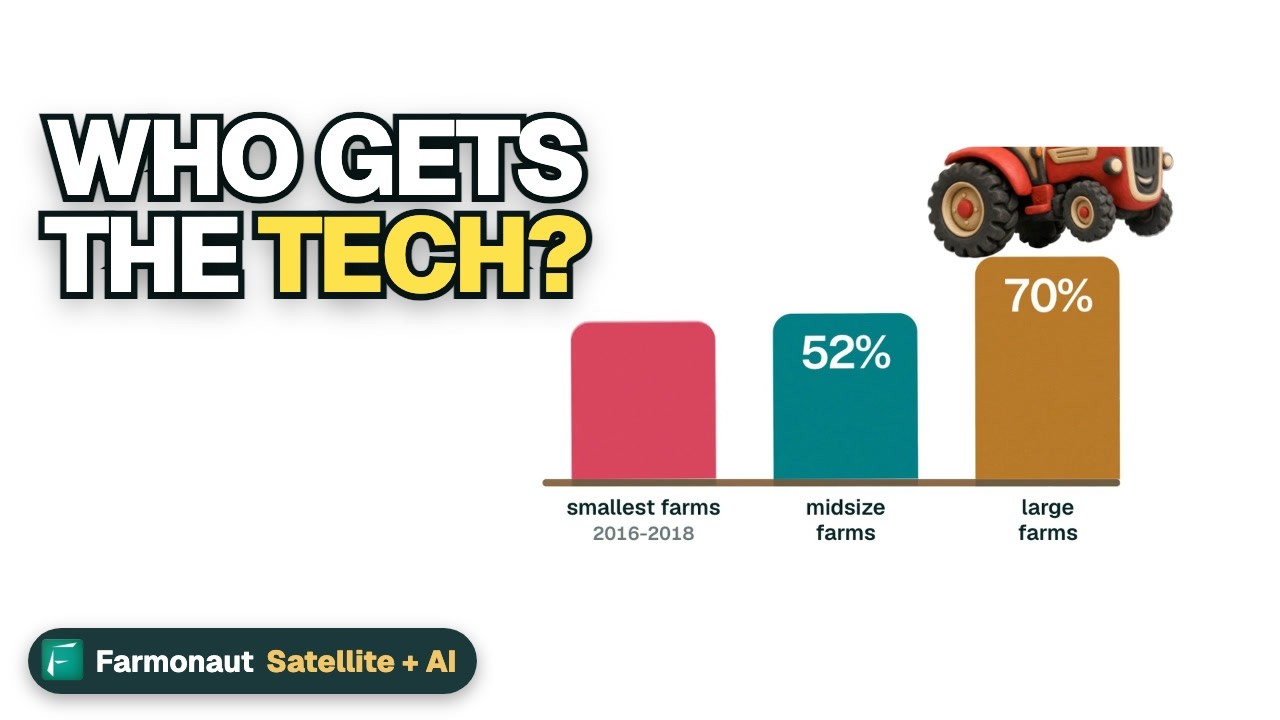
▶ What self-driving tractors and farm technology mean for jobs and rural towns. · 3:50
How to choose a smart tractor setup
Start from the job, not the brochure. These steps help most buyers narrow the choice.
- List your passes. Write down every field operation, the tool width and how many acres it covers each year. Wide tools and many passes favour guidance.
- Pick the accuracy you need. Tillage and spreading work fine with free or low-cost corrections. Planting, bedding, strip-till and controlled traffic need RTK-level repeatability.
- Check compatibility. Ask which of your current implements will run from the tractor screen through ISOBUS, and which functions need a brand-specific licence.
- Ask about subscriptions. Many features now need a yearly fee for corrections, data connection or software. Add these to the price over the years you will own the tractor.
- Look at retrofit first. An aftermarket steering kit on a tractor you already own can deliver most of the guidance benefit at a fraction of the cost of a new machine.
- Test the dealer. Ask how many trained precision technicians they have, what the response time is in planting season, and whether they can diagnose faults remotely.
- Own your data. Read the data terms. Make sure you can export field maps and logs in a standard format if you change brands or advisers.
For small and specialty farms the right answer is often a compact or utility tractor with simple guidance, not a large connected machine. Bigger is not always better: weight adds soil compaction, and a large machine may be idle most of the year.
▶ Six plain steps to start precision farming without buying a robot. · 4:18
Smart tractors on different types of farm
The same technology pays off in very different ways depending on the farm.
| Farm type | Useful smart features | Main watch-out |
|---|---|---|
| Large row crops | RTK auto-steer, section control, VRT, telematics | Subscription costs across many machines |
| Mid-size mixed | Retrofit auto-steer, basic yield and fuel logging | Compatibility with older implements |
| Orchard and vineyard | Narrow tractors, row guidance, targeted spraying, small electric models | Weak satellite signal under canopy |
| Livestock and hay | Guidance for mowing and spreading, telematics on loaders | Low use hours may not repay a big system |
| Small or part-time | Simple light bar or entry-level steering | Payback can take many years |
On grazing land, the ARS study above is a useful warning: guidance improved coverage, but fuel use went up, so the authors judged that a yield gain was needed before the system paid in that setting. On large arable farms with wide sprayers, the overlap savings tend to be larger because each metre of boom covers more ground.
Smart tractors and the environment
The environmental case rests on using less. Fewer overlaps mean less fertilizer and spray applied twice to the same strip, which can cut losses to water. Section control limits spraying near field edges and waterways. Controlled traffic keeps heavy wheels on the same lanes every year, so the rest of the field is less compacted.
There are limits. Larger tractors weigh more, and compaction from heavy machines can cut yields for years. Electric drive helps only where power is clean and the jobs are small. And as the ARS study shows, guidance alone does not always reduce fuel use. Claims of large emission cuts should come with a measured number, a crop and a place. Any change to how you apply fertilizer or crop protection products should follow the product label and local rules, and if you are unsure, ask an agronomist.
The FAO and African Union framework on sustainable agricultural mechanization (2018) makes a related point for African farms that applies elsewhere too: machines should fit the farm’s size, soils and service network, or they cost more than they return.
▶ Seven green farming technologies that save water, fuel and fertilizer. · 2:24
Where satellite data fits with smart tractors
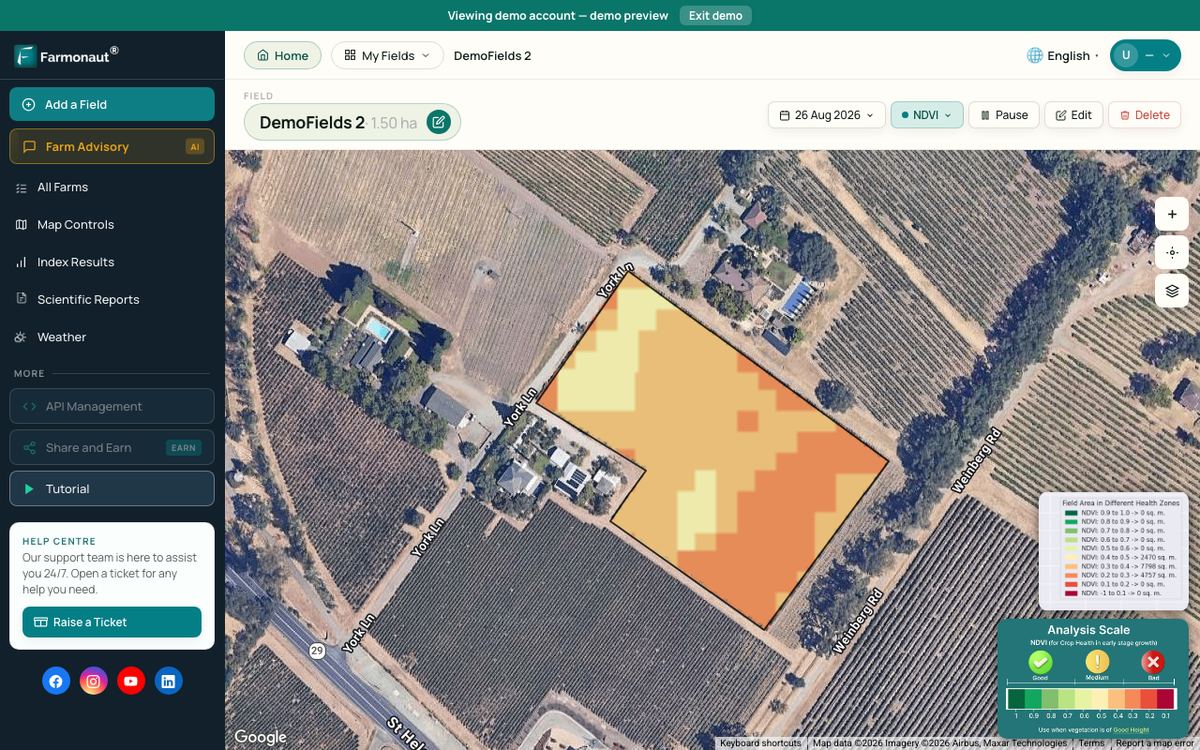
A smart tractor is good at doing a job precisely. It does not tell you where the problems are. That is where field maps come in. Yield maps from the combine, soil tests and satellite crop images all help draw the management zones that a variable-rate prescription needs.
Satellite images show where crops are growing more slowly or more strongly than the rest of the field. They do not show the cause; a person still needs to walk the spot and find out whether it is water, nutrients, pests or soil. Farmonaut provides satellite crop health maps that can help you choose which zones to check and where to change rates; see our page on agriculture GPS tracking for how location data and field maps work together.
Related pages on our site: Farmonaut home, agro admin app, mobile app, carbon footprinting, satellite and weather API docs, product traceability.
How we checked the numbers
Adoption figures come from the USDA Economic Research Service report EIB-248, which uses the Agricultural Resource Management Survey; each crop has its own survey year, so the crops in the chart are not from the same year. Sales come from AEM’s December 2025 report, which gives preliminary retail sales from member companies. Prices come from Manitoba Agriculture’s 2026-27 cost guide and are provincial planning values in Canadian dollars, not transaction prices. Overlap figures come from university extension services and a peer-reviewed USDA study, each with its own crop, field and year. Autonomy details come from a farm trade report on one manufacturer’s kits.
FAQ
What are smart tractors used for?
They do the same jobs as any tractor, such as tillage, planting, spraying, spreading, mowing and hauling. The difference is that they steer along GPS lines, control implements by location and record what was done where.
Can I make my old tractor smart?
Often, yes. Aftermarket kits add a receiver, a steering motor or valve and a display to many older tractors. You get guidance and basic mapping, though not every factory feature. Check that the kit supports your tractor model and your implements.
Are driverless tractors legal on public roads?
Current driverless kits are sold for field work. Moving the tractor on public roads still needs a driver. Rules differ by country and state, so check local road and safety rules before using any autonomous feature.
How accurate is tractor auto-steer?
It depends on the correction signal. Basic satellite corrections suit tillage and spreading. RTK corrections give pass-to-pass accuracy of a few centimetres, which planting and controlled traffic need. Ask the dealer for the stated accuracy and whether it holds from one year to the next.
Do smart tractors pay off on small farms?
Sometimes, but less often. The USDA found far lower use of precision tools on the smallest farms, which may reflect lower returns at small scale. Use the calculator with your own acres and costs, and consider a simple retrofit before a new machine.
Do smart tractors need an internet connection?
Guidance works from satellite signals and does not need the internet, though some correction services use a mobile data link. Telematics, remote diagnostics and cloud data sync do need mobile coverage. Check coverage in your fields before you pay for connected features.
Farmonaut crop monitoring
See your own fields from space
Use satellite crop health maps to choose which zones to check before you set variable rates.



Keep reading
Sources
- USDA ERS, Precision Agriculture in the Digital Era: Recent Adoption on U.S. Farms, EIB-248 (2023): ers.usda.gov
- AEM, United States Ag Tractor and Combine Report, December 2025: dev.aem.org
- Manitoba Agriculture, Cost of Production: Farm Machinery 2026-27: manitoba.ca
- Kansas State University Research and Extension, Field Efficiency Gains You Can Expect From a Guidance System, MF3069: bookstore.ksre.ksu.edu
- Iowa State University Extension, Precision Ag Technology Savings (2012): crops.extension.iastate.edu
- Ohio State University Extension, Benefits of Precision Agriculture: agcrops.osu.edu
- Ashworth et al., USDA ARS, Journal of the ASABE 65(3) (2022): ars.usda.gov
- AgWeb, John Deere Introducing Next Generation Perception Autonomy Kits: agweb.com
- Kalva and Janzen, farmdoc daily, University of Illinois (January 2026): farmdocdaily.illinois.edu
- FAO and African Union, Sustainable Agricultural Mechanization: A Framework for Africa (2018): fao.org
Discussion
Questions, corrections or field experience? Share them below. First-time comments are reviewed before they appear, and your email is never published.
No comments yet. Be the first to add a question or your experience.

 Farm Inc
 JJM Farms
 WeMe Global
 Pixxel
 Agrotoken
 Blue BearX
 Insignito
 Croptimum
 DnCubed
 Field Capacity
 Indosistim Teknologi
 Liquify Digital
 CU Foods
 BeyondTech Global
 Rouge VC
 AgroGreen Dynamics
 AgroRisk
 Oath Inc
 Reddane Farming
 Esri North East Africa
 Licence holder · Niger · Gold










