

Cotton harvest · Price and cost guide
John Deere Cotton Harvester Price and Cost per Acre
A new CP770 module picker lists at $1.33 million before the header (Deere, Feb 2026); Mississippi State budgets use about $1.1 million. Owning one costs about $189 per acre at 200 hours a year, while Texas custom pickers charged an average $0.15 per lint pound with modules in the 2026 survey.
Key takeaways
- Deere lists the CP770 at $1,326,450 and the CS770 at $1,036,370 before the header (Feb 2026). MSU 2026 budgets (2025 prices) use about $1.1 million for a 6-row module picker, $536,000 for a 4-row module picker and $268,000 to $465,000 for basket pickers.
- Owning the 6-row module picker costs $189.34 per acre in the MSU budget ($47.53 direct, $141.80 fixed) at 200 hours a year over 8 years, before module wrap.
- Texas A&M’s 2026 survey averaged $0.12 per lint pound for stripping and $0.15 for picking with on-board modules.
- Used CP770 pickers were listed at AUD 990,000 (2021) and AUD 1.54 million (2023) on an Australian sales site in October 2026; these are asking prices.
- The CP770 (555 hp) and CS770 (515 hp, 12-row header) replaced the CP690 and CS690 in 2021.
In this article
- John Deere cotton harvester price at a glance
- New price: what the budgets and dealers show
- Used John Deere cotton picker prices
- Cost per acre to own a cotton picker
- Custom hire rates for picking and stripping
- Own or hire: cotton picker break-even calculator
- John Deere cotton picker and stripper models
- Picker or stripper: how to choose
- Technology on John Deere cotton harvesters
- Where satellite field maps fit at harvest
- Deere's other harvesters
- How we checked the numbers
- FAQ
A new John Deere CP770 six-row module picker lists at $1,326,450 before the header, and a CS770 stripper at $1,036,370, on Deere’s price pages dated 5 February 2026 (government contract pages; options and dealer terms change the final price). The Mississippi State University 2026 cotton planning budgets use about $1.1 million for the same class, based on prices farmers paid in 2025. That is a budget estimate, not a dealer quote. Smaller four-row and basket pickers in the same budgets run from $268,000 to $536,000, and two used CP770 pickers were listed for sale in Australia at AUD 990,000 and AUD 1.54 million in October 2026.
So the John Deere cotton harvester price depends on three things: picker or stripper, new or used, and how many acres the machine will cover each year. This guide gives dated prices with their sources, the cost per acre of owning a picker, current custom-hire rates for picking and stripping, the main models, and a calculator to test owning against hiring on your own acres.
John Deere cotton harvester price at a glance
The table sums up what we found. Each figure is explained, with its source, further down the page.
| Machine | Price evidence | Type of price | Date |
|---|---|---|---|
| 6-row module picker (500 hp class, like the CP770) | About $1,100,000 | University budget estimate | MSU budgets, 2025 prices |
| 4-row module picker (365 hp) | About $536,000 | University budget estimate | MSU budgets, 2025 prices |
| Basket pickers (4 or 6 rows) | $268,000 to $465,000 | University budget estimate | MSU budgets, 2025 prices |
| Used CP770 (Australia) | AUD 990,000 (2021 model) and AUD 1,540,000 (2023 model) | Dealer asking price | Seen October 2026 |
| Used CP690 (Texas) | $625,000 for a 2019 model with 523 hours | Dealer asking price | Seen October 2026 |
| Custom picking with module | $0.15 per lint pound | Survey average | Texas A&M, 2026 survey |
| Custom stripping | $0.12 per lint pound | Survey average | Texas A&M, 2026 survey |
Older price guides that quote $350,000 to $550,000 for a new machine are too low for a current module picker. That range is closer to what the budgets show for basket pickers and smaller module machines.
New price: what the budgets and dealers show
Deere sells cotton harvesters through its dealers, and the final price depends on the build, the row units, the technology package and the trade-in. Deere’s US price pages dated 5 February 2026 list a base price of $1,326,450 for the CP770 picker and $1,036,370 for the CS770 stripper before options; the stripper header is extra (for example $251,626 for the SH12F 12-row folding header). Those price pages come from Deere’s government and military sales contracts, and a farm dealer quote can differ. A university planning budget gives a second, independent guide.
The Mississippi State University 2026 cotton planning budgets list purchase prices for self-propelled cotton pickers in their Appendix Table 2. The budgets are based on 2025 input prices. They do not name a brand. They list machines by row count, row spacing, horsepower and whether the picker dumps into a basket or builds round modules on board.
- 4-row, 38-inch basket picker, 250 hp: $268,000
- 4-row, 38-inch basket picker, 350 hp: $351,000
- 6-row basket picker, 355 hp: $465,000
- 4-row, 38-inch module picker, 365 hp: $536,000
- 6-row module picker, 500 hp: $1,099,000 (30-inch rows) or $1,100,000 (38-inch rows)
The 500 hp six-row module picker is the class closest to Deere’s current CP770, which has a 555 hp engine. Treat the MSU figure as a planning number. A dealer quote can be higher or lower once options and trade-ins are added.
Machinery prices have risen fast in recent years. A farmdoc daily article from October 2025 found that prices of new farm equipment rose by more than 20% between 2021 and 2023, and that tractor prices rose 21% from 2020 to 2023. A price you saw a few years ago is likely to be out of date.
Prices in Australia
Australian listings are in Australian dollars; these two were marked EGC (excluding government charges). In October 2026, a news page on farmmachinerysales.com.au showed two used CP770 pickers for sale: a 2021 model at AUD 990,000 and a 2023 model at AUD 1,540,000. These are asking prices, not sale results. Deere tested the 770 machines in Australian fields before launch.
Chart
Estimated purchase price of self-propelled cotton pickers
US dollars, by size class (rows, row spacing, horsepower); no brand named; 2025 prices
Used John Deere cotton picker prices
Used prices vary more than new prices. Engine hours, separator or picking-unit hours, the condition of the spindles and row units, the display and guidance package, and any warranty left on the machine all move the price.
Here is what we could check in October 2026:
- A 2019 CP690 with 523 hours in Taft, Texas, was listed by a dealer at $625,000 on farms.com.
- A 2021 CP770 was listed at AUD 990,000 and a 2023 CP770 at AUD 1,540,000 on an Australian sales site.
Auction results are harder to find. We searched for recent published auction sales of CP690 and CP770 pickers in the US and did not find a report we could open and check. Older Deere pickers do appear at farm auctions, but the reports we found did not post recent hammer prices. If you are buying used, check the sold archives of the main online farm auction sites for the last 12 months, and compare like with like: same model, similar hours, same row spacing.
Dealer asking prices are starting points. A machine that has sat on a lot for months may sell well below the ask. An auction price, in turn, comes without dealer service or warranty.
What to check on a used picker
- Engine and picking-unit hours. Ask for both. A picker can have low engine hours and a worn picking system, or the other way round.
- Row units and spindles. Ask what was replaced and when. These parts wear with every season.
- Module builder. Check the wrap feed and the handling system on round-module machines.
- Display and connectivity. Check which display is fitted and whether the data connection is active.
- Service records. A full dealer service history is worth more than a fresh coat of paint.
Cost per acre to own a cotton picker
The purchase price is only part of the story. What matters on the farm is what each acre costs to harvest. The MSU budgets split that cost into direct costs (labor, fuel, and repairs and maintenance) and fixed costs (depreciation, interest, insurance and housing spread over the acres the machine covers).
For the 6-row, 38-inch module picker, MSU estimates $47.53 per acre in direct costs and $141.80 per acre in fixed costs, a total of $189.34 per acre. That assumes 200 hours of use a year over an 8-year life, at 0.172 hours per acre, which works out to roughly 1,160 acres a year. The same budgets list module wrap as a separate cost, from about $39 to $73 per acre depending on the yield assumed.
The fixed part is large because the machine is expensive and used for only a few weeks each year. Fixed costs per acre fall as the machine covers more acres. That is why large farms and custom harvesters can spread a $1.1 million picker more thinly than a mid-size farm can.
Smaller machine classes cost less per acre in the MSU budgets: a 6-row basket picker comes to $86.60 per acre and a 4-row, 250 hp basket picker to $79.53 per acre. But basket pickers need boll buggies, module builders and more labor in the field, so a fair comparison has to include those costs too.
Chart
Direct and total cost per acre to own a cotton picker
US dollars per acre at 200 hours a year over 8 years; 38-inch rows unless stated; module wrap not included
Custom hire rates for picking and stripping
Many growers hire a custom harvester instead of owning one. Custom rates for cotton are usually quoted per pound of lint, so the cost per acre rises with your yield.
Chart
Custom cotton harvest rates in Texas
State average, US dollars per lint pound, including operator, machine and fuel; 6 to 16 responses each
The Texas A&M 2026 custom rates survey, published in February 2026, gives these state averages, including operator, machine and fuel:
- Stripping cotton: $0.12 per lint pound (16 responses)
- Stripping with on-board module building: $0.13 per lint pound (14 responses)
- Picking cotton: $0.14 per lint pound (6 responses)
- Picking with on-board module building: $0.15 per lint pound (8 responses)
The survey also lists per-acre rates, such as $41.67 for stripping and $57.25 for picking, but those rest on only 4 to 6 responses each. The per-pound rates are the better guide.
Mississippi numbers are similar. The Mississippi State Extension custom rates survey, run in 2024, found an average of $0.14 per lint pound for harvest with on-board modules, with a range of $0.12 to $0.15. That figure is based on three responses.
Why your yield changes the custom bill
At a per-pound rate, a higher-yielding field costs more to have picked. Yields differ a lot by state. In 2025, USDA put the US average at 856 pounds of lint per acre, according to the NASS executive briefing of 12 January 2026. Texas averaged 602 pounds per acre, while Arkansas averaged 1,398 pounds.
At $0.15 per pound, that is about $90 per acre at a 602-pound yield and about $210 per acre at a 1,398-pound yield. Ask your custom operator what the rate covers. Some rates include module wrap and some do not.
Chart
Cotton lint yield in the top five producing states
Pounds of lint per harvested acre, 2025 crop
Own or hire: cotton picker break-even calculator
This calculator compares the yearly cost of owning a picker with paying a custom rate. Enter your own price, acres, yield and rates. The default values are round examples set close to break-even, not benchmarks. The price and running cost are near the MSU 2026 budget figures for a 6-row module picker. The custom rate is the Texas A&M 2026 average for picking with on-board modules.
The ownership cost uses straight-line depreciation and interest on the average value of the machine. It leaves out insurance, housing and the cost of being late to harvest, which can matter more than any of the numbers here. This is not financial advice. Check your own figures with your lender, accountant or a farm business adviser before you buy.
Try the numbers for your own farm below.
Calculator
Is owning a cotton picker cheaper than hiring?
Enter your own price, acres, yield and rates.
- Owning: cost per acre: $137
- Hiring: cost per acre: $135
- Yearly ownership cost before running costs: $133,925
- Break-even acres per year: 1,539 acres
Example values only, not a benchmark or a forecast; every number is an input you can change. Defaults: price near the MSU 2026 budget for a 6-row module picker ($1,100,000, 2025 prices); running cost near MSU’s $47.53 per acre for labor, fuel and repairs; custom rate is the Texas A&M 2026 average for picking with on-board modules ($0.15 per lint lb); 900 lb is a round yield near the 2025 US average of 856 lb (USDA NASS). Resale value and interest rate are example assumptions with no source; ask your dealer and lender. Ownership cost = straight-line depreciation plus interest on the average of purchase and resale value; insurance, housing, module wrap and timeliness are not included. Not financial advice.
John Deere cotton picker and stripper models
Deere announced its current cotton harvesters, the CP770 picker and CS770 stripper, in August 2021, with deliveries from spring 2022. They replaced the CP690 and CS690. DTN reported at launch that both machines are about 75% new, are built at Deere’s Des Moines Works in Iowa, and run on Deere’s 13.6-liter engine.
CP770 cotton picker
Best for: large farms and custom harvesters in picker regions who want on-board round modules.
- 555 hp from the 13.6-liter engine.
- Deere says it is 5% more productive than the CP690, or about 4.4 more acres in a 10-hour day.
- Deere says it can cut harvest cost by up to $1.50 per bale compared with the CP690, through less wrap, fuel, labor and hauling.
- Fuel efficiency up to 20% better than the CP690, according to Deere.
- Round modules 2% larger and 5% denser; the machine wraps and ejects a module in just over 30 seconds.
CS770 cotton stripper
Best for: dryland cotton, including wide-row fields.
- 515 hp from the 13.6-liter engine.
- 12-row headers: a rigid header for narrow rows and a folding header for wide rows. The folding header is set for 40-inch rows and can be converted to 38-inch rows.
- Deere says it is up to 48% more productive in dryland cotton than the CS690 with an 8-row header, or up to 100 more acres in a 10-hour day.
- A new field cleaner that Deere says raises turnout by two points.
- Fuel efficiency up to 15% better than the CS690, according to Deere.
CP690 and older pickers
Best for: buyers who want a round-module picker at a lower price and can accept more hours and older technology.
The CP690 was Deere’s round-module picker before the CP770. Many are now on the used market. Deere first trialled its round-module picker on a farm in New South Wales, Australia, in 2008, according to John Deere Australia.
| Model | Type | Power | Status | Price evidence |
|---|---|---|---|---|
| CP770 | Picker, round module | 555 hp | Current, launched 2021 | $1,326,450 Deere list, base (Feb 2026); about $1.1M MSU class budget; AUD 0.99M to 1.54M used asks |
| CS770 | Stripper, round module | 515 hp | Current, launched 2021 | $1,036,370 Deere list, base, before header (Feb 2026) |
| CP690 | Picker, round module | Not checked | Replaced by CP770 | $625,000 ask for a 2019 unit (Texas, Oct 2026) |
| CS690 | Stripper, 8-row header | Not checked | Replaced by CS770 | No public price found |
Picker or stripper: how to choose
The choice is mostly about where you farm and how you grow cotton.
- Your region and yield. Deere built the CS770 with dryland cotton in mind, after stripper owners asked to cover more acres without driving faster. In the Texas A&M survey, 9 of the 16 stripping responses came from the North region of Texas, while most picking responses came from the South region.
- Your row spacing. Check that the header or row units match your rows. The CS770 folding header is built for 40-inch rows; the MSU budgets price pickers for 30-inch and 38-inch rows.
- Your acres per year. Fixed costs fall as acres rise. Use the calculator above to see where owning starts to pay.
- Your gin. Ask your gin how it handles round modules and whether it can take the larger module size the 770 machines can build. Cotton Grower reported that the machine asks the operator to confirm this with the gin before switching to the larger size.
- Your dealer and parts support. Harvest weeks are short. Check how fast your dealer can supply parts and service during the season.
- Hire as a fallback. Even owners sometimes hire extra capacity in a big year or after a breakdown.

▶ How climate and growing conditions shape cotton farming, and how satellite data helps growers adapt. · 9:17
Technology on John Deere cotton harvesters
The 770 machines launched with Deere’s Generation 4 display; Deere’s February 2026 price pages list the G5Plus CommandCenter display, with JDLink connectivity, which sends machine and harvest data to the John Deere Operations Center. Cotton Grower reported that JDLink came at no extra charge at launch, and that Deere’s Harvest Identification Cotton Pro uses RFID tags in the module wrap to trace cotton from the field, through the gin and to the mill.
Other changes include a cab that is 30% larger (the same cab as the X9 combine), more cameras and lighting, and transport speed raised from 17 to 20 mph.
Guidance is now common in cotton. USDA’s Economic Research Service report on precision agriculture (EIB-248, 2023) gives a 2019 estimate of 64.5% for the share of planted cotton acres using auto-steer. For a wider look at sensors and connected tools in cotton, see our guide to IoT in cotton farming.
Before you pay for add-ons, check that your display, guidance receiver and data subscriptions work with the machine you buy, especially on a used picker.

▶ Six plain steps to start precision farming without buying new machines. · 4:18
Where satellite field maps fit at harvest
A harvester records yield as it goes, but the decisions that shape harvest come earlier: when to apply growth regulators, when to defoliate and which fields to pick first. Field-level crop maps can help with those calls.
Texas A&M AgriLife is testing this kind of tool with 11 cotton producers in the Texas Coastal Bend. Its April 2026 report says the project combines drone and satellite data to estimate crop biomass and lint yield, to support decisions on growth regulator timing, defoliation timing and yield forecasts.
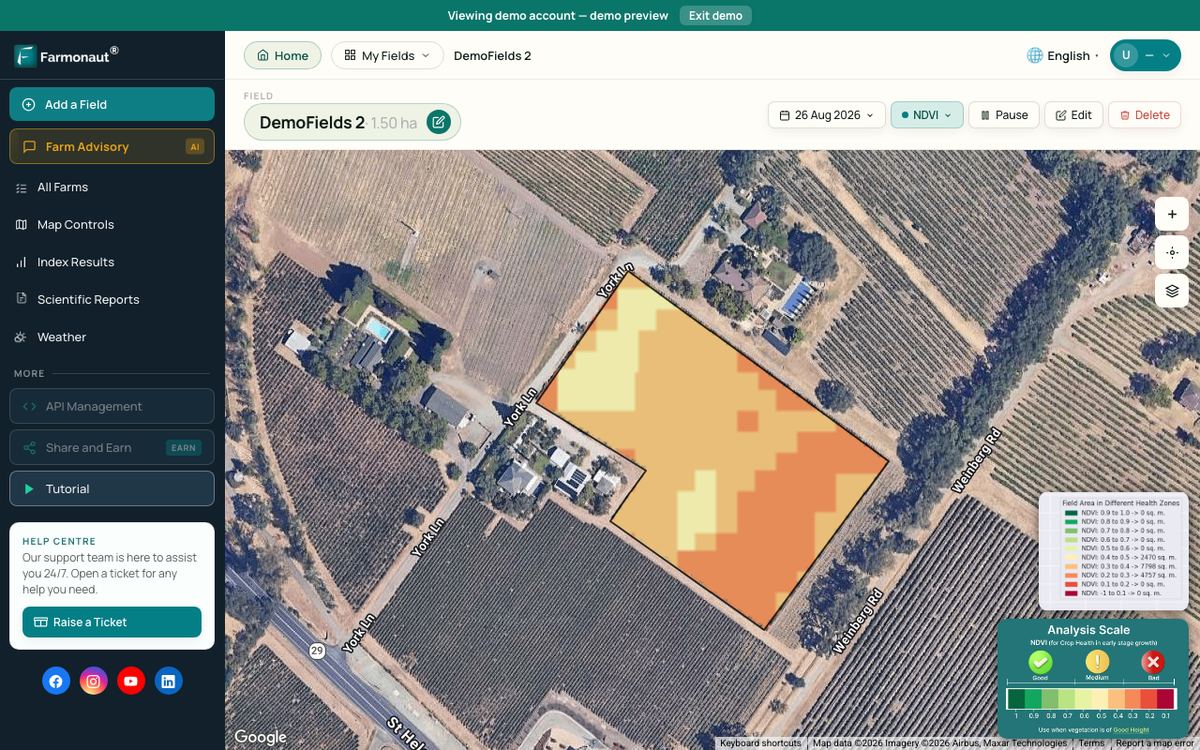
The Farmonaut Satellite + AI Farm Monitoring System gives satellite vegetation maps for your own fields on web, Android and iOS. Maps show where the crop canopy differs across a field; they do not show the cause, so a field check is still needed.

▶ How satellite monitoring and AI help cotton farmers follow crop health through the season. · 9:57
Deere’s other harvesters
Deere also builds combines for grain, sugarcane harvesters and forestry harvesters. For grain combine prices, see our separate combine price guides. Sugarcane growers can find crop advice in our sugarcane production guide.
How we checked the numbers
We used university and USDA sources for prices, costs and yields, and trade press for model specifications. Every price on this page has a date and says whether it is a budget estimate, a dealer asking price or a survey average.
- New prices: Mississippi State University 2026 planning budgets (2025 prices), Appendix Table 2.
- Custom rates: Texas A&M 2026 custom rates survey and Mississippi State Extension 2024 survey.
- Yields: USDA NASS executive briefing, 12 January 2026.
- Model facts: DTN and Cotton Grower launch reports (2021), which quote Deere’s own figures. Productivity and fuel claims are Deere’s and were not tested independently.
- Used prices: dealer listings we opened in October 2026. We found no recent US auction results we could verify.
Related pages on our site: large-farm management dashboard, fleet management, satellite and weather API docs, product traceability, carbon footprinting, satellite checks for crop loans and insurance, steps in farming.
Related reading on this site: Wheat Combine Harvester: Vintage to Modern & Price Insights.
FAQ
How much does a new John Deere cotton picker cost?
Deere’s 5 February 2026 price pages list the CP770 at $1,326,450 and the CS770 stripper at $1,036,370, before the header. The Mississippi State University 2026 budgets use about $1.1 million for a 6-row module picker of the CP770 class, based on 2025 prices. A dealer quote will depend on options and trade-in.
What is the cost per acre to own a cotton picker?
MSU estimates $189.34 per acre for a 6-row module picker used 200 hours a year over 8 years: $47.53 in direct costs and $141.80 in fixed costs. Module wrap is extra. Your cost falls as you cover more acres.
How much do custom cotton harvesters charge?
The Texas A&M 2026 survey averaged $0.12 per lint pound for stripping and $0.14 for picking, or $0.13 and $0.15 with on-board module building. Mississippi’s 2024 survey averaged $0.14 per pound with modules.
What is the difference between the CP770 and CS770?
The CP770 is a spindle picker with 555 hp. The CS770 is a stripper with 515 hp and a 12-row header, aimed at dryland cotton. Both build round modules; Deere announced them in August 2021 and began deliveries in spring 2022.
Is the CP690 still made?
No. The CP770 replaced the CP690 in Deere’s line-up, with deliveries from spring 2022. CP690 pickers are still sold on the used market; one 2019 unit with 523 hours was listed at $625,000 in Texas in October 2026.
Farmonaut crop monitoring
See your cotton fields from space
Draw your fields once and Farmonaut shows satellite vegetation maps for them through the season, on web, Android or iOS, to help plan defoliation and harvest order.



Keep reading


Sources
- Mississippi State University, 2026 Cotton Planning Budgets (Budget Report, 2025 prices): agecon.msstate.edu
- John Deere, cotton harvester price pages (government and military sales contract), 5 February 2026: deere.com
- Texas A&M AgriLife Extension, 2026 Texas Agricultural Custom Rates survey (February 2026): agecoext.tamu.edu
- Mississippi State University Extension, Custom Rates for Mississippi Agricultural Practices, P4048 (2024 survey): extension.msstate.edu
- Mississippi State University Extension, Custom Rates for Mississippi Agricultural Practices (publication page): extension.msstate.edu
- USDA NASS, Executive Briefing: 2025 crop production (12 January 2026): data.nass.usda.gov
- USDA ERS, Precision Agriculture in the Digital Era, EIB-248 (2023): ers.usda.gov
- farmdoc daily, Large increase in machinery costs suggests need to reconsider machinery purchase decisions (October 2025): farmdocdaily.illinois.edu
- Texas A&M AgriLife Today, Cotton precision: digital tools tested in Texas fields (22 April 2026): agrilifetoday.tamu.edu
- DTN Progressive Farmer, Deere intros new picker, stripper (1 September 2021): dtnpf.com
- Cotton Grower, Deere introduces new 770 Series cotton harvesters (2021): cottongrower.com
- Equipment Experts, John Deere unveils new cotton pickers and strippers (2021): equipmentexperts.com
- farmmachinerysales.com.au, John Deere launches new cotton equipment (with dealer listings seen October 2026): farmmachinerysales.com.au
- Farms.com used equipment, 2019 John Deere CP690 dealer listing, Taft, Texas (seen October 2026): m.farms.com
Discussion
Questions, corrections or field experience? Share them below. First-time comments are reviewed before they appear, and your email is never published.
No comments yet. Be the first to add a question or your experience.

 eKGIS
eKGIS Mostas Tech
 AgroStar
 Native Seeds
 Andex
Andex FCF India
 Unifrutti Gulf
 Deluxe Conseil
 TVS Electronics
 BW Pipelines
 WICO
WICO Chimera Innovation
 SkyHarvest
 Polaris Digitech
 Teledarbas
 Licence holder · Niger · Gold










