

Machinery · Buyer guide
Compact Tractor for Steep Hills: Buying Guide and Safety
On hilly ground, stability decides the right compact tractor: a wide track, four-wheel drive, a low build and a ROPS with a seat belt. Overturns cause about 130 deaths a year on US farms (University of Iowa).
Key takeaways
- US sales of two-wheel-drive tractors under 40 HP fell from 174,711 in 2022 to 122,854 in 2025 (AEM preliminary retail data).
- Tractor overturns cause about 130 deaths a year on US farms, and 80% involve experienced operators (University of Iowa Great Plains Center).
- ROPS with a seat belt are rated 99% (UNMC) to 99.9% (Ohio State) effective against death or serious injury in a rollover.
- There is no single safe slope angle; tyres, ballast, wheel width and loads all change it, so use your manual’s limit.
- Ownership cost per hour falls as hours of use rise; compare it with local hire rates using the calculator.
In this article
- Quick answer: what to look for on hilly ground
- Market size: how many compact tractors are sold
- Why slopes tip tractors over
- How to choose a compact tractor for steep hills
- Buying a used compact tractor for hill work
- Comparison: compact tractor types for hilly farms
- Safety on slopes: rules, facts and habits
- Ownership cost per hour: buy or hire?
- Setting up and using a compact tractor for steep hills
- Maps and records for sloping fields
- Orchard, vineyard and hillside crops
- Efficiency and running costs on sloping ground
- How we checked the numbers
- FAQ
The best compact tractor for steep hills is the one with a wide, adjustable wheel track, four-wheel drive, a low centre of gravity, a factory rollover protective structure (ROPS) and a seat belt you will actually wear. Horsepower matters less than stability: tractor overturns cause about 130 deaths a year on US farms, according to the Great Plains Center for Agricultural Health at the University of Iowa. This guide explains how to choose a compact tractor for steep hills, how to set it up, what the market looks like, and what it costs to own one per hour, with a calculator you can fill in with your own numbers.
Quick answer: what to look for on hilly ground
If you only read one part of this page, read this list. Each point comes back later with more detail and sources.
- ROPS and seat belt: a two-post or cab ROPS, certified for the tractor, and a belt that fits you.
- Four-wheel drive: front-wheel assist gives grip when going up and better braking when coming down.
- Wide, adjustable track: a wider stance moves the tipping line further from the centre of gravity.
- Low build: a low hood and seat keep the centre of gravity down; orchard and vineyard models are built this way.
- Hydrostatic or shuttle transmission: smooth, slow speed control without riding the clutch.
- Tyres and ballast: the right tread for your soil and enough rear weight for loader work.
- The manual’s slope limit: the maker’s own figure for your model beats any rule of thumb.
Before you buy, check local rules and talk to your dealer and insurer. If people other than you will drive the tractor, employer safety law applies (see the safety section below).
Market size: how many compact tractors are sold
Compact tractors are the biggest group of farm tractors sold in the United States by unit count. The Association of Equipment Manufacturers (AEM) reports sales of two-wheel-drive tractors under 40 horsepower each month. Its December 2025 report shows 122,854 such tractors sold in 2025, against 135,101 in 2024, a fall of 9.1% (AEM, December 2025 report). Total US farm tractor sales were 195,857 units in 2025, so the under-40 HP group made up close to two in every three tractors sold.
Chart
Market value forecasts, start and end year
USD billion; US compact tractors 2025 to 2035, world orchard tractors 2025 to 2030
The trend has been down for several years. AEM’s December 2023 report gives 174,711 units for 2022 and 156,070 for 2023 (AEM, US monthly ag report, December 2023). AEM notes that its figures are preliminary retail sales reported by member companies, so later numbers can change a little.
In dollar terms, FactMR puts US compact tractor sales at USD 2.85 billion in 2025 and forecasts USD 3.86 billion by 2035, a 3.2% yearly growth rate (FactMR, USA compact tractor industry analysis). FactMR says the 20 to 40 HP range is the largest power band, at about 52% of that value. For machines built for rows of trees and vines, Mordor Intelligence estimates a global orchard tractor market of USD 13.09 billion in 2025, rising to USD 16.32 billion by 2030, or 4.5% a year (Mordor Intelligence, orchard type tractors market). Note that this second figure is a world total, not a US one, and both are private forecasts rather than official statistics.
What does this mean for a buyer? Falling unit sales usually mean dealers hold more stock. AEM listed 58,567 under-40 HP tractors in dealer inventory at the start of December 2025. That can give a buyer room to ask for a better deal, set-up help or extra implements. It does not change what makes a machine safe on a hillside, which is the subject of the rest of this guide.
Chart
US sales of tractors under 40 HP
Two-wheel-drive farm tractors under 40 HP, units per calendar year, preliminary retail sales
Why slopes tip tractors over
Every tractor has a centre of gravity, the balance point of its weight. Draw lines between the points where the tyres touch the ground and you get the stability baseline. As long as the centre of gravity stays inside those lines, the tractor stays upright. Once it moves outside, the tractor tips and the operator cannot stop it. The University of Iowa’s Great Plains Center explains this in its podcast on tractor stability.
A slope moves the centre of gravity closer to the downhill tyres. So do other things that farmers meet every day:
- a raised front-end loader, which lifts the weight higher;
- a downhill wheel dropping into a hole, rut or washout;
- a bump under the uphill wheel;
- a sharp turn at speed, which adds a sideways force;
- wet grass or mud, where the tractor can slide before it tips.
The same podcast makes a point many buyers miss. A 15-degree slope used to be a common rule of thumb, but the speakers say there are too many variables for one number: how the tractor is weighted, its tyres and how wide the wheels are set all change its stability. So treat any single figure with care, and use the limit printed in your own operator’s manual.
Rear rollovers are a separate danger. The Iowa centre notes that a tractor can flip backwards in less than one second, often when it pulls a load hitched too high. The centre’s advice is to hitch loads only at the drawbar, never higher.

▶ How terrain analysis and satellite data help plan work on uneven farm ground. · 16:29
How to choose a compact tractor for steep hills
Use these steps in order. They move from the things that keep you alive to the things that make the work easier.
1. Start with protection, not power
Ask for a ROPS that is certified for the exact model. The Ohio State University farm safety programme says ROPS do not prevent rollovers, but with a seat belt they are 99.9 percent effective in preventing death or serious injury (Ohio State University Extension, tractor rollovers). The University of Nebraska Medical Center gives an estimate of 99% for the same pairing (UNMC Central States Center, 2024). Both say the belt is part of the system: without it the driver can be thrown out and crushed.
A folding ROPS is handy for low sheds and orchards. Fold it only for the moment you pass under a branch or door, and put it back up straight away. Do not wear the belt while it is folded.
2. Pick four-wheel drive and a wide track
Four-wheel drive gives grip uphill and braking on all four wheels downhill. A wide track moves the stability baseline outward. Texas Department of Insurance training material on rollovers advises using the widest wheel setting that suits the job (Texas Department of Insurance, tractor rollover safety). Many compact models let you reverse the rear wheels on their hubs or move the rims to widen the track. Check that the setting still fits between your rows.
3. Keep the machine low
Orchard and vineyard tractors are built narrow and low so they fit under branches and between rows. That low build also helps on side slopes. If you farm trees, vines or berries on a hillside, compare a standard compact tractor with a low-profile or specialty model of the same power.
4. Match horsepower to the implements you use
Buy power for the heaviest job you do often, not the one you do once a year. Check whether a brochure gives engine power or PTO power. Manitoba Agriculture’s machinery guide says to multiply net engine power by 0.88 to estimate PTO power (Manitoba Agriculture, farm machinery custom and rental guide). So a tractor sold as 35 net engine HP gives roughly 31 HP at the PTO.
5. Choose a transmission you can control slowly
On slopes you want low, steady speed. Hydrostatic drives let you creep forward and back with a foot pedal. Gear and shuttle drives can be just as safe if you stay in gear. The Texas guidance says to select the lowest gear before starting downhill and to keep the tractor in gear when going down. Never coast in neutral.
6. Plan tyres and ballast
Turf tyres are kind to lawns but slip on wet grass. Industrial (R4) and agricultural (R1) treads grip better in soil and mud. If you will use a front loader, add rear weight with a ballast box, wheel weights or filled tyres, as the manual allows. The OSHA test standard for tractor ROPS uses a minimum test weight of 110 lb per maximum PTO horsepower (OSHA 29 CFR 1928.51); that is a test condition, not a ballast target, so follow the maker’s ballast table.
7. Test-drive on your own ground
Ask the dealer for a demonstration on your steepest working area, at a safe speed and with the loader low. Check how the seat, pedals and belt fit you, and whether you can see the wheels and the edge of the slope.
Buying a used compact tractor for hill work
A used machine can save money, but on sloping land some faults matter more than usual. Bring a friend who knows tractors, and go through these checks before you agree a price.
- ROPS label: look for the certification label on the frame; a frame without one, or one that has been welded or drilled, should be replaced.
- Seat belt: check that it latches, retracts and is not frayed or sun-damaged.
- Brakes: test both brake pedals and the parking brake on a slope; hill work depends on them.
- Front axle and steering: play in the steering or worn front-axle pins makes the tractor wander on side slopes.
- Four-wheel-drive engagement: make sure the front drive engages and releases cleanly.
- Loader frame: look for cracks or bent arms, which can mean the loader was overloaded.
- Hours and service log: ask for records; an engine hour meter alone does not show how hard the tractor worked.
- Manual: ask for the operator’s manual, or download it from the maker, so you know the slope and ballast limits.
If the tractor was built before ROPS became standard in the mid-1980s, budget for a certified retrofit kit, or keep it off slopes entirely. The Iowa centre says the tractors involved in overturns are typically older ones without ROPS.
Comparison: compact tractor types for hilly farms
The table compares broad classes of machine rather than brands. Check the exact specifications of each model with the maker.
| Type | Best for | Strengths on slopes | Watch out for |
|---|---|---|---|
| Sub-compact | Small acreage, mowing, light loader work | Light, easy to handle, often hydrostatic | Narrow track and low weight; easy to overload the loader |
| Compact utility | Mixed small farms, 20 to 40 HP jobs | 4WD, wider track options, three-point hitch | Loader raises the centre of gravity |
| Orchard/vineyard | Trees, vines and berries in rows | Low and narrow build, fits under branches | Narrow track can reduce side-slope margin |
| Articulated | Vineyards and tight turns | Even weight, good grip, tight turning | Different steering feel; train before use |
| Two-axle mower | Steep grass and banks | Very low build made for slopes | Limited for loader or heavy PTO work |
For very steep banks, many farms use a slope mower or a remote-controlled mower instead of a tractor. That keeps the driver off the worst ground entirely.
Safety on slopes: rules, facts and habits
The facts on rollovers are blunt. The Iowa centre reports that about 1 in 10 operators overturns a tractor in their lifetime, that 80% of overturn deaths involve experienced operators, and that 1 in 7 farmers involved in an overturn is permanently disabled. Ohio State says rollovers account for 50 percent of tractor-related deaths in the United States.
Chart
Tractor rollover facts in percent
Selected US figures from extension and public-health sources
Old tractors are the biggest gap. ROPS became standard on US-built tractors in the mid-1980s, and the Iowa centre notes many older tractors without ROPS are still used. The National ROPS Rebate Program helps US farmers pay for a retrofit; its March 2025 flyer says the programme had helped install ROPS on over 3,600 tractors (National ROPS Rebate Program, 2025). Check its website for current funding in your state.
In the United States, OSHA rule 1928.51 says employers must provide ROPS and seat belts on agricultural tractors over 20 engine horsepower made after October 25, 1976, when employees drive them. Canada, the UK, the EU, Australia and New Zealand have their own rules. Check the rules where you farm and ask a safety adviser if you employ staff.
Habits that the Ohio State and Texas guidance both stress:
- Stay 10 feet or more away from ditches, riverbanks and steep drop-offs.
- Drive up and down slopes where the manual says so, not across them, unless the manual allows it.
- Keep side-mounted equipment on the uphill side.
- Carry a loader bucket as low as possible, especially when turning.
- Slow down before turns and on rough ground.
- If the tractor feels unstable on a slope, turn downhill, not uphill.
- Skip the slope when it is wet. Ground that is safe when dry can make a tractor slide.
Ownership cost per hour: buy or hire?
A compact tractor is a big purchase for a small farm. A simple way to judge it is the cost of owning it per hour of use, then comparing that with the hourly rate you would pay to hire one or to pay a contractor. Manitoba Agriculture’s machinery rental guide splits costs into ownership (depreciation, interest on the money tied up, housing and insurance) and operating costs (repairs, fuel and labour), and it assumes a salvage value of 33% of the purchase price. The farmdoc team at the University of Illinois also publishes yearly machinery cost estimates for US farms that you can use to check your own figures.
The calculator below uses that logic in a simple form. Depreciation is the price minus the resale value, spread over the years you keep the tractor. Interest is charged on the average value over that time. Repairs and fuel are your own hourly estimates. All defaults are round examples near break-even, not quotes or benchmarks; put in your own numbers.
Low hours raise the cost per hour quickly, because overhead is spread over fewer hours. If you use a tractor only a few days a year, hiring or a contractor may cost less. If you use it most weeks, owning often makes more sense, and you also get the machine when the weather allows rather than when a contractor is free.
Try the numbers for your own farm below.
Calculator
What does a compact tractor cost per hour to own?
Enter your price, resale value, years, hours and hire rate.
- Depreciation per year: $2,010
- Interest per year: $1,197
- Hire rate minus owning cost per hour: -$0 /hour
Example values only, not quotes, benchmarks or forecasts; every number is your input. Method follows Manitoba Agriculture’s machinery rental guide: depreciation is spread evenly over the years kept, and interest is charged on the average of the price and resale value. Manitoba assumes resale (salvage) at 33% of price; the default here is an example. Housing, insurance and labour are left out, so the true cost is higher. Get financial advice before a large purchase.
Setting up and using a compact tractor for steep hills
A good tractor can still roll if it is set up badly. Work through this list before the first job of the season.
- Read the slope, ballast and loader sections of the manual. Write the slope limit on a tag near the seat.
- Set the wheels to the widest track that fits your rows and gateways.
- Check tyre pressures on both sides; a soft tyre on the downhill side lowers your margin.
- Fit the ballast the manual lists for your loader or rear implement.
- Check the ROPS for cracks or loose bolts and the seat belt for wear.
- Walk the slope first. Mark holes, stumps, soft patches and drop-offs.
- Plan your route so that you travel up and down the hill and avoid turning on the steepest part.
- Tell someone where you are working, and carry a phone on your body, not in the cab.
Measure the slope instead of guessing. A phone level app or a simple inclinometer can give the angle. Remember that grade in percent and angle in degrees are not the same: a 20% grade is about 11 degrees, and a 15-degree slope is about a 27% grade. Compare the measured angle with your manual’s limit and leave a margin.
Maps and records for sloping fields
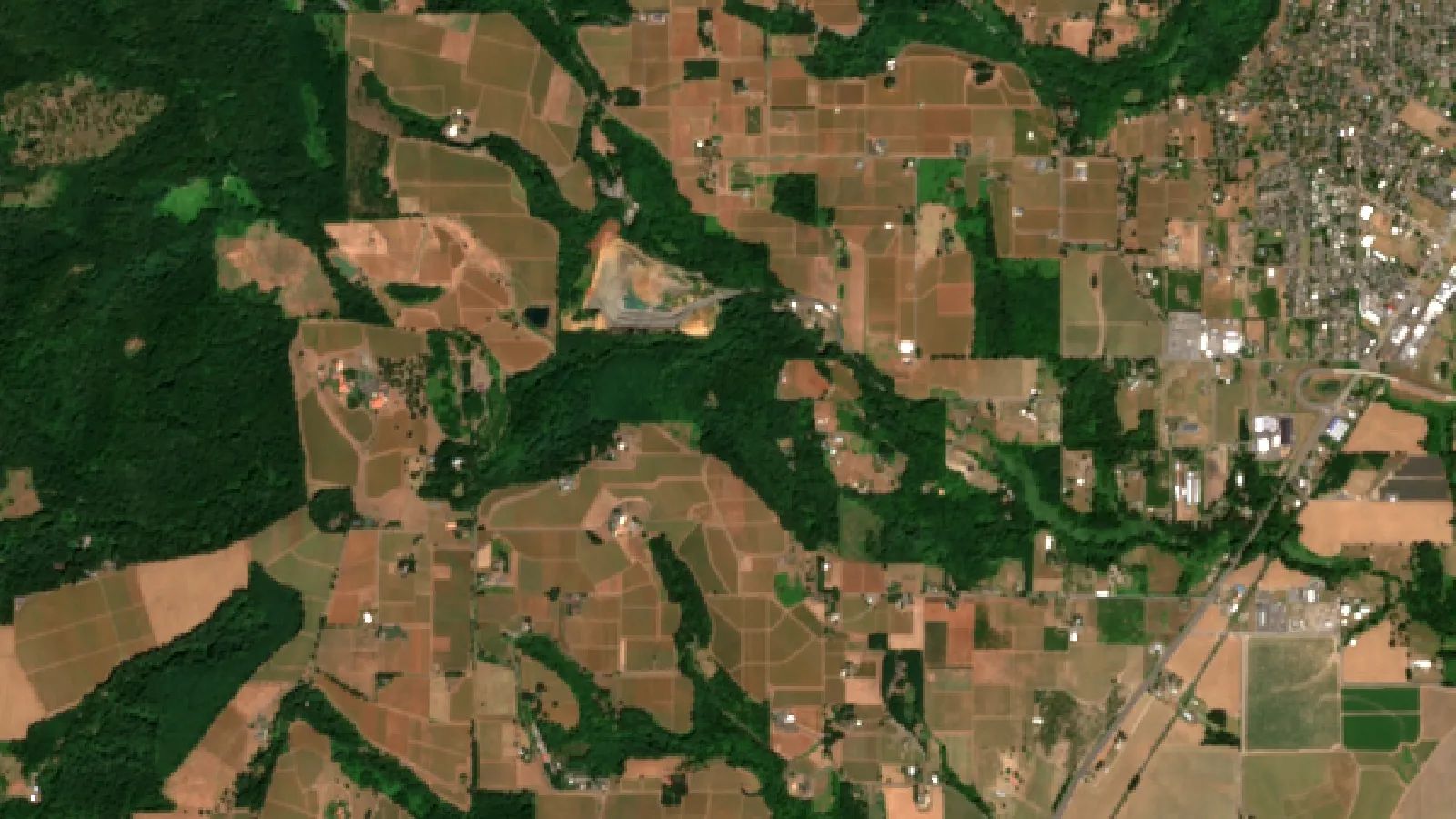
On hilly land, a map of where the ground is steep, wet or thin is useful well beyond the tractor seat. Slope maps help you decide which blocks to mow, which to graze and which to leave in permanent cover. Satellite crop maps show where plants grow well and where they struggle across a season, which often follows the slope and soil depth.
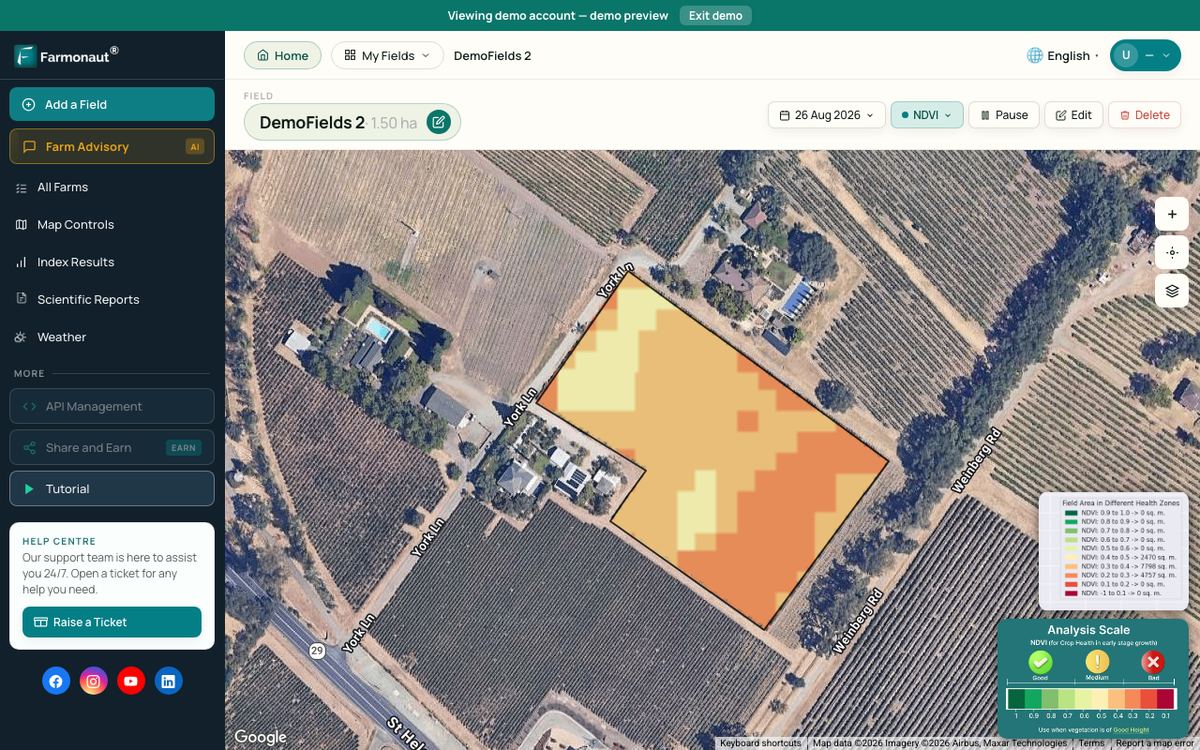
Farmonaut Satellite + AI Farm Monitoring System gives vegetation maps for the fields you draw, so you can see weak patches on a hillside and plan which areas need a visit before you take a tractor there. The fleet management tools can also help larger farms track where machines are working.
▶ Six plain steps to start precision farming, from field maps to satellite monitoring. · 4:18
Orchard, vineyard and hillside crops
Trees and vines on slopes bring two extra limits: row width and branch height. A tractor that is stable but too wide will damage plants, and one that is narrow and tall will tip. That is why specialty orchard and vineyard tractors exist. Mordor Intelligence segments that market into below 20 HP, 20 to 30 HP and 30 to 40 HP, which matches the compact power range.
For hillside rows, compare these points:
- overall width against your narrowest row, with a margin for the sprayer or mower;
- height to the top of the ROPS with it folded and raised;
- turning radius at the row ends, which are often on a slope;
- whether the PTO and hydraulics suit your sprayer, mulcher or mower.
In wine regions with very steep terraces, growers often use tracked carriers, winches or hand work on the steepest rows. A compact tractor fits best on moderate slopes where the manual’s limit is not reached.
Efficiency and running costs on sloping ground
Fuel use rises with load, and slope work adds load. The Manitoba guide estimates fuel cost with a 75% load assumption for its tractor rates, and explains how to adjust for other loads. On a small farm, the bigger costs are often overhead and repairs, not fuel, which is why the calculator above asks for both.
Simple ways to cut running costs:
- Match the implement to the tractor so you do not run at full load for long.
- Keep tyre pressures right for grip and less soil damage.
- Combine jobs on one trip up the hill where it is safe.
- Keep a service log; skipped services raise repair bills later.
Electric compact tractors are now on sale from some makers. FactMR lists electric drive as one of the trends it expects in its forecast. Check battery run time on slopes, since climbing uses more energy, and ask the dealer for real-world run times on ground like yours.

▶ Seven green farming technologies compared, from efficient machinery to precision tools. · 2:24
How we checked the numbers
Sales figures come from AEM’s monthly US reports for December 2023 and December 2025, which give full-year totals. Market values come from FactMR and Mordor Intelligence report pages, which are commercial forecasts. Safety figures come from the University of Iowa Great Plains Center, Ohio State University, the University of Nebraska Medical Center, the National ROPS Rebate Program and the Texas Department of Insurance. The legal rule comes from OSHA’s own page. The cost method follows the farmdoc and Manitoba Agriculture machinery guides. Earlier versions of this page gave the orchard tractor figure as a US number with 11.4% growth; the Mordor page shows a world total with 4.5% growth, and we have corrected it.
Related pages on our site: farm admin app, Farmonaut app, satellite and weather API, carbon footprinting, crop loan and insurance, product traceability, AI in agriculture.
Related reading on this site: Agricultural Mapping and Imaging Market: Size, Tools, Data.
FAQ
What is the safe slope for a compact tractor?
There is no single safe number. A 15-degree slope was an old rule of thumb, but tyres, ballast, wheel width, loader height and ground conditions all change the limit. Use the figure in your operator’s manual and stay well below it, especially on wet ground.
Is four-wheel drive needed on hills?
For regular hill work, yes. Four-wheel drive gives grip uphill and braking on all four wheels downhill. It does not stop a side rollover, so wheel width, speed and loader height still matter.
Should I wear a seat belt on a tractor?
Wear it when the tractor has an upright ROPS. Ohio State and UNMC put ROPS plus a seat belt at 99% or more effective against death or serious injury in a rollover. Do not wear the belt on a tractor without a ROPS or with a folded ROPS.
How much horsepower do I need for a hilly small farm?
Size the tractor to the heaviest implement you use often. FactMR reports that the 20 to 40 HP band is the largest share of US compact tractor sales. Check whether the rating is engine or PTO power; Manitoba Agriculture estimates PTO power at 0.88 times net engine power.
Is it cheaper to own or hire a compact tractor?
It depends on hours of use. Owning has fixed costs that do not fall when the tractor sits in the shed, so the cost per hour falls as use rises. Use the calculator on this page with your own price, resale value and hours, and get financial advice for large purchases.
Can I add a ROPS to an older tractor?
Often, yes. Retrofit ROPS kits exist for many older models, and in the US the National ROPS Rebate Program helps with the cost. Ask your dealer or local extension office which kit is certified for your tractor.
Farmonaut crop monitoring
See your hillside fields from space
Draw your fields once and Farmonaut shows satellite vegetation maps for them through the season, on web, Android or iOS.



Sources
- University of Iowa Great Plains Center for Agricultural Health, Tractor overturns: gpcah.public-health.uiowa.edu
- University of Iowa Great Plains Center, The Tipping Point: Understanding Tractor Stability (podcast transcript, 2026): gpcah.public-health.uiowa.edu
- Ohio State University Extension, Tractor rollovers, AEX-892.2.56 (2018): ohioline.osu.edu
- University of Nebraska Medical Center, Central States Center for Agricultural Safety and Health, ROPS news release (2024): unmc.edu
- National ROPS Rebate Program, one-page summary (March 2025): ropsr4u.org
- OSHA, 29 CFR 1928.51 Roll-over protective structures for agricultural tractors: osha.gov
- Texas Department of Insurance, Tractor rollover safety training: agate.tdi.texas.gov
- AEM, US monthly ag tractor and combine report, December 2023: newsroom.aem.org
- AEM, United States Ag Tractor and Combine Report, December 2025 (GlobeNewswire release, January 2026): stocks.observer-reporter.com
- FactMR, USA compact tractor industry analysis (2025-2035): factmr.com
- Mordor Intelligence, Orchard type tractors market (2025-2030): mordorintelligence.com
- Manitoba Agriculture, Farm machinery custom and rental rate guide 2026-27: manitoba.ca
- farmdoc, University of Illinois, Machinery cost estimates summary (2025): farmdoc.illinois.edu
Discussion
Questions, corrections or field experience? Share them below. First-time comments are reviewed before they appear, and your email is never published.
No comments yet. Be the first to add a question or your experience.

 Agreeta Solutions
 Agricultural Credit Policy Council
 BayWa
BayWa MCSOD
MCSOD Marei Nursery
 eKGIS
eKGIS Mostas Tech
 Native Seeds
 Andex
Andex FCF India
 Unifrutti Gulf
 Deluxe Conseil
 TVS Electronics
 WICO
WICO Chimera Innovation
 SkyHarvest
 Licence holder · Niger · Gold
 Licence holder · Nigeria · Gold + lithium










