

Variable Rate Technology Agriculture: 2025 Top 5 Trends Transforming Precision Farming
Variable Rate Technology in Precision Agriculture: Transforming Farming Practices by 2025
Introduction: The Rise of Variable Rate Technology in Agriculture
The agriculture variable rate technology market has undergone tremendous change over the past decade, with technological advances defining the way we grow food. As we approach 2025, variable rate technology agriculture stands out as a cornerstone in the evolving landscape of modern farming. It is not merely a buzzword—it’s a proven method for optimizing crop production, minimizing input waste, and driving vital sustainability goals. Sizing and growth figures for the sector are laid out in the VRT market in agriculture, alongside adoption trends.
In 2025, expectations are high for variable rate agriculture to take on an increasingly critical role, especially as the global demand for food continues to rise in the face of environmental constraints. This blog post dives deep into why the adoption of VRT will redefine precision agriculture and highlights the top five trends poised to transform variable rate farming in the coming year.
Understanding Variable Rate Technology (VRT) in Precision Agriculture
What Is Variable Rate Technology?
Variable rate technology (VRT) refers to the controlled, site-specific application of agricultural inputs—such as seeds, fertilizers, and pesticides—at different rates across a field, using precise data about soil conditions, crop health, and environmental variables.
- Unlike traditional uniform application: Every part of the field receives the same amount of input, regardless of actual need.
- VRT enables tailored input levels: Inputs are adjusted on-the-go to suit the requirements of each field zone, optimizing resource use and boosting overall efficiency.
The foundation of variable rate technology in precision agriculture lies in high-resolution spatial and temporal data. Using tools like GPS-guided machinery, advanced sensors, remote sensing via satellites or drones, and yield mapping, farmers and agronomists can map the variability of a field and generate detailed prescription maps.
These maps guide the application of inputs, ensuring that every square meter receives exactly what it needs for optimal production. The result? Enhanced yields, reduced waste, and minimized environmental impact.
The Evolution of Variable Rate Technology
As technology advances, variable rate agriculture is becoming more sophisticated and accessible. The landscape has evolved from basic grid sampling and simple fertility maps to dynamic, data-driven systems powered by satellite imagery, machine learning, and AI.

Why Variable Rate Technology Matters for Modern Farming
- Optimizes input use: Inputs like fertilizers and water represent significant costs.
- Reduces environmental contamination: Less input waste means lower nutrient runoff and reduced emissions.
- Boosts profitability: Precision input application translates into higher net returns.
- Supports sustainable practices: By using only what is needed, VRT enables more environmentally responsible agriculture.
2025 Top 5 Trends in Variable Rate Technology Agriculture
The agriculture variable rate technology market is poised for widespread adoption by 2025. Let’s break down the top 5 trends that will define the future of variable rate technology in precision agriculture:
-
Variable Rate Seeding & Enhanced Seed Placement
Variable rate seeding technologies use real-time data and soil maps to adjust seed density across the field. By 2025, expect strong growth in adoption as more farmers seek to optimize yields and resource efficiency.
- Ensures fertile zones receive higher seeding rates, while less productive areas get less.
- Prevents overcrowding and supports healthy crop competition.
- Can lift yields where seeding rates match each zone’s potential.
Application Example: Seeding can be adjusted for zones with high moisture and fertility, while sandy or lower moisture areas receive a lower rate, optimizing seed and resource use.
-
Advanced Sensor Integration & Remote Sensing
Modern variable rate farming increasingly integrates advanced sensors—including soil moisture, temperature, and nutrient sensors—combined with satellite and drone-based remote sensing. By 2025, such systems will power spatially-detailed prescription maps for real-time input adjustment.
- Satellites and drones provide up-to-date crop health and field variability insights.
- On-ground sensors feed fine-scale information about soil conditions and moisture levels directly to equipment.
- Lowering input waste through precise, variable application.
Application Example: If soil water sensors detect dry patches, the irrigation system automatically increases water application in those zones, conserving water elsewhere.
-
AI-Driven Prescription Maps and Decision Support
By 2025, AI-powered prescription maps will become standard in variable rate agriculture, merging historical yield data, multispectral satellite imagery, and agronomic insights.
- AI technology enables real-time analytics and more accurate decision support systems.
- Makes VRT accessible and actionable for a wider range of farmers.
- Adapts continuously based on new data collection and changing field conditions.
Application Example: Prescription maps may recommend higher nitrogen rates for zones identified as nutrient-deficient, while areas with lower yield potential receive less input.
-
Real-Time Fertilizer Application
Real-time, variable fertilizer application leverages technology and automation to adjust input rates on-the-fly as machinery moves across the field. By 2025, expect widespread use of connected, sensor-driven fertilizer spreaders and sprayers.
- Reduces fertilizer waste and environmental leakage.
- Improves nutrient uptake and crop health.
- Maximizes ROI by addressing sub-field variability in real time.
Application Example: Nutrient sensors and GPS-linked machines automatically speed up or slow down application, depending on the measured need zone-by-zone.
-
Zone-Specific Irrigation Management
Variable rate irrigation brings new precision to water management. Using sensors and satellite-based moisture monitoring, irrigation systems soon will automatically vary water delivery based on real-time needs.
- Conserves water resources and lowers costs.
- Reduces stress on plants by providing optimal water levels.
- Integrates with sustainability initiatives, minimizing runoff and pollution.
Application Example: Over-irrigation is prevented by precisely matching application to each soil zone’s exact need, increasing both crop performance and long-term sustainability.
Comparison Table of 2025 Trends in Variable Rate Technology

Key Drivers Behind VRT Adoption: Data, Sustainability & Market Growth
Expanding Market for Variable Rate Technology Agriculture
The variable rate technology agriculture market is set to expand significantly through 2025, driven by:
- Increasing awareness of sustainable farming practices and resource scarcity.
- Pressure to feed a growing global population more efficiently and with fewer environmental consequences.
- Technological advances in satellite technology, data analytics, and AI making precision systems viable for more farmers.
- Government incentives for sustainable input and water management.
How Big Is the Variable Rate Technology Market?
Research firms size the global VRT market at roughly USD 6 billion to USD 7 billion, but their numbers differ because each defines the market differently (some include non-farm uses). Figures below were checked in September 2026.
| Publisher | Base value | Forecast | Growth rate |
|---|---|---|---|
| Mordor Intelligence | USD 6.99 billion (2026) | USD 11.74 billion (2031) | 10.93% a year |
| Fortune Business Insights | USD 6.92 billion (2026) | USD 19.00 billion (2034) | 13.46% a year |
Both firms name North America as the largest regional market and hardware (controllers, spreaders, planters) as the largest component. Mordor puts fertilizer as the leading application, with variable rate irrigation growing fastest.
Survey data on real farms is more modest than the forecasts. According to the USDA Economic Research Service, VRT was used on 37.4% of US corn acres in 2016, 25.3% of soybean acres in 2018, 22.7% of cotton acres in 2019 and 18.8% of winter wheat acres in 2017. An earlier ERS study found VRT raised corn profits by about 1% on average in 2010. Gains are real but depend on how variable a field is.
Why Precision and Variable Input Application Will Dominate Modern Agricultural Practices
- Precision reduces waste and minimizes environmental contamination in nearby water systems.
- Controlled application pairs economic benefit (lower input costs) with environmental stewardship.
- Market demand for traceable, sustainably grown crops continues to rise—reinforcing the shift to smarter farming.
Our satellite-powered data platforms enable real-time monitoring, AI-based advisory systems, and carbon footprinting tools for both small and large-scale agriculture, making it easier to transition to these new systems.

Farmonaut: Empowering Precision Farming with Satellite Insights
At Farmonaut, we are committed to making satellite-driven variable rate agriculture solutions both affordable and accessible worldwide. Our core platforms utilize:
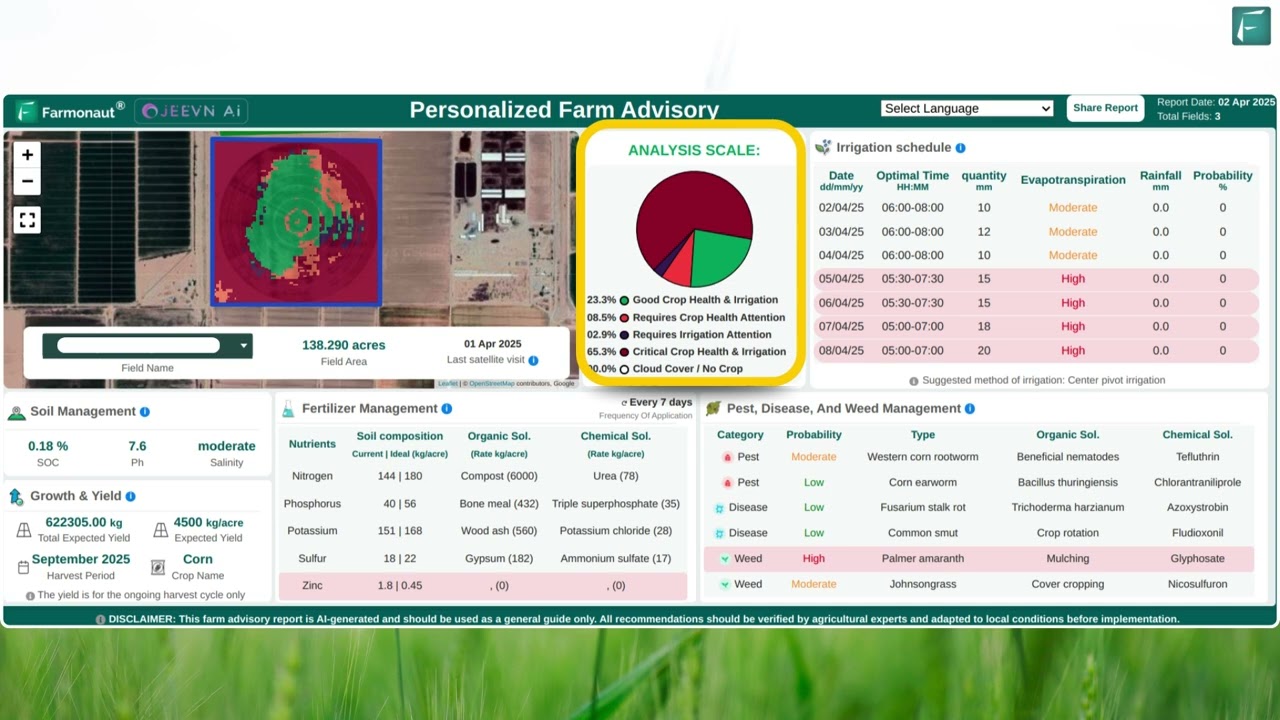
- Satellite-based monitoring for crops, soil health, and vegetation indices (like NDVI), which delivers in-depth field variability insights to inform prescription maps.
- AI-based advisory systems, such as Jeevn AI, providing real-time, data-driven recommendations on input application—from fertilizer rates to irrigation scheduling.
- Blockchain-enabled traceability solutions to guarantee supply chain transparency from farm to consumer.
- Fleet and resource management tools optimizing machinery fleets and operational efficiency for large-scale farm enterprises.
- Environmental impact monitoring including real-time carbon emissions data, helping farmers and agribusinesses stay compliant and measure sustainability.
Our technology is available via browser app, Android app, iOS app, as well as API integrations for custom enterprise needs. Learn more about technical details in our API developer docs.



Satellite-based loan and insurance verification also enables faster, more secure access to financing for farmers, reducing fraud and transparency issues commonly faced in traditional schemes.
Need to monitor vast plantations, forests or need forest management and advisory? Try our plantation and forest advisory solutions—powered by advanced satellite analytics and AI-backed recommendations.
For large farms looking for integrated management, explore our farm management platform for enterprises to track yield, resource allocation, and sustainability indices.
The Broader Impact: Sustainability, Productivity, and Profitability
Environmental Sustainability and Responsible Resource Use
Variable rate technology fundamentally supports sustainable agriculture by limiting excessive input use and minimizing environmental contamination. Fertilizer runoff is a major cause of waterway pollution and soil degradation—by applying only what’s needed, both problems are curbed. Water savings via zone-specific irrigation reduce greenhouse gas emissions from pumping and lessen the water footprint of agriculture.
Increasing Productivity to Feed a Growing Global Population
With the global population past 8 billion (a UN milestone of November 2022), precision agriculture technology like VRT becomes crucial to boosting yields while protecting scarce resources. The agriculture variable rate technology market will not only serve large corporate growers, but new innovations and affordable data platforms are opening the doors for smallholders and cooperatives as well.
Economic Benefits: Profitability Meets Precision
- Reduced input waste = lowered cost.
- Higher yields = increased profits.
- Improved crop health = decreased risk of disease outbreaks and more resilient production against climate volatility.
Integrating AI, remote sensing, variable input technology, and satellite data is more than a technological leap—it’s a new era for agriculture. At Farmonaut, our mission is to empower every farmer and agri-enterprise with comprehensive, actionable information for sustainable, data-driven management.
Practical Steps for Implementing VRT in 2025 and Beyond
Are you ready to transition to variable rate technology in precision agriculture? Here are suggested steps to maximize benefits in 2025 and in the future:
- Start with Data Collection: Gather high-resolution field data—satellite imagery, historical yields, soil tests.
- Leverage Remote Sensing Technologies: Partner with platforms that deliver multispectral and temporal data at affordable cost.
- Use AI-Driven Prescription Systems: Employ smart algorithms that translate data into actionable maps for input application.
- Invest in Compatible Machinery: Upgrade spreaders, sprayers, and planters that can read variable rate prescription maps—or retrofit existing equipment with VRT modules.
- Train Your Team: Upskill personnel or work with digital advisors to ensure data interpretation and field execution is precise.
- Monitor and Adjust: Continuously evaluate crop performance, input efficiency, and adjust strategy as new tech and data become available.
Our satellite-driven apps and APIs make these steps simpler, faster, and more cost-effective for farmers and agriculture businesses worldwide.
Frequently Asked Questions (FAQ) about Variable Rate Technology Agriculture
1. What is variable rate technology, and how does it differ from traditional input application?
Variable rate technology (VRT) enables site-specific application of seeds, fertilizers, pesticides, and water at varying rates across a field, based on spatial/temporal data. Unlike traditional uniform methods, VRT tailors input levels precisely to need, improving efficiency, productivity, and sustainability.
2. What are the top benefits of variable rate agriculture for farmers?
- Lower input costs and reduced waste (especially for expensive fertilizers and water).
- Increased yields and better crop health.
- Minimized environmental impact—reducing contamination of water bodies and greenhouse emissions.
- Improved resource management and sustainable farming practices.
3. How important is remote sensing in precision agriculture?
Satellite and drone remote sensing offer high-resolution, up-to-date field data to power decision-making. They provide vital insights for monitoring crop health, soil moisture, and variability—essential for effective variable rate technology agriculture.
4. Can small and medium-sized farms access VRT technology in 2025?
Yes. Technological progress and platforms like Farmonaut are actively lowering the barriers—making satellite data, AI-driven recommendations, and scalable tools affordable even for smaller farms, cooperatives, and groups.
5. What infrastructure is required to implement variable rate farming?
- Access to high-quality field data (satellite, sensors, historical yield records).
- VRT-compatible equipment (planters, spreaders, sprayers) or retrofit modules.
- Decision support systems and prescription map software.
- Training or digital advisory services for effective data-driven execution.
6. What is the estimated input waste reduction and yield increase by adopting VRT in 2025?
There is no single figure; results depend on crop, field variability and region. A USDA ERS study found VRT raised corn profits by about 1% on average in 2010.
7. How can Farmonaut help me advance my precision agriculture strategy?
We provide real-time satellite monitoring, AI-powered recommendations, environmental impact tracking, and blockchain-based traceability—all accessible via mobile, web, or API for scalable, cost-effective implementation of variable rate technology.
Conclusion: Shaping the Future of Agriculture with VRT
The future of variable rate technology in precision agriculture is here. By 2025, the sector will witness widespread adoption of variable rate technology agriculture—not as a luxury, but as a necessity for sustainable, productive, and profitable farming.
Driven by dynamic data collection, remote sensing advances, AI analytics, and modern machinery, variable rate agriculture will deliver tangible benefits—from enhanced crop yields and lower environmental impact to improved resource and input management. As an industry, embracing these practices will be key to feeding a growing population and building resilient agricultural systems that stand the test of time.
Whether you manage a large-scale enterprise, a family-run farm, or a government operation, platforms like Farmonaut make transitioning to variable rate farming and data-driven management more achievable than ever.
Ready to experience the next evolution in precision farming?
- Access detailed satellite analytics, soil and crop health reports, and AI-driven input recommendations.
- Integrate blockchain for full supply chain traceability and boost your sustainability profile.
- Explore our web app, mobile solutions, and APIs to transform your farm operations in 2025—no matter your location or scale.
Start your Farmonaut journey today—where sustainable, smart, and profitable farming begins.
Discussion
Questions, corrections or field experience? Share them below. First-time comments are reviewed before they appear, and your email is never published.
No comments yet. Be the first to add a question or your experience.

 Raketla
 Polaris Digitech
 Teledarbas
 Wild Oak Farm
 SFX
SFX BACF Africa
 Doodlakine
 Exurbia Geospatial
 FieldZero
 Indico Company
 Kubota
 FFBS
FFBS Jontra
 Tucor
Tucor
 Licence holder · Niger · Gold










