

NDVI vs EVI, Agriculture: 2026 Crop Health Insights
Meta Description: NDVI vs EVI, Agriculture: 2026 Crop Health Insights—Discover how NDVI and EVI indices and satellite data are advancing crop health monitoring, precision agriculture, and sustainability for a data-driven future.
Keywords: ndvi vs evi, agriculture, crop, health, indices, satellite, monitoring, advanced, 2025, 2026, precision, yield, data
“By 2026, EVI can detect 30% more subtle crop stress signals than NDVI in dense canopies.”
“In 2025, over 70% of precision agriculture fields will use NDVI or EVI satellite indices for health monitoring.”
NDVI vs EVI: Advancing Vegetation Monitoring in Modern Agriculture
In the rapidly evolving landscape of modern agriculture, precise and timely monitoring of crop health is crucial for optimizing yields, managing resources, and ensuring sustainability. The ability to detect subtle variations in vegetation status—be it due to environmental conditions, disease, or resource imbalance—has never been more essential. With the expansion of precision agriculture in 2025 and beyond, farmers, agronomists, and agricultural stakeholders are leveraging advanced remote sensing tools, most notably the Normalized Difference Vegetation Index (NDVI) and Enhanced Vegetation Index (EVI), to revolutionize crop monitoring.
These two biophysical indicators—NDVI and EVI—rely on analysing the spectral reflectance of plants, particularly in the red and near-infrared (NIR) bands, offering quantitative insights into vegetation vigor, biomass, and plant stress. However, their methodologies, sensitivities, and applications differ substantially, making the comparison between NDVI vs EVI highly relevant for agricultural stakeholders navigating the data-driven future of crop management in 2026 and beyond.

Understanding NDVI: The Classic Crop Health Index
Let’s start by exploring NDVI, the traditional favourite among vegetation indices. NDVI stands out due to its simplicity, robustness, and widespread acceptance in global agricultural monitoring systems in 2025.
- What is NDVI? The Normalized Difference Vegetation Index is calculated as:
NDVI = (NIR – Red) / (NIR + Red)
where NIR (near-infrared) and Red (visible red) correspond to the reflectance values from these parts of the spectrum. - How does it work? Healthy plants strongly absorb red light for photosynthesis and reflect NIR due to leaf structure, so high NDVI values indicate robust crops, while lower values reveal stressed or sparse vegetation.
- Key Uses: Crop growth monitoring (from sowing to maturity), biomass estimation, and stress detection (drought, pest, nutrient deficiencies).
- Advantages: Simple formula, fast computation, low data requirements, long historical archive.
- Limitations: NDVI saturates in densely vegetated canopies (mature crops)—limiting discernment at high biomass—and it’s impacted by soil background and atmospheric effects, reducing accuracy in some scenarios.
Continued improvements in satellite sensors, especially with frequent data from platforms like Sentinel-2 and Landsat 9, ensure NDVI remains a go-to index for broad, initial agricultural assessments. NDVI stands as the reference point for evaluating newer indicators like EVI.

The Emergence & Advantages of EVI in Modern Agriculture
In the world of vegetation monitoring, EVI is the enhanced approach developed to overcome some of NDVI’s key weaknesses—especially in dense crop canopies and highly variable environmental conditions.
- What is EVI? The Enhanced Vegetation Index incorporates additional bands and coefficients into its calculation:
EVI = G × (NIR – Red) / (NIR + C1 × Red – C2 × Blue + L)
where:- G: Gain factor (often 2.5)
- C1, C2: coefficients for the atmospheric correction (commonly C1=6, C2=7.5)
- L: canopy background adjustment (typically 1)
- Blue: correction for atmospheric scattering
- Why is EVI Important? EVI’s advanced formula minimizes atmospheric effects (aerosol scattering) and soil background influences. Crucially, EVI remains sensitive even in dense, lush, or mature crop stands—capturing variations in high biomass scenarios where NDVI hits a ceiling.
- Benefits:
- Greater sensitivity in high-biomass, densely vegetated fields (e.g., rice, wheat, maize during peak growth).
- Reduced atmospheric and soil background “noise,” providing consistent data despite weather or location.
- Better for precision yield forecasting and high-resolution stress detection.
- Limitations: Slightly higher computational complexity and need for more data bands (including blue). Still, with today’s satellites, this is not a significant barrier.
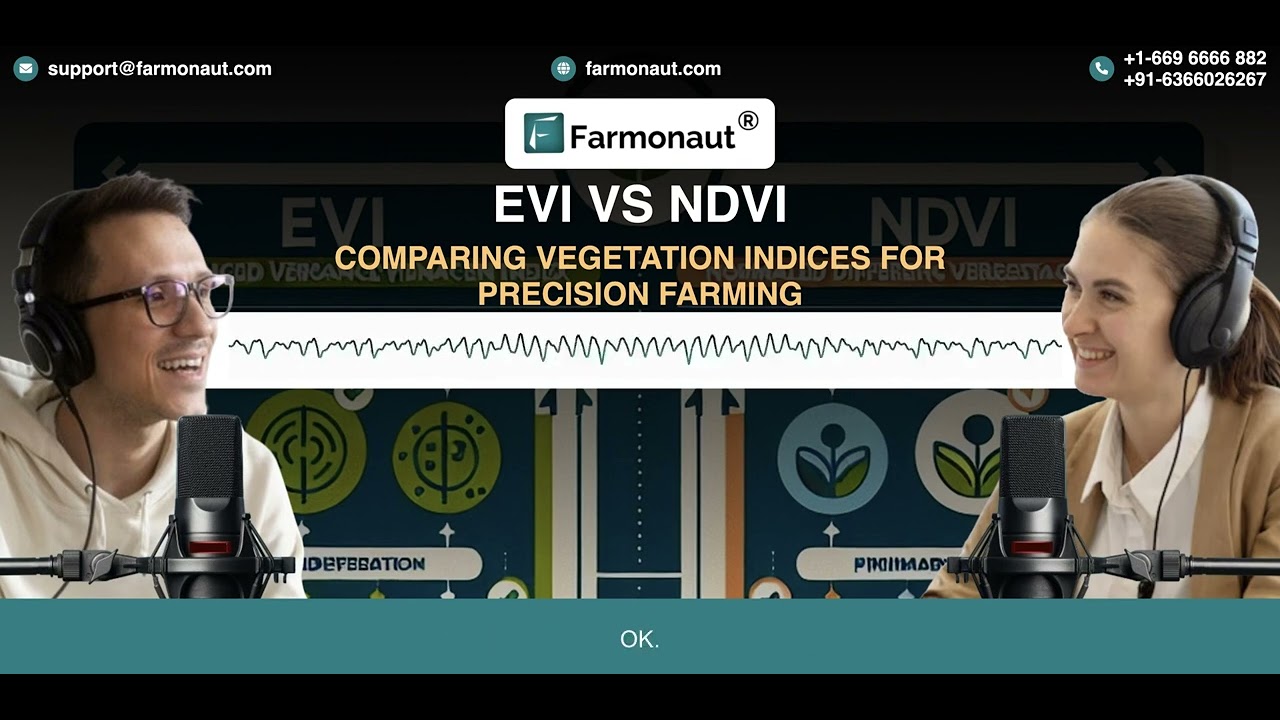
Key Differences: NDVI vs EVI, Agriculture Applications & Insights
The comparison of NDVI vs EVI in agriculture boils down to how each handles critical factors:
- Atmospheric resistance:
- NDVI is more influenced by aerosol, haze, and clouds.
- EVI’s use of the blue band and coefficients (C1, C2, L) reduces these effects.
- Sensitivity to soil background:
- NDVI values can be skewed when vegetation cover is sparse.
- EVI corrects for soil “noise” in the calculation, resulting in more reliable biophysical indicators.
- Saturation in dense canopies/high biomass:
- NDVI saturates (values top out, little differentiation) in dense, mature crops or forests.
- EVI remains sensitive, so it’s better at tracking fine-scale changes at peak crop growth.
- Simplicity and computation:
- NDVI is easily calculated (widespread integration on most platforms).
- EVI requires an extra data band but is still efficiently processed with today’s advanced agricultural systems.
- Data availability:
- NDVI has vast historical datasets for longitudinal crop health analysis.
- EVI’s archive, while smaller, is rapidly growing with modern satellites (Sentinel-2, Landsat 8/9, MODIS).

Comparison of NDVI and EVI Indices for Crop Health Monitoring (2025 Estimates)
| Index | Data Source (Satellite Types/Sensors) | Sensitivity to Soil Background | Performance under Dense Vegetation | Atmospheric Resistance | Typical Value Range (Estimated) | Main Application in Agriculture | Example 2025 Use Case (Estimated Adoption) |
|---|---|---|---|---|---|---|---|
| NDVI | Sentinel-2, Landsat 9, MODIS, commercial satellites | High (values can be affected by soil reflectance in sparse crops) | Saturates quickly (less sensitive in mature or dense canopies) | Moderate (prone to aerosol, haze, and cloud interference) | From -0.1 (bare soil) to 0.8+ (very healthy vegetation) | Growth stage tracking, general stress detection, historical trend analysis | 70%+ of fields in precision agriculture use NDVI for primary monitoring (2025) |
| EVI | Sentinel-2, Landsat 8/9, MODIS (with blue, red, and NIR bands) | Low (formula corrects for soil background noise) | Remains sensitive (excellent for peak growth & high biomass) | High (effectively reduces atmospheric & aerosol influences) | Typically 0 to 1+ (rarely negative) | Yield forecasting, advanced stress monitoring, dense crop management | 30%+ fields (and rising) in high-yield regions rely on EVI for in-season management (2025) |

Satellite Data, Remote Sensing, & Precision Tools for 2026
In 2026, the role of satellite data and remote sensing in precision agriculture is both foundational and transformative. Let’s break down how the advancement of NDVI vs EVI, agriculture vs tools has created new paradigms:
- High-Frequency Data Feeds: Modern satellites (e.g., Sentinel-2 at 5-day revisit intervals) provide near real-time imagery for timely crop stress detection and status monitoring.
- Integration with Smart Platforms: Satellite-derived indices are used in precision management platforms to guide irrigation, fertilization, and pest control, minimizing input waste and maximizing yields.
- AI & Data Analytics: Today’s systems leverage machine learning to analyze NDVI/EVI time series alongside environmental and weather data, boosting the accuracy of yield prediction and early-warning systems for farmers.
- Mobile and API Accessibility: Accessible via web apps, Android, and iOS apps, users can monitor fields and receive actionable insights anywhere, anytime.
Data is now the core driver of farm profitability, resource conservation, and climate adaptation in agricultural landscapes from India and Asia to the Americas and Africa.




For developers and agri-tech integrators, Farmonaut’s API delivers direct access to satellite-derived NDVI/EVI data and more. Check our API page and Developer Documentation for streamlined integration with your digital platforms.
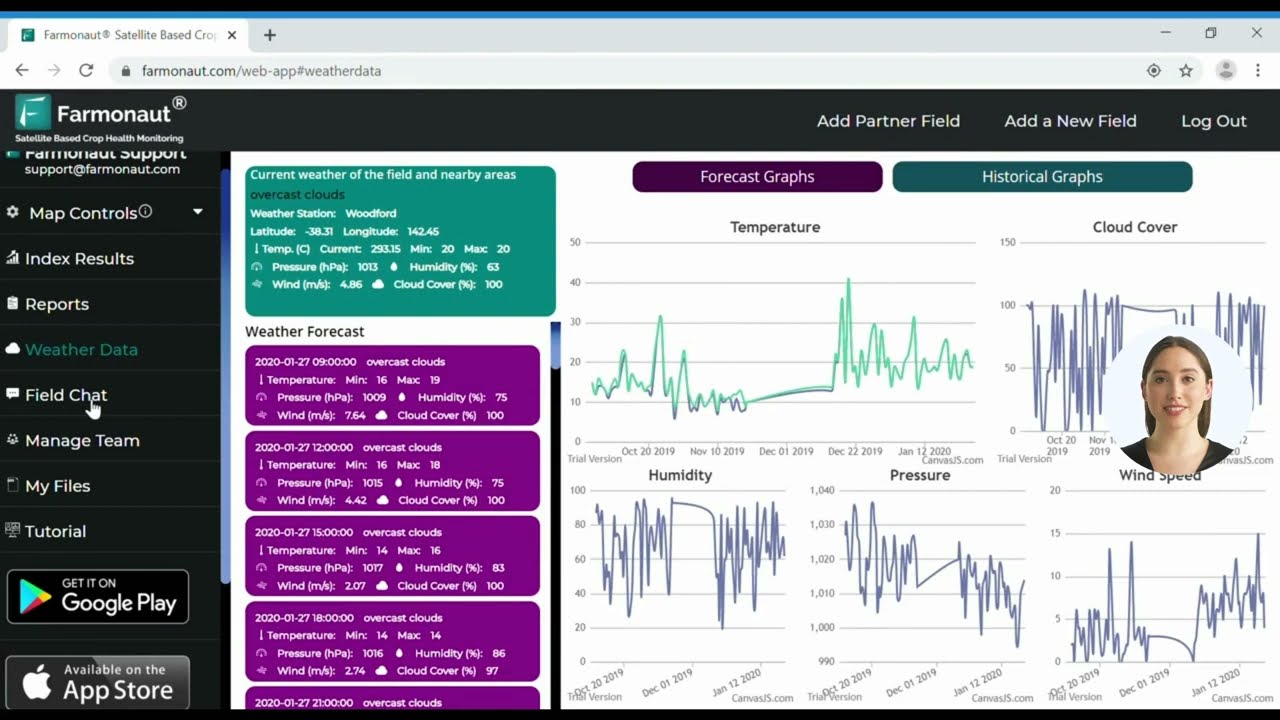
Farmonaut: Satellite Solutions for 2026’s Agricultural Revolution
At Farmonaut, we are committed to making satellite-driven insights accessible, affordable, and transformative for agriculture and related industries worldwide. Our platform leverages the power of NDVI and EVI indices—alongside advanced AI, blockchain, and real-time monitoring tools—to empower farmers, businesses, and government agencies in the transition to smart, sustainable food systems.
Key Advantages of Farmonaut’s Crop Health Monitoring Include:
- Multispectral Satellite Imagery: We use satellite data (NIR, red, blue bands) to monitor crop health, biomass, and field status—enabling early warning and in-season decision making.
- Real-Time Advisory via AI: Our Jeevn AI Advisory System delivers actionable strategies based on satellite and environmental data to optimize resources and boost yield, reducing losses in farming operations.
- Blockchain-Based Traceability: Our product traceability features help the agriculture sector ensure supply-chain transparency, build consumer trust, and reduce fraud.
- Resource Management: Our fleet and resource management tools optimize logistics, machinery usage, and operational efficiency for maximum ROI.
- Environmental Impact Tracking: With carbon footprinting, we support sustainable practices and compliance with evolving regulations—essential for grants and finance in 2025–26.
Our modular subscription model means satellite intelligence—from NDVI vs EVI maps to AI recommendations—is available to everyone from individual farmers to multi-national agri-businesses.

Get started with Farmonaut’s affordable satellite monitoring subscriptions for every farm operation:
Farmonaut is also uniquely positioned to serve crop loan and insurance verification for banks and insurers, and large-scale farm management for agribusinesses and cooperatives.
2026 Use Cases: Practical NDVI vs EVI, Agriculture Scenarios
Scenario 1: Early Growth Stage in Maize (NDVI)
- Field is partially bare, crops emerging. NDVI’s high sensitivity reveals differences in emergence, allowing targeted re-sowing or nutrient application.
- Benefit: Optimizes plant population and uniformity ahead of yield-critical stages.
Scenario 2: Peak Biomass in Rice (EVI)
- Rice field at heading stage, green biomass is at maximum. NDVI saturates, but EVI remains sensitive to subtle differences in vigor—highlighting areas of water or disease stress even in lush canopies.
- Benefit: Enables precision irrigation and crop protection to reduce losses during critical growth phases.
Scenario 3: Dust/Haze in Semi-Arid Regions (EVI)
- Atmospheric dust is high. EVI’s correction for aerosol/scattering delivers much clearer signals, reducing false alarms and improving yield forecasting models.
Scenario 4: Multi-Season Analysis (NDVI and EVI Trends)
- Combining NDVI and EVI across seasons helps evaluate the efficacy of new seed varieties or farming methods.
- Farmonaut’s unified platform enables overlay of these indices, historical weather, and farm operations data.
Scenario 5: IoT and Satellite Fusion
- In 2026, leading farms combine NDVI/EVI data with soil sensors and weather stations for 360° crop management.
- Automated insights from AI advisory systems further streamline field actions and documentation.
Challenges and Directions: Beyond NDVI & EVI in Crop Monitoring
NDVI and EVI are foundational to modern agricultural monitoring systems, but they have limitations:
- Cloud & Temporal Gaps: Sensors can be blocked by persistent clouds.
- Spectral Limits: Some crop stresses (e.g., nutrient imbalances or disease) may not be immediately visible in the NIR/red/blue bands.
- Spatial Resolution: Small field plots (e.g., vegetable gardens, small farms) may not be fully captured by current satellite pixels—although high-res constellations and UAV data help bridge the gap.
The Future: The integration of complementary technologies is already defining the 2026 landscape:
- Synthetic Aperture Radar (SAR): Offers structural information (e.g., standing water, crop lodging, soil moisture) in all weather conditions.
- Hyperspectral Imaging: Expands the spectrum far beyond NIR/red/blue to detect plant nutrient status, disease, and subtle stress.
- IoT Sensors: On-ground data adds granularity and ground-truths satellite assessments.
- Machine Learning Models: Fuse NDVI/EVI with environmental time-series and operational data for predictive analytics that outstrip traditional indices alone.
FAQ: NDVI vs EVI, Agriculture Insights
What is the main difference between NDVI and EVI in crop health monitoring?
NDVI is best for broad, early-stage vegetation monitoring with historic comparability, while EVI outperforms in high-density canopies, handling atmospheric and soil background influences much better.
Can I use both NDVI and EVI together for my farm?
Absolutely. Many modern platforms—and Farmonaut’s solutions—allow the overlay and integration of both indices. This gives you both a detailed and summary view of crop health.
How often can I get NDVI/EVI data for my fields in 2026?
With satellites like Sentinel-2, updates are possible every 5 days under clear skies. Farmonaut’s API and platform keep you updated with the latest insights as soon as new imagery is available.
Are NDVI and EVI suitable for all crop types?
They work for most major crops (e.g., wheat, rice, maize, soy), but certain stress types or specialty crops may benefit from hyperspectral or SAR data as well for deeper insight.
How do these indices help in managing inputs and sustainability?
By detecting stress early and providing zonal maps, you can apply fertilizer, water, or crop protection inputs only where needed—saving money, boosting yield, and minimizing environmental impacts. Farmonaut’s carbon footprinting tools also help track emissions and compliance.
Conclusion: Next-Gen Indices for a Resilient Agricultural Future
The journey of NDVI vs EVI in agriculture underscores the transformation of crop monitoring—from simple visual assessments to precise, satellite-driven, data-rich management. NDVI continues to serve as a universal indicator for crop growth stages, rapid stress detection, and historical trend analysis due to its simplicity and vast integration. EVI is now indispensable for dense or high-biomass crops and challenging environmental contexts, thanks to its advanced algorithm correcting for atmospheric and soil background effects.
The ability to harness the complementary strengths of both indices—and integrate them with AI, SAR, hyperspectral data, and IoT sensors—empowers agricultural stakeholders to optimize yields, manage resources smartly, and ensure sustainability in an era of climate uncertainty. As we move into 2026 and beyond, embracing advanced remote sensing tools like NDVI and EVI is not just an opportunity, but a necessity for thriving in data-driven agriculture.
Ready to get started? Explore Farmonaut’s platform, access via Android or iOS, or connect directly via API for seamless integration with your management systems.
Harness the power of NDVI and EVI—and lead the way to sustainable, data-driven, and resilient agriculture in 2026 and beyond.

 Polaris Digitech
 ASQI
ASQI Teledarbas
 Wild Oak Farm
 SFX
SFX BACF Africa
 Doodlakine
 Exurbia Geospatial
 FieldZero
 Indico Company
 Kubota
 FFBS
FFBS Jontra
 Tucor
Tucor
