

Reviewed March 2026 against USDA Farm Service Agency lending-rate notices and the FSA Loan Program Summary (FY2025).
Try it: Run your own numbers →
A farm loan is financing tied specifically to agricultural production or land ownership — split mainly into operating loans (working capital for a single season) and farm ownership loans (land purchase or long-term improvements). In the United States, the USDA Farm Service Agency set its direct Farm Operating Loan rate at 4.750% and its direct Farm Ownership Loan rate at 5.875% for March 2026, with a reduced 1.875% rate on the Farm Ownership down-payment program for qualifying beginning farmers. Below, we break down every major loan type, current rate and limit data, how Queensland and Tennessee borrowers fit into the picture, and a repayment calculator you can run with your own numbers.
Table of Contents
- Farm Loans vs. Agricultural Loans vs. Farm Financing: What’s the Difference
- Types of Agriculture Loans and Ag Farm Loans
- Current US FSA Rates and Loan Limits
- What Is a Farm Ownership Loan
- Farm Loans in Tennessee
- Farm Loans in Queensland and Australia
- Repayment Calculator
- How to Qualify: Documents and Application Steps
- How Satellite Verification Speeds Up Farm Loan Approval
- FAQ
- Try it: Run your own numbers
Farm Loans vs. Agricultural Loans vs. Farm Financing: What’s the Difference
In practice, “farm loans,” “agricultural loans,” “ag loans” and “farm financing” describe the same lending category — credit extended against agricultural land, equipment, livestock, or projected crop income — with the terminology shifting by lender and region. In the US, “farm loan” usually points to a USDA Farm Service Agency (FSA) product; “agricultural loan” or “ag loan” more often refers to a commercial bank, credit union, or Farm Credit System product. In Australia, “farm loan” and “farm financing” cover both major-bank agribusiness lending (NAB, Westpac, ANZ, CBA) and state or federal drought and recovery finance.
The FSA alone obligated $6.74 billion in farm loans across all program types in fiscal year 2025, according to the agency’s Loan Program Summary — and that figure excludes the much larger volume of commercial agricultural lending done by banks, Farm Credit associations, and credit unions, which is not consolidated into a single public total. If you are trying to size the total US farm-lending market, the FSA total is a floor, not a ceiling: treat it as the federally-backed slice, and add your own lender’s disclosures for the commercial slice.
The FSA made 14,170 direct operating loans and 2,291 guaranteed operating loans in fiscal year 2025, alongside $4.42 billion in combined direct and guaranteed farm ownership lending, per the FSA Loan Program Summary. FSA republishes this summary annually; FY2026 figures are expected in October 2026.

Low-investment, high-return agribusiness ideas worth financing
Types of Agriculture Loans and Ag Farm Loans
Whether you search for “agricultural loans,” “agriculture loan,” or “ag farm loans,” the products on offer fall into the same three functional buckets. The names change by lender; the purpose doesn’t.
- 1. Operating loans (working capital). Cover seed, fertilizer, fuel, labor, and other single-season inputs. FSA’s direct Farm Operating Loan carried a 4.750% interest rate in March 2026 and is capped at a $400,000 direct loan limit, per Farm Bill 2’s 2026 program summary. Guaranteed operating loans, where FSA backs a portion of a bank-issued loan rather than lending directly, made up 2,291 of FSA’s FY2025 operating-loan volume against 14,170 direct loans.
- 2. Farm ownership loans (land and long-term capital). Fund land purchase, farm consolidation, or major structural work such as barns and irrigation systems. FSA’s direct Farm Ownership Loan rate was 5.875% in March 2026, with a $600,000 direct loan limit. A separate down-payment variant for qualifying beginning and underserved farmers carried a 1.875% rate the same month — the widest rate gap between any two FSA products currently published.
- 3. Emergency and disaster loans. Cover losses from production disasters, not routine operating costs. FSA’s Emergency Loan rate was 3.750% in March 2026 — below both standard operating and ownership rates, reflecting its disaster-relief purpose rather than standard underwriting.
“Agricultural business startup loans” is not a single named federal product — it is the practical answer new entrants get by combining an FSA microloan or beginning-farmer down-payment loan with commercial or credit-union operating credit. Treat it as a strategy, not a product to search for by that exact name.

Carbon farming and soil health practices that lenders increasingly track
Current US FSA Rates and Loan Limits
FSA publishes updated lending rates on the first business day of each month. The table below reflects the rates and limits current as of the March 2026 announcement — check the source link for whatever month you are reading this in, since these figures move monthly while loan limits move only when Congress or USDA revises the program.
| Loan Type | Interest Rate (March 2026) | Loan Limit | Term | Primary Use |
|---|---|---|---|---|
| Direct Farm Operating Loan | 4.750% | $400,000 | Up to 7 years | Seed, fertilizer, fuel, labor, livestock purchase |
| Direct Farm Ownership Loan | 5.875% | $600,000 | Up to 40 years | Land purchase, farm expansion, major improvements |
| Farm Ownership Down Payment (beginning/underserved farmers) | 1.875% | Set as % of purchase price | Up to 20 years | Reduced-barrier entry to land ownership |
| Emergency Loan | 3.750% | Set per disaster declaration | Varies by loss assessment | Recovery from qualifying production disasters |
Source: USDA FSA March 2026 lending rate announcement; loan limits per Farm Bill 2’s 2026 USDA farm loan program summary. FSA rates reset monthly — bookmark the announcement page rather than this table if you need a live figure.
Comparing a commercial bank’s quoted rate directly against FSA’s direct-loan rate without checking whether it’s a direct or guaranteed product. Guaranteed loans are issued by a private lender at that lender’s rate, with FSA only backing part of the balance — the rate is negotiated with the bank, not fixed at the FSA direct-loan level. Always ask your lender which structure you’re being quoted. See Farmonaut’s overview of crop loan and insurance verification options for how documentation requirements differ between the two.

Precision technology lenders now factor into risk assessment
What Is a Farm Ownership Loan
A farm ownership loan is long-term financing used to buy land, consolidate holdings, refinance existing farm debt, or fund permanent improvements — as distinct from an operating loan, which covers a single production cycle. FSA’s direct Farm Ownership Loan carried a 5.875% rate and a $600,000 direct limit in March 2026, with terms extending up to 40 years — far longer than the 7-year cap on direct operating loans, reflecting that land is a durable asset rather than a consumed input.
The down-payment variant exists specifically to lower the entry barrier for beginning farmers, veterans, and historically underserved producers: at 1.875% in March 2026, it sat more than 4 percentage points below the standard direct ownership rate. Combined direct and guaranteed farm ownership lending reached $4.42 billion across fiscal year 2025, according to FSA’s Loan Program Summary — the single largest lending category FSA tracks, ahead of standard operating loans by dollar volume.
If your search brought you here for “what is a farm ownership loan” specifically: it is not a startup grant, and it is not forgivable. It is a mortgage-style instrument secured against the land itself, underwritten against your production plan, credit history, and (for direct loans) FSA’s own assessment of farm viability rather than a bank’s standard commercial criteria.
Farm Loans in Tennessee
Tennessee farmers accessing FSA credit apply through the same national direct and guaranteed loan structure covered above — there is no separate Tennessee-specific FSA rate; the 4.750% operating and 5.875% ownership rates from March 2026 apply nationwide. What differs by state is the mix of local lenders layered on top: Farm Credit associations serving Tennessee, state department of agriculture programs, and local banks and credit unions each set their own commercial rates independent of FSA’s published figures.
Tennessee’s FSA county and state office network processes direct loan applications locally even though the rate itself is national — a Tennessee producer’s application timeline depends more on that local office’s caseload than on anything state-specific in the rate structure. For land purchase specifically, review how agricultural mortgage securitization affects farm financing availability, since secondary-market demand for farm mortgages influences how readily local lenders extend ownership credit.
Farm Loans in Queensland and Australia
For Queensland and broader Australian searches, we have to be direct about a gap: no verified, current interest-rate or loan-volume figures for Australian agricultural lenders — NAB, Westpac, ANZ, CBA, or state-specific Queensland programs — were available in the research for this article, and we will not invent them. Real rates from major Australian agribusiness lenders change with the RBA cash rate and each bank’s own risk margin, and vary meaningfully by security type and loan purpose.
Here is the reliable method to get a current figure for your own situation rather than relying on a number that would be stale within a month of publication:
- For national agricultural finance data and drought/recovery lending programs: check ABARES (Australian Bureau of Agricultural and Resource Economics and Sciences) publications directly for the latest farm finance survey results.
- For a live rate quote: request current agribusiness lending rates directly from NAB, Westpac, ANZ, or CBA’s agribusiness banking desks — these are quoted per application based on security and purpose, not published as a flat headline rate.
- For Queensland-specific programs: the Queensland Rural and Industry Development Authority (QRIDA) administers state-level concessional loans and drought assistance; check QRIDA’s own program pages for current rates and eligibility, since state-level Queensland farm loan data was not part of the verified research base for this piece.
This is the honest answer to “farm loans qld”: the structure exists (state concessional loans via QRIDA plus the big-four banks’ agribusiness desks), but a specific current rate needs to come from those sources directly rather than from a figure repeated secondhand.

Satellite and AI insight tools now used in farm loan risk assessment
Repayment Calculator: Estimate Your Farm Loan Payments
Use the calculator below with the rates from the table above, or with a rate quoted to you directly, to estimate a monthly payment before you apply.
Run your own numbers
Assumes a standard fixed-rate amortizing loan with no fees, no balloon payment, and no down payment already applied. It does not model guaranteed-loan lender fees, variable-rate resets, or Australian lending structures. Use it to compare scenarios, not as a binding offer — confirm your actual amortization schedule with your lender.
How to Qualify: Documents and Application Steps
Requirements differ by lender and loan type, but every FSA direct loan application and most commercial agricultural loan applications converge on the same core documentation:
Key Documents Checklist for a Farm Loan Application
- Financial statements and tax returns — typically the last 2–3 years, where the operation has an existing filing history
- Production history or, for new entrants, training certificates and a demonstrated farm-management background
- A written business plan with cash-flow projections
- Land ownership or lease documents
- Collateral details, including equipment, land, or crop insurance coverage
- Government-issued ID and residency/citizenship proof
Direct FSA loans are underwritten by FSA staff against these documents and typically involve more paperwork and longer review than a guaranteed loan, where a bank does the underwriting and FSA simply backs part of the balance. If your farm is expanding into carbon footprinting or needs supply-chain traceability, some lenders now accept digital verification records alongside — or in place of — a manual farm inspection.
How Satellite Verification Speeds Up Farm Loan Approval
Farmonaut provides satellite-based crop monitoring, AI advisory, and blockchain traceability tools that lenders and insurers can use to verify farm operations without an in-person site visit — relevant wherever a loan application asks for production history or asset verification.
- 🛰 Satellite crop monitoring: Tracks in-season crop vitality and supports risk assessment for land-purchase and operating-loan underwriting.
- 📉 AI-based advisory: Recommendations on irrigation, fertilizer timing, and harvest scheduling that a lender can cross-reference against your stated production plan.
- 🔗 Blockchain traceability: Supply-chain documentation useful for loan compliance and buyer verification. See Farmonaut’s product traceability tools.
- 🌫 Carbon footprint tracking: Some lenders offer better terms for documented emissions reduction. See Farmonaut’s carbon footprinting tool.
- 🖥 Digital reports for lenders: Reduces the need for manual inspection visits during underwriting.
Farmonaut does not issue loans, set lending rates, or act as a financial regulator — it supplies verification data that farmers can bring to whichever lender, FSA office, or Australian agribusiness bank they are working with.
Developers and AgTech companies can integrate Farmonaut’s satellite data API — see the full developer documentation here. For operations managing loan-linked assets across multiple sites, also see Fleet Management and the large-scale farm management and satellite field mapping platform.

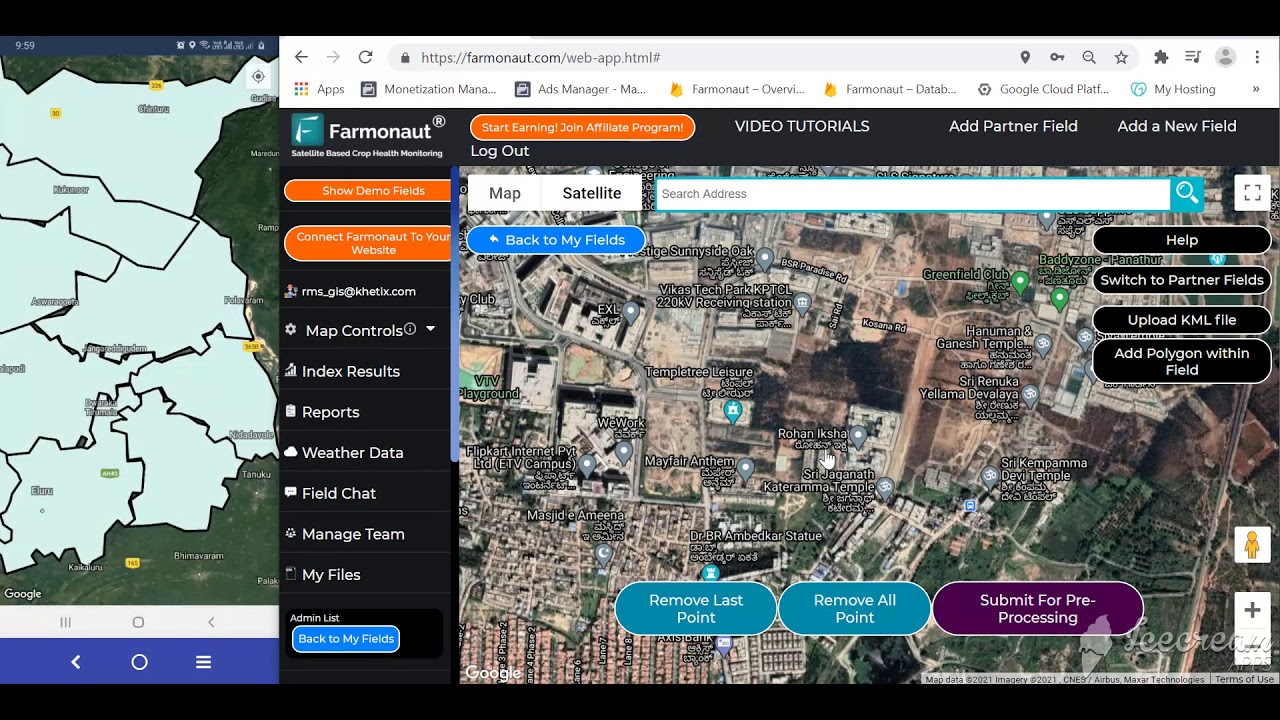
Farmonaut web platform walkthrough

Satellite-based crop health monitoring
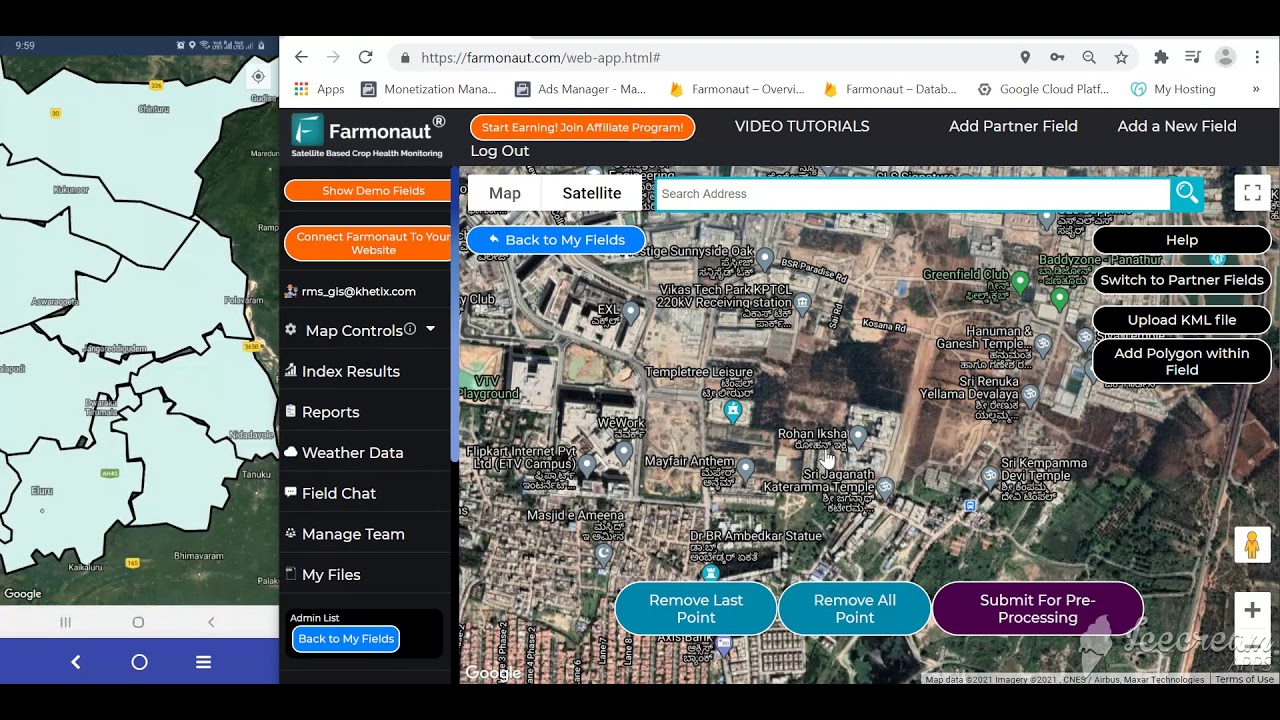
Large-scale field mapping for multi-site operations

Admin tools for managing farm and fleet data
FAQ: Farm Loans and Agricultural Loans
Q1. What is the current interest rate on a farm loan?
For US FSA direct loans, the rate published for March 2026 was 4.750% for Farm Operating Loans and 5.875% for Farm Ownership Loans, with a reduced 1.875% rate on the Farm Ownership down-payment program. FSA updates these rates monthly at the start of each month — check the FSA lending rate announcement page for the current month’s figures. Commercial and Australian agribusiness rates are quoted separately by each lender and are not published in a single national table.
Q2. What is a farm ownership loan, exactly?
It is long-term financing for purchasing land, consolidating a farm, refinancing farm debt, or funding permanent structures — distinct from an operating loan, which funds a single season’s inputs. FSA’s direct version carries terms up to 40 years and a $600,000 limit as of the 2024–2026 program structure.
Q3. How much do US farm loans total each year?
FSA obligated $6.74 billion across all direct and guaranteed loan types in fiscal year 2025, including 14,170 direct operating loans, 2,291 guaranteed operating loans, and $4.42 billion in combined farm ownership lending. This figure covers FSA only — it does not include the separate, uncatalogued volume of commercial bank and Farm Credit System agricultural lending.
Q4. Are farm loan rates different in Tennessee or Queensland?
US FSA rates are set nationally, so Tennessee borrowers use the same 4.750%/5.875% direct-loan rates as any other state; what varies locally is which commercial lenders and Farm Credit associations serve the area. For Queensland, no single national rate applies — check QRIDA directly for state concessional programs and contact NAB, Westpac, ANZ, or CBA’s agribusiness desks directly for a current commercial quote, since these are not published as flat headline rates.
Q5. What documents do I need for an agricultural loan application?
At minimum: a business plan, land ownership or lease documents, tax returns and financial statements where available, production history or training credentials, collateral details, and government ID. Direct FSA loans require more documentation review than guaranteed loans, where a bank handles underwriting.
Q6. How can I verify my production history without years of paper records?
Satellite crop-monitoring platforms can generate a documented history of crop health and land use that supplements or substitutes for manual records, particularly useful for beginning farmers applying for microloans or down-payment assistance. See how Farmonaut’s crop loan and insurance verification works for the mechanics.






Further reading:
Summary
Farm loans, agricultural loans, ag loans, and farm financing are largely the same lending category described with different words. In the US, FSA’s direct rates for March 2026 were 4.750% for operating loans and 5.875% for ownership loans, against limits of $400,000 and $600,000 respectively, with $6.74 billion obligated across all FSA loan types in fiscal year 2025. Tennessee borrowers use those same national rates through local FSA offices and lenders. Queensland and broader Australian borrowers should go directly to QRIDA and to NAB, Westpac, ANZ, or CBA’s agribusiness desks for a current quote, since no single published national rate exists there.
For land purchases specifically, also see how agricultural mortgage securitization affects farm financing availability, and how broader crop price pressure is reshaping farm financial stress across the US. Whichever loan type you pursue, always verify the current month’s rate directly with FSA or your lender before applying — the rate you read here has a publication date attached to it for exactly that reason.

 WICO
WICO Gen Chayat
 Chimera Innovation
 Hiteshi Infotech
 Clubhouse OS
 SkyHarvest
 Polaris Digitech
 Teledarbas
 Wild Oak Farm
 SFX
SFX BACF Africa
 Doodlakine
 Exurbia Geospatial
 FieldZero
 Indico Company
