

AI in Agriculture: Transforming US Farming & Horticulture for 2025 & Beyond
“AI-driven farms are expected to increase crop yields by up to 30% in the US by 2025.”
Introduction: The Transformative Role of AI in Agriculture
US agriculture stands at the forefront of a remarkable technological revolution driven by rapid advances in artificial intelligence (AI). As we move through 2025 and approach 2026, the integration of AI in agriculture and horticulture is reshaping traditional practices, enhancing productivity, sustainability, and resilience amid new challenges.
With the global population expected to reach nearly 8 billion by 2026, efficient and smart agriculture remains critical for food security and rural development. Artificial intelligence now enables farm operations to respond to resource scarcity, climate change, and growing demand for food, making it an essential role in shaping the future of farming and horticulture across the US.
In this comprehensive guide, we explore how AI-driven approaches—ranging from precision agriculture to AI-enabled weather forecasts, soil monitoring, and crop prediction models—are reshaping every aspect of agriculture and horticulture in the US. We analyze key technologies, discuss their real-world impact, and outline why 2025 is a pivotal year for the sector.

Revolutionizing Precision Agriculture in 2025: Optimizing Inputs, Maximizing Yields
Precision agriculture—fueled by AI—is a transformative approach that optimizes inputs (like water, fertilizers, and pesticides) to maximize yields while reducing environmental impact. In 2025, it continues to be widespread in US agriculture, especially among large-scale farming operations.
- Data is collected through drones, satellite imagery, in-field sensors, and public/private weather forecasts.
- Machine learning algorithms analyze variables such as soil health, moisture levels, nutrient composition, and pest infestations to recommend precise input use.
- These AI-powered systems enable farmers to understand their farmland at a micro-level through detailed, data-driven farm maps.
- This leads to simultaneously boosting yields and reducing waste, making the sector more sustainable and profitable long-term.
The adoption of precision agriculture driven by AI
is expected to accelerate through 2026 and beyond, with substantial benefits for resource management and environmental conservation.

Modern platforms, like Farmonaut, combine satellite imagery with real-time AI insights to
enable farmers to optimize every aspect of farm management. Our satellite-based solutions provide data on vegetation health, soil moisture, nutrient levels, and infrared signatures—empowering smarter decisions at every stage of crop production.
Explore large-scale farm management tools with Farmonaut’s Agro-Admin App, designed to centralize data, automate crop monitoring, and streamline resource scheduling for commercial agricultural operations.
AI in Crop Monitoring & Disease Management: Early Detection with Precision
“By 2025, over 50% of US horticulture companies will use AI for real-time crop monitoring and soil analysis.”
Horticulture and agriculture have been particularly benefited by AI applications in crop monitoring and disease management. Using advanced image recognition, powerful AI models can identify early signs of diseases, pest outbreaks, and nutrient deficiencies with high accuracy.
- Photos captured by drones, smartphones, or stationary field cameras are analyzed with machine learning and deep learning algorithms.
- Early detection systems allow timely interventions—reducing crop losses and reliance on broad-spectrum chemical treatments.
- For example, AI models trained on extensive, labeled imagery can distinguish between fungal infections and nutrient deficiencies, allowing for specifically targeted management responses.
- This precision approach to crop health not only saves resources, but also promotes sustainable, climate-smart agriculture.

With platforms like our
carbon footprinting solution, users get actionable data on
crop health, disease history, and environmental impact, turning every field into a
data-driven ecosystem designed to withstand future climate risks.
Our blockchain-based traceability solution further ensures supply chain transparency by recording every farm input and crop health intervention—fostering trust and protecting against fraud.

For those seeking direct integration, Farmonaut provides an AI & Satellite insights API and up-to-date API Developer Docs. These tools are ideal for custom workflow automation, third-party app development, or building unique user experiences around AI in agriculture.
Automated Farm Machinery & Robotics: Efficiency for US Agriculture 2025
Automated machinery powered by artificial intelligence is redefining the efficiency of farming tasks in the United States:
- Autonomous tractors and robotic harvesters perform seeding, planting, and crop collection around the clock, reducing labor shortages and improving consistency.
- Advanced AI navigation and computer vision systems allow farm machinery to detect field boundaries, obstacles, and optimal paths without human intervention.
- Robotic weeding systems use image recognition to distinguish between crops and weeds, minimizing the need for chemical herbicides and reducing costs.
- This automation trend is especially prominent across large-scale operations in US agriculture and horticulture.

Farmonaut’s Fleet Management tools are designed to help farms and agribusinesses monitor machine status, schedule maintenance, optimize routes, and reduce operational costs—leveraging real-time AI-driven insights for all types of field vehicles.

This approach is not just about operational efficiency but is central to enabling smart farming, allowing our users to focus on high-value tasks while routine, laborious jobs are left to autonomous systems.
AI Drives Supply Chain & Market Forecasting: Secure, Efficient, Profitable
AI agriculture solutions aren’t limited to the field. They reshape the entire agricultural supply chain, including:
- Market Forecasting: Machine learning models analyze weather forecasts, historical price data, and consumer trends to provide farmers with optimal planting schedules and harvest times.
- Supply & Logistics: AI optimizes shipment routes, storage conditions, and demand planning to reduce post-harvest losses and improve market stability.
- Specialty Crops: In horticulture and specialty niche crops, AI predictions match supply with demand, keeping margins strong for growers and reducing spoilage.
Farmonaut’s crop loan and insurance tools leverage satellite verification to secure financial transactions with real-time crop status, helping farmers access credit and cover risks efficiently. Our data-driven systems minimize fraud while creating trust among growers and financial institutions.
With secure, blockchain-based traceability (see Farmonaut Traceability Solution), every step of the agricultural chain—from planting to export—is digitally recorded, ensuring authenticity and supporting new standards in US agriculture and global food safety.
Fostering Sustainable Agriculture & Environmental Stewardship
Sustainable practices are essential for the future of US agriculture and horticulture. AI empowers farmers to tackle climate change, manage resource scarcity, and promote biodiversity:
- Precision Irrigation: AI-enabled irrigation systems monitor soil moisture and weather trends, activating water delivery only as needed—conserving billions of gallons annually.
- Climate Modeling: Advanced AI models predict environmental stressors, pests, and droughts, enabling timely interventions and adaptation strategies.
- Regenerative Agriculture: Data insights help optimize crop rotation, encourage cover cropping, and enhance soil health—moving US agriculture further toward net-zero carbon and climate resilience.
- Resource Transparency: AI and blockchain traceability (see: Traceability Solution) enable digital record-keeping for sustainability metrics and reporting.

Our Carbon Footprinting system goes a step further by empowering farms to track their carbon emissions, demonstrating compliance and creating new value in both domestic and export markets. With accurate data, farms can shift toward climate-smart practices and meet evolving consumer demand for sustainability.
The rise of regenerative agriculture—where soil health, carbon capture, and biodiversity are prioritized—shows that AI agriculture and advanced data will be the backbone of environmental stewardship for decades to come.
Farmonaut: Satellite Technology Transforming Agriculture in the US & Beyond
Farmonaut is a pioneering satellite technology company offering affordable, scalable solutions for agriculture and horticulture globally. Our mission is to make satellite-driven insights accessible—democratizing technology for every size of farm, business, and government.
Key Technologies:
- Satellite-Based Monitoring: Multispectral imagery for plant health, soil conditions, and real-time alerts in both agriculture and horticulture.
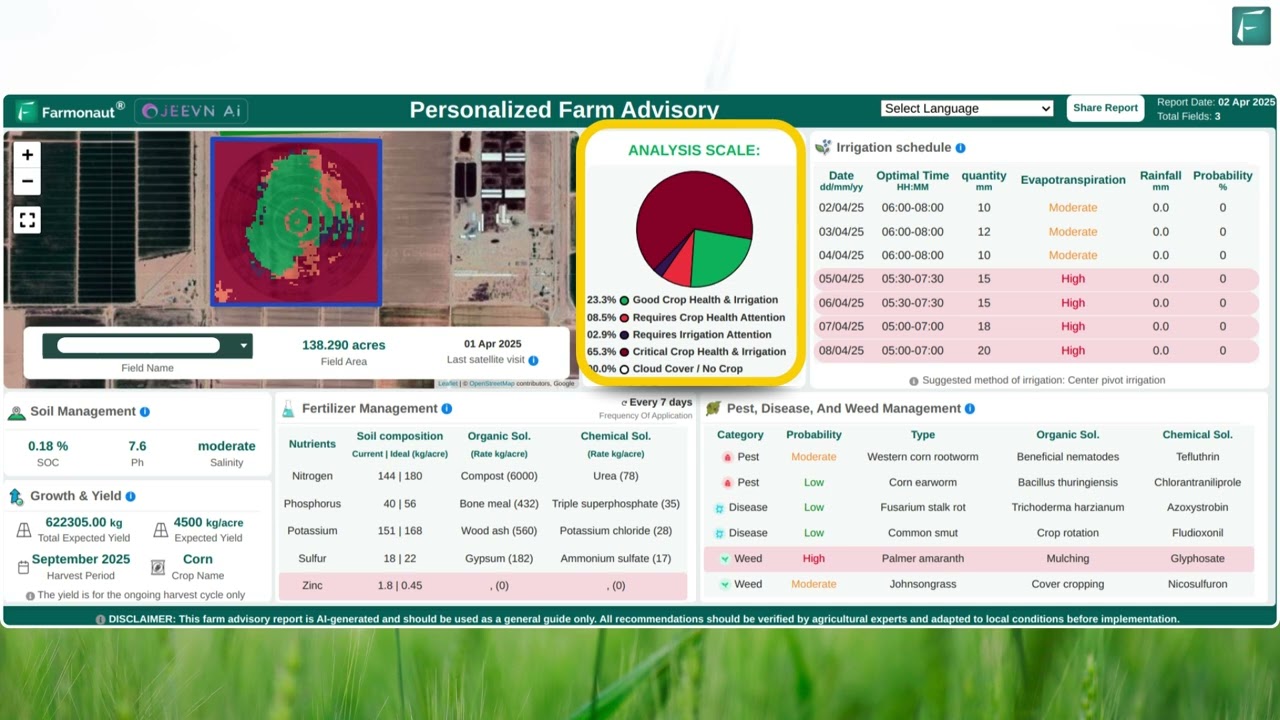
- Jeevn AI Advisory: Automated detection, weather analysis, and recommendations for disease management, resource efficiency, and climate-smart strategies.
- Blockchain-Driven Traceability: Full supply chain transparency, boosting consumer trust and regulatory compliance.
- Resource & Fleet Management: Optimize machine usage, maintenance scheduling, and logistics to cut costs and increase safety.
- Environmental Impact Tracking: Real-time metrics for carbon footprint, water usage, and nutrient runoff, fostering sustainable agriculture.



Our web, Android, and iOS platforms simplify the use of satellite and AI insights for farmers and agronomists. Our flexible API access supports businesses, developers, and government users integrating our technology into custom workflows.
Farmonaut’s
carbon footprinting and
blockchain traceability tools promote environmental responsibility and transparency across the agricultural sector.
Crop loan and insurance solutions help farmers and institutions manage risk and access capital, while large-farm management dashboards bring multi-site operations under one digital umbrella.
Comparative Analysis Table: Key AI Technologies & Their Estimated Impacts in US Agriculture, 2025
| AI Technology | Application Area | Estimated Yield Improvement (%) | Estimated Cost Reduction (%) | Environmental Impact | Adoption Rate 2025 (%) |
|---|---|---|---|---|---|
| Precision Drones & Satellite Imaging | Crop Monitoring, Disease Detection | 15–30% | 10–20% | Reduced pesticide/fertilizer usage, water conservation | 60 |
| Smart Soil Sensors & IoT Systems | Soil Health, Precision Irrigation | 10–20% | 10–15% | Significant water saving, lower nutrient run-off | 45 |
| Predictive Analytics | Yield Forecasting, Risk Management | 12–18% | 8–12% | Optimized resource use, less waste | 55 |
| AI-Powered Automated Machinery | Planting, Harvesting, Weeding | 10–15% | 15–25% | Minimized chemical use, lower fuel consumption | 40 |
| AI & Blockchain for Traceability | Supply Chain, Product Authentication | Up to 10% | 5–10% | Lower food waste, greater transparency | 35 |
Farmonaut Subscription Plans: Flexible and Affordable Satellite-AI for All
At Farmonaut, we believe access to advanced satellite, AI, and blockchain-driven agricultural insights should be open to all. Whether you are a smallholder farmer, commercial agribusiness, government agency, or technology developer, our subscription-based plans are made to scale.
Start with our online app:
— or download our
Future Outlook & Key Challenges: AI in Agriculture & Horticulture, 2026 and Beyond
While AI agriculture is a game-changer, its integration comes with challenges:
- Data Privacy & Security: Protecting farm and supply chain data is critical. Advances in blockchain solutions, such as those in Farmonaut Traceability, are addressing these concerns.
- Accessibility for Smallholders: Ensuring small and medium-sized farms can afford and adopt AI in agriculture remains a top priority, and systems like Farmonaut’s affordable subscription model aim to lower barriers.
- Infrastructure Needs: Reliable internet and robust digital connectivity are essential for widespread AI adoption in rural America; public-private investments are needed.
- Training & Awareness: Education on AI tools for farmers is vital to ensure equitable benefits and reduce the digital divide across US agriculture and horticulture.
- Cultural & Knowledge Integration: Successfully blending AI insights with generational expertise results in holistic, sustainable agricultural practices.
As we journey into 2026 and beyond, AI in agriculture is poised to make US and global agriculture more resilient, productive, and sustainable. Responsible technology adoption will be crucial in meeting
food demand for a growing population while preserving our planet for generations to come.
FAQ on AI in Agriculture & Horticulture (2026 & Beyond)
1. What is the primary role of AI in US agriculture and horticulture in 2025 & 2026?
AI’s primary role in US agriculture is to optimize farm management through real-time data collection, advanced analytics, and predictive modeling. AI-powered solutions drive improved crop yields, reduce resource use (such as water and fertilizers), and enable timely interventions for disease, pest, and nutrient management.
2. How does AI help reduce environmental impact in farming?
AI in agriculture enables precise input application (fertilizers, pesticides, irrigation) to prevent waste and minimize runoff, reduces dependence on chemicals, and promotes regenerative soil health—addressing critical conservation challenges.
3. Are Farmonaut’s AI tools suitable for smallholders and family farms?
Yes! With scalable subscription models, app, and API access, Farmonaut’s affordable solutions are designed for both smallholders and large commercial farms seeking actionable AI insights into crop health, resource usage, and market trends.
4. What are the emerging trends for AI in US agriculture and horticulture by 2026?
- Greater integration of satellite and drone monitoring systems
- Increased adoption of AI-powered automated machinery
- Blockchain-backed traceability for supply chain transparency
- Expansion of carbon footprinting and environmental reporting
- Enhanced weather prediction and risk management models
5. Can AI help manage labor shortages in US agriculture?
Yes. AI-driven mechanization (autonomous tractors, robots, automated harvesters) allows farms to address labor shortages, reduce human error, and boost operational efficiency.
Conclusion: AI’s Transformative Journey in Agriculture
As we move deeper into 2025 and look ahead to 2026, AI stands as a pivotal enabler of innovation in agriculture and horticulture. Empowering farmers with precise data, automating laborious tasks, enhancing disease management, and fostering sustainable growth, AI agriculture is securing food security and ecosystem stewardship for the future.
With satellite technology, advanced AI algorithms, blockchain traceability, and actionable insights, US agriculture and horticulture are ready to meet climate challenges, rising demand, and sustainability requirements head-on. Harnessing this potential responsibly will define agricultural success and rural prosperity in the decades to come.

 Chimera Innovation
 Hiteshi Infotech
 Clubhouse OS
 Progenseed
 SkyHarvest
 Polaris Digitech
 Teledarbas
 Wild Oak Farm
 SFX
SFX BACF Africa
 Doodlakine
 Exurbia Geospatial
 FieldZero
 Indico Company
