

Difference Between USA and Indian Farming: Key Facts
Differentiating Key Agricultural Concepts and Practices: A Contemporary Perspective for 2025
- Agriculture: The Backbone of Global Economies
- Differentiating Commercial Farming and Plantation Farming
- Modern Farming vs Traditional Farming
- Difference Between Farming and Agriculture
- Difference Between USA Farming and Indian Farming
- Comparative Matrix: USA vs Indian Farming Practices (Est. 2025)
- Trends: Farming, Technology, and Sustainability for 2025
- Farmonaut: Satellite Technology Advances for Agriculture, 2025
- Frequently Asked Questions: USA vs Indian Farming & Modern Practices
Agriculture: The Backbone of Global Economies
Agriculture remains the backbone of many countries and economies, especially in India, where a significant proportion of the population depends on farming. As we move into 2025, the sector is transforming rapidly due to technological advancements, climate change, urbanization, and shifting economic paradigms. In this contemporary landscape, a clear understanding of key agricultural concepts—like the ability to differentiate between commercial farming and plantation farming, modern farming and traditional farming, and the difference between farming and agriculture—becomes critical.
This blog provides an in-depth overview of these concepts and practices, offering data-based comparisons of USA and Indian farming systems for 2025. With actionable insights, a comparative matrix, trivias, and embedded videos, this article is your comprehensive resource for everything related to modern agriculture, technology, and sustainability.
Differentiating Commercial Farming and Plantation Farming
When navigating the broad landscape of agricultural practices, it’s important to differentiate between commercial farming and plantation farming. These two farming systems exhibit unique structures, techniques, and market orientations, which shape agricultural productivity not only in countries like India and the USA, but also across global supply chains.
What is Commercial Farming?
Commercial farming refers to large-scale production of crops and livestock, primarily intended for sale in domestic and global markets. Instead of focussing on personal consumption, commercial farms aim to maximize productivity and profits.
- Emphasis on Modern Techniques: The sector employs mechanized machinery, advanced irrigation techniques, high-yield varieties (HYVs), chemical fertilizers, and often, pesticides.
- Market-Driven Crop Choices: Crops are cultivated based on market demand. Typical commercial crops in North America include wheat, maize, and soya beans, which are grown for both local and global supply chains.
- Scale: Farms are often vast in size, ranging from hundreds to thousands of hectares, especially in countries like the USA.
- Labor and Mechanization: These farms minimize manual labor via high mechanization, enhancing both efficiency and scale.
- Diverse Production: Unlike plantations, commercial farms may cultivate multiple crops (not just one).

What is Plantation Farming?
Plantation farming is a specialized form of commercial agriculture, focused on growing a single crop across large estates, predominantly in tropical and sub-tropical climates. Its key features include:
- Monoculture: Plantations exclusively produce one crop, such as tea, coffee, sugarcane, rubber, bananas, or oil palm, over large areas.
- Labor-Intensive: Despite some mechanization, many plantations still employ considerable amounts of manual labor for activities like harvesting and crop maintenance.
- Export Orientation: Most products are intended for global export markets, historically tied with colonial economies and foreign investment.
- Distinct Socio-Economic Structure: Plantations often involve unique management and labor systems, with many workers living on or near the estate.
Differentiating Key Points:
- Commercial farming emphasizes diverse crops and is highly mechanized.
- Plantation farming is monoculture-oriented, focuses on a single export crop, and often remains more labor-intensive despite scale.
Why This Distinction Matters in 2025:
As global markets become more connected and sustainability takes center stage, understanding the difference between these models is essential for policy, trade, and technology adoption.

Modern Farming vs Traditional Farming
To differentiate between modern farming and traditional farming is to recognize the evolution of agricultural practices from local, low-input systems to highly managed, technology-driven enterprises. This distinction is at the core of how productivity and sustainability shape food systems for 2025 and beyond.
Traditional Farming: Roots in Local Knowledge and Low Input
- Manual Labor & Techniques: Heavy reliance on manual labor and indigenous knowledge systems.
- Inputs: Use of organic manures, natural pesticides, local seed varieties, and rain-fed irrigation.
- Diversity: Mixed or inter-cropping systems, often with integration of livestock for nutrient cycling.
- Scale & Output: Usually small-scale, producing for household consumption with surplus for nearby markets.
- Environmental Impact: Lower carbon footprint, higher biodiversity preservation, but lower yields per hectare.
Modern Farming: Scientific Advances, Mechanization, and Data
- Advanced Inputs: High-yield crop varieties (HYVs), synthetic fertilizers, advanced pesticides, hybrid seeds.
- Mechanization: Utilizes tractors, harvesters, drones, irrigation pumps, and automated machinery.
- Precision Technology: Leverages soil testing, satellite monitoring, GPS, and AI-driven resource management.
- Systematic Approach: Emphasis on monoculture, input optimization, and market-led planning.
- Scale & Productivity: Focused on high-scale, high-output operations; feeds into global supply chains.
- Sustainability: Increasing turn toward conservation agriculture, integrated pest management, and environmental monitoring for climate resilience.
Farmonaut Satellite Technology and Smart Farming
In the era of advanced technologies and data-driven agriculture, satellite monitoring, AI advisory systems, and blockchain-based traceability—like those offered by Farmonaut—are shaping the next phase of sustainable and precision farming. We enable farmers, businesses, and governments worldwide to optimize their agricultural operations, monitor crop health, and implement climate-resilient practices for 2025 and beyond.
Looking to manage agricultural operations at scale? Explore our Large-Scale Farm Management Solutions for real-time satellite-based monitoring, resource optimization, and actionable insights.

Difference Between Farming and Agriculture
The difference between farming and agriculture is foundational for everyone engaged in the food system—from policy makers to traders and end consumers. Although both terms are often used interchangeably, there are nuanced differences that clarify their scope and relevance.
Farming: The Core Production Activity
- Refers specifically to: The cultivation of crops and the rearing of livestock.
- Activities: Land preparation, sowing, irrigation, weeding, harvesting, animal husbandry.
- Scope: Primarily the primary production segment of the value chain.
- Focus: Actual food, fiber, or animal product creation for sale or consumption.
Agriculture: The Broader Ecosystem
- Broader Term: Encompasses farming as well as forestry, fisheries, agro-processing, supply chain management, marketing, policy development, and soil conservation.
- Activities: Includes research, resource management, logistics, environmental conservation, rural development, and economic planning.
- Value Chain: Spans all the way from pre-production research and planning to post-harvest processing and retail.
Key Insight: While farming is at the center—focused on crop or livestock production—agriculture extends far beyond, incorporating economic, environmental, social, and policy considerations.
Farmonaut APIs for Agriculture and Farming
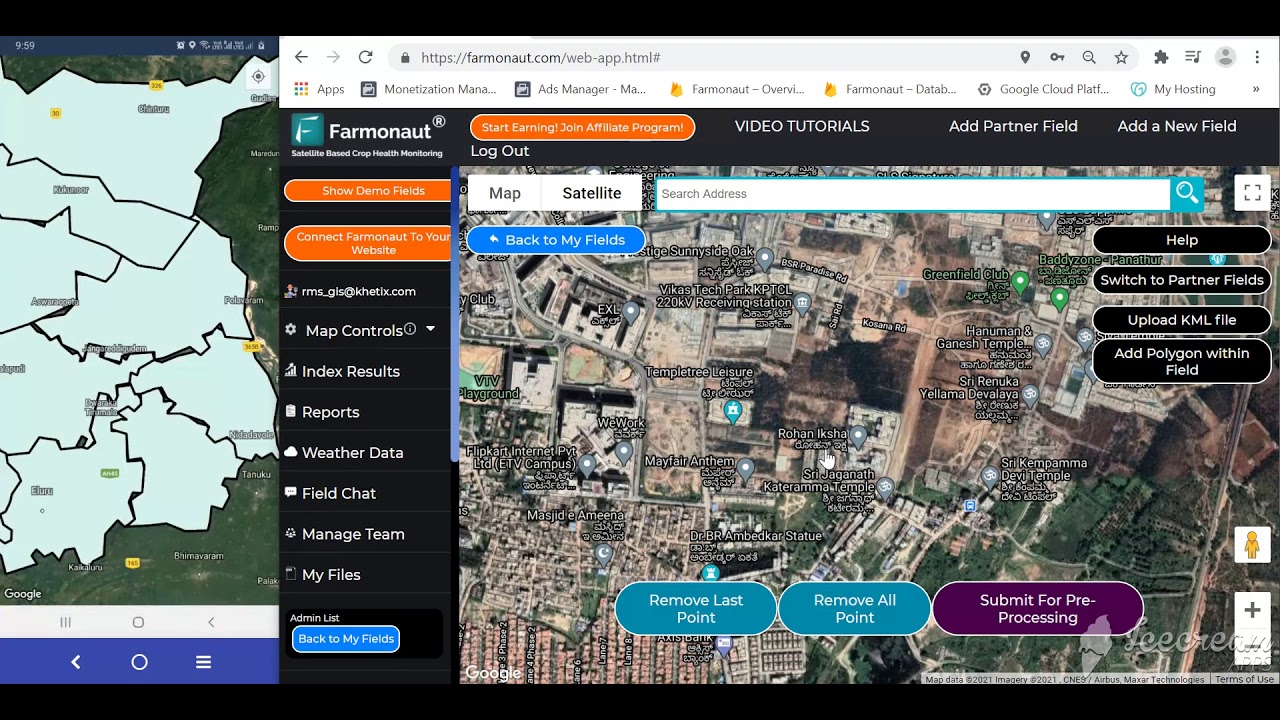
For 2025’s data-driven farming and agriculture, integrating reliable satellite data is essential. Our Farmonaut API and API Developer Docs help businesses, developers, and government agencies embed real-time, remote-sensing insights directly into their operations.
Difference Between USA Farming and Indian Farming
To differentiate between USA farming and Indian farming is to unpack fundamental differences in scale, mechanization, technology adoption, crop patterns, productivity, and government support systems. It also brings to light the unique challenges and opportunities for both countries as they move toward a sustainable agricultural future.
Key Parameters: Scale, Technology, Management
- Farm Size: USA farms average 178 hectares, Indian farms average 1.08 hectares (per 2024 estimates).
- Mechanization Level: U.S. farming employs advanced machinery, while India relies more on manual labor and basic equipment.
- Major Crops: The U.S. emphasizes monocultures of cereals like corn and soybeans. India is more diversified, with cereals, pulses, horticulture, and plantation crops.
- Technology Adoption: In the U.S., 60%+ of farms use precision agriculture. In India, adoption is under 10% in 2024, though accelerating.
- Market and Subsidies: The U.S. benefits from mature supply chains and insurance schemes. Indian farmers face market access and credit challenges but are seeing improvements via digital initiatives.
- Sustainability Focus: Both moving toward sustainability, but with country-specific priorities: climate resilience and water conservation in India, input optimization in the USA.

These differences are not just a matter of scale or productivity, but stem from historic, geographic, social, and economic factors unique to each region. Both regions are leveraging technology for next-generation agricultural development.
Comparative Matrix: USA vs Indian Farming Practices (Est. 2025)
| Parameter | USA (Est. 2025) | India (Est. 2025) |
|---|---|---|
| Farm Size (Avg. Hectares) | 178 | 1.08 |
| Mechanization Level | Advanced; widespread use of GPS-guided tractors, harvesters | Limited to mid-level; tractors, harvesters in large and medium farms, manual in smallholdings |
| Major Crops | Corn, soybeans, wheat, cotton | Rice, wheat, pulses, sugarcane, tea, coffee, oilseeds |
| Average Yield (Tons/Hectare) | Wheat: 3.4; Corn: 10.5 | Wheat: 3.4; Rice: 4.0 |
| Labor Intensity | Low; largely mechanized | High; manual labor significant |
| Irrigation Coverage (%) | ~60% (advanced irrigation and rain-fed in combination) | ~47% (depends on region; major gap in Eastern and Central India) |
| Use of Precision Technology | 60%+ farms employ satellite, drones, IoT | 5-10% (rapidly increasing with digital initiatives) |
| Government Support | Subsidies, crop insurance, research grants, infrastructure | Subsidies, MSP, credit schemes, crop insurance, digital apps |
| Sustainability Initiatives | Regenerative agriculture, precision fertilizer use, cover cropping, conservation tillage | Organic farming, water conservation, soil health cards, climate resilience planning |
Looking to understand and implement climate resilient farming? With Farmonaut’s Carbon Footprinting solution—learn more—you can monitor your environmental impact and promote genuine sustainability in agriculture and supply chains.

Farming, Technology, and Sustainability: Trends and Innovations for 2025
The agricultural sector in both India and the USA is experiencing a technological renaissance, fostering modern practices that boost productivity and sustainability. Here’s how the evolution is manifesting for the farming industry in 2025:
Precision Agriculture & Data Analytics
- Satellite Data: Tech platforms like ours bring satellite image-based crop insights, soil moisture levels, and early pest/disease alerts to all sizes of farms.
- IoT and Sensors: Sensors in fields and storage track irrigation, soil nutrients, weather, and machine performance, making input use both efficient and targeted.
- AI and Machine Learning: Predictive models tailor advisory for resource management (from fertilizer schedules to climate planning).
Environmental and Resource Conservation
- Carbon Footprinting: Tools like Farmonaut’s Carbon Footprinting help farmers and businesses monitor and reduce the environmental impact of their practices.
- Water Management: Advanced irrigation methods, soil health monitoring, and precision water application counter drought and water scarcity.
- Blockchain Traceability: Our solution: blockchain-based product traceability ensures authentic, transparent supply chains—critical for exports, consumer trust, and food security.
Insurance, Loans, and Financial Security
- Remote Sensing for Verification: With satellite-based farm verification, institutions can streamline loan and insurance processing, cutting fraud and increasing access to funding for both small and large farmers.
Fleet and Resource Management
- Farmonaut’s Fleet Management: Optimize movement and operation of tractors, harvesters, and vehicles across your holdings with smart digital fleet solutions—increasing efficiency for businesses managing large farms and equipment.



How Satellite and AI Are Reshaping Agriculture
- Satellite and AI solutions are central to modern farming. Farmonaut, for instance, bridges the accessibility gap in precision agriculture for both individual farmers and agribusinesses worldwide.
- With remote field mapping, actionable monitoring, and AI-driven advisories, users can now achieve high-precision, climate-smart agriculture regardless of geography.
Farmonaut: Satellite Technology Advances for Agriculture, 2025
As a global satellite monitoring and AI technology provider, Farmonaut empowers the agricultural sector with:
- Real-Time Crop Monitoring: Via multispectral satellite images for soil quality, crop health, and irrigation management.
- Resource and Fleet Optimization: Insights to minimize input use, maximize machine utilization, and reduce fuel and water wastage.
- Jeevn AI Advisory: Data-driven weather, crop, and resource advice for enhanced productivity and risk mitigation.
- Blockchain-Driven Traceability: Enhances supply chain transparency, cuts fraud, and ensures authenticity from farm to market.
- Environmental Compliance: Monitor carbon footprint and environmental impact for regulatory and sustainability targets.
Our affordable, scalable platform is available via web, Android, and iOS, and supports API integrations for businesses and developers worldwide.
Farmonaut Subscription Plans
How Farmonaut Supports Innovation Across Sectors
- Individual Farmers: Access to cost-effective monitoring, advisory, and traceability solutions for crop and resource management.
- Enterprises: Satellite and AI automation for large-scale, multi-site operations—supporting productivity, sustainability, and global competitiveness.
- Government Agencies: Policy support, environmental tracking, and resource allocation for national rural development.
- Financiers: Reliable satellite-based verification for boosting credit and insurance accessibility.
Frequently Asked Questions: USA vs Indian Farming & Modern Agricultural Practices
Commercial farming involves diverse crops and is highly mechanized, targeting large-scale sale and high productivity. Plantation farming focuses on a single crop (monoculture), is often more labor-intensive, and is geared toward export markets.
Q2: How does modern farming differ from traditional farming?
Modern farming integrates advanced technology, machinery, and scientific methods for higher yields and precision. Traditional farming relies on manual labor, organic inputs, and indigenous techniques, typically resulting in lower productivity but higher biodiversity.
Q3: Why do USA farms have higher average yields and mechanization than Indian farms?
U.S. farms are larger, better-funded, and more mechanized with high adoption rates of precision technology. Indian farms tend to be small, fragmented, and more reliant on manual labor, affecting overall productivity.
Q4: What role does irrigation play in Indian farming compared to the U.S.?
Irrigation coverage is higher and more advanced in the U.S., facilitated by modern infrastructure. In India, only about 47% of farmland is irrigated, though digital solutions and public schemes are closing this gap.
Q5: How are environmental concerns addressed in agricultural practices?
Both countries emphasize sustainable practices. This includes carbon footprint monitoring, integrated pest management, conservation tillage, and organic farming, with digital platforms like Farmonaut supporting traceable, verifiable sustainability.
Q6: What are the key benefits of AI and satellite technology in farming for 2025?
Enhanced productivity, early warnings for crop disease or drought, efficient resource application, transparent supply chains, and better access to financing—transforming both smallholdings and commercial farms.
Conclusion
Achieving a holistic understanding of the difference between USA farming and Indian farming, alongside the fundamental differences across commercial and plantation farming, and modern versus traditional farming practices, is critical for informed policy, sustainable development, and technology-driven evolution in agriculture by 2025. As farming evolves, digitalization, satellite insights, AI, and blockchain will ensure that productivity and sustainability reinforce each other, empowering rural and urban food systems worldwide.
For those interested in leveraging the power of satellite and AI for smarter, more sustainable agriculture, we encourage exploring Farmonaut’s affordable, scalable solutions—designed for today and tomorrow’s farming challenges.

 Sama Premium
 Mahaswami
 Prochecker
 Tres Valles
 LACOS Geoinformation
 Pulsar Supernova
 Magrifly
 LatConnect 60
 WebsEdge
 Blickwinkel
 Agricultural Credit Policy Council
 MCSOD
MCSOD Marei Nursery
 eKGIS
eKGIS Mostas Tech
 Andex
Andex FCF India
 Unifrutti Gulf
 Deluxe Conseil
