

Farming basics · Terms explained
Difference Between Agriculture and Vegetation Explained
Agriculture is what people do with land; vegetation is what grows on it. A wheat crop is both, an untouched forest is only vegetation, and a dairy barn is only agriculture. FAO put agricultural land at 4.8 billion hectares in 2021.
Key takeaways
- Agriculture is a managed activity; vegetation is plant cover, wild or managed. They are not opposites.
- FAO’s test for cultivated cover is planting or cultivating with an intent to harvest, so orchards and teak plantations count.
- In 2021, agricultural land, forest and other land each took about a third of the world’s land (FAO).
- About 51% of the US land base was in agricultural use in 2022, and much of that is grazing land (USDA ERS).
- Yield is output per area; production is the total. Iowa out-produced Illinois in 2025 on a lower corn yield (USDA NASS).
In this article
- Agriculture vs vegetation at a glance
- What vegetation means
- What agriculture means
- Where agriculture and vegetation overlap
- How much land is agriculture and how much is natural vegetation
- Land cover vs land use: the idea behind the difference
- How satellites tell cropland from natural vegetation
- What changes when vegetation becomes farmland
- Difference between agriculture and cultivation
- Difference between horticulture and agriculture
- Difference between yield and production in agriculture
- Comparison table: agriculture, vegetation, cultivation, yield, production
- How to use these terms on a farm
- FAQ
The difference between agriculture and vegetation is simple: agriculture is an activity, and vegetation is a description. Agriculture means people managing crops or livestock to produce food, fiber or fuel. Vegetation means whatever plant cover grows on a piece of land, wild or managed. FAO data for 2021 put agricultural land at 4.8 billion hectares and forest at 4.1 billion hectares, about a third of the world’s land each.
This guide shows where the two terms overlap, how official land statistics and satellites separate them, and how the related words cultivation, horticulture, yield and production fit in. It also has a calculator that turns your own harvest into yield and a break-even figure.
Agriculture vs vegetation at a glance
Use this table for a quick answer. The sections below explain each row.
| Point | Agriculture | Vegetation |
|---|---|---|
| What it is | A managed system of production | The plant cover on an area |
| Type of word | An activity or land use | A description or land cover |
| Human role | Deliberate and repeated | None to heavy; the word covers both |
| Includes animals? | Yes, livestock is part of it | No, plants only |
| Main purpose | Food, fiber, fuel and income | No purpose implied |
| Measured by | Yield, production, income | Species, density, cover, biomass |
| Examples | Wheat farm, dairy, orchard | Forest, prairie, wetland, a wheat crop |
The last row holds the point that confuses people. A wheat crop is vegetation as well as agriculture. A dairy barn is agriculture but not vegetation. An untouched forest is vegetation but not agriculture. So the two words are not opposites. They answer different questions: “What is growing here?” and “What are people doing with this land?”
What vegetation means
Vegetation is the plant life of an area taken as a whole: trees, shrubs, grasses, herbs and mosses. The word says nothing about who planted them or why. A botanist may describe a hillside as oak woodland. A land manager may describe the same slope as grazed. Both can be right.
Natural vegetation is a narrower term. The FAO Land Cover Classification System treats natural and semi-natural vegetation as cover that is in balance with its environment, and it includes plants that grew back after human disturbance once they have recovered. So a regrown woodland can count as semi-natural even if it was a field long ago.
Vegetation is usually described by a few plain measures:
- Type: forest, grassland, shrubland, wetland, tundra.
- Density: how much of the ground the plants cover.
- Species: which plants are present, and whether they are native.
- Biomass: how much plant material there is.
What agriculture means
Agriculture is the organized growing of crops and raising of animals for people to use. It covers far more than the field. It includes crop choice, rotation plans, budgets, inputs, machinery, storage, markets, advice and policy. A farm is a business decision as much as a piece of land.
Three things mark land as agricultural. Someone manages it on purpose. The management repeats over time. And there is an output to harvest or sell. FAO’s land cover system makes the same test for crops: its cultivated and managed class takes in all vegetation planted or cultivated with an intent to harvest, including wheat fields, orchards and rubber or teak plantations. Intent to harvest is the dividing line, not how green the land looks.
▶ Twenty careers in agriculture, showing how much of the sector lies beyond field work. · 7:04
Where agriculture and vegetation overlap
Real land does not always sort neatly. These four cases are the ones that cause arguments in land planning, leases and grant forms.
Rangeland and pasture
Native grassland can be natural vegetation and farm land at once. The grass may never have been sown, yet cattle graze it for income. USDA’s Economic Research Service reported that livestock grazing was the main use of about 659 million acres of US grassland pasture and range in 2017, more than half of all US agricultural land. A cover map would call much of that grassland. A land use table calls it agriculture.
Grazed forest
The same report counted 132 million acres of US forest grazing land in 2017. Trees are the vegetation; cattle are the agriculture.
Plantations and orchards
From a satellite or a road, a teak plantation can look like a forest. FAO’s system still places planted, harvested trees in the cultivated class. Apple orchards and vineyards fall on the same side.
Fallow and abandoned fields
A field left for a season stays agricultural, even with weeds on it. A field left for decades may become woodland again. The switch depends on whether anyone still manages it, so check local rules before you treat old farmland as natural cover or clear regrowth.
How much land is agriculture and how much is natural vegetation
FAO’s land statistics brief says the world has about 13 billion hectares of land, leaving out Antarctica and inland waters. In 2021, agricultural land, forest and other land (barren areas, deserts, urban land and infrastructure) each took about a third. Within agricultural land, cropland was 1.6 billion hectares and permanent meadows and pastures 3.2 billion hectares.
Chart
World land by broad use
Billion hectares, 2021; excludes Antarctica and inland waters
Two other figures add context. FAO’s Global Forest Resources Assessment 2025 estimates forest at 4.14 billion hectares, 32% of land. Our World in Data, in an article first published in 2019, counts agriculture as 44% of habitable land, a larger share because that measure leaves out glaciers, deserts and other barren land.
In the United States, USDA’s Major Land Uses series says about 51% of the land base was in agricultural use in 2022. Grassland pasture and range was the largest use and forest uses came next. Cropland stood at 377 million acres in 2022, the lowest since the series began in 1945. USDA also notes that higher productivity has let farmers get more output from the same cropland base, so output and cropland area do not have to rise together.
Land cover vs land use: the idea behind the difference
Map makers solve the confusion with two terms. Land cover is what is physically on the ground, such as grass, trees, crops or water. Land use is what people do there, such as grazing, cropping or recreation. Vegetation is a land cover word. Agriculture is mainly a land use word.
The difference between vegetation and agriculture is the same whichever word comes first. Vegetation can exist with no farming at all. Farming can exist with no vegetation in view, as in a feedlot or on a bare field after tillage.
How satellites tell cropland from natural vegetation
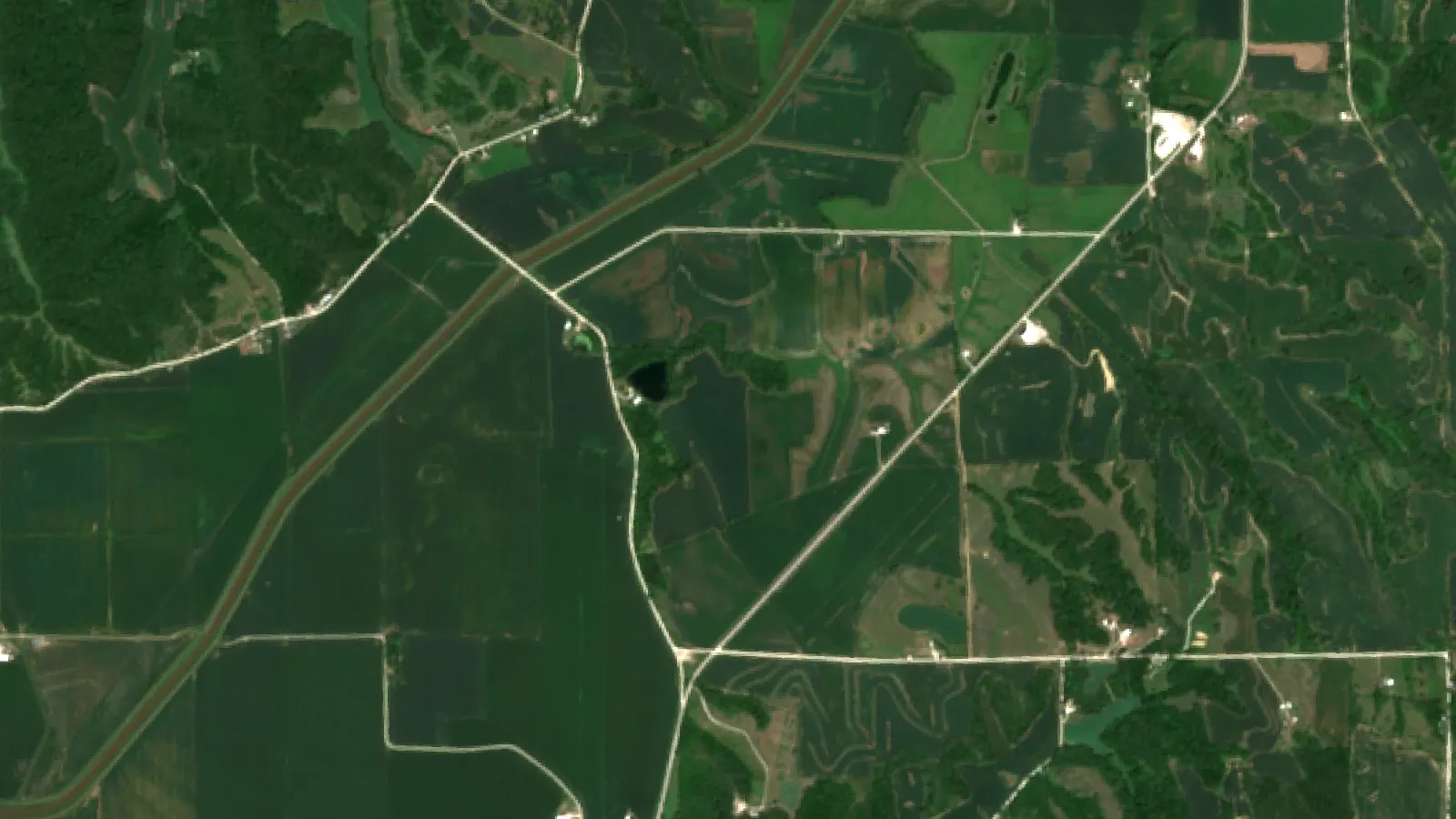
Satellites see vegetation directly. According to NASA’s guide to vegetation indices, chlorophyll in leaves strongly absorbs visible light, while leaf structure strongly reflects near-infrared light. NDVI compares the two. A high reading says plants are dense and green. It does not say whether a person planted them.
To separate crops from wild cover, analysts add time and ground truth. Crops tend to follow a clear cycle of planting, green-up and harvest. The USDA Cropland Data Layer uses satellite images from the growing season along with agricultural ground reference data to map specific crops each year, at 10-meter resolution since 2024. Its non-crop classes draw on a separate national land cover database, which shows that crop mapping and general vegetation mapping are different jobs.
The same logic helps on a single farm. The Farmonaut Satellite + AI Farm Monitoring System tracks vegetation indices field by field, so a grower can compare crop areas across the season. A low reading is a prompt to walk that part of the field, since a satellite shows the change and not its cause.

▶ Tutorial on monitoring crops with satellite imagery and crop health indices in the Farmonaut web system. · 8:43
What changes when vegetation becomes farmland
Turning natural cover into farmland changes more than the plants. Soil gets disturbed, and it may lie bare for part of the year. A global study in Nature Communications estimated that cropland covered about 11.2% of the land studied in 2012 but accounted for 50.5% of predicted soil erosion. That is a modelled estimate, but it shows why the starting cover deserves attention.
Existing plant cover is a useful first clue before converting land, but it is not enough alone. Keep the checks practical:
- Note which plants grow there and how well. This gives a first hint about moisture, drainage and weed pressure.
- Test the soil. Plant cover alone will not tell you pH or nutrient levels.
- Look at slope and water paths, since these drive erosion once the cover is gone.
- Check the rules. Clearing native vegetation may need a permit, and wetlands are often protected. Ask your local authority or a qualified adviser before any work starts.
Difference between agriculture and cultivation
Agriculture is the whole system. Cultivation is the hands-on field work inside it: preparing soil, planting, weeding, tending and harvesting. All cultivation of crops for use is part of agriculture, but agriculture also includes livestock, planning, research, advice, marketing and more.
A simple test: if the task happens in the field and affects the crop this season, it is likely cultivation. If it happens at a desk, in a barn or at a market, it is still agriculture but not cultivation. For the steps in order, see our guide to farming steps.
Difference between horticulture and agriculture
Penn State Extension defines horticulture as a branch of plant agriculture that deals with garden crops such as fruits, vegetables and ornamental plants, and it also includes trees, shrubs, turf and lawns. So horticulture sits inside agriculture. It is not a rival to it.
| Point | Agriculture overall | Horticulture |
|---|---|---|
| Scope | All crops and livestock | Garden crops, fruit, ornamentals, turf |
| Usual scale | Small to very large | Often smaller, can be large |
| Common focus | Volume across the area | Quality and appearance as well as volume |
| Examples | Wheat, corn, cattle, dairy | Apples, lettuce, roses, nursery trees |
| Typical methods | Field machinery, rotations | Pruning, grafting, greenhouses, irrigation |
These are general patterns, not fixed rules. A large apple grower can farm more land than a small grain farmer.
Difference between yield and production in agriculture
Yield is output per unit of area. Production is total output. The formula links them: production = yield x harvested area. Vegetation has neither figure in the usual sense, since these measures assume a harvest.
Chart
Corn for grain production in selected states
Million bushels, 2025, seven selected states
US corn makes the difference clear. USDA’s Crop Production 2025 Summary reports a record 17.0 billion bushels of corn for grain in 2025, from a record average yield of 186.5 bushels per acre on 91.3 million harvested acres. These are final-season estimates for the whole country.
State figures from the same report show why you should not swap the terms. Illinois had a higher yield than Iowa (214 vs 210 bushels per acre), yet Iowa produced more (2.77 vs 2.35 billion bushels) because it harvested more acres. Indiana yielded 204 bushels per acre and South Dakota 171, but South Dakota produced slightly more. For more state detail, see our page on corn yield by state.
Use yield to judge how a field or a method performed. Use production to plan storage, trucking, contracts and sales. A rising total can hide a falling yield if the area grew.
Chart
Yield and production are separate measures
Corn for grain, 2025, seven selected states
Try the numbers for your own farm below.
Calculator
What is your yield, and does it cover your costs?
Enter your own harvest, price and cost to separate yield from production.
- Break-even yield: 180.0 bu/acre
- Margin per acre, US$: $0
- Whole-field margin, US$: $0
Example values only, set near break-even; not a benchmark or forecast. All figures are your own inputs, and costs vary by farm. For financial decisions, get professional advice.
Comparison table: agriculture, vegetation, cultivation, yield, production
| Term | Meaning | Example | Human role | Usual unit |
|---|---|---|---|---|
| Agriculture | Managed crop and livestock system | Mixed grain and cattle farm | High and continuous | Land area, income, output |
| Vegetation | Plant cover in an area | Prairie, boreal forest | Any level | Percent cover, biomass |
| Cultivation | Field work on crops | Tilling, sowing, weeding | High during the season | Acres or hectares worked |
| Horticulture | Garden, fruit and ornamental crops | Orchard, greenhouse | High | Output per area, grade |
| Yield | Output per unit area | 186.5 bu/acre of corn | A measured result | bu/acre, t/ha |
| Production | Total output | 17.0 billion bu of corn | An added-up result | Tonnes, bushels |
The example figures in the yield and production rows are the 2025 US corn numbers from USDA above.
How to use these terms on a farm
- Record cover before you change it. Photograph and map the plant cover first. It gives you a baseline for soil, weed and water decisions.
- Plan cultivation inside the wider business. Field work should follow the budget, the input plan and the market target.
- Keep yield and production in separate columns. Compare fields on yield. Report supply on production.
- Use harvested acres in the yield sum. Planted acres give a lower figure if part of a field was lost, and the two are not comparable.
- Weigh horticulture on margin. Fruit, vegetables and nursery crops often need more labor and capital. Cost them per acre before you switch.
- Match your words to your audience. Agronomists tend to ask about yield. Buyers and lenders may ask about total production and area. Forms for leases, grants or insurance may define these words their own way, so read those definitions or ask a professional.
▶ How to read a satellite farm advisory, starting from a change in a maize field’s expected yield. · 9:13
FAQ
What is the main difference between agriculture and vegetation?
Agriculture is a managed activity that produces food, fiber or fuel. Vegetation is the plant cover on an area, whether or not anyone manages it. Crops count as both.
True or false: natural vegetation refers to fruits and vegetables grown on a specific farm?
False. Natural vegetation means plants that grow in an area without being planted for harvest, such as native forest or grassland. Fruits and vegetables on a farm are cultivated crops, and they belong to horticulture.
Can vegetation be turned into agricultural land?
Yes, through clearing, soil work and planting, or by grazing it. It can have lasting effects on soil and habitat, and it may need a permit. Check local rules first.
Is horticulture different from agriculture?
It is a part of agriculture. Penn State Extension calls it a branch of plant agriculture for fruits, vegetables, ornamentals, trees, shrubs and turf.
What is the difference between yield and production?
Yield is output per unit of area, such as 7 tonnes per hectare. Production is total output. At that yield, 20 hectares produce 140 tonnes.
Does green land on a satellite image mean farming?
No. Vegetation indices show green plant cover, not its purpose. Crop maps add seasonal patterns and ground reference data to tell cropland from natural cover.
Related pages on our site: types of land use; carbon footprinting; crop loans and insurance; farm fleet management; product traceability; web app; mobile app; satellite data API; API developer docs.
Farm monitoring
See your own fields from space
Track vegetation indices across your fields with the Farmonaut Satellite + AI Farm Monitoring System.




Keep reading

Sources
- FAO, FAOSTAT Analytical Brief 71: Land statistics and indicators 2000-2021: openknowledge.fao.org
- FAO, Land Cover Classification System: concepts and user manual: fao.org
- FAO, Global Forest Resources Assessment 2025: forest extent and change: openknowledge.fao.org
- Our World in Data, Half of the world’s habitable land is used for agriculture: ourworldindata.org
- USDA ERS, Major Land Uses (2022 update): ers.usda.gov
- USDA ERS Amber Waves, Data series tracks major uses of US land (December 2024): ers.usda.gov
- USDA NASS, Crop Production 2025 Summary (January 2026): release.nass.usda.gov
- USDA NASS, Cropland Data Layer FAQ: nass.usda.gov
- NASA Science, Measuring Vegetation (NDVI and EVI): science.nasa.gov
- Penn State Extension, Introduction to Horticulture: extension.psu.edu
- Borrelli et al., Nature Communications (2017), global impact of land use change on soil erosion: nature.com
Discussion
Questions, corrections or field experience? Share them below. First-time comments are reviewed before they appear, and your email is never published.
No comments yet. Be the first to add a question or your experience.

 Magrifly
 LatConnect 60
 Disease Free Life
 WebsEdge
 Blickwinkel
 Agricultural Credit Policy Council
 BayWa
 MCSOD
 Marei Nursery
 eKGIS
 Mostas Tech
 Native Seeds
 Andex
 FCF India
 Unifrutti Gulf
 Deluxe Conseil
 WICO
 Chimera Innovation

 Licence holder · Niger · Gold
 Licence holder · Nigeria · Gold + lithium
 Client · Tanzania · Gold
 Client · Somalia · Gold
 Client & affiliate partner · Ghana · Gold










