

Combines · Used buyer guide
Used John Deere Combine Prices: S670 vs X9 1100
A 2013 John Deere S670 with 2,316 hours sold for $103,500 in Illinois on 30 June 2026, against a 2026 auction average of about $75,125 (Machinery Pete). A 2022 X9 1100 sold for $425,250 in December 2024. The old 9600 walker combine listed at $115,000 new in 1989, without a header (FARM SHOW).
Key takeaways
- S670 (built 2011 to 2017, 9.0 L, about 300 bu): a 2013 unit sold for $103,500 on 30 June 2026; the 2026 auction average was about $75,125 (Machinery Pete).
- X9 1100 (model year 2021 on, 700 hp max): a 2022 unit with 613 hours sold for $425,250 at a BigIron auction on 18 December 2024 (Farms.com).
- JD 9600 (launched for 1989): a walker combine with 190 or 253 hp and a 240 bu tank, listed at $115,000 new without a header (FARM SHOW, 1989).
- New combine list prices in University of Illinois estimates rose from $478,000 (2017) to $784,500 (2025) for a 470 hp machine.
- Custom combining of corn cost a median $44 per acre in Iowa in 2025; owning pays only when a machine harvests enough acres, so test your numbers in the calculator.
In this article
- Used John Deere combine prices at a glance
- Used John Deere combine prices at recent auctions
- How to read an auction price
- John Deere 9600: the budget walker combine
- John Deere S670: the mid-size used favourite
- John Deere X9 1100: the high-capacity option
- S670 vs X9 1100: which one fits your farm?
- How new combine list prices have moved
- What a used combine really costs per acre
- Own or hire: work out your cost per acre
- How to choose a used combine
- Case IH alternatives, in brief
- Use your own field data before you buy
- How we checked the numbers
Used John Deere combine prices run from an average of about $75,000 for an S670 at 2026 auctions to more than $400,000 for a late-model X9 1100 (December 2024 sale). The old 9600 walker combine listed at $115,000 new in 1989, without a header. Two dated examples: a 2013 S670 with 2,316 engine hours sold for $103,500 at an Illinois farm auction on 30 June 2026, and a 2022 X9 1100 with 613 engine hours sold for $425,250 on 18 December 2024. The S670 figure comes from the Machinery Pete auction report of 7 July 2026, which also put the average S670 auction price for 2026 at about $75,125.
This buyer guide compares three generations of John Deere combines, from the old 9600 to the S670 and the X9 1100. It gives specs from launch reports, dated auction results, a chart of new-combine list prices, and a calculator that shows what a used machine costs you per acre against hiring a custom operator. All prices are in US dollars unless marked. Auction results are the final sale prices reported for one machine on one day, not price guides. Dealer asking prices are higher and are named as such where we use them.
Used John Deere combine prices at a glance
The table sums up the three machines this guide covers. The S7 row shows Deere’s current mid-size line for reference. Power figures are rated unless marked “max”. The X9 and S7 figures come from launch reports; the S670 figures are European (ISO) ratings, so a North American spec sheet may differ a little.
| Model | Built | Engine and power | Grain tank | Dated price evidence | Best for |
|---|---|---|---|---|---|
| JD 9600 | From 1989 | Walker combine; 190 hp (small grain) or 253 hp (corn, rice) at launch | 240 bu | $115,000 suggested retail new, 1989 (253 hp, less header); no used sale record we could verify | Small grain farms on a tight budget with a good mechanic |
| JD S670 | 2011 to 2017 | 9.0 L; 378 hp (to 2015) or 397 hp (2015 on), ISO rated | About 300 bu (106 hl) | $103,500 for a 2013 unit, 30 Jun 2026; 2026 average about $75,125 | Corn and soybean farms of a few thousand acres |
| JD X9 1100 | Model year 2021 on | 13.6 L; 700 hp max | 16,200 L (about 460 bu) | $425,250 for a 2022 unit, 18 Dec 2024 | Large farms and custom harvesters |
| JD S7 (new) | Model year 2025 on | 333 to 543 hp rated | 300 or 400 bu | New; no used results yet in our sources | Buyers comparing a late used S-series with new |
Sources for each row are in the sections below. The X9 tank size in bushels is our conversion from litres (about 35.2 litres per bushel), rounded.
Used John Deere combine prices at recent auctions
Auction results are the best public evidence of what used combines really sell for, because asking prices can sit on a listing for months. The results below are single machines, so hours, options and condition drive each one. Read them as dated examples, not as the value of your machine.
Chart
Selected John Deere combine auction results
US dollars, final auction price of one machine, model year and sale month shown; the last bar is an average
At a Ritchie Bros. sale in Medford, Minnesota, on 30 June 2026, a 2024 S780 with 476 hours sold for $414,000. On the same day, at a Schmid Auction sale in Moweaqua, Illinois, the 2013 S670 with 2,316 engine hours brought $103,500, which the report called the second-highest S670 auction price of the year. The same report says buyers were turning to newer used machines because five- to 12-year-old machines were in short supply.
A Farms.com report on a December 2024 BigIron sale lists the top prices of that day. The 2022 X9 1100 (613 engine hours, 453 separator hours) sold for $425,250 to a buyer from Iowa after 373 bids. A 2023 S770 with 366 engine hours sold for $400,500, and a 2022 S780 with 513 engine hours sold for $375,000. The X9 had a 4600 display and precision activations listed with it, which matters: a combine sold without its activations may need new subscriptions before it can run guidance or yield mapping.
Prices move with the season. In the July 2026 report, Machinery Pete said used combines in good condition “jumped up in June”. Buyers who shop after harvest, when trade-ins reach dealer lots, may see a different market than buyers who shop in early summer.
How to read an auction price
An auction result looks like a simple number, but several things sit behind it. Check each one before you use a result to value a machine you want to buy or sell.
- Buyer’s fees. Some auction houses add a buyer’s fee on top of the winning bid, and some report the price with the fee included. Read the sale terms so you compare like with like.
- What was in the lot. A combine sold with a corn head or draper is a different lot from a bare machine. The reports above list the combine only, with its options.
- Hours and age together. A newer machine with high hours can sell for less than an older one with low hours. The 2013 S670 that brought $103,500 had 2,316 engine hours, so a unit of the same year with twice the hours may sell for much less.
- Location and timing. Prices differ by region and season. A machine sold in June, just before wheat harvest, may draw more bidders than the same machine in late winter.
- Transport and set-up. Moving a combine and its header from a distant sale, and fitting it for your crops, adds to the real cost of a low bid.
Dealer trade-in values and private sales add more data points. A dealer price often includes some reconditioning or a short warranty, which an auction lot does not. When you see one very high or very low result, look for the reason in the lot details before you treat it as the market price.
John Deere 9600: the budget walker combine
The 9600 was the largest of Deere’s 90 series Maximizer combines. A FARM SHOW report from 1989 describes the just-introduced line of three diesel models: the 9400 (155 hp), the 9500 (190 hp) and the 9600, offered with 190 hp for small grains or 253 hp for corn and rice. The 9600 had a 240-bushel grain tank and a 140-gallon fuel tank. Unlike the S-series and X9 machines, it separates grain with straw walkers rather than a rotor.
Why buyers still look at it:
- Low entry price. A 30-plus-year-old combine costs a fraction of a used S-series. That makes it a fit for small-grain farms that harvest a few hundred acres a year.
- Simple mechanics. The 1989 report quotes a custom operator who said the 9600 parts manual listed about 40% fewer parts than the older 8820. Fewer electronics also means fewer software problems.
- Heavy crops. A custom operator in the 1989 report said it handled heavy, lodged crops well and was not power-limited like the rotary machines of that time.
The trade-offs are real. The 9600 was designed before yield monitors, guidance and telematics were common, so most units have none unless one was added later. Adding a yield monitor is possible, but the USDA Economic Research Service found that replacing a soybean yield monitor cost just over $8,000 in 2018, so a retrofit can add a large share to the price of an old machine. Parts for a combine this old can also take time to find, and a breakdown in harvest costs more than the part.
When new in 1989, FARM SHOW gave a suggested retail price of $115,000 for a 9600 with the 253 hp engine, without a header. That is a list price, not a used value. We could not open a dated used sale record for a 9600, so we do not quote one. Auction result pages on sites such as Purple Wave and BigIron list past sales. Compare at least three recent results for the same year, hours and condition before you bid.
Best for: small grain growers, hobby farms and second combines kept for back-up, where low capital cost matters more than speed or data.
John Deere S670: the mid-size used favourite
The S670 belongs to Deere’s S600 series of rotary combines. According to Koneviesti’s spec database, the S-series line (S660, S670, S680, S685 and S690) was sold from 2011 to 2017. The S670 used a 9.0-litre engine rated at 378 hp until 2015 and 397 hp from 2015 to 2017 (ISO figures), with extra power available while unloading. It had a grain tank of about 300 bushels (106 hectolitres). The same source says the S660 and S670 differed mainly in engine power, and that newer engines with urea injection arrived for 2016.
What you get compared with a 9600:
- A single rotor in place of straw walkers, which suits corn and soybeans.
- Precision ag hardware such as a display, guidance and yield mapping is common on these machines, but what works depends on what is installed and the activations that come with it.
- A transmission that shifts automatically on the ProDrive option, and extra engine power while unloading.
Dated prices: the Illinois sale on 30 June 2026 ($103,500 for a 2013 unit with 2,316 hours) was well above the 2026 auction average of about $75,125 in the same report. That spread is normal for a model built over seven years: hours, header, tracks, maintenance records and the last major service move the price more than the model number.
Best for: corn and soybean farms that want rotor capacity and yield data without paying late-model prices, and that harvest enough acres to spread the cost (see the calculator below).

▶ Six plain steps to start precision farming, including how auto-steer use grew on US corn acres. · 4:18
John Deere X9 1100: the high-capacity option
Deere announced the X9 1000 and X9 1100 in 2020 for the 2021 harvest. A High Plains Journal launch report says the X9 1100 can harvest up to 30 acres of tough, high-yielding wheat or up to 7,200 bushels of high-yielding corn per hour, and run up to 14 hours without refuelling. The X9 has a new 13.6-litre engine, dual separator rotors, and a cleaning shoe with 36% more cleaning area than the S790.
The UK magazine Profi gives the X9 1100 a maximum of 700 hp (639 hp for the X9 1000), a grain tank of up to 16,200 litres and a claimed 100 tonnes of wheat per hour at under 1.0% loss. Some dealer pages show about 690 hp; we could not confirm which figure is current, so treat 690 to 700 hp as the range. Treat the throughput figures as Deere’s own claims under good conditions.
Dated prices: the 2022 X9 1100 at the December 2024 BigIron sale brought $425,250. Dealer asking prices for newer machines are not sale results, so compare them with auction results of the same year and hours.
Best for: large grain farms and custom harvesters with long harvest days, where acres per hour decide whether the crop comes off in time.

▶ What farm automation such as self-steering machines means for farms and rural towns. · 3:50
S670 vs X9 1100: which one fits your farm?
The S670 and X9 1100 are not rivals so much as two price points. The question is how many acres you harvest and how short your harvest window is.
- Acres. University of Illinois cost estimates show combine costs per acre fall fast as acres rise, because depreciation and interest stay the same whether you harvest 600 or 2,400 acres. A big machine on a small farm is the most expensive mistake.
- Crop. Both are rotary machines. The X9’s extra capacity pays most in high-yield corn and tough wheat, where an S670 has to slow down.
- Labour. A higher-capacity machine can mean fewer combines and operators. The farmdoc daily analysis gives the example of farms harvesting 9,000 acres with two combines instead of three. That saving does not show in the purchase price.
- Technology. Check which displays, receivers and software activations come with each machine. Activations may not transfer with a used sale.
If neither fits, look at a late used S-series such as the S770 or S780. The 2024 and 2023 examples above sold for $400,500 to $414,000, which is close to the X9 1100 result, so compare like with like on hours and year.
How new combine list prices have moved
Used John Deere combine prices follow new prices. The University of Illinois farmdoc harvesting cost estimates, updated every other year, use list prices for typical new combines. Their 470 hp combine rose from $478,000 in the June 2017 estimate to $784,500 in August 2025, and the 540 hp combine from $500,500 to $818,200. The 2025 estimate also lists a 330 hp combine at $645,700.
Chart
List price of a new combine in Illinois cost estimates
US dollars, list price used in each farmdoc harvesting cost estimate (2017 to 2025)
A farmdoc daily analysis from October 2025 says prices of new farm equipment rose by more than 20% between 2021 and 2023, and that the list price of the combine in its cost estimates rose 26% over those two years. It also reports that depreciation on central Illinois corn farms rose from $69 per acre in 2021 to $87 in 2024, and repairs from $32 to $39 per acre. When new machines cost this much, demand for good used ones stays firm.
New S7 combines show what the newer machines add. DTN’s S7 launch report lists the S7 600 at 333 hp and the S7 700 at 402 hp, both on a 9.0-litre engine with a 300-bushel tank, and the S7 800 (473 hp) and S7 900 (543 hp) on a 13.6-litre engine with a 400-bushel tank. Deere says its new automation, which uses cameras to read the crop ahead of the header, gives up to 20% more productivity. A Deere dealer lists maximum power at 367 hp for the S7 600 and 617 hp for the S7 900.
What a used combine really costs per acre
The price you pay is only the start. The farmdoc estimates for August 2025 put the cost of combining corn with a new 470 hp combine at $54.40 per acre and soybeans at $47.60, when the machine harvests 2,500 acres a year. That covers depreciation, interest, insurance, housing, repairs, fuel and labor. The same estimates show how much acres matter: for the 470 hp machine, corn costs $181.80 per acre at 600 acres but $55.80 at 2,400 acres.
Chart
Corn combining cost per acre by acres harvested
US dollars per acre, new combines of three sizes, all costs including depreciation, interest, repairs, fuel and labor
A used combine lowers the depreciation and interest part, but older machines can need more repairs, and an older model may harvest fewer acres per hour. The farmdoc daily analysis suggests about 3,000 acres a year as a benchmark for owning a new combine at a sensible cost, and notes that smaller farms may share a combine or hire custom harvesting.
Custom hire rates to compare against
Custom rates are the main alternative to owning. They include the operator, fuel, repairs and the machine.
- The Iowa State custom rate survey, as summarised by Agweek, gave a 2025 median of $44 per acre for combining corn (range $25 to $80) and $40 for soybeans. It assumed diesel at $3.66 per gallon.
- Wisconsin’s 2025 custom rate survey gave an average of $38.47 per acre for combining corn (34 responses) and $38.45 for soybeans.
- The Mississippi State custom rate survey (2024) gave an average of $47 per acre for corn and $43 for soybeans, from 8 responses each.
- In Canada, Manitoba’s 2026/2027 machinery cost guide gives rotary combine custom rates of about $31 to $40 per acre in Canadian dollars, without the header.
Small surveys give wide ranges. Ask two or three local operators for a quote, and ask whether grain carts, trucks and downed-crop charges are included.
Chart
Custom combining rates for corn vs cost of owning
US dollars per acre; survey averages or medians, plus the farmdoc cost of a new 470 hp combine on 2,500 acres
Own or hire: work out your cost per acre
Use the calculator to compare the yearly cost of owning a used combine with paying a custom operator. Enter your own purchase price, the value you expect to sell it for, how long you will keep it and how many acres it will harvest each year. The defaults are round example numbers set close to break-even, not a valuation of any model.
The formula follows the farmdoc method in simple form: yearly depreciation is the price minus resale value, divided by the years you keep it; interest and insurance with housing are charged on the average value. Repairs, fuel and labor go in as one per-acre figure, because they depend on the machine and your crop.
Try the numbers for your own farm below.
Calculator
Is owning a used combine cheaper than hiring?
Enter your own price, resale value, acres and local custom rate.
- Yearly fixed cost of owning: $23,700
- Owning minus hiring, per acre: $1
- Custom hire cost per year: $35,200
- Break-even acres per year: 817 acres
Example values only, set close to break-even; they are not a value for any model or a forecast. Yearly fixed cost = (price minus resale) divided by years kept, plus interest at your rate and 1% for insurance and housing, both on the average of price and resale value. The 1% insurance and housing figure is fixed in the formula and follows the University of Illinois farmdoc harvesting estimates (August 2025). The $44 custom rate example is the 2025 Iowa median for corn (Iowa State survey, via Agweek). The calculator leaves out timeliness, grain carts, trucks and tax effects; get advice from your lender or accountant before you buy.
How to choose a used combine
Follow these steps before you bid or sign.
- Set your acres first. Work out how many acres the combine will harvest each year, now and in five years. Then pick the size class. Use the calculator to see your break-even acres.
- Check both hour meters. Engine hours and separator hours tell different stories. Auction listings often give both, as the BigIron reports above do. A wide gap can mean a lot of road travel or idling.
- Ask for records. Service invoices, the last rotor, concave and feeder house work, and any engine or emissions repairs on 2016-and-later engines with urea injection.
- Price the header separately. A corn head or draper can cost as much as an old combine. The farmdoc 2025 estimates list a 12-row corn head at $173,500 and a 35-foot grain platform at $79,300 new.
- Confirm the technology. Which display, GPS receiver and software activations come with the machine, and will they transfer to you? Ask the dealer to check the serial number.
- Inspect in person or pay someone who can. Look at the rotor or walkers, bearings, belts, chains, the unloading auger and the cab electronics. Run the separator if the seller allows.
- Compare at least three dated results. Use auction results for the same model, year range and hours, and note the date of each. Prices from two years ago may not hold today.
Financing, warranty and tax treatment change the real cost. Get advice from your lender or accountant, and read the sale terms, before you commit.
Case IH alternatives, in brief
Many buyers compare red and green machines at the same sale. A Farms.com report on a September 2024 BigIron sale in Nebraska lists a 2020 Case IH 8250 with 1,119 engine hours at $241,250, a 2019 8250 on tracks at $207,000, a 2022 9250 at $300,250 and a 2016 7240 at $150,750. At the December 2024 sale, a 2022 8250 brought $274,500.
The 250 series has been replaced. Case IH’s US product page now lists the Axial-Flow 260 series: the 7260 at 402 hp, the 8260 at 480 hp and the 9260 at 550 hp. The older Case IH 7230 and the much older Case 660 still turn up in listings; we found no dated sale record for either that we could check. For prices and specs of the 8250 and its sister models, see our Case IH 8250 guide linked at the end of this page.
Use your own field data before you buy
The right combine size depends on your yields and your harvest window, not on the brochure. If you have yield maps from earlier seasons, use them to work out bushels per hour at your typical yields. Auto-steer use has grown fast: the USDA Economic Research Service reports it on 5.3% of planted corn acres in 2001 and 58% in 2016, so many farms that run guidance already log machine data that can help size the next combine.
Field-level crop maps help too. Farmonaut shows satellite vegetation maps of each field through the season, which can point out the low and high parts of a field before harvest and help you plan which fields to cut first. It does not replace a yield monitor, but it adds a view of fields where you have no machine data.
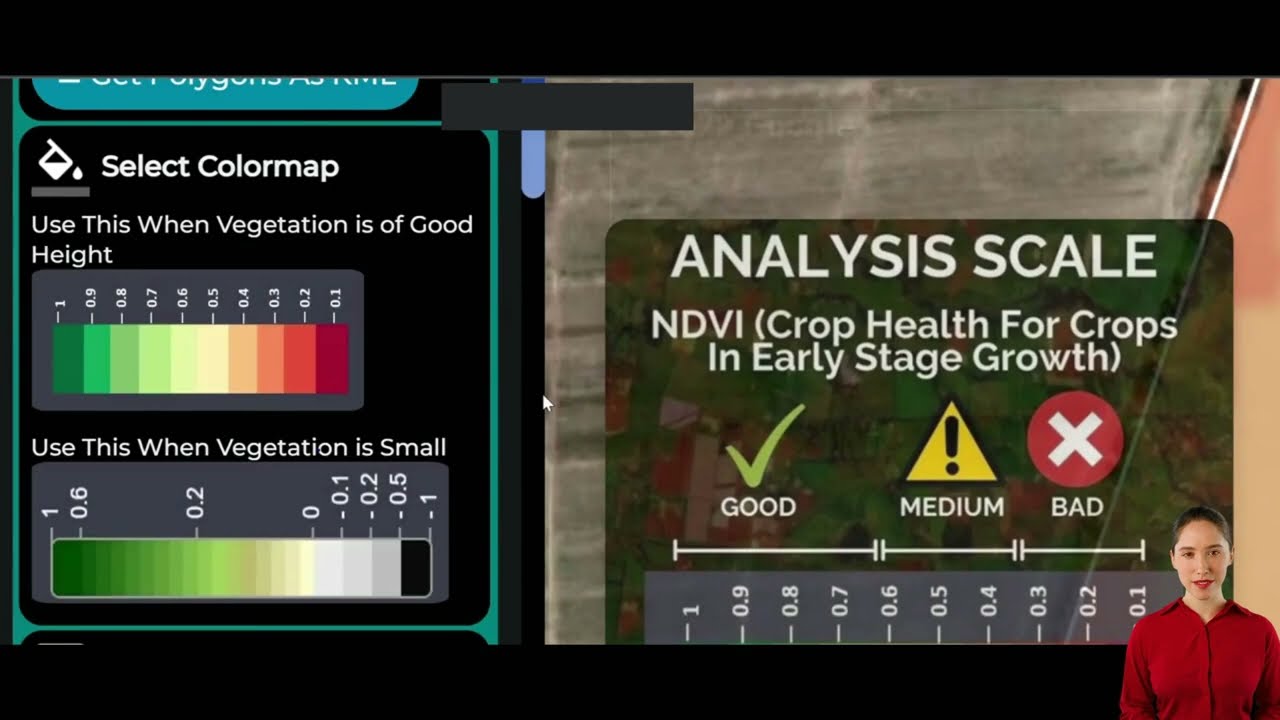
▶ A tour of the Farmonaut web app and how to read satellite crop maps for each field. · 10:16
How we checked the numbers
We used only auction results with a date, a model year and engine hours, from reports we could open in October 2026. Specs come from launch reports (FARM SHOW for the 9600, High Plains Journal and Profi for the X9, DTN for the S7) and from Koneviesti’s spec database for the S670. Cost figures come from the University of Illinois farmdoc estimates and farmdoc daily, and custom rates from Iowa State (via Agweek), University of Wisconsin, Mississippi State and Manitoba. Where sources disagree, as on X9 1100 maximum power, we say so. We left out figures we could not trace to a page we read, including a sale price for the 9600.
FAQ
How much is a used John Deere S670 combine worth?
It depends on the year, hours and options. Machinery Pete put the average S670 auction price in 2026 at about $75,125, and a 2013 unit with 2,316 engine hours sold for $103,500 in Illinois on 30 June 2026. Check recent local results for machines like yours.
What did a used X9 1100 sell for at auction?
A 2022 X9 1100 with 613 engine hours sold for $425,250 at a BigIron auction on 18 December 2024, as reported by Farms.com.
Is a John Deere 9600 still worth buying?
It can be for small grain farms with a few hundred acres and a good mechanic. It is a walker combine first sold for 1989, with 190 or 253 hp and a 240-bushel tank. Most units have no yield mapping or guidance unless it was added later, and parts can take time to find.
How many acres do I need to own a combine?
There is no single number. A farmdoc daily analysis suggests about 3,000 acres a year as a benchmark for a new combine. A used machine lowers the break-even. Use the calculator on this page with your price, resale value and local custom rate.
What is a fair custom rate for combining corn?
Survey figures for 2025 include a median of $44 per acre in Iowa and an average of $38.47 in Wisconsin. Mississippi’s 2024 survey averaged $47. Local rates vary with fuel, field size and whether a grain cart and truck are included.
Related pages on our site: new John Deere combine prices, Case IH 8250 price and specs, precision agriculture software, fleet management, large-scale farm management, Farmonaut API, developer docs, product traceability, carbon footprinting and the app download page.
Farmonaut crop monitoring
See your own fields from space
Draw your fields once and Farmonaut shows satellite vegetation maps for each one through the season, on web, Android or iOS.




Keep reading

Sources
- AgWeb, Pete’s Pick: John Deere S780 and S670 lead record-breaking June auctions (Machinery Pete, 7 July 2026): agweb.com
- Farms.com, Buyers spend green on green and red equipment (BigIron auction of 18 December 2024; published 20 December 2024): m.farms.com
- Farms.com, Case IH combines take spotlight at auction (BigIron auction of 4 September 2024): m.farms.com
- FARM SHOW Magazine, Operators report on Deere’s Maximizer combine (1989, Vol. 13, Issue 2): farmshow.com
- Koneviesti Konedata, John Deere S660-S690 combine specifications (2011-2017): koneviesti.fi
- High Plains Journal, New Deere combine ready to help high-end producers (18 August 2020): hpj.com
- Profi, 700hp for John Deere X-Series combine flagship (2020): profi.co.uk
- DTN/Progressive Farmer, John Deere unveils 9RX Series tractors, S7 combines at 2024 Commodity Classic (28 February 2024): dtnpf.com
- 21st Century Equipment, John Deere reveals S7 Series combines at 2024 Commodity Classic (11 March 2024): 21stcenturyequipment.com
- University of Illinois farmdoc, Machinery Cost Estimates: Harvesting (August 2025): farmdoc.illinois.edu
- University of Illinois farmdoc, Machinery Cost Estimates: Harvesting (September 2023): farmdoc.illinois.edu
- University of Illinois farmdoc, Machinery Cost Estimates: Harvesting (September 2021): farmdoc.illinois.edu
- University of Illinois farmdoc, Machinery Cost Estimates: Harvesting (July 2019): farmdoc.illinois.edu
- University of Illinois farmdoc, Machinery Cost Estimates: Harvesting (June 2017): farmdoc.illinois.edu
- farmdoc daily, Large increase in machinery costs suggests need to reconsider machinery purchase decisions (14 October 2025): farmdocdaily.illinois.edu
- Agweek, Farm custom rates show slight increase for 2025 (Iowa Farm Custom Rate Survey summary, 17 April 2025): agweek.com
- University of Wisconsin-Madison Extension, Custom Rates for 2025 Wisconsin Farm Operations (2026): farms.extension.wisc.edu
- Mississippi State University Extension, Custom Rates for Mississippi Agricultural Practices, P4048 (2024 survey): extension.msstate.edu
- Manitoba Agriculture, Cost of Production: Farm Machinery, custom and rental guide (2026/2027): manitoba.ca
- Case IH US, Axial-Flow 260 Series combines (product page, viewed October 2026): caseih.com
- USDA Economic Research Service, Precision Agriculture in the Digital Era: Recent Adoption on U.S. Farms, EIB-248 (2023): ers.usda.gov
- USDA Economic Research Service, EIB-248 publication page (2023): ers.usda.gov
Discussion
Questions, corrections or field experience? Share them below. First-time comments are reviewed before they appear, and your email is never published.
No comments yet. Be the first to add a question or your experience.

 Payagri
 WB Dev
 Sama Premium
 Prochecker
 Tres Valles
 LACOS Geoinformation
 Pulsar Supernova
 Magrifly
 LatConnect 60
 WebsEdge
 Blickwinkel
 Agricultural Credit Policy Council
 MCSOD
 Marei Nursery
 eKGIS
 Mostas Tech
 Andex
 FCF India
 Unifrutti Gulf
 Deluxe Conseil

 Licence holder · Niger · Gold
 Licence holder · Nigeria · Gold + lithium










