

Agrivoltaics · Guide with lease calculator
Solar Panels on Farmland: Benefits, Lease Income and Limits
Solar panels on farmland can pay a lease and, in some designs, share the field with crops. Published trials show yields from about 19% lower to 3 times higher, and lease offers vary widely. Use the calculator to test your own numbers.
Key takeaways
- Lease offers reported to Purdue in June 2024: 69% of farmers who discussed a lease were offered $1,000 per acre or more, against a 2026 US average cash rent of $160.
- Crop yield under panels ranged from about 19% lower to 3 times higher in published trials. The result depends on the crop, the climate and the year.
- Solar leases often run 15 to 30 years in the operations phase, so check the escalator, taxes and who removes the equipment.
- A utility-scale solar plant uses about 8 acres of land per megawatt (NREL, 2013), so project size decides how many acres a lease covers.
- US federal support has tightened: USDA stopped funding solar on productive farmland in 2025. Have a lawyer review any lease.
In this article
- Introduction: Agrivoltaics and the Future of Sustainable Agriculture
- The Concept of Solar Panels on Agricultural Land
- 7 Powerful Benefits of Solar Panels on Farmland
- Comparative Benefits-Impact Table: Solar Panels on Farmland
- Key Challenges & Considerations for Solar Panels on Agricultural Land
- Technological Innovations and Policy Trends Shaping Solar Panels on Farmland
- How Farmonaut Satellite Technology Supports Agrivoltaics
- Video Insights: Solar, Agrivoltaics, Farming, and Satellite Tech
- Frequently Asked Questions (FAQ) on Solar Panels on Farmland
- Conclusion: Solar Panels on Farmland as a Cornerstone of Sustainable Agriculture
- Farmonaut Subscription Plans: Affordable Access to Satellite Intelligence for Every Farm
Introduction: Agrivoltaics and the Future of Sustainable Agriculture
Solar panels on farmland are changing the way we approach sustainable energy production and land management. With the world facing growing pressure to meet food demands and urgent renewable energy targets, stakeholders in the agricultural sector are increasingly looking at the integration of solar panels on agricultural land, a practice also known as agrivoltaics.
Chart
US solar capacity has grown every year
Net summer capacity in gigawatts, United States, 2014 to 2024
In recent years, the question “Can you put solar panels on agricultural land?” has shifted from a regulatory curiosity to a mainstream solution addressing efficiency, clean energy, and farm income. Agrivoltaic systems enable the coexistence of crop production and solar power generation without significantly disrupting farming operations. Modern advancements have made this integration more feasible, providing a dual benefit for food and energy security.
The Concept of Solar Panels on Agricultural Land
The installation of solar panels on farmland involves placing photovoltaic (PV) systems on arable land, designed to allow simultaneous crop growth and energy generation. Unlike traditional utility-scale solar farms built on non-productive land, these systems are:
- Elevated or spaced to let sufficient sunlight reach crops below, minimizing the shading impact while optimizing solar energy generation.
- Adapted for both row crops and grazing, allowing agricultural operations to continue without significant interference.
- Integrated through smart mounting systems and PV panel placement, which are increasingly becoming more affordable and efficient due to technological advances.
This dual-use or multipurpose approach is a core reason why agrivoltaics is now referred to as a promising innovation for enhanced land use efficiency—particularly in regions with limited available arable land. Agrivoltaic systems enable us to double-dip the benefits of land, meeting the global demand for both food and clean electricity generation.
How much land does a solar plant use? A study of US plants by NREL (now the National Laboratory of the Rockies) found a total site area of 7.5 to 8.7 acres per megawatt (AC), depending on plant size and tracking type (NREL, 2013). A Berkeley Lab update counted DC capacity for plants built from 2007 to 2019 and gave updated densities for 2019 plants of 2.8 acres per MWdc for fixed-tilt plants and 4.2 for tracking plants (Lawrence Berkeley National Laboratory, 2022). The two studies use different measures, so do not compare their numbers directly. For agrivoltaic sites with crops, grazing or habitat, the NREL InSPIRE project counted nearly 600 sites on about 60,000 acres in November 2024, up from 27,000 acres in 2020 (NREL, 2024).
Chart
About 8 acres of land per megawatt
Total site area, acres per megawatt (AC), US plants studied as of the third quarter of 2012
7 Powerful Benefits of Solar Panels on Farmland
The integration of solar panels on farmland offers many advantages, both for farmers and for society as a whole. Below, we deep-dive into the most significant benefits that make solar panels on agricultural land an attractive solution for sustainable agriculture.
-
1. Enhanced Land Use Efficiency: Maximizing Productivity
Solar panels on farmland address the critical issue of efficient land use. By combining energy and food production within the same footprint, farmers can escape the traditional “either/or” dilemma between agriculture vs. energy.
- Helps utilize limited or high-value arable land for both crop cultivation and solar energy generation.
- Particularly valuable in regions with high population density and growing demands on limited farmland.
- Allows the deployment of next-generation photovoltaic systems that are elevated or strategically spaced to let sunlight reach the crops.
-
2. Additional Income for Farmers: Diversifying Revenue Streams
Solar panels farmland provides a crucial economic benefit by offering farmers a new stream of income. In times of fluctuating crop prices and climate uncertainties, diversified revenue is more important than ever.
- Leasing land to solar developers can create a stable cash flow for farm owners, because lease payments are set by contract and do not rise or fall with crop prices.
- Self-generation: Farmers can use the electricity produced for their own operations, reducing operational costs for irrigation, cooling, or other on-farm needs, and may even sell excess back to the grid.
For comparison, lease offers reported in Purdue surveys have often been several times the average US cash rent for cropland (see the lease section below). Offers vary by place, and not every farm gets one.
-
3. Microclimate Regulation: Improving Crop Health and Yields
One unique feature of solar panels on agricultural land is their ability to create a beneficial microclimate for certain crops. When properly designed:
- Partial shading reduces soil temperature, lessens heat stress on crops, and minimizes water evaporation.
- This effect is particularly advantageous in hot or drought-prone regions, where water scarcity limits productivity.
- Some shade-tolerant crops exhibit improved yields under these partial shade conditions, and additional water savings are possible in dry climates. In an Arizona study, jalapeno peppers gave about the same fruit under panels with 65% less plant water loss.
Microclimate regulation also enables the introduction of new crop varieties that may have otherwise failed in direct, full sunlight conditions.
-
4. Renewable Energy Production: Clean Energy for Tomorrow
Installing solar panels on farmland contributes significantly to the global clean energy transition:
- Reduces the reliance on fossil fuels, thus cutting greenhouse gas emissions and helping fight climate change.
- Provides on-site electricity generation for farm operations — making farms less dependent on external energy markets and price volatility.
- Supports regional and national climate goals while reducing the farm’s carbon footprint.
With accelerating climate concerns, such sustainable solutions are increasingly important, and contribute toward a greener, more resilient agriculture sector.
-
5. Enhanced Climate and Economic Resilience: Buffering Farmers Against Uncertainty
Solar panels on agricultural land not only reduce exposure to volatile crop markets but also:
- Offer a local power supply in times of grid unpredictability, if the farm also has battery storage.
- Some designs may offer wind and hail protection for crops, but hail can also damage panels, so ask your installer and insurer.
- Provide steady revenue even in years of poor agricultural output, helping farmers meet operational costs and maintain financial stability.
- Add a steady lease income that lenders may weigh when you apply for agricultural loans and insurance, although lender and insurer rules vary.
-
6. Biodiversity and Soil Health: Supporting Environmental Stewardship
When we talk about solar panels farmland with environmental concerns in mind, the benefits extend to:
- Preserved soil structure and less erosion (compared to tilled, fallow, or monoculture land) when mounting systems are thoughtfully designed.
- Potential to integrate habitat corridors or wildflower mixes between panel rows, increasing farm biodiversity.
- Possible changes in pesticide and water demands due to modified microclimates, which may lower stress on the broader ecosystem. This needs more field research.
- Supports use of carbon footprinting tools to monitor sustainability goals and track greenhouse gas reduction metrics in farm operations.
-
7. Technology Adoption and Modernization: Enabling Smart Farms
Solar panels on farmland drive the adoption of smart technologies and data-driven approaches on the farm:
- Integration of battery storage, smart inverters, and digital monitoring systems helps farmers better manage both energy and agricultural operations.
- Enables participation in agrivoltaic research projects, pilot programs, and regional innovation clusters. Satellite-based solutions (like Farmonaut’s) can help with crop monitoring near solar sites.
- Facilitates traceability in food and energy production; platforms like Farmonaut’s blockchain-based traceability tools enhance transparency for regulatory compliance and market confidence.
What solar leases pay, and what to check before you sign
Lease rates differ a lot by place, so use survey data rather than one average. In the Purdue Ag Economy Barometer for June 2024, 69% of the farmers who had discussed a solar lease with a company said they were offered $1,000 per acre or more a year, and 58% said the lease included an annual escalator, most often 2% to 3% (Purdue University, 2024). In the March 2026 survey, 21% reported offers above $1,500 per acre, but only 5% said they or a landlord they work with had signed a solar lease (Purdue University, 2026). An American Farmland Trust brief for Illinois, dated May 2022, put typical leases at $800 to $1,200 per acre for 20 to 30 years (American Farmland Trust, 2022). For comparison, the average US cropland cash rent was $160 per acre in 2026 (USDA ERS, 2026).
Taxes and farm programs can change once land is under a solar lease. In Ohio, land that leaves the farm-use tax program can owe a penalty equal to the tax savings of the three previous years, unless only part of a parcel is converted (Ohio State University Extension, 2020). Nebraska Extension advises that the lease should make the developer cover any rise in property tax, including back taxes on the farm-use assessment, and should say who removes the equipment and restores the land (University of Nebraska, 2017). Penn State’s agricultural law program says landowners should not sign the developer’s form as written and will need an attorney who knows these leases (Penn State, 2021). Ask a lawyer to review any lease before you sign.
Chart
Share of farmers offered $1,000 or more per acre, selected surveys
Percent of surveyed farmers who discussed solar leasing with a company and were offered $1,000 per acre or more. Selected survey months; other months were higher or lower.
Chart
Cropland cash rent is well below many reported solar lease offers
Average cropland cash rent, dollars per acre per year, 2026, selected regions
Infographic
The usual phases of a solar lease, in 5 steps
- 1OptionThe developer pays for the right to develop, often for about two to five years. You may be able to keep farming.
- 2DevelopmentThe developer studies the site and seeks permits and financing, often two to five years. If work does not start, the lease usually ends.
- 3ConstructionBuilding takes about nine months to over a year, depending on the size of the project.
- 4OperationsThe longest phase, often 15 to 30 years. Payments are usually highest here and often rise with inflation or a fixed percent.
- 5Renewal and removalMany leases let the developer renew for five or ten years. Make sure the lease says who removes the equipment and restores the land.
Try the numbers for your own farm below.
Calculator
How much could a solar lease pay over the contract?
Enter your own acres, rate, escalator and contract length. The default numbers are only examples.
- Income in year 1: $40,000
- Income in the final year: $64,337
- Average income per year: $51,248
- Crop income given up over the contract: $200,000
- Lease total minus crop income given up: $1,081,212
Example values only, not a benchmark. Real offers vary by place: see the Purdue survey (2024, 2026) and USDA ERS cash rent (2026) figures above. The calculator uses one rate for every year, while real leases often pay different amounts in the option, construction and operations phases. It ignores taxes, fees and changes in crop income. Leases vary, so a lawyer should review any lease before you sign.
Comparative Benefits-Impact Table: Solar Panels on Farmland
| Benefit | Description | Reported Impact (see sources) | Environmental Advantage |
|---|---|---|---|
| Increased Farm Income | Leasing for solar or on-farm electricity generation adds new revenue streams. | Depends on lease rate and acres; use the lease calculator | Stabilizes rural economies, encourages long-term stewardship |
| Crop Yield Effects | Partial shading can protect some sensitive crops in hot, dry climates. | From about 19% lower to 3 times higher in published trials | Soil held more water under panels in an Arizona trial |
| Dual Land Use Efficiency | Simultaneous farming and energy production maximizes land value. | Land use efficiency of 160% in 2017 and 186% in 2018 at a German pilot | Reduces land conversion for separate solar farms, protecting habitats |
| Reduced Carbon Footprint | Replacing fossil energy with solar directly cuts emissions. | Depends on the grid power it replaces | Advances national clean energy targets |
| Water Conservation | Shade from panels reduces evaporation and cooling needs. | Jalapeno peppers: about equal fruit with 65% less plant water loss (Arizona) | Mitigates drought risk and preserves vital aquifers |
| Biodiversity Support | Panel rows/flower corridors support pollinators and wildlife. | Total insects tripled and native bees rose over 20-fold at two planted Minnesota sites | Promotes ecosystem recovery and soil health |
| Climate and Economic Resilience | Steady power/income buffers farmers against uncertainty. | Lease payments are fixed by contract; no sourced figure for volatility | Builds strong, sustainable rural communities |
The original table gave rounded ranges that we could not trace to a study, so its cells now show published results. Effects depend on the crop, the climate, the shade level and the year. In Germany, a Fraunhofer ISE pilot measured land use efficiency of 160% in 2017 and 186% in 2018, meaning the shared land gave more combined crop and power output than two separate plots (Fraunhofer ISE, 2019). At two Minnesota solar sites planted with native habitat on former cropland, total insects tripled and native bees rose over 20-fold across five years (Environmental Research Letters, published December 2023). That study covers two sites, so results may differ elsewhere.
Chart
Crop yield under panels, open field = 100
Percent of open-field yield. One site per crop, single seasons.
Key Challenges & Considerations for Solar Panels on Agricultural Land
While solar panels farmland present tremendous opportunities for enhanced, sustainable agriculture, several challenges require thoughtful management:
-
Crop Compatibility:
Not all crops thrive under partial shade. Continued research into which crops and varieties respond well to agrivoltaic conditions—as well as ongoing field trials—is essential to maximize both agriculture and energy production.
-
Land Use Regulations and Zoning:
Legal considerations remain for installing solar panels on agricultural land. Regulations often vary by country/region. Advocating for policy changes to support dual land use rather than restrict it is vital for wider adoption.
-
Installation and Maintenance Costs:
Though costs are falling over time, elevated or adjustable mounting systems for agrivoltaics can be more expensive to install than conventional ground-mounted PV. However, lower costs in technology, easier financing options, and large-scale farm management tools can help improve the return on investment over time.
-
Soil Compaction and Farm Operations:
PV mounting structures, if poorly designed, can interfere with traditional farm machinery access and lead to soil compaction. Innovations in system design, as well as satellite-based assessments, help ensure that agriculture operations remain streamlined.
-
Balancing Energy and Agriculture:
Ensuring year-round energy yield without negatively impacting sensitive planting and harvesting schedules requires advanced planning—supported by crop modeling, digital placement tools, and ongoing monitoring.
Technological Innovations and Policy Trends Shaping Solar Panels on Farmland
Agrivoltaic systems benefit from advances in technology and a shifting policy landscape:
Modern Technology Enabling Agrivoltaics
- Bifacial Solar Panels: Capture sunlight from both sides, maximizing power generation and making more efficient use of the light reflected by crops and soil.
- Adjustable, Elevated, and Spaced Mounts: Allow optimal sun exposure for crops underneath while adapting to changing seasonal light angles.
- Robotics & AI-Based Operations: Panel cleaning robots and remote diagnostics (supported by satellite data) reduce manual maintenance costs and downtime.
- Battery Storage Systems: Enable farms to store excess solar electricity generated during peak sun hours, balancing intermittent solar energy with constant agricultural demands.
- Digital Mapping & Crop Monitoring: Satellite imagery and AI tools can support crop health monitoring and day-to-day farm decisions.
Evolving Policy and Regulatory Support
- Land-Use Rules and Support: Policy is mixed. Some governments recognize the importance of dual land use, while others limit solar on cropland. Check local rules for solar panels on agricultural land.
- Research Grants & Pilot Programs: Some governments fund dual-use research, which can speed up agrivoltaic research and adoption.
- Carbon and Sustainability Reporting: Businesses and farms using carbon footprinting and sustainability tools will be best positioned to meet evolving market, regulatory, and consumer demands concerning environmental responsibility.
- Energy Infrastructure Modernization: Connected microgrids and local balancing markets allow farms to maximize off-grid or semi-grid usage, selling excess energy while ensuring their own energy resilience.
The Growing Role of Digital and Satellite Technologies
In addition to physical hardware innovations, satellite and digital monitoring are crucial in optimizing agrivoltaic systems. Farmonaut’s satellite-driven insights for crop health, soil moisture, and real-time weather allow farm decision-makers to:
- See which parts of a field grow well or poorly, which can help with crop choice near panels.
- Automate data-driven risk management, enabling precision farming while reducing manual labor and costs.
- Verify farm operations and performance for loans, insurance, and compliance via data-backed evidence—a feature especially helpful to both farmers and financial institutions.
- Access fleet management, resource tracking, and traceability solutions, helping integrated, modern agriculture operations.
For details on integrating these solutions, explore our API and API documentation.
US federal support for solar on cropland has tightened. In August 2025, USDA said it would stop funding solar panels on productive farmland, and that ground-mount solar systems over 50 kW would no longer qualify for REAP guaranteed loans (USDA, 2025). In October 2026, a USDA final rule for REAP said it would discourage solar and wind systems on cropland (USDA, 2026). Other countries differ. Germany’s preliminary standard DIN SPEC 91434 asks agrivoltaic systems to keep at least 66% of the reference crop yield and caps the land lost to the system at 10% or 15%, depending on the category (Fraunhofer ISE, 2022). Check which rules and programs apply to your land before you plan around a grant or a guaranteed loan.
How Farmonaut Satellite Technology Supports Agrivoltaics
As a leader in satellite-based agricultural intelligence, we at Farmonaut help the solar panels farmland revolution by providing:
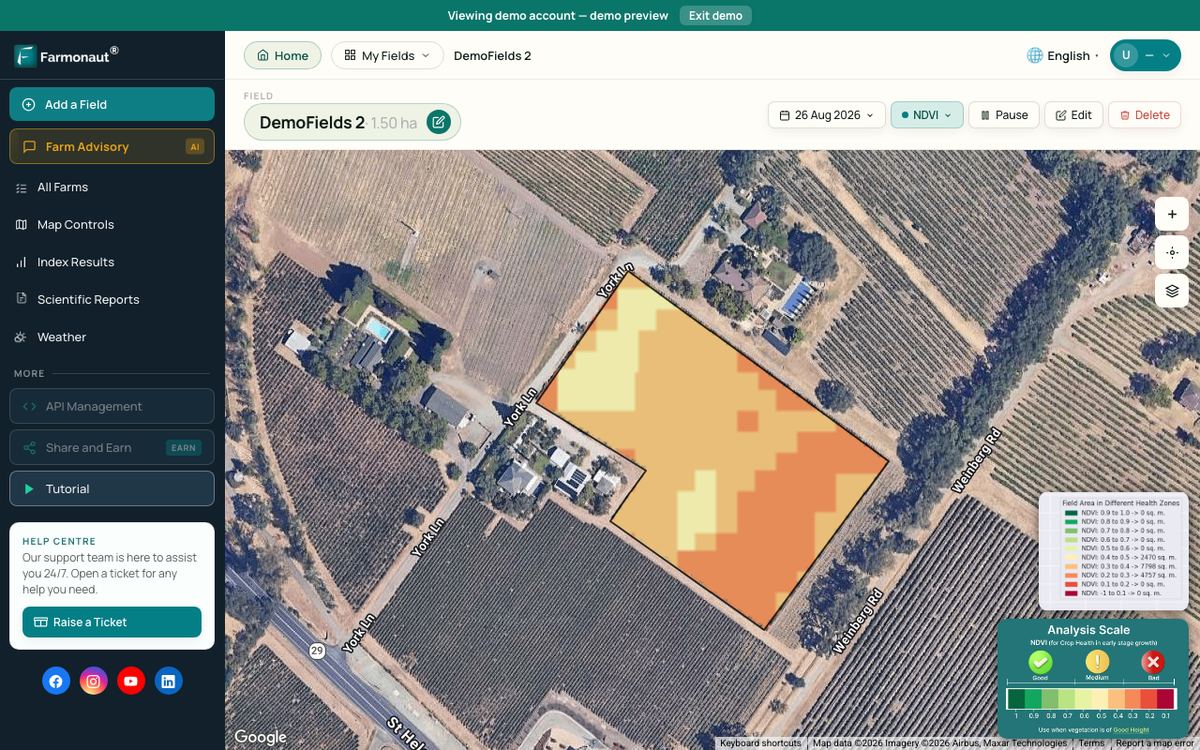
- Multispectral Monitoring: Our systems monitor crop health (NDVI, NDMI), soil moisture, and microclimate parameters—useful for watching crops near solar sites. The maps can show which parts of a field do better or worse, which helps farmers match shade-tolerant crops to appropriate zones.
- Real-Time Advisory: With AI-based advisory, users receive weather alerts, field-level insights, and strategy recommendations, which can help farmers act quickly on crop issues near solar sites.
- Blockchain Traceability: Our traceability solutions let growers and energy producers maintain transparent, tamper-proof records for both food and electricity output, supporting regulatory requirements and building market trust.
- Environmental Impact Tracking: Carbon footprinting tools measure emissions offsets from adopting solar panels on farmland, supporting farm sustainability reporting, branding, and regulatory compliance.
- Large Scale Management: Our tools for large-scale farm management offer integrated fleet, field, and resource oversight, making the leap from traditional to hybrid farms smooth.
Access Farmonaut’s powerful solutions on any device:
Video Insights: Solar, Agrivoltaics, Farming, and Satellite Tech
Two short videos show how satellite monitoring works. They do not cover solar panels, but they show the crop data a farmer can watch near a solar site: crop health maps and the farm web app.
▶ How satellite NDVI maps show crop stress before it is visible from the ground · 4:09
▶ A walkthrough of the Farmonaut web app for satellite field monitoring · 8:02
Frequently Asked Questions (FAQ) on Solar Panels on Farmland
Q1. Can you put solar panels on agricultural land?
Yes, it is increasingly common to install solar panels on farmland using agrivoltaic systems. Modern systems are designed to be minimally disruptive, allowing the coexistence of crop cultivation, livestock grazing, and renewable energy generation. Regulatory requirements, however, can vary by region, so always check local land-use zoning and agricultural policy.
Q2. What types of crops benefit most from partial shading beneath solar panels?
Results differ by crop, climate and year. In an Arizona study, chiltepin peppers and cherry tomatoes gave more fruit under panels and jalapeno peppers gave about the same. In Germany, potatoes, wheat and celeriac gave 18% to 19% less in 2017 and wheat and celery did slightly better in the hot summer of 2018. Ongoing research and satellite data analysis help identify local varieties best suited for solar-shaded microclimates.
Q3. What is the estimated ROI for farmers installing solar panels on their land?
ROI depends on location, installation costs, power purchase agreements, and crop selection. However, no single figure fits every farm. Lease offers vary widely: in the Purdue June 2024 survey, 27% of farmers who had discussed a lease were offered $1,500 per acre or more. Payback for an on-farm system depends on incentives, yields and energy prices. Try your own numbers in the lease calculator above, and note that income from solar is not guaranteed. Results depend on the site, the lease terms and the power market.
Q4. How do solar panels impact crop health and soil?
When properly designed, solar panels help moderate soil temperature, reduce water evaporation, and even shield crops from extreme weather. Compaction or shading issues can be minimized by using elevated, spaced mounts and regular field monitoring, often with the help of satellite imagery and digital tools.
Q5. What digital tools can help with crop monitoring near solar panels?
Platforms that use satellite imagery, IoT sensors, and AI tools (such as Farmonaut’s services) are increasingly used for crop and land monitoring, and predictive yield analysis. These tools can support data-driven decisions on the crop side.
Q6. Can I use solar panels for both energy generation and selling power back to the grid?
Yes, most modern solar installations (subject to regional regulations and interconnection agreements) enable farmers to use the energy generated for on-farm operations while selling excess power to the grid through net metering or feed-in tariffs, further improving income and sustainability.
Conclusion: Solar Panels on Farmland as a Cornerstone of Sustainable Agriculture
Solar panels on farmland represent a major solution for meeting energy needs, securing rural income, and enhancing climate resilience — all without sacrificing food security or environmental integrity. As solar spreads, the integration of solar technology in agriculture will continue to emerge as a best practice for maximizing land productivity, stabilizing farm economics, and supporting global sustainability goals.
With the ongoing support of satellite-driven platforms like Farmonaut—offering real-time crop and soil monitoring, blockchain-based traceability, and resource management tools—farmers and agribusinesses gain the actionable intelligence they need to optimize dual land use and thrive in an era of accelerating change.
As innovations in technology, policy, and digital tools continue to accelerate, we expect solar panels on agricultural land to play a pivotal role in shaping the future of farming, food production, and rural energy for years to come.
Farmonaut Subscription Plans: Affordable Access to Satellite Intelligence for Every Farm
Help your farm’s performance, optimize agrivoltaic systems, and gain deep, actionable insights with flexible Farmonaut subscription plans. Live monitoring, smart analytics, and digital traceability are now within reach for farms of all sizes.
Farmonaut crop monitoring
See your own fields from space
The Farmonaut Satellite + AI Farm Monitoring System shows crop health maps for your fields, which can help you track how each area of a field performs over time.



Keep reading
Sources
- Purdue University and CME Group, Ag Economy Barometer news release, June 2024 survey (2024): ag.purdue.edu
- Purdue University and CME Group, Ag Economy Barometer, June 2024 report with Figure 7 (2024): ag.purdue.edu
- Purdue University and CME Group, Ag Economy Barometer news release, March 2026 survey (2026): ag.purdue.edu
- American Farmland Trust, Illinois Smart Solar Siting brief (May 2022): farmlandinfo.org
- USDA Economic Research Service, Farmland Value, cropland rent by region (2026): ers.usda.gov
- US Energy Information Administration, Electric Power Annual 2024, Table 4.2.B (2025): eia.gov
- NREL, Land-Use Requirements for Solar Power Plants in the United States, Ong et al. (2013): docs.nlr.gov
- Lawrence Berkeley National Laboratory, Land Requirements for Utility-Scale PV, Bolinger and Bolinger (2022): emp.lbl.gov
- NREL (National Laboratory of the Rockies), Lighting the Way for Agrivoltaics (2024): nlr.gov
- NREL (National Laboratory of the Rockies), Agrivoltaics research page (2025): nlr.gov
- Barron-Gafford et al., Agrivoltaics provide mutual benefits across the food-energy-water nexus in drylands, Nature Sustainability (2019): nature.com
- Fraunhofer ISE, Agrophotovoltaics increases land use efficiency by over 60 percent (2017): energie.fraunhofer.de
- Fraunhofer ISE, Agrophotovoltaics: high harvesting yield in hot summer of 2018 (2019): ise.fraunhofer.de
- Walston et al., Insect community responses to habitat establishment at solar energy facilities in Minnesota, Environmental Research Letters (2024): iopscience.iop.org
- Ohio State University Extension, Farmland Owner’s Guide to Solar Leasing (2020): farmoffice.osu.edu
- University of Nebraska-Lincoln CropWatch, Solar Land Lease: Considerations in Nebraska (2017): cropwatch.unl.edu
- Penn State Center for Agricultural and Shale Law, Solar Leasing: How It Works and When It Doesn’t (2021): aglaw.psu.edu
- USDA press release, Secretary Rollins blocks taxpayer dollars for solar panels on prime farmland (2025): usda.gov
- USDA press release, final rule for the Rural Energy for America Program (2026): usda.gov
- Fraunhofer ISE presentation on DIN SPEC 91434, hosted by American Farmland Trust (2022): farmlandinfo.org
Discussion
Questions, corrections or field experience? Share them below. First-time comments are reviewed before they appear, and your email is never published.
No comments yet. Be the first to add a question or your experience.

 Hydenmet
 Dirks Bros Farms
 Red August Group
 Farm Inc
 WeMe Global
 Agrotoken
 Blue BearX
 Insignito
 Croptimum
 DnCubed
 Field Capacity
 Indosistim Teknologi
 Liquify Digital
 CU Foods
 BeyondTech Global
 Rouge VC
 AgroGreen Dynamics
