

Industrial minerals · Uses and data
Rock Phosphate Uses: 7 Main Uses Ranked, With Data
Rock phosphate is used mainly for fertilizer: about 90% of mined rock goes to the fertilizer industry (FAO). The rest makes feed phosphates, elemental phosphorus for glyphosate, detergents, food additives and battery-grade acid.
Key takeaways
- About 90% of the world’s mined phosphate rock goes to fertilizer; feed, detergents and chemicals take the rest (FAO).
- More than 95% of US rock mined in 2025 became wet-process phosphoric acid; the balance made elemental phosphorus, mostly for glyphosate (USGS, 2026).
- World output was about 250 million tonnes in 2025, led by China, Morocco, the United States and Russia; Morocco holds about 50 of 73 billion tonnes of reserves (USGS, 2026).
- The World Bank rock price (f.o.b. North Africa) was US$152.50 per tonne in April 2026, down from a US$321.70 average in 2023.
- Phosphate rock joined the US Final 2025 List of Critical Minerals in November 2025 (USGS, 2026).
In this article
- What is rock phosphate?
- 7 rock phosphate uses, ranked by tonnage
- How rock phosphate is mined and processed
- Where rock phosphate comes from
- Rock phosphate prices and what moves them
- What to check before valuing a phosphate deposit
- Environmental effects of phosphate mining and use
- Frequently asked questions
Rock phosphate is used mainly to make fertilizer. About 90% of the world’s mined phosphate rock goes to the fertilizer industry, and the rest goes into animal feed, detergents and chemicals (FAO, Use of phosphate rocks for sustainable agriculture). In the United States, more than 95% of the rock mined in 2025 was turned into wet-process phosphoric acid for ammonium phosphate fertilizers and feed supplements, and the balance became elemental phosphorus, mostly for the herbicide glyphosate (USGS Mineral Commodity Summaries 2026).
This guide lists the 7 main rock phosphate uses, shows how much of each product the rock feeds, gives dated price and production data, and explains what a consultant should check before valuing a phosphate deposit. A calculator near the end turns tonnes and grade into contained P2O5 and an example value.
What is rock phosphate?
Rock phosphate (also called phosphate rock or phosphorite) is a natural rock with a high content of phosphate minerals. The main mineral is apatite, a calcium phosphate. In sedimentary deposits the apatite is usually francolite, a carbonate-rich form. The term covers both raw ore and the cleaned-up concentrate sold to acid plants (FAO, chapter 2).
Grade is the key number. Phosphate grade is given as percent P2O5 (phosphorus pentoxide), not as percent phosphorus. Pure fluorapatite holds a little over 42% P2O5, so every real ore is lower than that, diluted by clay, sand, carbonate and silica (FAO, chapter 3). To turn P2O5 into elemental phosphorus, multiply by 0.436.
Sedimentary and igneous deposits
Sedimentary marine phosphorites supply about 80% of world production. They formed on old sea floors and in shallow basins, and they are often soft, porous and reactive. Igneous deposits supply about 17%, and the rest comes from residual and guano-type deposits. They are hard, crystalline apatite in rocks such as carbonatites, and they react slowly in soil (FAO, chapter 2). USGS notes that the largest sedimentary deposits are in northern Africa, the Middle East, China and the United States, while major igneous deposits are in Brazil, Canada, Finland, Russia and South Africa.
This matters for use. Reactive sedimentary rock can sometimes be spread on fields after grinding. Hard igneous rock almost always goes through an acid plant first. Our guide to types of ore deposits explains how sedimentary and igneous ores differ more generally.
Is phosphorus found in rocks?
Yes. Phosphorus is an element, not a rock, and in nature it is almost always locked in phosphate minerals. Phosphate rock is the only economic source of new phosphorus for fertilizer. Recycling from manure, sewage sludge and food waste helps, but it does not replace mining at today’s scale.
▶ How remote sensing measures ground from a distance, in plain words. · 2:01
7 rock phosphate uses, ranked by tonnage
How we ranked them: by the share of mined rock each route takes, using the USGS account of US use in 2025 and the FAO global split (about 90% fertilizer). Most of the non-fertilizer uses are small and are not reported separately, so the order of uses 4-7 is approximate. The table gives the product each use makes and who buys it.
| Rank | Use | Main products | Share of rock | Who buys it |
|---|---|---|---|---|
| 1 | Phosphoric acid for ammonium phosphate fertilizers | DAP, MAP, liquid fertilizers | Most of the 90% fertilizer share | Fertilizer makers, farm co-ops |
| 2 | Superphosphate fertilizers | Single superphosphate (SSP), triple superphosphate (TSP) | Part of the fertilizer share | Pasture, cereal and oilseed growers |
| 3 | Direct application as ground rock | Finely ground reactive rock phosphate | Small, mostly local | Growers on acid soils, organic farms |
| 4 | Animal feed phosphates | Dicalcium and monocalcium phosphate | Small (non-fertilizer share) | Feed mills for poultry, pigs, cattle |
| 5 | Elemental phosphorus and chemicals | Phosphorus, glyphosate, flame retardants | The balance of US rock after acid | Agrochemical and chemical firms |
| 6 | Purified phosphoric acid | Food-grade phosphates, LFP battery cathodes, electronics | Small but growing | Food, battery and chip makers |
| 7 | Detergents, water and metal treatment | Sodium tripolyphosphate, corrosion inhibitors | Small, falling in many countries | Cleaning products, water utilities, metal finishers |
1. Phosphoric acid for DAP and MAP fertilizers
Best for: large, consistent ore bodies near sulphur or sulphuric acid supply. Most rock goes to wet-process acid plants. The ground rock is dissolved in sulphuric acid, which gives phosphoric acid and a by-product called phosphogypsum. The acid is then reacted with ammonia to make diammonium phosphate (DAP) and monoammonium phosphate (MAP), the two most traded phosphate fertilizers. In the United States, about 25% of the wet-process acid made in 2025 was exported as DAP, MAP, merchant-grade acid and other products (USGS, 2026).
Pros: huge, steady demand; world use of P2O5 in fertilizers was about 47.8 million tonnes in 2025 and is forecast to reach 51.5 million tonnes by 2029 (USGS, 2026). Cons: acid plants are costly, need sulphur, and leave large phosphogypsum stacks.
2. Single and triple superphosphate
Best for: pasture and cereal markets that also want sulphur or calcium. Single superphosphate (SSP) is rock treated with sulphuric acid; it keeps the gypsum, so it carries sulphur and calcium as well as phosphorus. Triple superphosphate (TSP) is rock treated with phosphoric acid, so it is much richer in P2O5. Pros: simpler plants than DAP. Cons: lower nutrient content (SSP) means higher freight cost per tonne of nutrient.
3. Direct application of ground rock phosphate
Best for: acid soils and long-season crops. Some soft, reactive sedimentary rock can be ground fine and spread straight on the field. Soil acid slowly dissolves the apatite and releases phosphorus. FAO advises applying it before planting, around planting time in very acid soils (pH below 5.5) and several weeks earlier in less acid soils (FAO). Rock is tested for reactivity with standard solubility tests in neutral ammonium citrate, 2% citric acid and 2% formic acid.
Pros: no acid plant, low cost, slow release, accepted in many organic systems. Cons: weak on neutral or alkaline soils, slow to act, and only reactive rock works. Hard igneous rock is a poor choice for direct use.
4. Animal feed phosphates
Best for: producers with access to purified acid and low-fluorine rock. Livestock and poultry need phosphorus for bones and growth. Feed phosphates such as dicalcium phosphate are made from phosphoric acid that has been cleaned of fluorine. USGS lists feed supplements alongside fertilizers as an end use of US wet-process acid. Pros: higher value per tonne than fertilizer. Cons: strict purity rules on fluorine and heavy metals.
5. Elemental phosphorus, glyphosate and industrial chemicals
Best for: electric furnace operators with cheap power. In the thermal route, rock is smelted with coke and silica to make elemental phosphorus. In the United States, the rock that is not used for wet-process acid goes to elemental phosphorus, which is used mainly to make glyphosate herbicide (USGS, 2026). Other phosphorus chemicals go into flame retardants, metal treatment and specialty compounds. Pros: high-value products. Cons: very energy hungry.
6. Purified phosphoric acid for food and batteries
Best for: acid producers that can meet battery-grade purity. Purified phosphoric acid (PPA) is used in food and drink additives, electronics and the lithium iron phosphate (LFP) battery cathode. A 2025 report by the Transition Accelerator says electric vehicles took about 5% of PPA demand and could take 24% by 2030, and that LFP made up 66% of battery output in China in 2023 (Transition Accelerator, From Rocks to Power). The same report notes that iron and phosphorus make up about 90% of the mineral content of an LFP cathode. Pros: premium prices. Cons: purification is costly and only some rock suits it.
7. Detergents, water treatment and metal finishing
Best for: chemical makers serving industrial cleaning and utilities. Sodium tripolyphosphate softens water in detergents, and phosphates are added to drinking water to reduce pipe corrosion and to metal surfaces before painting. Many countries now limit phosphates in household laundry and dishwasher products because they feed algae in lakes, so this use is smaller than it was. Pros: steady utility demand. Cons: falling consumer demand under detergent rules.
How rock phosphate is mined and processed
Most phosphate rock is mined in open pits or strips, because many sedimentary beds lie near the surface under a few metres to tens of metres of overburden. Draglines and large excavators strip the overburden, dig the ore, and the land is backfilled and reshaped behind the active cut. Our explainer on how strip mining is done covers the method step by step, and the benefits of strip mining covers its costs and trade-offs.
Infographic
From rock to fertilizer in 5 steps
- 1StripRemove overburden above the phosphate bed.
- 2MineDig ore with draglines or excavators.
- 3BeneficiateWash, screen and float to raise P2O5 grade.
- 4Acid plantDissolve rock in sulphuric acid to make phosphoric acid.
- 5FertilizerReact acid with ammonia to make DAP and MAP.
After mining, ore is beneficiated: washed, screened and floated to remove clay, sand and carbonate and to raise the P2O5 grade. The concentrate is then sold as marketable rock or sent to an acid plant. USGS defines marketable product as beneficiated rock with a P2O5 content suitable for phosphoric acid or elemental phosphorus production. For a fuller look at plant steps, see our page on the phosphate mining process.
Phosphogypsum and other by-products
Acid plants leave large volumes of phosphogypsum, several tonnes for every tonne of P2O5 produced. Because it carries traces of radium from the rock, US rules control how the stacks are managed and when the material may be removed or used (40 CFR Part 61, Subpart R). Any study of a new acid plant must plan for stack design, water balance and closure from the start.
Where rock phosphate comes from
World mine output was about 250 million tonnes of marketable rock in 2025, up about 5% on 2024. China, Morocco, the United States and Russia were the leading producers, in that order (USGS, 2026). Reserves are far more concentrated than production: of about 73 billion tonnes of world reserves, Morocco holds about 50 billion tonnes, roughly two-thirds. World resources are more than 300 billion tonnes, and USGS states there are no imminent shortages.
Chart
Phosphate rock reserves
Billion tonnes, 2025, selected countries, selected countries
Chart
Phosphate rock mine production by country
Million tonnes of marketable rock, 2025 estimates
In the United States, five companies mined phosphate rock at 10 mines in Florida, Idaho, North Carolina and Utah in 2025, producing about 20 million tonnes of marketable product valued at US$1.9 billion at the mine. Florida producers face falling reserves and lower P2O5 grades, so imports rose. In October 2025 the Bureau of Land Management approved a new phosphate mine in Caribou County, Idaho, to replace an existing mine as it runs out (USGS, 2026). For mine locations by state, see our US mining map.
Phosphate rock as a critical mineral
Phosphate rock was added to the US Final 2025 List of Critical Minerals, published on 7 November 2025 (90 FR 50494), after public comment on the draft list (USGS, 2026). Canada recognised phosphorus as a critical mineral in June 2024 (Transition Accelerator, 2025). The EU also sets a cadmium cap on phosphate fertilisers of 60 mg per kg of P2O5 under its fertilising products regulation (Regulation (EU) 2019/1009), which makes low-cadmium rock more valuable for that market.
Rock phosphate prices and what moves them
There are two useful price series. The World Bank tracks phosphate rock f.o.b. North Africa: US$321.70 per tonne on average in 2023, then US$152.50 per tonne in 2024 and 2025, and still US$152.50 in April 2026 (World Bank Pink Sheet, May 2026). USGS reports the average value of US marketable rock at the mine, which was about US$100 per tonne in 2025. Prices of the finished fertilizers moved the other way: DAP averaged US$685.20 per tonne in 2025 against US$550.00 in 2023 (World Bank).
Chart
US phosphate rock value at the mine
US$ per tonne, f.o.b. mine, 2025 estimated
Chart
Rock and fertilizer prices, 2023 vs 2025
US$ per tonne, annual averages
What drives the price: fertilizer demand and crop prices, sulphur and ammonia costs at acid plants, export policy in major producers, freight, and rock quality (P2O5 grade, cadmium, and impurities such as iron, aluminium and magnesium oxides that hurt acid plants). Treat any price as an example and check the latest monthly figure before using it.
What to check before valuing a phosphate deposit
Readers who advise on phosphate licences usually need answers to the same questions. Use this list as a first screen, then the calculator for a quick contained-P2O5 figure.
- Grade and thickness: P2O5 percent, bed thickness and overburden ratio decide whether strip mining pays.
- Rock type: sedimentary or igneous; reactivity if direct application is planned.
- Beneficiation: can washing and flotation reach a marketable grade, and at what recovery?
- Impurities: cadmium for the EU market, and iron, aluminium and magnesium oxides for acid plants.
- Market route: export rock, local acid plant, or ground rock for nearby farms.
- Water, power and sulphur: acid plants need all three.
- Closure: land reshaping, water and phosphogypsum plans. See mining site restoration strategies.
Satellite imagery helps at the screening stage: it maps exposed beds, old pits, land cover and access before anyone books a field crew. Farmonaut’s mining platform turns a licence boundary into satellite target maps; results are exploration targets, not a resource estimate. Our guide to phosphate and potash exploration covers the field side.
Calculator
How much P2O5 is in your phosphate rock?
Enter your own tonnage, grade, recovery and price.
- Contained phosphorus (t P): 87,280
- P2O5 recovered to concentrate (t): 160,000
- Concentrate tonnes: 533,333
- Gross concentrate value (US$): $80,000,000
Example values only, not a benchmark. P2O5 to phosphorus factor 0.4364 is a chemical constant (atomic weights). The price is an input: example, use today’s price (the World Bank publishes a monthly phosphate rock price).
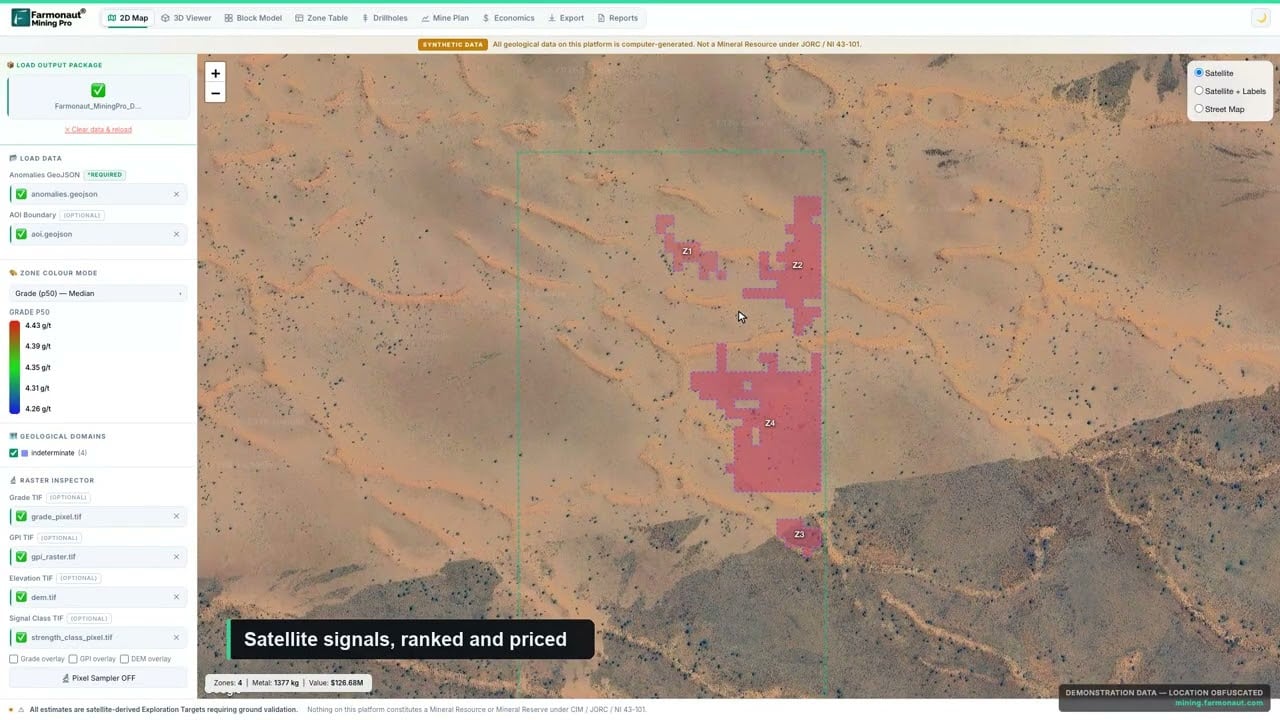
▶ What Farmonaut Mining Pro shows for a licence area. · 4:56
Environmental effects of phosphate mining and use
Mining disturbs large areas, so land reshaping and replanting are part of every mine plan. Processing creates phosphogypsum stacks that need long-term care. On farms, phosphorus that washes off fields into lakes and rivers feeds algae blooms; good practice is to apply only what soil tests call for, at the right time and place. Cadmium in some rocks can build up in soil, which is why the EU set its limit.
Recycling helps close the loop. Phosphorus can be recovered from manure, sewage sludge and food waste, and some countries now require recovery from sewage. These sources add supply, but mined rock remains the base of world fertilizer production.

▶ The seven environmental impacts of mining, explained in clay. · 2:31
Frequently asked questions
What is rock phosphate used for?
Mainly fertilizer. About 90% of mined phosphate rock goes to the fertilizer industry (FAO). The rest makes animal feed phosphates, elemental phosphorus for chemicals such as glyphosate, detergents, food additives and battery-grade acid.
What are the main uses of rock phosphate besides fertilizer?
Animal feed supplements, elemental phosphorus and phosphorus chemicals, purified phosphoric acid for food and LFP batteries, and water treatment and detergent phosphates.
Can you put rock phosphate directly on soil?
Yes, if the rock is reactive and the soil is acid. FAO advises using it on acid soils and applying it before planting. On neutral or alkaline soils it releases phosphorus too slowly to help most crops.
Is rock phosphate the same as phosphate fertilizer?
No. Rock phosphate is the raw mineral. Fertilizers such as DAP, MAP, SSP and TSP are made from it with sulphuric or phosphoric acid, which makes the phosphorus much more soluble.
Which country produces the most phosphate rock?
China, with an estimated 110 million tonnes of marketable rock in 2025, followed by Morocco with 36 million tonnes and the United States with 20 million tonnes (USGS, 2026).
Which country has the largest phosphate reserves?
Morocco, with about 50 billion tonnes of the world’s roughly 73 billion tonnes of reserves (USGS, 2026).
How is the grade of phosphate rock measured?
As percent P2O5. Pure fluorapatite holds just over 42% P2O5; mined ore is lower and is upgraded by washing and flotation before sale.
How much does phosphate rock cost per tonne?
The World Bank price for rock f.o.b. North Africa was US$152.50 per tonne in April 2026. The average value of US rock at the mine was about US$100 per tonne in 2025 (USGS). Check the latest figure before relying on either.
Is phosphate rock a critical mineral?
Yes, in the United States it was added to the Final 2025 List of Critical Minerals in November 2025. Canada recognised phosphorus as critical in June 2024.
Is phosphorus a rock?
No. Phosphorus is a chemical element. In nature it occurs inside phosphate minerals such as apatite, and rock rich in those minerals is called phosphate rock.
More from Farmonaut: agro admin app, carbon footprinting, crop loan and insurance, farmonaut satellite weather api developer docs, fleet management, product traceability, what is phosphate rock used for top 7 benefits explained.
This page is for information only. It is not investment advice. Prices change; check the latest published figure.
Farmonaut mining
Map your phosphate licence from space
Consultants can get satellite target maps for a licence boundary before planning fieldwork.

Mining Pro sample view, synthetic data
Keep reading
Sources
- USGS, Mineral Commodity Summaries 2026: Phosphate Rock: pubs.usgs.gov
- FAO, Use of phosphate rocks for sustainable agriculture, chapter 1: fao.org
- FAO, Use of phosphate rocks for sustainable agriculture, chapter 2 (world deposits): fao.org
- FAO, Use of phosphate rocks for sustainable agriculture, chapter 3 (characterization): fao.org
- FAO, Use of phosphate rocks for sustainable agriculture, chapter 4 (direct application): fao.org
- FAO, Use of phosphate rocks for sustainable agriculture (contents): fao.org
- World Bank, Commodity Price Data (Pink Sheet), May 2026: thedocs.worldbank.org
- World Bank, Commodity Markets: worldbank.org
- eCFR, 40 CFR Part 61 Subpart R, radon emissions from phosphogypsum stacks: ecfr.gov
- EUR-Lex, Regulation (EU) 2019/1009 on fertilising products: eur-lex.europa.eu
- Transition Accelerator, From Rocks to Power: Phosphate (2025): transitionaccelerator.ca
Discussion
Questions, corrections or field experience? Share them below. First-time comments are reviewed before they appear, and your email is never published.
No comments yet. Be the first to add a question or your experience.

 Viahara Mining
 Mining SARL
 SenGold Invest SAS
 Sania Corporation
 Sean Mining Limited
 NTS Group (Pty) Ltd
 Mine4Africa
 Lithspo Minerals Limited
 Tintina Mining Group
 Dalgety Minerals Pty Ltd
 Vortex Minerals Pty Ltd
 Faith At Work (Pty) Ltd
 Geotech Mining Solutions plc
 Vulcan International Limited
 Kidepo Associates
 GKY Mining
 Alkimy SARL
 Double A Trading
 GemSprout Metals Limited
 Qader Group
 Ileys General Trading
 SG Gold Mining LLC
 VRV Global Pte Ltd
 Omsri International FZE

 Client · Tanzania · Gold
 Client & affiliate partner · Ghana · Gold










