

Jamun Tree Guide: Growth, Roots, Uses & US Care
Reviewed September 2026 against the USDA PLANTS Database and peer-reviewed nutrition research indexed on NCBI PMC.
Try it: Run your own numbers →
A jamun tree (Syzygium cumini) is a fast-growing evergreen in the myrtle family that reaches 10–30 meters (33–98 ft) at maturity, produces a purple-black fruit called jamun that is rich in vitamin C and iron, and grows outdoors in the continental United States only in USDA hardiness zones 10–11 — coastal South Florida, the Florida Keys, and parts of Hawaii. It was introduced to Florida by the USDA in 1911 and has since naturalized there. Below is what the tree looks like as a seedling (jamun ka podha / jamun ka paudha), what its root system does to nearby structures, what the fruit contains, and how to tell if your climate can support one.

Table of Contents
- What Is a Jamun Tree? Quick Identification
- Tree Size, Growth Rate, and Time to Fruit
- Jamun Tree Root System: What to Know Before Planting
- Can You Grow Jamun in the US? Hardiness Zones and History
- Jamun Fruit Uses: Nutrition, Vitamin C, and Iron
- Jamun and Blood Sugar: What the Clinical Research Shows
- Jamun vs. Common US Fruit Trees: Comparison Table
- Planting Distance Calculator
- Growing Jamun: Site Selection and Care
- Jamun Tree at Home: The “Shubh or Ashubh” Question
- Monitoring a Jamun Planting with Satellite Tools
- FAQ
- Try it: Run your own numbers
What Is a Jamun Tree? Quick Identification
Jamun (also spelled jaamun, and searched as jamun ka ped, jamun ke ped, or in Hindi जामुन का पेड़) is the common name for Syzygium cumini, an evergreen tree in the same family as clove and eucalyptus (Myrtaceae). In English-language nursery trade in the United States it is usually labeled Java plum or black plum — searching “jamun tree” in a US context will mostly surface these two trade names. The tree carries glossy, leathery, oblong leaves 6–12 cm long, small cream-white flowers in clusters, and an oblong fruit that ripens from green to pink to a dark purple-black — the fruit itself is what most people mean when they simply say “jamun.”
A young jamun ka podha (jamun sapling/plant) has a single upright stem with a narrow crown; the tree does not branch into its familiar wide, dome-shaped canopy until 3–4 years of establishment. If you’re evaluating nursery stock, look for a straight central leader, unblemished bark, and no yellowing on the newest leaves — chlorosis at that stage usually signals a root-bound container rather than a disease issue.
Tree Size, Growth Rate, and Time to Fruit
According to the USDA PLANTS Database characteristics profile, jamun is classified as a medium growth-rate species that reaches a mature height of 10 to 30 meters (33–98 feet) in the ground, unpruned. That is a wide range because final height depends heavily on soil depth, water availability, and whether the tree is grown as a single-stem forest tree or kept pruned as an orchard/dooryard tree — most home plantings in Florida and similar climates are maintained at 6–9 meters (20–30 ft) through routine pruning, well below the unpruned ceiling.
US tropical nursery data on Black Java Plum (the jamun tree’s US trade name) puts first fruit production at 6–7 years from planting under cultivation conditions. That is slower than many popular US backyard fruit trees — a grafted mango or avocado in a comparable South Florida planting often fruits in 3–4 years — so budget for a longer establishment period if income or harvest timing matters to your planning.
Jamun Tree Root System: What to Know Before Planting
The single most-searched structural question about this species is the jamun tree root system, and the honest answer is that there is no USDA or peer-reviewed dataset publishing a specific lateral root-spread figure in feet or meters for Syzygium cumini — this is a genuine gap in the published US record, not something we can round off for you. What is documented and consistent across USDA and tropical-tree nursery sources is the growth pattern that drives the concern:
- Deep, wide-ranging root system: jamun develops a deep taproot combined with extensive lateral roots, consistent with its mature above-ground size of 10–30 m — a tree that size needs a proportionally large root plate for anchorage and water uptake.
- Root spread generally tracks canopy spread: the standard rule of thumb used by US extension and nursery services for large evergreen trees of this stature is to plant at least as far from structures, septic lines, and pavement as the tree’s expected mature height — for a 10–30 m tree, that means a minimum setback of 10 meters (33 ft), and up to 30 m (98 ft) if you intend to let it reach full unpruned height.
- Practical mitigation: gardeners in Florida who want jamun near a home typically keep the tree pruned to 6–9 m specifically to constrain both canopy and root vigor — pruning height and root aggressiveness scale together in large Myrtaceae trees.
If you need an exact root-spread number for an engineering or foundation-clearance decision (not just a home garden), the correct method is a direct soil-and-root survey by a certified arborist at your specific site — published botanical databases do not carry per-species lateral-root-radius figures precise enough to substitute for that.
Ignoring the tree’s eventual 10–30 m mature size and planting a jamun ka tree within a few meters of a foundation, driveway, or septic field. Use Farmonaut Crop & Forest Advisory to plan spacing against your actual plot boundaries before you plant.
Can You Grow Jamun in the US? Hardiness Zones and History
Jamun performs best in USDA hardiness zones 10 and 11, per the USDA PLANTS Database species profile — that covers coastal South Florida, the Florida Keys, and the warmest microclimates of Hawaii. It has essentially no cold tolerance; young trees are damaged by any frost, and the species is not a candidate for zone 9 or colder without significant winter protection and still-uncertain survival.
The USDA introduced jamun to Florida in 1911 as part of early-20th-century tropical plant introduction programs, and it has since naturalized in parts of the state — the Florida Natural Areas Inventory tracks it among introduced species established in Florida ecosystems. That century-plus US presence is why nursery stock under the “Black Java Plum” name is available from Florida-based tropical fruit nurseries, even though it is not a USDA NASS-tracked commercial crop (there is no acreage, yield-per-acre, or farm-gate value series for jamun in US crop statistics — it simply is not grown at commercial scale here, so treat any “jamun ka kheti” yield figures you see quoted in a US-agriculture context as unverifiable for US conditions).
Jamun Fruit Uses: Nutrition, Vitamin C, and Iron
The fruit is the main reason jamun is grown at all, and it is genuinely nutrient-dense. Per 100 grams fresh weight, jamun fruit carries roughly 60 kcal of energy according to general nutritional databases. Peer-reviewed analysis published in 2022 and indexed on NCBI PMC found jamun fruit ascorbic acid (vitamin C) content ranging from 5.70 to 137 mg per 100 g, and iron content from 0.10 to 4.60 mg per 100 g — both figures span a wide range because they were pooled across multiple cultivars and studies, which is itself useful to know: fruit from different jamun varieties can differ by more than 20-fold in vitamin C content. The seeds carry their own profile, with iron content around 4.20 mg per 100 g — often higher and more consistent than the flesh.
The primary jamun tree uses beyond fresh eating are the seed, peel, and bark, which carry the fruit’s most concentrated bioactive compounds:
- Seed powder: dried and ground for use in blood-sugar-management supplements (see clinical data below).
- Peel extract: the same 2022 NCBI PMC analysis measured total phenolic content in jamun peel at 4,812–5,990 mg per 100 g (gallic acid equivalent, dry weight) — an unusually high concentration of antioxidant phenolic compounds — with a DPPH radical-scavenging inhibition rate of 90.6% for the peel extract, a standard lab measure of antioxidant strength.
- Seed water extract: measured at 338 mM Trolox equivalent per 100 g on the ORAC antioxidant assay, another standard antioxidant-capacity measure used in food science.
- Juice, jams, and preserves: commercial and home food-processing uses that extend the fruit’s short fresh shelf life.
- Timber: the wood is dense and durable, used in general construction and craft applications where available at scale.
Jamun and Blood Sugar: What the Clinical Research Shows
Jamun’s reputation as a diabetes-supportive food is not folklore — it has direct clinical trial backing, though it should be read as adjunct evidence, not a substitute for prescribed treatment. A study published in 2022 and indexed on NCBI PMC enrolled 99 patients with metabolic syndrome in a 90-day trial of jamun seed powder dosed at 10 g twice daily. The trial reported a 46.67–52.67% reduction in blood glucose, a result the authors describe as comparable to the standard antidiabetic drug glibenclamide, and a 50% reduction in triglycerides in patients supplemented with a 30% freeze-dried jamun powder formulation.
Separately, animal-model research cited in the same 2022 review found an 18.20–20.41% reduction in body weight in diabetic models over a 60-day trial using an ethanolic jamun extract. Animal-model results do not translate directly to human dosing, so treat that figure as directional research evidence, not a human guideline.
For the primary research, read the full studies directly: Phytochemical Profile, Biological Properties, and Food Applications of Syzygium cumini (NCBI PMC, 2022) and Astounding Health Benefits of Jamun toward Metabolic Syndrome (NCBI PMC, 2022). To track newer trials, search “Syzygium cumini metabolic syndrome” or “jamun diabetes” on PubMed Central directly — new human trials on jamun’s glycemic effects are added on a rolling basis as they clear peer review.

Jamun vs. Common US Fruit Trees: Comparison Table
An AI summary can tell you jamun is a tropical fruit tree. What it won’t hand you is a side-by-side against the trees a US reader actually has planted or is considering — mature size, years to fruit, and cold tolerance, three numbers that decide whether the tree fits your lot.
| Tree | Mature Height | Years to First Fruit | USDA Zones | Cold Tolerance |
|---|---|---|---|---|
| Jamun (Black Java Plum) | 10–30 m (33–98 ft) | 6–7 years | 10–11 | None — frost damages young trees |
| Grafted mango (typical US planting) | 6–12 m (managed) | 3–4 years | 10–11 | Low — brief light frost only |
| Avocado (Hass-type, US grove) | 6–9 m (managed) | 3–4 years | 9–11 | Moderate for some cultivars |
Jamun figures per USDA PLANTS Database and US tropical nursery data (Kens Nursery); mango/avocado figures reflect typical managed dooryard/grove practice in the same zones, included for scale comparison only — verify current cultivar-specific figures with a local extension office before planting.
Planting Distance Calculator
Enter the tree’s expected mature height and your local minimum-setback preference to get a recommended planting distance from structures, based on the “setback ≥ mature height” rule used for large evergreen trees in this size class.
Run your own numbers
Assumptions: uses the general “setback ≥ mature height” rule of thumb for large evergreen trees, not a per-site engineering survey. Excludes soil type, slope, existing underground utilities, and local building code minimums — always confirm with a certified arborist or local extension office before planting near structures or septic systems.

Growing Jamun: Site Selection and Care
If your property falls within USDA zones 10–11, here is the practical checklist for starting a jamun ka paudha (jamun sapling) or evaluating an established tree:
- Zone check first: confirm your exact USDA hardiness zone against the current USDA PLANTS Database species profile before buying nursery stock — zone maps are periodically revised, so check the live page rather than relying on a memorized zone number.
- Spacing: apply the setback rule above; for orchard-style plantings, tropical nursery guidance for large Myrtaceae trees generally recommends generous inter-tree spacing to allow full canopy development if left unpruned.
- Soil: jamun tolerates a wide range of soil types, which is part of why it naturalized successfully in Florida after the 1911 USDA introduction — but it does not tolerate frost at any soil type.
- Pruning for size control: if you want fruit access without a 30 m tree, plan on annual structural pruning starting in year 2–3, before the central leader outgrows easy reach.
- Monitoring establishment: the 6–7 year gap to first fruit is long enough that tracking canopy growth and vegetation health year over year — rather than waiting to “see” progress — is the only way to catch a stalled or stressed planting early.
For plantation-scale precision agriculture tools that apply to jamun and other tree crops alike, see Monitor Multiple Farms At-Scale and Farmonaut Satellite Monitoring on web or mobile.
Because jamun takes 6–7 years to first fruit, use satellite-based NDVI tracking from the day you plant, not just once fruiting starts — a slow-growing tree that never shows canopy vigor gains is the earliest sign of a site or root problem, years before fruit failure would tell you the same thing.
Jamun Tree at Home: The “Shubh or Ashubh” Question
A recurring search is whether a jamun ka ped ghar mein shubh ya ashubh hai — whether keeping a jamun tree at home is auspicious or inauspicious. This is a question of regional folk belief and Vastu-adjacent tradition, not agronomy or botany, and beliefs vary by region and household — there is no single documented “correct” answer, and nothing in the USDA or peer-reviewed horticultural record addresses auspiciousness, because that isn’t a scientific question. What the botanical record does support is a practical, non-superstition-based version of the same question: is a jamun tree a good structural fit near a house? The answer there is concrete and covered above — a mature 10–30 m tree with a deep, wide root system needs real distance from foundations and utilities, which is worth weighing regardless of which tradition’s answer you follow on the symbolic question.
Monitoring a Jamun Planting with Satellite Tools
For anyone managing more than a backyard tree — an agroforestry block, a research planting, or a mixed orchard that includes jamun among other tree crops — the same site-selection and root-spacing math above scales up, and it’s harder to track by eye across multiple hectares. Farmonaut’s platform supports that at scale:
- 📡 Satellite-based monitoring: track vegetation health (NDVI), soil moisture, and canopy development across a planting without a physical site visit for every check.
- 🔗 Blockchain traceability: secure supply-chain records for jamun-based food and herbal products moving to market — see Product Traceability.
- 🌍 Carbon and environmental tracking: quantify tree-planting contributions to carbon and water metrics — see Carbon Footprinting and Environmental Compliance.
- 🚜 Fleet and resource management: for larger agroforestry or mixed-orchard operations, see Farmonaut Fleet & Resource Management Tools.

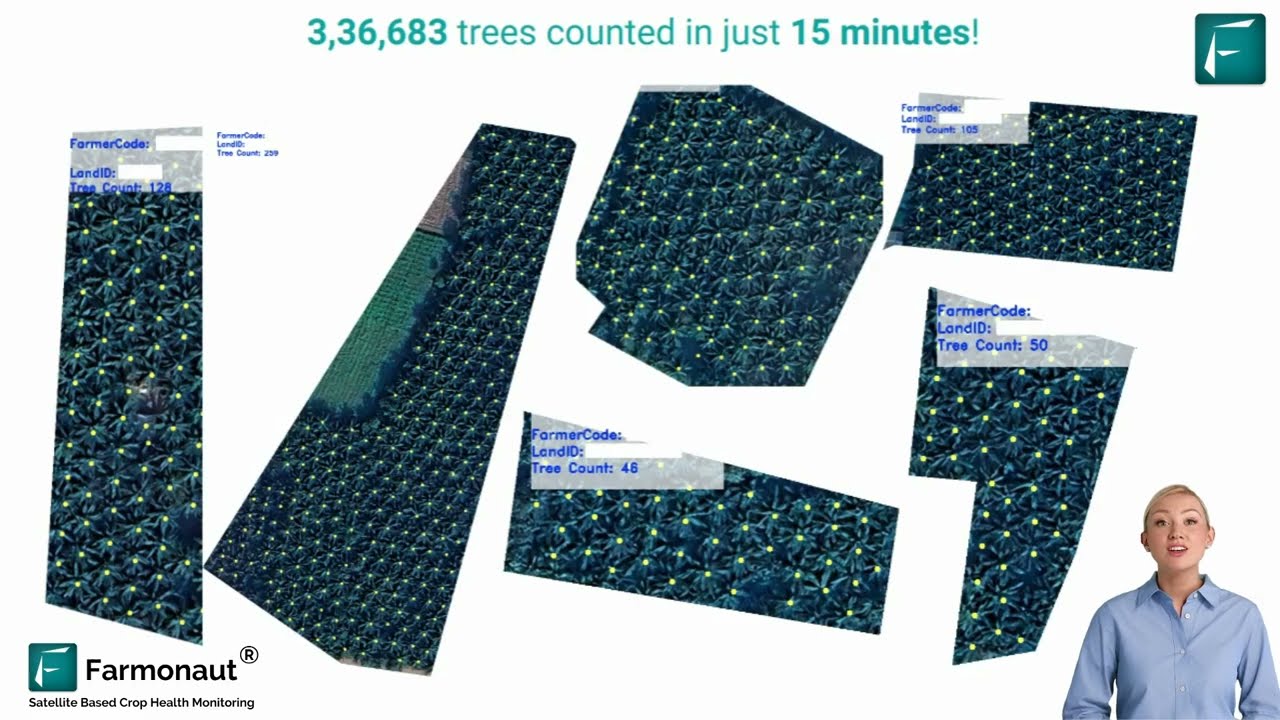
Developers integrating tree-monitoring or weather data into their own tools can access the Farmonaut Satellite API and Developer Docs, or the general API.



For growers financing an orchard planting that includes jamun or similar tree crops, satellite-verifiable records can support loan and insurance applications — see Farmonaut’s Crop Loan & Insurance Services for details and regional availability.
FAQ
How tall does a jamun tree get?
A: 10–30 meters (33–98 ft) at full maturity, unpruned, per the USDA PLANTS Database. Most home and orchard plantings are kept pruned to 6–9 m (20–30 ft) for practical harvest access.
How long until a jamun tree bears fruit?
A: Typically 6–7 years from planting under cultivation, per US tropical nursery data on the Black Java Plum — longer than common US dooryard fruit trees like grafted mango or avocado (3–4 years).
Can I grow a jamun tree in the continental United States?
A: Only in USDA hardiness zones 10–11 — coastal South Florida, the Florida Keys, and similar frost-free microclimates. It has no meaningful cold tolerance. Check your exact zone against the current USDA PLANTS Database entry before planting.
What does the jamun tree root system do to nearby structures?
A: No US database publishes an exact lateral root-spread figure, but the species develops a deep taproot and extensive lateral roots consistent with its 10–30 m mature size. Standard practice is a minimum setback from structures equal to the tree’s expected mature height; get a certified arborist survey for any foundation- or septic-critical decision.
What is jamun fruit used for?
A: Fresh eating, juice, jams and preserves, seed powder for blood-sugar-support supplements, and peel/bark extracts valued for high phenolic antioxidant content. The wood is also used as timber where available at scale.
Does jamun actually help with blood sugar?
A: A 2022 clinical trial of 99 patients found jamun seed powder (10 g twice daily, 90 days) reduced blood glucose by 46.67–52.67%, comparable in the study to glibenclamide. This is peer-reviewed clinical evidence, not a substitute for prescribed diabetes treatment — discuss with a physician before use.
Is keeping a jamun tree at home shubh (auspicious) or ashubh (inauspicious)?
A: That’s a matter of regional folk belief, not botanical science, and answers vary by tradition. What is factual is the practical side: plan real distance from your house based on the tree’s mature root and canopy size, regardless of which symbolic answer you follow.
Sources cited throughout: NCBI PMC, Phytochemical Profile of Syzygium cumini (2022), NCBI PMC, Jamun and Metabolic Syndrome (2022), and the USDA PLANTS Database species profile for Syzygium cumini. Hardiness zones and species characteristics are reviewed by USDA on an ongoing basis — check the live database page for the current figures rather than relying on any single dated snapshot, including this one.
Discussion
Questions, corrections or field experience? Share them below. First-time comments are reviewed before they appear, and your email is never published.
No comments yet. Be the first to add a question or your experience.

 Rashail Infotech
 Unifrutti Gulf
 Deluxe Conseil
 TVS Electronics
 BW Pipelines
 WICO
WICO Gen Chayat
 Chimera Innovation
 SkyHarvest
 Polaris Digitech
 Teledarbas
 Wild Oak Farm
 SFX
SFX Doodlakine
 Exurbia Geospatial
