

Combines · Spec and cost guide
Biggest John Deere Combine: X9 1100 and 50 ft Header
The X9 1100 is Deere’s biggest combine: 603 hp rated, 690 hp maximum and a 460 bu grain tank. The widest Deere header listed is the 50 ft HD50F. Case IH lists a larger AF11.
Key takeaways
- John Deere X9 1100: 603 hp rated, 690 hp maximum, 460 bu grain tank, 5.3 bu/s peak unload rate (MachineFinder); Deere lists a 550 bu tank option on the X9 from model year 2027 (Deere, 26 February 2026).
- Widest Deere header listed: HD50F flex draper, 50.1 ft; the 27-row CF27 corn head for model year 2027 is about 45 ft by arithmetic (Heritage Tractor; Deere release).
- Case IH lists the AF11 at 775 hp and a 567 bu tank, above the X9 1100 on both figures; horsepower ratings are not on the same basis.
- The Manitoba guide’s hourly rental rate for a flex draper runs from C$68 (30 ft) to C$97 (50 ft) (Manitoba Agriculture, 2026/27); the 50 ft head adds C$13 an hour over 40 ft.
- Header loss can be up to 60% of corn loss and 90% of soybean loss (Iowa State), so a wider header only pays if the combine can feed it and losses stay low.
In this article
- Biggest John Deere combine: the X9 1100 in numbers
- Case IH AF Series: the main rival for size
- Widest John Deere header
- What a wider header and a bigger combine cost per hour
- Does a wider header save money? Header width calculator
- How to choose a header size
- Older Deere combines: S7 and the 9600
- Using satellite maps at harvest
- How we checked the numbers
- FAQ
The biggest John Deere combine is the X9 1100: 603 hp rated and 690 hp maximum, a 460-bushel grain tank and a peak unload rate of 5.3 bushels per second (MachineFinder, retrieved October 2026). It is the largest in Deere’s X9 and S7 lines on engine power and tank size. The widest Deere header on dealer spec sheets is the 50 ft HD50F draper. For comparison, Case IH lists a bigger machine, the AF11, at 775 hp and a 567-bushel tank.
This guide puts the specs side by side, shows what a wider header changes, and adds cost charts and a calculator that tests whether a 45 ft header beats a 35 ft one on your acres.
Biggest John Deere combine: the X9 1100 in numbers
John Deere announced the X9 1000 and X9 1100 in 2020, with deliveries from 2021. Deere described the X Series as aimed at large-scale growers harvesting high-yielding wheat and high-moisture corn (High Plains Journal, August 2020). The table compares the X9 pair with the three larger S7 models Deere launched for model year 2025 (the S7 600 and 660 are left out).
| Model | Engine power | Grain tank | Peak unload rate |
|---|---|---|---|
| X9 1100 | 603 hp rated, 690 hp maximum | 460 bu; a 550 bu tank is optional on the X9 from model year 2027 | 5.3 bu/s |
| X9 1000 | 549 hp rated, 630 hp maximum | 420 bu | 4.6 bu/s |
| S7 900 | 543 hp | 400 bu | 4.2 bu/s |
| S7 800 | 473 hp | 400 bu | 4.2 bu/s |
| S7 700 | 402 hp | 300 bu | 4.2 bu/s |
X9 figures are from MachineFinder (retrieved October 2026). S7 figures are from DTN Progressive Farmer (February 2024), which gives one horsepower number per S7 model. The model year 2027 tank option comes from Deere’s own announcement (see below).
What sets the X9 apart is the size of the crop-handling parts, not only the engine. Deere’s X Series material, repeated on a Hutson dealer page, lists a 75 sq ft cleaning shoe with 36% more cleaning area than the earlier S790. The same page gives up to 7,200 bushels an hour in high-yielding corn and 30 acres an hour in wheat. These are Deere’s maximum claims, not field averages.
Deere also compares the X9 1100 with the older S790. It puts harvest capacity at 140% to 170% of the S790, depending on crop: 170% in tough wheat, 150% in high-moisture corn, 145% in soybeans and 140% in canola. Deere uses the S790 as the comparison machine in its table.
An independent test, paid for by Deere
In autumn 2020 Deere contracted the Prairie Agricultural Machinery Institute (PAMI) in Western Canada to compare the X9 1100 with a CLAAS 8800 in tough wheat and canola. In 102 bu/acre wheat, PAMI found a 28% capacity advantage for the X9 at a 1% total loss threshold. Deere published the results on its dealer pages, so read them as a manufacturer-commissioned test rather than a neutral one.
Model year changes to the X9
On 26 February 2026 Deere announced updates to its model year 2027 X9 and S7 combines (Global Agriculture, reprinting the Deere release). For the X9 these include an optional 550-bushel grain tank with heavy-duty final drives, a new 35 ft (10.7 m) unloading auger that gives 4 ft more clearance between header and auger for wider headers, and half-length concaves. Deere also added crops to Harvest Settings Automation, which sets concave clearance, fan speed, rotor speed and sieve settings from the crop type, location and your loss limits. Deere’s harvesting marketing manager said Deere saw productivity gains of 20% or better last harvest year with Harvest Settings Automation and Predictive Ground Speed Automation. That is Deere’s own statement, and the release gives no test conditions.
Chart
Grain tank size of the largest Deere and Case IH combines
Bushels, manufacturer figures for the models shown; standard tank unless marked
Case IH AF Series: the main rival for size
As of October 2026, Case IH lists its AF Series as its largest combines: 634 to 775 hp, a 455 or 567 bushel grain tank and unload rates of 4.5 to 6.0 bushels per second (Case IH, AF Series page). The AF11 is the top model: a dual-rotor Class 10+ machine at 775 hp, with a 567-bushel tank and a 6 bu/s unload rate (Case IH, AF11 page). Case IH says the AF Series has the largest grain tank in the industry. That is a manufacturer claim, and on Deere’s own numbers the X9 1100 tank is smaller (460 bu, or 550 bu with the 2027 option).
Compare the horsepower figures with care. Deere gives a rated and a maximum figure for the X9, while Case IH gives a single engine horsepower for the AF Series. Ask each dealer which rating applies. The measure that matters on your farm is bushels per hour at your loss limit, not the label on the engine.
Widest John Deere header
The widest Deere header we found listed is the HD50F hinged flex draper, with a cutterbar length of 50.1 ft (15.3 m) (Heritage Tractor spec sheet). Its flexible cutterbar sits on a hinged draper with a total wing range of 45 in., and the knife runs at 520 cycles a minute on an X Series combine and 490 on an S-Series. For corn, Deere announced a 27-row folding corn head on 20-inch spacing for model year 2027. By arithmetic (27 rows x 20 in.), that is a 45 ft head.
| Header | Width | Type |
|---|---|---|
| HD50F | 50.1 ft (15.3 m) cutterbar | Hinged flex draper |
| HD45F | 45 ft (13.7 m) cutterbar | Hinged flex draper |
| CF27 | 27 rows at 20 in., about 45 ft | Folding corn head, model year 2027 |
| C16F | 40.33 ft (12.3 m) overall | 16-row folding corn head, 30 in. rows |
Beyond Deere, MacDon sells a 61 ft FD261 FlexDraper, described by MacDon as a fully flexing draper with the most crop capacity it has offered (MacDon, FD2 Series page). That is the widest header we found in a maker’s catalogue, and whether it fits a given combine is a question for your dealer.
Sources: Heritage Tractor (HD50F), AllMachines (HD45F), Global Agriculture (CF27), Sloan’s dealer spec sheet (C16F). The spec sheets are dealer copies of Deere data, so confirm width and combine fit with a dealer before you order. The table covers Deere only.
Why a wider head does not always mean faster harvest
A header can only work as fast as the combine can feed it. If the combine is at its throughput limit, extra width just means you drive slower. The calculator below lets you test that. Wide heads also bring side effects. South Dakota State University Extension warns that larger heads concentrate residue behind the machine, and that platforms up to 30 ft wide already gather residue into a 5 ft swath. Concentrated residue can insulate the soil, reduce seed-to-soil contact and make planting harder next spring (SDSU Extension). It also says most combines with platform headers (the page is undated) can work at 3 to 4 miles per hour without problems.
Header losses can outweigh a width gain
Iowa State University says header loss can account for as much as 60% of total corn loss and 90% of total soybean loss (Iowa State Extension, 2019). North Carolina State Extension notes that most soybean harvesting losses come from the gathering unit, and that field losses averaged about 10% of yield in the studies it cites, with 3 to 4% a practical target for machine loss (NC State Extension, 2017). So a header that sheds seed can cost more than the hours it saves. Check losses behind the header at the start of each field.
What a wider header and a bigger combine cost per hour
Prices change often and dealers quote machines by configuration, so we use two public cost guides instead of a sticker price. They are planning figures for budgeting and custom work, not dealer quotes or auction results.
Chart
Hourly rental rate of a flex draper header by width
Canadian dollars per hour, Manitoba cost guide
The Manitoba government’s 2026/27 farm machinery guide lists flex draper headers at purchase prices from C$155,000 (30 ft) to C$220,000 (50 ft). It converts them to hourly rental rates (Manitoba Agriculture, Cost of Production: Farm Machinery, 2026/27). The same guide values a Class 10+ combine (626 hp and above) at C$1,150,000 and a custom rate of C$735 an hour before the header.
Going from a 40 ft to a 50 ft header adds C$13 an hour in that guide (C$84 to C$97). The wider head pays back only if it raises your acres per hour by more than that extra cost.
The same guide gives a work rate and a custom rate in dollars per acre for each combine class. Bigger classes cut the cost per acre, from C$40 for Class 6 to C$31 for Class 10, and the guide shows the same C$31 for Class 10+.
The University of Illinois farmdoc team prices whole combine setups (Machinery Cost Estimates: Harvesting, August 2025). Its example combine assumes 85% of list price, 175 hours a year, a 10-year life and diesel at US$3.00 a gallon. The appendix rows use 75 to 177 combine hours a year, depending on the setup. Bigger combines cost less per acre because the same overhead is spread over more acres, as long as the machine works more acres each year. Its 540 hp example uses a US$818,200 list price and its 470 hp example US$784,500.
Chart
Combine class: acres per hour against custom cost per acre
Manitoba custom-rate guide, 2026/27, header not included
Chart
Cost per acre of combining, by combine and head size
US dollars per acre, University of Illinois model, August 2025; acres per year differ by row
Does a wider header save money? Header width calculator
The work-rate formula is width in feet times speed in miles per hour, divided by 8.25 to give acres per hour. It is the one used in the Manitoba guide (width x speed x field efficiency x 5,280 / 43,560). Enter the average speed you actually achieve, after turns and stops. A combine can also have a throughput limit, so the calculator caps the work rate at the limit you enter.
Try the numbers for your own farm below.
Calculator
Does a wider header lower your cost per acre?
Enter your own speed, costs and combine limit to compare two header widths.
- Header A acres per hour: 12.7 ac/hr
- Header B acres per hour: 13.0 ac/hr
- Header A cost per acre: $41
- Header B cost per acre: $41
- Header A combine hours: 157 hours
- Header B combine hours: 154 hours
Example values only, not a benchmark or a forecast. Acres per hour = width in ft x speed in mph / 8.25, the work-rate formula in the Manitoba Agriculture machinery guide (2026/27); the 8.25 is fixed in the formula and your speed should already allow for turns and stops. The work rate of each header is capped at the combine limit you enter. Header rates are examples, not Deere prices (the Manitoba guide lists C$77 and C$88 an hour for 35 and 45 ft flex drapers); use your own rates, in C$ per hour. Combine cost per hour is a C$ example, use today’s price.
How to choose a header size
- Start with the combine, not the header. Find your combine’s throughput at your loss limit for your crop. A header much wider than that adds cost without adding speed.
- Check the unloading auger. Deere says its new 35 ft unloading auger for the X9 gives 4 ft more clearance between the header and the auger, so wider headers fit. Ask what your machine has.
- Match the crop. Draper heads cut small grains, canola and soybeans. Corn needs a row-crop head, which costs more per hour in the Manitoba guide (C$265 an hour for a 12-row folding head, C$364 for a 16 to 18 row one).
- Think about terrain. Deere says its hinged drapers pivot and flex to follow uneven ground, and that the HDF flexible-cutterbar version cut missed crop in soybeans or lentils by 6% against a MacDon draper in its own theoretical internal comparison. Treat that as a manufacturer claim and ask for a field demo.
- Plan for residue. Wider heads concentrate chaff. Set the spreaders and check the spread each season.
- Check road transport rules. Header trailers and folding corn heads have legal width and lighting limits that vary by state and province, so check with your local authority.
- Use guidance. Kansas State University estimates that a well-working guidance system can raise field efficiency by up to 10% by cutting overlap (K-State Research and Extension, MF3069).

▶ The Farmonaut Agro Admin app for large-scale farm management, crop health and task management. · 7:27
Older Deere combines: S7 and the 9600
You may not need the biggest machine. DTN’s 2024 specs list the S7 700 at 402 hp with a 300 bu tank and the S7 800 at 473 hp with a 400 bu tank, so they are the models to look at if the X9 is more machine than your acres need.
The 9600 is a much older combine and still turns up in used listings. Specifications for it vary between listing sites, so check the operator’s manual or ask a Deere dealer for the grain tank and engine of the exact serial number before you buy. A combine of that age is unlikely to have the loss sensing or automation Deere lists for the X9 and S7.
Using satellite maps at harvest
Harvest timing is a field-by-field decision, and satellite images can show differences between fields that help you decide which to check first. Deere’s own Predictive Ground Speed Automation uses satellite scans of crop height and biomass, plus cab cameras, to adjust combine speed (Global Agriculture, February 2026). The Farmonaut Satellite + AI Farm Monitoring System shows vegetation maps for your own fields through the season on web, Android and iOS, which can help you compare fields when you plan the harvest order.
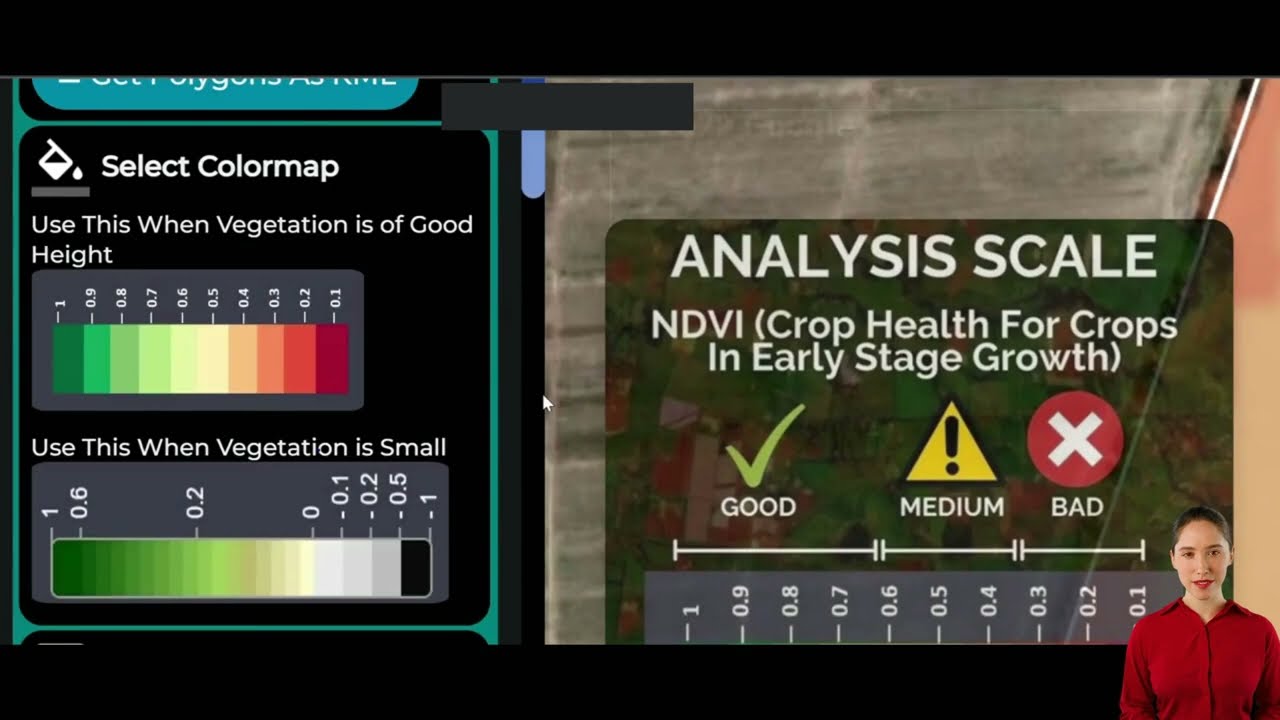
▶ How to read satellite vegetation data in the Farmonaut web app. · 10:16
How we checked the numbers
X9 and header figures come from MachineFinder, Deere’s news release as printed by Global Agriculture, HPJ, and dealer copies of Deere spec sheets. Case IH figures come from Case IH’s own pages, and the 61 ft draper from MacDon’s page. S7 figures are from DTN. Cost figures come from the Manitoba government guide (2026/27, Canadian dollars) and the University of Illinois farmdoc (August 2025, US dollars). Loss figures come from Iowa State, NC State and SDSU Extension. Manufacturer maximums are not field averages. We did not include a price for new machines because dealers quote by configuration.
Related pages on our site: John Deere X9 combine price guide, Agro Admin app, fleet management, crop loan and insurance, carbon footprinting, product traceability, weather API docs, satellite API and web and mobile apps.
FAQ
What is the biggest John Deere combine?
The X9 1100 is the biggest in Deere’s X9 and S7 lines: 603 hp rated, 690 hp maximum and a 460 bu grain tank, and Deere says a 550 bu tank is optional on the X9 from model year 2027 (MachineFinder; Global Agriculture).
What is the widest combine header John Deere makes?
The widest Deere header we found listed is the HD50F flex draper at 50.1 ft. The 27-row CF27 corn head announced for model year 2027 is about 45 ft by arithmetic.
What is the biggest header for a combine in any brand?
The widest we found in a maker’s catalogue is the MacDon FD261 FlexDraper at 61 ft. It is not a Deere product, and we did not find a Deere combine fit stated on MacDon’s page, so ask a dealer.
How big is the John Deere 9600 grain tank?
Listings for this older machine disagree, so we do not give a number here. Ask a Deere dealer to look up your serial number.
Is the Case IH AF11 bigger than the X9 1100?
On manufacturer pages, yes: Case IH lists 775 hp and 567 bu for the AF11 against 690 hp maximum and 460 bu for the X9 1100. Horsepower ratings are not stated on the same basis.
Does a wider header always harvest faster?
No. The combine’s throughput sets the limit. If the combine is full at a lower speed, a wider header only adds cost and residue to manage. Use the calculator above with your own numbers.
Check local rules for road transport and follow your dealer’s safety instructions. This guide is general information, not financial advice, so get professional advice before a large equipment purchase.
Farmonaut crop monitoring
See your own fields from space
Draw your fields once and Farmonaut shows satellite vegetation maps for them through the season, on web, Android or iOS.




Keep reading

Sources
- MachineFinder, John Deere X9 Combine: Features, Specs, and Capabilities: blog.machinefinder.com
- High Plains Journal, New Deere combine ready to help high-end producers (August 2020): hpj.com
- DTN Progressive Farmer, John Deere unveils 9RX tractors, S7 combines (February 2024): dtnpf.com
- Hutson Inc, John Deere X9 1100 (Deere X Series material, PAMI benchmark): hutsoninc.com
- Global Agriculture, John Deere announces model year 2027 combine and front-end updates (26 February 2026): global-agriculture.com
- Case IH, Axial-Flow AF Series combines: caseih.com
- Case IH, AF11 combine: caseih.com
- Heritage Tractor, John Deere HD50F hinged frame flexible cutterbar draper: heritagetractor.com
- AllMachines, John Deere HDF45 header specs: allmachines.com
- Sloan’s, John Deere C16F folding corn head: sloans.com
- MacDon, FD2 Series FlexDraper header: macdon.com
- South Dakota State University Extension, Harvesting for maximum soybean yields: extension.sdstate.edu
- Iowa State University Extension, Verifying combine adjustments during crop harvest (2019): crops.extension.iastate.edu
- North Carolina State Extension, Reduce soybean harvest losses (2017): content.ces.ncsu.edu
- Manitoba Agriculture, Cost of Production: Farm Machinery guide 2026/27: manitoba.ca
- University of Illinois farmdoc, Machinery Cost Estimates: Harvesting (August 2025): farmdoc.illinois.edu
- Kansas State University, Field efficiency gains you can expect from a guidance system (MF3069): bookstore.ksre.ksu.edu
Discussion
Questions, corrections or field experience? Share them below. First-time comments are reviewed before they appear, and your email is never published.
No comments yet. Be the first to add a question or your experience.

 Farmitopia
 TVS Electronics
 BW Pipelines
 WICO
 Gen Chayat
 Chimera Innovation
 SkyHarvest
 Polaris Digitech
 Teledarbas
 Wild Oak Farm
 SFX
 BACF Africa
 Doodlakine
 Exurbia Geospatial
 FieldZero
 Indico Company

 Licence holder · Niger · Gold










