

Precision farming · Buyer guide
John Deere Precision Agriculture: 6 Tools and an ROI Check
John Deere’s precision stack links guidance, planting, spraying, harvest and autonomy tools to the Operations Center, which Deere says covers about 500 million engaged acres (FY2025, company figure). Here are the six core tools, what Deere claims for each, USDA adoption data and a calculator to test payback.
Key takeaways
- The stack has three layers: in-cab hardware (G5 display, StarFire 7500 receiver, JDLink modem), yearly software licences, and the Operations Center cloud account.
- Deere says See & Spray ran on 5M+ acres in 2025 and cut non-residual herbicide use by nearly 50% on average; the fee is $1 per fallow acre or $5 per in-crop acre (Deere, Nov 2025).
- USDA ERS: auto-steer and guidance went from 5.3% of planted corn acres in 2001 to 58% in 2016; variable rate reached 37.4% of corn acres (2016).
- GAO (Jan 2024) cited USDA data that 27% of US farms or ranches used precision agriculture in 2023, with up-front cost, data ownership and missing standards as key barriers.
- Autonomy kits for certain 8R and 9R tractors had limited 2025 availability with a full launch planned for 2026 (AgWeb, Jan 2025).
In this article
- John Deere precision agriculture at a glance
- How the John Deere precision stack fits together
- The 6 core John Deere precision tools
- Precision Upgrades: new tech on machines you already own
- How many farms use precision agriculture?
- Deere's own numbers: sales, research and engaged acres
- Does John Deere precision agriculture pay? An ROI check
- How to choose: a buyer checklist for farm managers and agronomists
- Where satellite crop monitoring fits
- How we checked the numbers
- FAQ
John Deere precision agriculture is the company’s set of guidance receivers, in-cab displays, machine modems, smart planters and sprayers, harvest automation and autonomy kits, all linked to one cloud account called the John Deere Operations Center. Deere’s FY2025 Fact Book says more than 1 million connected machines and about 500 million engaged acres now run on this stack. Those are company figures, not independent counts.
This guide goes through the six tools that matter most to a farm manager, with a “Best for” line for each, the dated claims Deere makes, and what independent sources say. It adds USDA adoption data, Deere’s own sales and research numbers, a buyer checklist, and a calculator so you can test whether an upgrade pays on your own acres.
John Deere precision agriculture at a glance
The table sums up the six tools. Every claim in the “Deere says” column is the company’s own figure, reported through trade press. Prices depend on your dealer, your machine and the licence level you choose.
| Tool | What it does | Best for | Deere says (date) |
|---|---|---|---|
| Operations Center | Cloud account for machine, field and job data | Any farm with connected machines | About 500 million engaged acres (FY2025) |
| StarFire + AutoTrac | Satellite guidance and auto-steer | Row crops, long working days | Bundled in Precision Ag Essentials (dealer guide, Apr 2025) |
| ExactEmerge | High-speed planter row units | Large corn and soybean acres | Accurate placement up to 10 mph (dealer guide, Apr 2025) |
| See & Spray | Camera-targeted herbicide spraying | High weed pressure, big sprayer use | Nearly 50% less non-residual herbicide on average (Nov 2025) |
| S7 harvest automation | Cameras set combine speed ahead of the crop | Large grain harvests | Up to 20% more productivity (Feb 2024) |
| Autonomy kits | Driverless tillage with 360° cameras | Labour-short tillage seasons | Full kit launch planned for 2026 (Jan 2025) |
How the John Deere precision stack fits together
Think of the stack in three layers. The first is hardware in the cab: a display, a satellite receiver and a modem. The second is software licences that switch features on. The third is the Operations Center, where field boundaries, guidance lines, prescriptions and job records live.
Deere sells a starting bundle called Precision Ag Essentials. A John Deere dealer guide from April 2025 lists its one-time hardware kit as a G5 or G5 Plus display, a StarFire 7500 receiver and a JDLink modem. The software is sold as renewable licences:
- AutoTrac: auto-steer, with a two-year first licence that then renews yearly.
- Essentials: AutoTrac plus Section Control and RowSense, for one year.
- Essentials and SF-RTK: the same, plus the higher-accuracy SF-RTK correction signal.
- Advanced: adds implement guidance, turn automation, AutoPath, in-field data sharing, Machine Sync and Satellite Maps.
The licence model matters for budgeting. Part of the cost is a one-time hardware purchase, and part is a yearly fee you can raise or lower as needs change. Ask your dealer for both numbers in writing before you compare options.
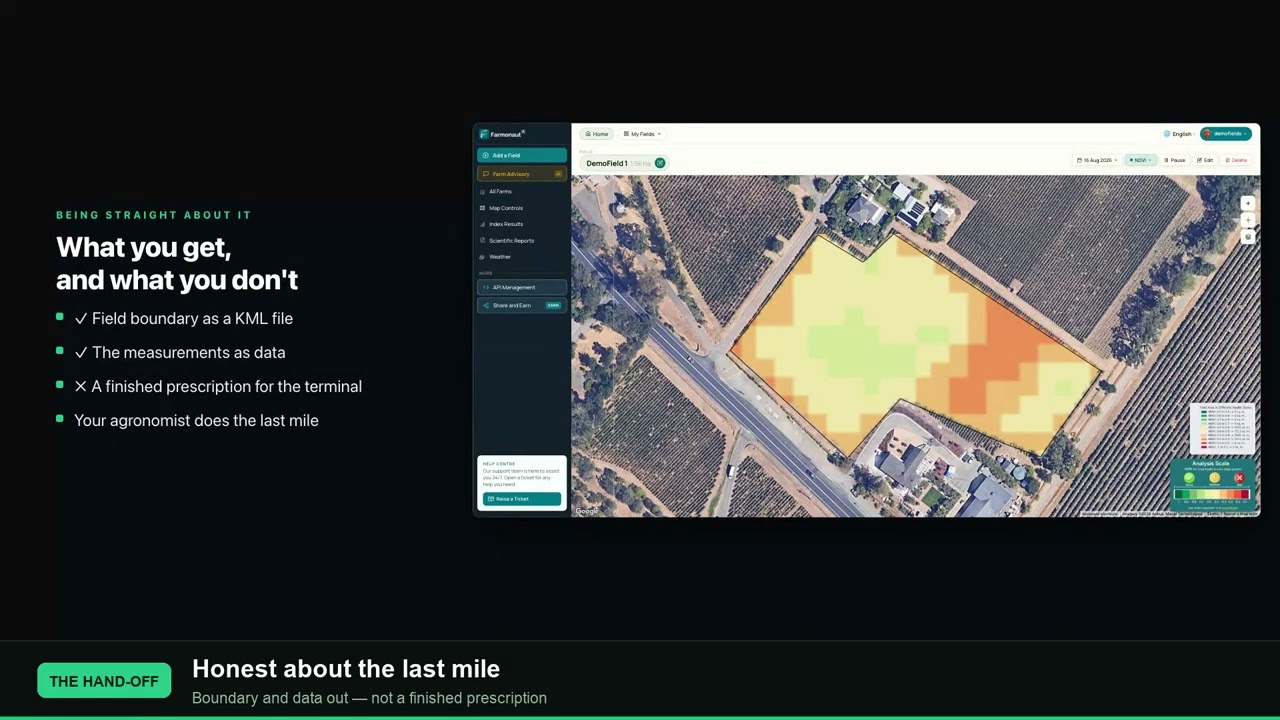
▶ How satellite crop maps make the zones that variable-rate equipment acts on, and where the data hand-off happens. · 2:12
The 6 core John Deere precision tools
Each tool below has a “Best for” line, what Deere says it does, and what to check before you buy. Where a figure is Deere’s own, we say so and give the date.
1. Operations Center and JDLink
Best for: any farm that runs connected machines and wants one place for field records.
The Operations Center is Deere’s cloud account. JDLink is the modem and service that send data from the machine to it over a cellular link. In the account you can see where machines are, what each one did in each field, and share that record with an agronomist or a custom operator. Deere’s Fact Book counts about 500 million engaged acres and 147 million “highly engaged” acres on its technology stack (FY2025). It does not define those terms in the Fact Book, so treat them as a measure of reach, not of results.
What to check: cellular coverage on your fields, who in your team and outside it gets access, and how you can export your data if you change brands later.
2. StarFire receivers and AutoTrac guidance
Best for: row-crop farms where operators spend long hours in the cab and overlaps waste seed, fuel and chemicals.
A StarFire receiver on the cab roof takes satellite positions and a correction signal. AutoTrac then steers the tractor along saved guidance lines. SF-RTK is Deere’s higher-accuracy correction signal, sold as part of a licence level. Guidance is the most widely adopted of the precision tools USDA tracks: the data further down show it on more than half of planted acres for the major row crops.
What to check: which correction level you need (sub-metre for tillage, centimetre-level for strip till or controlled traffic), and whether your older receivers can be moved to new machines.
3. ExactEmerge planter row units
Best for: large corn and soybean operations that need to cover acres fast in a short planting window.
ExactEmerge uses a brush belt to carry each seed down to the furrow, so the seed is not dropped from a height. The dealer planter guide (April 2025) says it keeps placement accurate at speeds up to 10 mph (16 km/h). The MaxEmerge 5e row unit is the other meter Deere offers as a planter upgrade.
What to check: whether your soils and residue let you actually plant at higher speed, and how much spare time a faster planter buys you in a typical spring.
4. See & Spray targeted spraying
Best for: farms or custom applicators with heavy weed pressure and many sprayed acres.
See & Spray uses cameras on the boom to spot weeds and open only the nozzles above them. Deere’s November 2025 release, reprinted by High Plains Journal, says the system ran on more than 5 million acres in 2025 and that customers cut non-residual herbicide use by an average of nearly 50%. The saving applies to non-residual products only, and the figure is self-reported. The same release cites Deere-commissioned trials in seven states, run with universities and other third-party researchers, that averaged 2 more bushels of soybeans per acre (up to 4.8) than broadcast spraying. Deere’s Josh Ladd told Oklahoma Farm Report in December 2025 that over 1,000 machines were running in North America.
Pricing changed in 2025. Under Deere’s Application Savings Guarantee, users pay a per-acre fee of $1 per fallow acre or $5 per in-crop acre. For 2026, Deere added an Unlimited Annual License for high-use operations (Deere release, November 2025). Always follow the herbicide label and local rules: targeted spraying changes where product goes, not what the label allows.
What to check: how many of your acres get non-residual passes, what you spend per acre on them, and whether the per-acre fee or the annual licence fits your use.
5. Harvest automation on S7 combines
Best for: large grain harvests where one operator runs a combine for long days.
Deere launched the S7 series at Commodity Classic in February 2024 for model year 2025. DTN reported that Predictive Ground Speed Automation uses stereo cameras to read crop mass about 30 feet ahead of the header and set speed before the machine reaches it. Deere says this, with Harvest Settings Automation, gives up to 20% more productivity. The same launch brought See & Spray Premium to a Hagie sprayer, the first time it was offered on a machine that is not a John Deere sprayer.
What to check: whether an upgrade to your current combine gives the feature at a lower cost than a new machine.
6. Autonomy kits for tillage
Best for: farms that struggle to find operators for long tillage seasons.
At CES in January 2025, Deere showed a second-generation autonomy kit with 16 cameras giving a 360° view, fitted to a 9RX tractor. Rental Equipment Register noted that it builds on the autonomy Deere first showed at CES 2022, and that the American Farm Bureau Federation estimates about 2.4 million farm jobs need filling each year. AgWeb reported that the kits fit model year 2022 and newer 9R and 9RX tractors and model year 20.5 and newer 8R and 8RX tractors. Dealers had a limited number for 2025, with a full launch planned for 2026. The system works only with John Deere tillage tools fitted with autonomy kits, and the speed rose 40% to 12 mph over the first version.
What to check: the kit’s real availability at your dealer, which of your tillage tools qualify, and your insurer’s view of driverless field work.
Precision Upgrades: new tech on machines you already own
Deere sells retrofit kits under the name Precision Upgrades. AgWeb notes that Deere renamed this product line in 2023 and that the autonomy kits are sold through it. The April 2025 dealer guide lists upgrades for planters (ExactEmerge and MaxEmerge 5e row units), sprayers (See & Spray and individual nozzle control such as ExactApply), combines (concaves, separator grate covers, cross auger shutoff), tractors (autonomous tillage readiness) and air seeders (the AccuRate metering system).
Upgrades matter because new machines cost much more than they did. A farmdoc daily analysis from October 2025 found new farm equipment prices rose more than 20% from 2021 to 2023, and USDA’s tractor price index rose 21% from 2020 to 2023. A kit that adds one feature to a sound machine can be a cheaper way to test a technology.
How many farms use precision agriculture?
The best national data come from USDA’s Agricultural Resource Management Survey. The USDA Economic Research Service report EIB-248 (2023) found that auto-steer and guidance were used on 5.3% of planted corn acres in 2001 and 58% in 2016. ERS reported in 2023 that guidance was used on well over half of the acres planted to the main row crops.
Chart
Auto-steer and guidance use by crop
Percent of US planted acres, latest ARMS survey year for each crop
Other tools lag behind. In the same ERS report, variable-rate technology was used on 37.4% of corn acres (2016) and 25.3% of soybean acres (2018). Yield maps, soil maps and variable rate reached only 5% to 25% of planted acres for winter wheat, cotton, sorghum and rice. In 2019, GPS was used on 40% of all US farm and ranch acres.
Farm size makes a large difference. ERS found that 7% of farms with under 200 acres of cropland (in the 2016 corn survey) used yield maps, against 50% of farms with more than 1,725 acres. Counted by farms instead of acres, the share is lower still: the US Government Accountability Office (GAO-24-105962, January 2024) cited USDA data showing 27% of US farms or ranches used precision agriculture practices in 2023. GAO named high up-front costs, farm data sharing and ownership concerns, and a lack of common standards between brands as the main barriers.
Deere’s own numbers: sales, research and engaged acres
Deere reports a Production and Precision Agriculture segment, which covers large tractors, combines, cotton pickers, sprayers and planters together with their technology. It is not a technology-only figure. The FY2025 Fact Book shows segment net sales of $26.8 billion in 2023, $20.8 billion in 2024 and $17.3 billion in 2025. The segment’s sales fell in each of the last two years.
Chart
Deere Production and Precision Ag net sales
US$ billion, fiscal years; segment includes large machines, not technology only
Research spending moved the other way. Deere’s company-wide research and development expense rose from $1.9 billion in 2022 to $2.3 billion in 2025, according to the same Fact Book. That figure covers all Deere divisions, including construction and turf, so it is not precision-only either.
Chart
Deere research and development expense
US$ billion, company-wide, fiscal years
Does John Deere precision agriculture pay? An ROI check
The return depends on three things: how many acres the tool touches, how much it saves or adds per acre, and what it costs each year. Machinery costs set the background. In the farmdoc daily analysis, machinery-related costs on central Illinois corn farms rose from $136 per acre in 2021 to $171 per acre in 2024, a 25% rise.
Chart
Machinery costs per acre, central Illinois corn
US$ per acre, Illinois FBFM farms on high-productivity farmland
Simple rules help. Guidance and section control pay through fewer overlaps and less operator fatigue, so the gain grows with acres and the number of passes. See & Spray pays mainly where you spend real money on non-residual herbicide passes. Planter and harvest upgrades pay through timeliness, which is hard to measure on one farm in one year. USDA’s ERS notes that larger farms adopt these tools at higher rates, which may be because the returns are larger at scale.
Use the calculator below with your own figures. It works for any precision tool that cuts an input, adds yield, or both. The default numbers are examples set close to break-even, not benchmarks.
Try the numbers for your own farm below.
Calculator
Will a precision upgrade pay on your acres?
Enter your own acres, input spend, expected saving, yield gain and tech costs.
- Yearly benefit (input saved + extra crop): $10,000
- Yearly cost (fees + hardware share): $10,000
- Input saving needed to break even (over 100% = cannot): 25.0 %
- Net per acre: $0
Example values only, set close to break-even; they are not benchmarks or forecasts. The $5 per acre fee default matches Deere’s 2025 See & Spray in-crop fee (Deere release, Nov 2025); the fallow fee is $1 per acre. Every other default is a round example. Hardware cost is spread evenly over the years you enter, with no interest, tax or resale value. Yield gain and input saving vary by field and season: test on your own farm and get financial advice before you buy.
How to choose: a buyer checklist for farm managers and agronomists
Use these steps before you sign for any precision upgrade, from a receiver to a full See & Spray boom.
- Start with the problem. Name the cost you want to cut (overlap, herbicide, planting delays, operator hours) and measure it for one season.
- Get both prices. Ask for the one-time hardware price and the yearly licence or per-acre fee, and how they change if you drop a level.
- Test the claim on your farm. Company averages, such as the See & Spray herbicide figure, come from many farms. Ask for a demo or a strip trial on your own fields.
- Check data rights. Decide who can see your Operations Center data and how you can export it. GAO lists data ownership as a key barrier to adoption.
- Check repair access. In January 2025 the US Federal Trade Commission sued Deere, alleging it limits repair tools to its dealers, as Farm Policy News at the University of Illinois summarised. Deere said it would defend the case, but in July 2026 it settled with the FTC and five states, agreeing to give farmers and independent shops the repair tools its dealers get, under 10 years of oversight. Ask your dealer what diagnostic access you will have.
- Plan for a mixed fleet. If you run more than one brand, ask which data formats and displays work across them.
- Get professional advice. For financing, leasing and tax treatment, talk to your lender or accountant before you commit.
Agronomists and consultants can ask growers to share Operations Center access for field records and prescriptions. Agtech startups that build tools for growers need the grower’s permission to read machine data and should read each platform’s data terms early.
▶ Six plain steps to start precision farming without buying a robot. · 4:18
Where satellite crop monitoring fits
Machine data tell you what the machine did and where. They do not show how the crop looks between passes. Satellite images fill that gap: they show changes in plant vigour across every field each time a clear image comes in, whatever brand of equipment you run.
Farmonaut Satellite + AI Farm Monitoring System gives vegetation maps for fields you draw once, on web, Android and iOS, and works next to a John Deere or mixed fleet. Satellites show where the crop changed, not the cause, so scout the spots a map flags before you act.
▶ How satellite NDVI maps show crop stress across a 400-acre corn farm before it is visible from the ground. · 4:09
How we checked the numbers
We used Deere’s FY2025 Fact Book for company-wide figures, Deere’s dated news releases (as reprinted by High Plains Journal, DTN, AgWeb and Rental Equipment Register) for product claims, and a John Deere dealer’s April 2025 guides for bundle and upgrade details. We label every Deere figure as a company claim. Adoption data come from USDA’s Economic Research Service and the GAO; cost data come from farmdoc daily at the University of Illinois. We did not use Deere product pages for numbers, because their content changes without dates. We will update this John Deere precision guide when Deere publishes its next Fact Book or USDA releases new adoption data.
FAQ
What is John Deere precision agriculture?
It is Deere’s set of guidance receivers, displays, modems, smart planters, targeted sprayers, harvest automation and autonomy kits, linked by the John Deere Operations Center cloud account. Deere counts about 500 million engaged acres on it (FY2025 Fact Book, company figure).
How much does See & Spray cost per acre?
Under Deere’s Application Savings Guarantee, launched in 2025, the fee is $1 per fallow acre or $5 per in-crop acre. For 2026, Deere also offers an Unlimited Annual License for high-use operations. Hardware and machine prices are separate; ask your dealer for a written quote.
Can I add John Deere precision technology to an older machine?
Often, yes. Deere’s Precision Upgrades line offers kits for planters, sprayers, combines, tractors and air seeders, and the Precision Ag Essentials bundle adds a display, StarFire receiver and JDLink modem to new or older Deere machines. Compatibility depends on model and year, so check with a dealer.
How many US farms use precision agriculture?
GAO cited USDA data showing 27% of US farms or ranches used precision agriculture practices in 2023. By acres the share is much higher: USDA’s ERS found guidance on 58% of planted corn acres in 2016, mainly because large farms adopt more (note the different survey years).
Are John Deere autonomous tractors available?
Deere showed its second-generation autonomy kit at CES in January 2025. AgWeb reported that dealers had a limited number of kits for 2025, for certain 8R, 8RX, 9R and 9RX tractors with John Deere tillage tools, and a full launch planned for 2026. We found no public confirmation of that launch by October 2026, so ask your dealer about availability in your area.
Related pages on our site: fleet management, the agro admin app for large farms, carbon footprinting, crop loan and insurance checks, product traceability, the satellite and weather API developer docs, the API sign-up and the Farmonaut apps.
Farmonaut crop monitoring
See your own fields from space
Draw your fields once and Farmonaut shows satellite vegetation maps through the season, next to whatever brand of machines you run, on web, Android or iOS.




Keep reading
Sources
- John Deere, FY2025 Fact Book (investor relations, 2025): s22.q4cdn.com
- USDA ERS, Precision Agriculture in the Digital Era: Recent Adoption on U.S. Farms, EIB-248 (2023), PDF: ers.usda.gov
- USDA ERS, EIB-248 publication page (2023): ers.usda.gov
- US GAO, Precision Agriculture: Benefits and Challenges for Technology Adoption and Use, GAO-24-105962 (January 2024): gao.gov
- farmdoc daily, University of Illinois, Large Increase in Machinery Costs Suggests Need to Reconsider Machinery Purchase Decisions (14 October 2025): farmdocdaily.illinois.edu
- Farm Policy News, University of Illinois, FTC Sues John Deere Over Right to Repair (January 2025): farmpolicynews.illinois.edu
- High Plains Journal, reprint of Deere release: See & Spray across 5 million acres in 2025 (12 November 2025): hpj.com
- Oklahoma Farm Report, John Deere’s See & Spray cuts herbicide use 50% (29 December 2025): oklahomafarmreport.com
- DTN, John Deere Unveils 9RX Series Tractors, S7 Combines at 2024 Commodity Classic (28 February 2024): dtnpf.com
- Rental Equipment Register, John Deere Shows New Autonomous Machines at CES 2025 (7 January 2025): rermag.com
- AgWeb, John Deere Introducing Next Generation Perception Autonomy Kits (6 January 2025): agweb.com
- RDO Equipment (John Deere dealer), Overview of John Deere Precision Upgrades (2 April 2025): rdoequipment.com
- RDO Equipment (John Deere dealer), John Deere Precision Upgrades for Your Planter (2 April 2025): rdoequipment.com
- Farm Policy News, University of Illinois, FTC Settlement Secures Right to Repair for Farmers (July 2026): farmpolicynews.illinois.edu
Discussion
Questions, corrections or field experience? Share them below. First-time comments are reviewed before they appear, and your email is never published.
No comments yet. Be the first to add a question or your experience.

 Etherspace Network
 Teledarbas
 Wild Oak Farm
 SFX
 BACF Africa
 Doodlakine
 Exurbia Geospatial
 FieldZero
 Indico Company
 Kubota
 FFBS
 Jontra
 Tucor

 Licence holder · Niger · Gold
 Licence holder · Nigeria · Gold + lithium










