

Weather Forecasting in Agriculture: Farmonaut’s Farm Guide
Reviewed August 2026 against USDA ERS and Virginia Tech AAEC forecast-accuracy research.
Try it: Enter your numbers above. →
Weather forecasting in agriculture means combining satellite data, on-farm sensors, and statistical models to predict rainfall, temperature, and frost risk at field level — not just the regional forecast on the evening news. Done well, it cuts the yield-forecast error that comes from relying on condition ratings alone and gives growers a window to act before a weather event hits. Below is what the data actually shows about accuracy, adoption, and the market for agricultural weather services, plus where Farmonaut’s weather forecasting for agriculture platform fits.
Table of Contents
- How Accurate Is Agricultural Weather Forecasting?
- Best Farm Weather Station: What the Adoption Numbers Say
- Weather Intelligence for Agriculture: What It Adds
- Agricultural Construction and Weather Timing
- Agricultural Weather Forecasting Companies and the Market
- Farmers Weather Forecast App and Integration
- FAQ
- Try it: Enter your numbers above.
How Accurate Is Agricultural Weather Forecasting?
The clearest public accuracy data on agricultural forecasting doesn’t come from a weather company — it comes from USDA crop yield forecasts, which behave the same way weather-dependent farm forecasts do: early-season estimates carry real error that narrows as the season progresses. Virginia Tech’s Agricultural and Applied Economics research group found that USDA corn yield forecasts based on mid-June crop condition ratings carried an average error margin of 10 bushels per acre across 2011-2012, while soybean forecasts from the same mid-June ratings carried a 2.5 bushel per acre error margin over the same two years, per Virginia Tech AAEC.
That same research found combining regression models with USDA’s own forecast — rather than relying on condition ratings in isolation — improved corn forecast accuracy by 10% and soybean forecast accuracy by 6% across the 1993-2012 period. The takeaway for a working farm: a single data source (a condition rating, a regional forecast, a neighbor’s rain gauge) always carries more error than a blended model pulling from satellite data, ground stations, and historical trend together. This is the same logic behind hourly, farm-specific forecasting instead of a daily regional one.
USDA’s Economic Research Service also tracks how many farms have adopted the precision tools that feed better weather-linked decisions. On large-scale crop farms, 70% had adopted guidance autosteering systems and 68% had adopted yield monitors, maps, or soil maps as of 2023, according to USDA ERS. Midsize farms lagged on autosteering at 52% adoption the same year. These are the farms best positioned to layer hourly weather intelligence on top of equipment they already run.
Why Farm-Level Forecasts Beat Regional Ones
- Hourly updates catch rainfall and temperature swings a daily regional forecast averages away
- Satellite-fed models can resolve conditions at field scale, not county scale
- Blended forecasting (multiple models plus ground truth) is the same principle that improved USDA’s own corn and soybean accuracy by 10% and 6% respectively
Best Farm Weather Station: What the Adoption Numbers Say
“Best farm weather station” is really two questions: hardware on your own field, or a network of stations and satellite data feeding a forecast to your phone. The global market has priced this decision at scale. The farm automated weather station market was valued at $1.25 billion in 2025 and is forecast to reach $2.88 billion by 2034, a 9.7% compound annual growth rate over 2024-2034, according to Growth Market Reports. North America accounted for roughly 35% of global farm automated weather station usage in the 2024-2025 period per market research estimates — the largest single regional share tracked.
A standalone weather station on your own land gives you ground truth for your exact microclimate — useful if your farm sits in a frost pocket or a rain shadow a regional model won’t catch. A satellite-and-network model, like the one behind Farmonaut’s platform, gives you hourly forecasts and severe weather warnings without capital spend on hardware, plus coverage for every field you manage, not just the one with a station on it. Most working farms end up using both: a station for hyper-local ground truth, and a network forecast for everywhere else.
| Decision factor | On-farm weather station | Satellite + network forecasting (Farmonaut) |
|---|---|---|
| Upfront cost | Hardware purchase and installation | Subscription, no hardware |
| Coverage | Single fixed location | Every field you add, any location |
| Update frequency | Continuous, but local only | Hourly, farm-specific |
| Maintenance | Sensor calibration, power, connectivity | None — cloud-based |
| Integration with satellite crop data | Requires separate system | Native (NDVI, soil moisture, same platform) |
Weather Intelligence for Agriculture: What It Adds
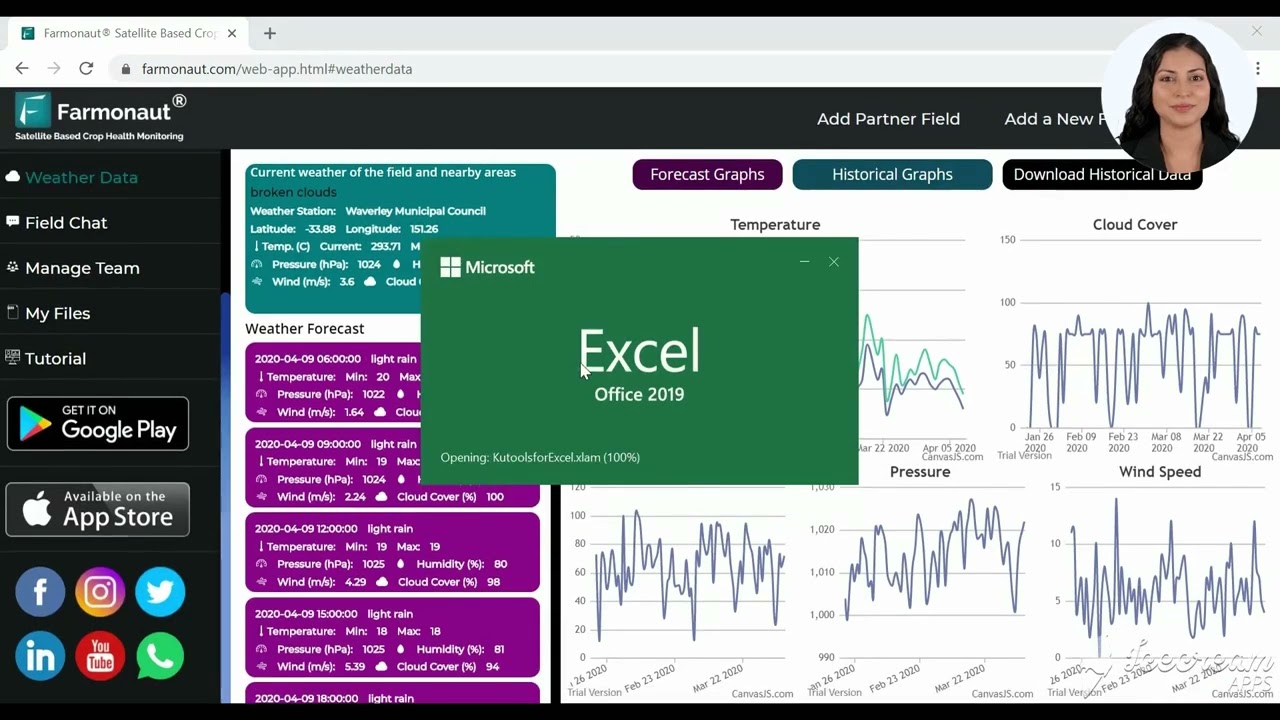
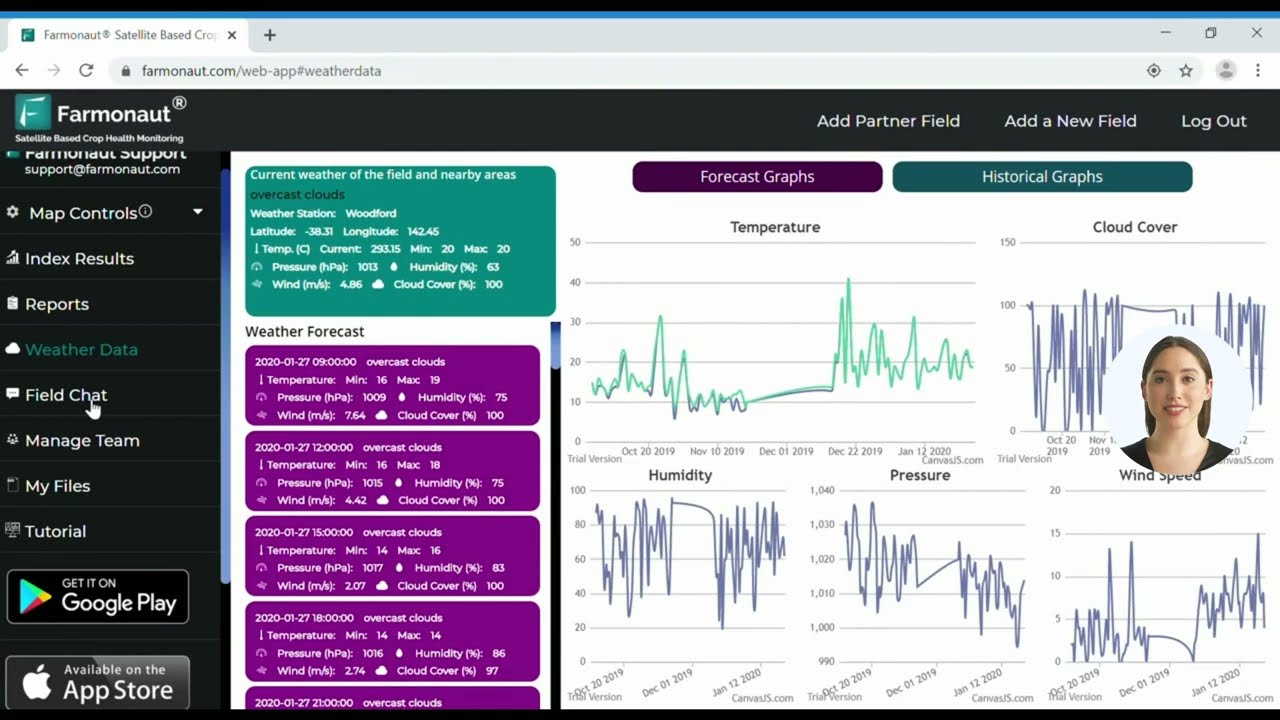
Weather intelligence for agriculture goes a step past forecasting: it’s the layer that turns a rainfall prediction into an irrigation trigger, or a frost warning into an automated alert to equipment. Farmonaut’s agricultural weather intelligence covers:
- Rainfall: precipitation forecasts plus historical records for irrigation planning
- Temperature: daily max/min predictions for frost and heat-stress protection
- Humidity: a leading input for crop disease-risk modeling
- Wind speed and direction: needed for spray timing and pollination windows
- Solar radiation: an input to photosynthesis and growth-stage models
- Evapotranspiration: the core variable for irrigation scheduling
“Farmonaut’s agritech solution integrates satellite data and crop weather intelligence to enhance farm productivity and reduce climate-related risks.”
This is also where risk management lives: frost risk assessments, heat stress warnings, drought monitoring, and flood potential alerts, so the farm gets an early signal instead of reacting after damage is done.
Climate Outlook and Seasonal Planning
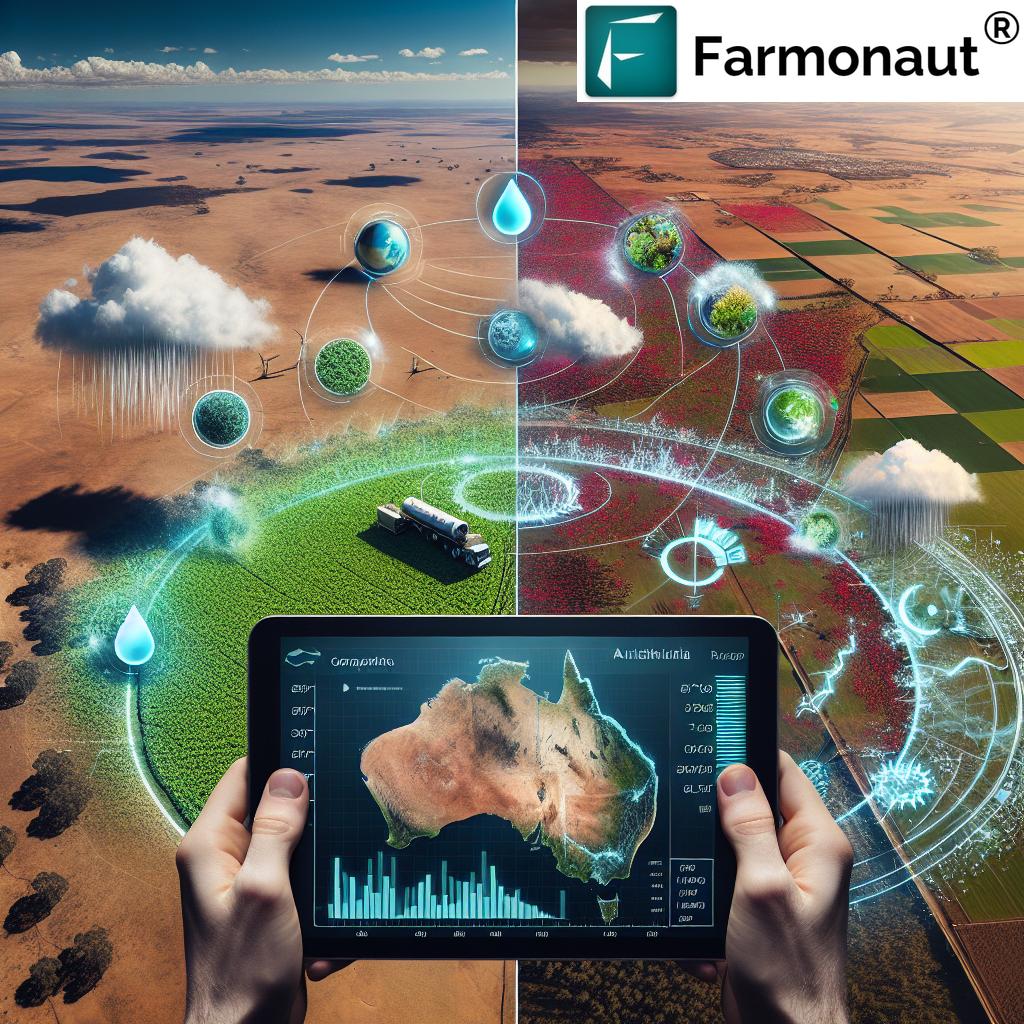
Long-term planning needs more than a seven-day forecast. Farmonaut’s climate outlook layer covers seasonal forecasts and long-term temperature and rainfall trend data, which feed decisions on crop selection, resource allocation, and infrastructure investment for the season ahead. For teams building this into their own systems, the outlook data is accessible through our API.

Agricultural Construction and Weather Timing
Agricultural construction — grain bins, barns, irrigation infrastructure, drainage, fencing, and equipment sheds — is one of the most weather-exposed categories of farm work, and it depends on the same forecasting layer as planting and harvest decisions. Concrete pours need a dry, frost-free window; roofing and structural steel work need low wind; drainage and tiling work needs soil dry enough to support equipment without rutting.
The planning problem is the same one crop growers face: a daily regional forecast doesn’t tell you whether your specific site will be workable tomorrow morning. Hourly, farm-specific forecasts — temperature, wind speed, and rainfall probability by location — let a construction crew or on-farm team schedule pours, deliveries, and equipment moves around windows that actually hold, not around a forecast that covers an entire county. Severe weather warnings also give crews lead time to protect uncured concrete, secure temporary structures, and reschedule crane or lift work before wind risk sets in.
Agricultural Weather Forecasting Companies and the Market
The market for agricultural weather forecasting services is growing alongside the hardware market. With the automated farm weather station segment alone projected to grow from $1.25 billion in 2025 to $2.88 billion by 2034 at a 9.7% CAGR, forecasting companies are competing on three fronts: forecast resolution (regional vs. farm-specific), update frequency (daily vs. hourly), and integration depth (standalone app vs. full precision-ag platform tied to satellite crop monitoring).
Where Farmonaut differentiates from a standalone weather-only provider is integration: the same platform that delivers hourly forecasts also runs NDVI-based crop health monitoring, soil moisture analysis, pest and disease risk modeling, and yield prediction — all as part of our precision farming tools. A grower doesn’t need to reconcile a weather app against a separate crop-health app; the forecast and the field data sit in one system.
Farmonaut vs. Traditional Regional Forecasting
| Feature | Farmonaut | Traditional regional forecast |
|---|---|---|
| Update frequency | Hourly | Daily |
| Localization | Farm-specific | Regional/county-wide |
| Farm management integration | Yes, via API | No |
| Severe weather warnings | Real-time | Delayed relative to farm-specific need |
| Satellite crop data integration | Native (same platform) | Not included |
| Mobile app access | Android and iOS | Varies by provider |
These solutions extend past crop farming too — aviation flight planning, renewable energy generation forecasting, utility demand prediction, forestry fire-risk management and timber production, emergency preparedness, insurance risk assessment, marine operations, and mining all draw on the same underlying weather intelligence layer.

Farmers Weather Forecast App and Integration
A farmers weather forecast app earns its place on your phone by doing two things a browser tab can’t: pushing alerts the moment conditions change, and syncing with the equipment and records you already keep. Farmonaut’s smart farming weather integration includes automated alerts and notifications, custom weather-based triggers for farm equipment, integration with major farm management software platforms, and full API access for custom builds — documented in our developer documentation.
Experience the platform through our web application.

Get the mobile apps: Android and iOS.


Irrigation Timing Calculator
Evapotranspiration and rainfall forecast data only help if you turn them into an irrigation decision. Use the calculator below to estimate your net irrigation need for the coming week from your own forecast numbers.
Enter your numbers above.
Assumes a simple water-balance model: irrigation need = evapotranspiration minus forecast rainfall, adjusted for system efficiency. Excludes soil moisture carryover, runoff, and deep percolation losses — pair this with your own soil moisture readings before setting a final irrigation schedule.
Frequently Asked Questions
Q: How accurate is agricultural weather forecasting?
A: There’s no single published accuracy percentage across all providers. What’s documented is USDA’s own yield forecast error: 10 bushels per acre for corn and 2.5 bushels per acre for soybeans from mid-June condition ratings (2011-2012 average), narrowing as more data comes in through the season, per Virginia Tech AAEC. Blended models improved on single-source forecasts by 10% for corn and 6% for soybeans over 1993-2012.
Q: What’s the best farm weather station?
A: It depends on whether you need hardware ground-truth for one field or coverage across every field you manage. See the comparison table above — most operations benefit from pairing an on-farm station with a satellite/network forecasting service like Farmonaut.
Q: Can I access Farmonaut’s weather data on my mobile device?
A: Yes, via our Android and iOS apps, both linked above.
Q: Does Farmonaut provide historical weather data?
A: Yes — historical weather data is available alongside live forecasts for trend analysis and planning.
Q: How current are the adoption and market figures in this article?
A: The precision-agriculture adoption rates are USDA ERS’s 2023 figures; the weather station market sizing is Growth Market Reports’ 2025 estimate with a forecast to 2034. Both update on their own schedules — check USDA ERS directly for newer adoption data, and USDA’s WAOB publishes a monthly WASDE scorecard tracking current forecast performance for the freshest accuracy read.
Q: Can Farmonaut’s weather data integrate with my existing farm management software?
A: Yes, through API access documented in our developer documentation.
Subscription Options
Further reading:
The Bottom Line
Weather forecasting in agriculture works best as a system, not a single number: hourly, farm-specific data; a blended model rather than one source; and integration with the equipment and software already running your operation. The durable check for any provider you evaluate — including us — is simple: ask for update frequency, ask whether the forecast is farm-specific or regional, and ask whether it ties into your existing farm management stack. If the answer to any of those is no, you’re looking at a traditional regional forecast wearing a new interface.
Ready to move to farm-specific, hourly weather intelligence? Sign up for Farmonaut and start today.
Discussion
Questions, corrections or field experience? Share them below. First-time comments are reviewed before they appear, and your email is never published.
No comments yet. Be the first to add a question or your experience.

 Farmitopia
 TVS Electronics
 BW Pipelines
 WICO
 Gen Chayat
 Chimera Innovation
 SkyHarvest
 Polaris Digitech
 Teledarbas
 Wild Oak Farm
 SFX
 BACF Africa
 Doodlakine
 Exurbia Geospatial
 FieldZero
 Indico Company

 Licence holder · Niger · Gold










