

Reviewed September 2026 against USDA Economic Research Service, Frontiers in Plant Science, and MarketsandMarkets.
Try it: Run your own numbers →
“70% of large-scale US crop farms now use GPS autosteering; precision agriculture raises yields 20–30% according to current peer-reviewed research.”



IoT-driven agricultural automation and agri robotics have moved past the pilot stage on large US operations: 70% of large-scale crop farms already run GPS guidance autosteering and 68% use yield monitors and soil maps, according to USDA’s Economic Research Service. The US precision agriculture technologies market was valued at $2,615 million in 2023 and is projected to grow at a 9.5% compound annual rate through 2030. This article lays out what’s actually adopted, what it costs, what it saves, and how to check the numbers yourself before your next equipment or software purchase.
We’ll also cover where robotics farming and smart apiary technology genuinely fit into this picture — and where they don’t, so you’re not chasing hype that doesn’t apply to your operation.
Table of Contents
- Real US Adoption Data: Who’s Actually Using This
- Historical Evolution of Agricultural Technology
- Smart Farming Hacks Optimizing Agriculture
- Agri Robotics and IoT: Market Size and Growth
- Smart Apiary Technology and Farm Planning Software
- ROI Calculator: Precision Ag Payback Period
- Comparison Table of Smart Farming Hacks and Their Estimated Impact
- Farmonaut’s Innovations: Smart Farming Elevation
- Challenges and Considerations in Agricultural Technology
- FAQ: Agricultural Technology & Smart Farming
Real US Adoption Data: Who’s Actually Using This
Before covering the technology itself, here’s who has actually adopted it, verified against USDA’s Economic Research Service Charts of Note (2023 data, the most recent farm-size breakdown published). On large-scale crop farms, 70% use guidance autosteering systems on tractors and equipment, and 68% use yield monitors, yield maps, and soil maps. Midsize farms trail behind on autosteering at 52% adoption. These figures come from USDA’s farm structure surveys and are refreshed after each NASS survey cycle — the full farm count comes from the Census of Agriculture, conducted every five years with the next full census due in 2029, while the NASS Agricultural Practices Survey updates annually. For a current-year number specific to your state and farm size, query USDA NASS QuickStats directly at quickstats.nass.usda.gov.
The gap between large and midsize farms matters for anyone evaluating IoT-driven agricultural automation: this is capital-intensive technology, and adoption still correlates strongly with farm scale rather than crop type or region. If you operate below the “large-scale” threshold USDA uses in its survey (typically 2,000+ acres for row crops), expect adoption rates closer to the midsize figures, and budget accordingly using the ROI calculator further down this page.
Historical Evolution of Agricultural Technology
Before we unveil the smart farming hacks, let’s travel through the timeline of agricultural technology—a journey that began with ancient implements and now brims with modern digital solutions:
- Early Implements: The fundamental plow and irrigation systems allowed greater cultivation and higher crop yields.
- Industrial Revolution: The invention of mechanized equipment like tractors and combine harvesters drastically cut manual labor while boosting productivity and agricultural scale.
- Green Revolution (Mid-20th Century): Advancements in chemical fertilizers, pesticides, and engineered high-yield crop varieties transformed the global food system.
- Information Age: The turn of the millennium brought satellite-based monitoring, AI-driven analytics, and precision irrigation, ushering in real-time, data-centric farming.
- Try it: Run your own numbers
Today, agricultural technology integrates digital platforms, IoT, blockchain, machine learning, and agri robotics, establishing a robust foundation for resilient, sustainable farming practices in the United States and beyond.
Smart Farming Hacks Optimizing Agriculture
From precision agriculture to blockchain in agriculture, these hacks are turning US farms into high-tech, highly-productive, and sustainable food operations:
1. Precision Agriculture: GPS-Driven Decisions
Precision agriculture harnesses GPS, GIS (Geographic Information Systems), and remote sensing to manage intra-field variability and optimize resource use. Current peer-reviewed research synthesized in Frontiers in Plant Science puts the crop yield improvement from precision agriculture adoption at 20–30%, a wider and more current range than earlier estimates. By collecting high-resolution data on soil conditions, crop health, and environmental factors, growers can plant, irrigate, and fertilize with far tighter accuracy than blanket-rate application allows.
- Benefit: Yield gains of 20–30% (Frontiers in Plant Science), reduced input waste, improved soil health.
- Key Tools: GPS-equipped tractors, yield mapping, variable-rate application systems.
- Use Case: Targeted application of fertilizers and pesticides prevents overuse and runoff, safeguarding waterways and reducing input spend.
Read the full study: Frontiers in Plant Science, precision agriculture productivity synthesis.
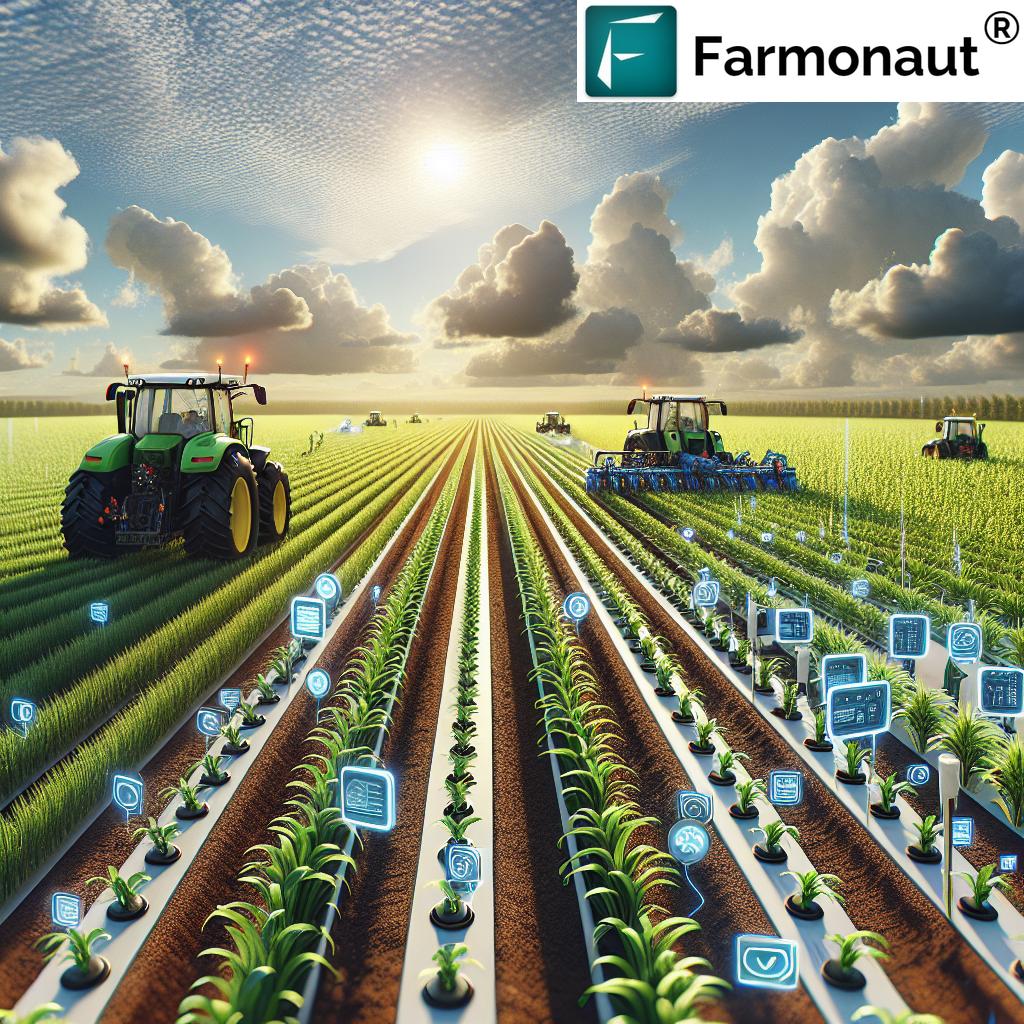
2. Autonomous Machinery & Agri Robotics
Agri robotics — the machinery side of agricultural technology — has matured into a distinct, fast-growing market segment rather than a lab curiosity. North America holds a 36.4% share of the global agricultural robots market as of 2024, and the US agricultural robotics market specifically is projected to grow at a 27.3% compound annual rate from 2024 through 2030, per MarketsandMarkets. Self-driving tractors and harvesting robots rely on advanced sensors and AI to complete routine tasks—planting, weeding, soil analysis—with minimal human input, and the labor case is now backed by numbers: agricultural robots cut labor costs by 40–70% in current automation research from DataM Intelligence.
- Advantage: Efficient planting and harvesting schedules, reduced labor dependency, consistent performance even in adverse conditions.
- Sustainable Angle: Automated weeders using computer vision eliminate unwanted plants without chemicals, supporting natural soil health.
- Market Reality: 36.4% of the global agricultural robots market is North American (2024), growing at 27.3% CAGR in the US through 2030.
Source: MarketsandMarkets, US agricultural robot market and DataM Intelligence, autonomous farming equipment ROI.
3. Drones in Agriculture: Eye in the Sky
Drones in agriculture have redefined monitoring and data collection. Using multispectral sensors, UAVs provide real-time imagery to track plant health, pest infestations, and soil moisture levels. A consolidated count of how many US farms actively fly drones for crop monitoring, spraying, or scouting is not published — manufacturers report units sold, not farm-level adoption — so if you need that figure for a specific state or crop, the closest proxy is USDA NASS QuickStats’ farm equipment and technology tables, cross-referenced against your state extension office’s drone program enrollment data.
- Standout Features: Wide field coverage, high-frequency data, rapid detection of anomalies (pest, nutrient, or disease).
- Optimization: Early diagnosis enables precise intervention and maximizes yields.
- Advanced Application: Spraying fertilizers or pesticides with accuracy, reducing operator exposure and input waste.
4. IoT in Agriculture: Connected Farm Networks
IoT (Internet of Things) in agriculture — the backbone of what “iot-driven agricultural automation” searches are usually after — establishes connected networks of sensors, devices, and data processing systems for live field monitoring. Soil moisture, temperature, and nutrient levels are instantly measured and analyzed. The global IoT in precision agriculture market is projected to reach $47.2 billion by 2034, according to Market.us forecasts — a scale that reflects sensor networks, connectivity infrastructure, and the analytics layered on top, not a single product category.
- Efficiency: Automated irrigation based on actual soil moisture readings conserves water and prevents over- or under-watering.
- Platform Spotlight: The Farmonaut platform lets farmers track moisture and crop health from any smart device.
Source: Market.us, IoT in precision agriculture market forecast.
Explore the Farmonaut Satellite API
for seamless farm data and weather integration into your own applications or agri-research systems.
Check the Developer Docs here.
5. AI & Machine Learning in Smart Farming Solutions
Artificial Intelligence in farming and machine learning algorithms are capacity-multipliers for farmers. From weather prediction to yield forecasting and pest detection, AI transforms raw data into actionable intelligence.
- Example: AI models predict local weather patterns and suggest optimal planting times, helping farmers reduce input costs and maximize their production.
- Tool Highlight: Farmonaut Jeevn AI Advisory System delivers real-time, customized strategies for smarter, more informed decisions.
6. Soil Health Monitoring & Nanosensors
Healthy soil is the bedrock of sustainable food production. Nanosensors and advanced soil analysis tools deliver real-time insights into nutrient levels, moisture, pH, and trace element profiles, complementing the 68% of large US farms already running yield and soil maps per USDA ERS.
- Precision Benefit: Targeted fertilizer applications improve crop yields while avoiding input waste or environmental contamination.
- Innovative Solutions: Multispectral satellite imaging—like that offered by Farmonaut’s platform—enables crop health and soil moisture monitoring even at large scales.
-
Explore:
Farmonaut Carbon Footprinting Solutions
for tracking and reducing your agro-environmental impact.
7. Blockchain in Agriculture: Traceability & Trust
Blockchain in agriculture resolves the need for accurate, transparent, and secure data sharing along the food supply chain. Every step—from planting to harvest, processing, and sale—is logged on an immutable digital ledger, ensuring authenticity.
- Impact: Enhanced food safety, reduced fraud, and fairer transactions between farmers, suppliers, and consumers.
- Tech Spotlight: Farmonaut’s blockchain-enabled product traceability platform lets agribusinesses trace goods with confidence.

8. Advanced Resource & Fleet Management
Managing field machinery, vehicles, and labor-intensive logistics can be daunting on large operations. Advanced fleet management tools automate the tracking of tractors, combine harvesters, and support logistics in large or distributed fields.
- Advantage: Reduced fuel use, maintenance costs, and downtime; optimized machinery utilization and safety.
-
Tech Example: Our
Farmonaut Fleet Management module
streamlines agricultural operations, substantially improving ROI for agribusinesses.
9. Sustainable Farming Practices and Carbon Tracking
Sustainable farming practices and monitoring your farm’s carbon footprint help future-proof agriculture against tightening input costs and regulatory scrutiny.
- How It Works: IoT sensors, satellite analytics (like those by Farmonaut), and AI evaluate sustainability—tracking water use, emission levels, and resource optimization.
- Get Started: Check Carbon Footprinting to measure and improve your farm’s sustainability status.
“Agricultural robots reduce labor costs by 40–70%, and midsize farms save $20,000–$34,000 a year in input, fuel, and labor costs after adopting precision technology.”
Agri Robotics and IoT: Market Size and Growth
The North America precision farming market was valued at $4.10 billion in 2025 and is projected to grow at a 6.7% compound annual rate from 2025 through 2032, per MarketsandMarkets. That sits alongside the narrower US precision farming figure of $2,615 million in 2023 growing at 9.5% CAGR through 2030 (PS Market Research) — the two numbers cover different geographic scopes and base years, so don’t average them; cite whichever matches the claim you’re making. For current-year updates, both PS Market Research and MarketsandMarkets typically refresh their forecasts in Q1 or Q2 of each year — check their published reports directly rather than relying on a figure that’s aged past its base year.
On the robotics side specifically, North America’s 36.4% share of the global agricultural robots market (2024) combined with a 27.3% US CAGR through 2030 signals that agri robotics is consolidating in North America faster than the broader precision ag category is growing — a useful distinction if you’re deciding whether to prioritize robotic hardware or software/sensor investment first.
Smart Apiary Technology and Farm Planning Software
Smart apiary technology — sensor-monitored beehives that track hive weight, internal temperature, humidity, and colony activity remotely — is a real and growing category, but a consolidated figure for how many US beekeeping operations have adopted robotic or sensor-based hive monitoring is not published in USDA or NASS survey data at the time of writing. If you manage an apiary and want adoption or cost benchmarks specific to your region, the most direct path is your state’s Department of Agriculture apiary registration program combined with extension-service beekeeping technology surveys, where they exist — USDA’s broader technology adoption tables (linked above) do not break out apiary equipment separately from general farm technology.
Farm planning software — field mapping, crop rotation planning, and input-scheduling platforms — likewise doesn’t have a standalone USDA penetration figure distinct from the broader precision agriculture adoption numbers already cited (70% autosteering, 68% yield/soil mapping on large farms). In practice, farm planning software adoption tracks closely with the yield-mapping and soil-mapping figure, since most planning platforms ingest that same field data. If your operation already collects yield and soil maps, you’re most of the way to planning-software readiness; the gap is usually integration, not data availability.
ROI Calculator: Precision Ag Payback Period
Use your own acreage and current spend to estimate a payback period for precision agriculture or robotics adoption, based on the $20,000–$34,000 annual savings range and 40–70% labor cost reduction figures cited above.
Run your own numbers
Assumptions: labor savings percentage applied per DataM Intelligence’s 40–70% range for agricultural robots; combines with a flat $20,000–$34,000/year input-fuel-labor savings band from midsize-farm case studies (Koenig Equipment ROI research) prorated to your acreage against a 1,500-acre baseline. Excludes financing costs, maintenance, and crop-specific variables — treat the output as a starting estimate, not a quote.
Comparison Table of Smart Farming Hacks and Their Estimated Impact
| Smart Farming Hack | Description | US Adoption / Market Data | Source & Date |
|---|---|---|---|
| Precision Agriculture | GPS/GIS-driven resource optimization based on field data | 20–30% yield improvement; 70% of large farms use autosteering | Frontiers in Plant Science; USDA ERS, 2023 |
| Autonomous Machinery & Agri Robotics | Self-driving tractors and robots performing routine tasks | 40–70% labor cost reduction; 27.3% US market CAGR (2024–2030) | DataM Intelligence; MarketsandMarkets |
| Drones in Agriculture | Aerial crop monitoring, pest detection, and precision spraying | Farm-level adoption count not consolidated — see USDA NASS QuickStats | USDA NASS QuickStats (query directly) |
| IoT in Agriculture | Sensor-driven, automated field monitoring and responsive systems | $47.2 billion global market projected by 2034 | Market.us, IoT in Precision Agriculture |
| AI & Machine Learning | Predictive analytics, pest & yield forecasting, data-driven farming | Embedded in precision ag yield gains above (20–30%) | Frontiers in Plant Science |
| Soil Health Monitoring & Nanosensors | Real-time soil and nutrient monitoring for targeted fertilization | 68% of large farms use yield/soil maps | USDA ERS, 2023 |
| Blockchain in Agriculture | Secure, transparent product traceability in supply chains | No USDA adoption figure published | — |
| Farm Planning Software | Field mapping, rotation planning, input scheduling platforms | Tracks with 68% yield/soil map adoption on large farms | USDA ERS, 2023 (proxy) |
| Smart Apiary Technology | Sensor-monitored hive weight, temperature, and colony activity | No consolidated US adoption figure — check state ag department registries | — |
| Resource & Fleet Management | Automation of machinery and logistics operations | $20,000–$34,000/year savings for midsize farms | Koenig Equipment ROI research, 2025–2026 |
Farmonaut’s Innovations: Smart Farming Elevation
As a provider of agricultural technology, Farmonaut delivers precision, data-driven agriculture tools and insights. Our platform synergizes satellite imagery, AI, and blockchain to support every link in the modern food system—from large-scale agribusiness to smallholder farms and government agencies.
- Crop Health and Soil Monitoring: Farmonaut’s satellite-based crop health monitoring generates NDVI plant growth maps, tracks soil moisture levels, and identifies potential pest outbreaks. This supports resource allocation decisions and yield optimization.
- Jeevn AI Advisory System: Our personalized, AI-driven advisory analyzes satellite and weather data, delivering guidance for efficient planting, irrigation, and input application.
- Blockchain Traceability: By leveraging blockchain in agriculture, we support secure, transparent supply chains—addressing consumer demand for food safety and authenticity.
- Resource & Fleet Management: Fleet management tools help businesses minimize operational risks, reduce costs, and improve sustainability.
- Carbon Footprint Tracking: With carbon assessment tools, we help operations monitor and reduce environmental impact.
- Access and Flexibility: Farmonaut’s app is available for web, Android, and iOS, along with a powerful API (API Access).
- Large-Scale and Collaborative Management: For NGOs and government operations, our large-scale farm management tools deliver real-time oversight and support for complex projects.
Challenges and Considerations in Agricultural Technology
While these technologies set new benchmarks, adoption is not without hurdles. For farming systems to reach their potential, operations need to weigh:
- Cost and Accessibility: The upfront investment behind the $2,615 million US market figure isn’t evenly distributed — 70% autosteering adoption on large farms versus 52% on midsize farms (USDA ERS, 2023) shows the capital barrier is real, not theoretical.
- Data Privacy & Security: Intensified monitoring and data sharing demand rigorously enforced privacy protocols, particularly as IoT sensor networks scale toward the $47.2 billion 2034 market projection.
- Environmental Impact: Electronic waste and the life cycle of digital devices must be considered as operations transition to high-tech agriculture systems.
- Labor and Social Dynamics: A 40–70% labor cost reduction from robotics (DataM Intelligence) means real workforce transitions — plan for retraining and role shifts rather than treating automation as a simple cost cut.
On a related note, autonomous systems built for agricultural fields share underlying sensor and AI-vision technology with other detection applications — see our coverage of AI-driven drone detection use cases for how similar computer-vision approaches are applied outside farming.
FAQ: Agricultural Technology & Smart Farming
What percentage of US farms use precision agriculture technology?
Per USDA’s Economic Research Service (2023 data), 70% of large-scale crop farms use guidance autosteering systems and 68% use yield monitors, yield maps, and soil maps. Midsize farms show 52% adoption of autosteering. These figures update after each NASS survey cycle — check USDA NASS QuickStats (quickstats.nass.usda.gov) for the current figure by state and farm size.
How big is the agri robotics market in the US?
North America holds a 36.4% share of the global agricultural robots market as of 2024, and the US segment is projected to grow at a 27.3% compound annual rate from 2024 through 2030, per MarketsandMarkets. Agricultural robots reduce labor costs by 40–70% according to current DataM Intelligence research.
Is smart apiary technology widely adopted in the US?
There’s no consolidated USDA or NASS figure for smart apiary technology (sensor-monitored beehive) adoption specifically — it isn’t broken out from general farm technology statistics. Check your state Department of Agriculture’s apiary registration program or your local extension service for region-specific data.
Does farm planning software have its own adoption data?
Not as a standalone category — farm planning software adoption tracks closely with the 68% yield-mapping and soil-mapping figure from USDA ERS, since most planning platforms use that same field data as their input.
How does precision agriculture increase crop yields?
Precision agriculture uses GPS, GIS, remote sensing, and real-time data to identify variability in soil, moisture, and crop health, enabling targeted input application. Current peer-reviewed research (Frontiers in Plant Science) puts the yield improvement at 20–30%.
What role do drones in agriculture play in modern farming?
Drones enable rapid, precise monitoring of large fields, detecting pest infestations, water stress, or nutrient deficiencies early for timely, site-specific responses. A consolidated US farm-adoption count isn’t published; check USDA NASS QuickStats for the closest available proxy data.
How can I get started with Farmonaut’s smart farming solutions?
Download the Farmonaut app (available for Web, Android, and iOS) to begin monitoring your farm using satellite imagery, AI advisory, blockchain traceability, and resource management—no extra hardware needed.
Start Your Smart Farming Journey
Armed with real USDA and market-research data on agricultural technology adoption, you’re positioned to evaluate field management, resource allocation, and supply chain efficiency decisions with actual numbers instead of guesswork. Whether you’re a tech-savvy agribusiness, a government institution, or an ambitious smallholder, agricultural technology offers scalable, cost-effective, and sustainable solutions.
Ready to transform your farm? Click here to start using Farmonaut’s platform, and unlock precision agriculture services—no specialist hardware required.
In summary, agricultural technology is measurable, not just a buzzword: 70% large-farm autosteering adoption, a $2,615 million US market, and 20–30% documented yield gains are the current state of play, refreshed annually by USDA and market researchers. By tracking AI, drones, IoT, and agri robotics against their real adoption data rather than marketing claims, farmers and agribusinesses can make capital decisions with the same rigor USDA applies to its surveys.

 Grow Indigo
 FFBS
FFBS Jontra
 Kalustyan
 Tucor
Tucor Geno
Geno Hayleys Agriculture
 Linx Agritech
 Adinet
 Save Your Soils
 Grandstream Algérie
 XOS Realty
 Geospatial Lab Africa
 Agro La Gándara
 HIPSAC
 ZOL Zimbabwe
 Juligerm
