

Agtech Startups Driving Precision Agriculture: A US Guide
Reviewed September 2026 against USDA Economic Research Service farm technology adoption data and the Association of Equipment Manufacturers (AEM) precision agriculture benefit study.
Try it: Run your own numbers →
Agtech startups are companies building software, sensors, robotics, and satellite tools that let farmers see and manage their fields at a level detailed enough to change what they spray, water, and plant. The category spans precision agriculture, vertical farming, farm robotics, and blockchain traceability, and it draws a disproportionately small share of venture funding relative to the size of the problem it addresses: agtech captured just 0.57% of global venture capital as of the most recent tracking period, per Market Research Future (Market Research Future, AgTech Market report). That gap between attention and impact is exactly why so many agriculture startups look similar from the outside and why farmers need a way to tell them apart by what they actually measure.
What Agtech Startups Actually Do
An agtech startup is a company that applies a specific technology — satellite imaging, computer vision, robotics, blockchain, or machine learning — to one narrow problem in farming rather than trying to be a general-purpose farm operating system. That narrowness is a feature, not a limitation: the startups that gain traction with US and European growers tend to solve one measurable problem (weed removal without herbicide, or verified carbon accounting, or autonomous field scouting) and prove the number before they expand the pitch.
This matters for anyone searching for “agriculture startups” or “agritech startups” expecting a directory: the useful comparison isn’t a list of names, it’s which category of problem each company addresses and what independent data exists on the size of that problem. The sections below cover farm automation technologies with sourced adoption figures, then walk through vertical farming, open-source hardware, robotics, and blockchain traceability — the five categories where agtech companies are shipping products farmers can buy today, not concepts still in a pitch deck.

Adoption by the Numbers: USDA and AEM Data
Before ranking any startup, it’s worth establishing how much of US agriculture is actually using this technology, because impressions of “everyone’s doing precision ag now” and “this is still niche” are both wrong depending on farm size. The USDA Economic Research Service’s most recent published breakdown, from February 2023, found that 70% of large-scale crop farms use guidance autosteering systems, versus 52% of midsize farms — a real gap, not a marginal one (USDA ERS, Precision Agriculture in the Digital Era). The same report found 68% of large-scale farms use yield monitors paired with soil maps, and dairy operations running robotic milking systems saw a 13% increase in net returns.
The economic case has since been quantified further. The Association of Equipment Manufacturers published a study on February 23, 2026 estimating that current precision agriculture adoption delivers a 5% productivity increase on average, alongside an 8% reduction in fertilizer use, a 9% reduction in herbicide use, a 7% reduction in fuel consumption, and a 5% reduction in water consumption (AEM, Precision Agriculture Benefits study, Feb 2026). On a 1,000-acre row-crop operation, AEM translates that into roughly $66,000 a year in added revenue from the yield increase and roughly $52,000 a year in combined input savings across fertilizer, herbicide, fuel, and water — a combined $118,000 annual swing that explains why large operations adopted first and why the gap with midsize farms is a capital question as much as a technology one.
These figures are three years old for the adoption side and current for the economic-impact side, and both refresh on different schedules. USDA updates farm technology adoption data through its Agricultural Resource Management Survey (ARMS), published annually at the USDA ARMS data products page — check there for adoption rates newer than the 2023 ERS figures cited here. For commodity prices and input costs that feed directly into any ROI calculation, USDA NASS Quick Stats updates on a weekly or monthly cadence and is the authoritative source for current fertilizer, fuel, and crop prices by state.

Does Precision Agriculture Harm Farmers?
This is a fair question to ask before spending capital on new equipment, and the honest answer splits into two separate claims that get conflated. On the economic side, the AEM and USDA ERS figures above are the closest thing to an authoritative answer available: adoption correlates with higher net returns (13% for dairy robotic milking) and lower input costs (8% fertilizer, 9% herbicide, 7% fuel, 5% water), not worse outcomes. Nobody publishing peer-reviewed farm economics data is showing precision agriculture reducing farmer income at the whole-farm level.
Where the concern is legitimate is narrower: data ownership, contract terms with equipment dealers, and the capital barrier itself. A midsize farm adopting autosteering at 52% versus a large farm at 70% (USDA ERS, 2023) reflects a genuine affordability gap, and that gap is a real harm if a farmer takes on debt for a system that doesn’t fit their acreage or crop mix. The GAO and AEM data referenced in this article do not include a peer-reviewed comparative study on whether precision ag returns differ significantly by US region — Corn Belt versus Great Plains versus West — so if your operation sits in a specific region, the honest move is to pull your own regional NASS Quick Stats numbers rather than assume the national average applies unchanged. Similarly, no USDA dataset breaks out precision ag ROI by operation size below 500 acres in the detail available for larger operations, even though smaller farms make up the majority of US farms by count — treat any claim of guaranteed ROI at small scale as unverified until you run the numbers on your own acreage using the calculator further down this page.
Key Areas of Agtech Innovation Reshaping Farming
Five categories account for most of what agriculture technology companies are actually shipping to farms today, as distinct from concepts still raising a seed round:
- Precision Agriculture (satellite, sensors, guidance)
- Vertical Farming (controlled-environment agriculture)
- Open-Source & Accessible Hardware
- Robotics & Farm Automation
- Blockchain-Powered Supply Chain Transparency
Each addresses a different constraint — labor availability, land and water scarcity, cost of entry, repetitive task execution, or buyer trust — and a farm operation typically adopts from more than one category rather than picking a single winner.
Comparison Table: 7 Agtech Startups by Category
| Company | Core Technology | Main Application | Region of Operation | Category | Sourced Impact Figure |
|---|---|---|---|---|---|
| Farmonaut | Satellite Monitoring, AI Advisory, Blockchain Traceability | Crop Health Monitoring, Sustainability Tracking | Global (US, EU, and 100+ countries) | Precision Agriculture | Affordable subscription, mobile + API access; see adoption context in USDA ERS data above |
| FarmWise Labs | AI, Computer Vision, Mechanical Weeders | Chemical-free weed removal | United States | Robotics & Automation | Titan FT-35 autonomous weeding robot; company-reported, not independently audited |
| Stacked Farm | Automated Vertical Farming System | Indoor leafy greens and herbs | Australia | Vertical Farming | Company-reported water savings vs. field production; verify current figure with the company |
| FarmBot | Open-Source CNC Precision Agriculture Machine | Home and community-scale automation | United States (global DIY community) | Open-Source Hardware | Free, published hardware and software designs; no adoption-rate data published |
| Solinftec | Solar Robotics, AI, Plant Health Analysis | Autonomous crop monitoring | Brazil (expanding to US row-crop markets) | Robotics & Automation | Solix Ag Robotics platform; company-reported input reduction, not independently audited |
| Hectare Agritech | Blockchain Trading Platforms | Digital grain and livestock markets | United Kingdom | Blockchain / Supply Chain | Direct-to-buyer trading platform; adoption figures not independently published |
| Regrow | Satellite Data, ML, Soil/Crop Carbon Modeling | Emissions monitoring, sustainability reporting | United States | Precision Agriculture / Carbon | Used in corporate supply-chain GHG reporting programs; figures proprietary to client contracts |
A note on the figures in that last column: several of these companies are privately held and report their own impact numbers without third-party audit. Where USDA or AEM data covers the same category — autosteering, yield monitoring, input reduction — that independent data is cited separately above and should carry more weight than a single vendor’s marketing claim.
1. Precision Agriculture Technology: Managing Fields with Data
Precision agriculture is the category with the most independently verified data behind it, which is precisely why USDA ERS tracks it separately from other agtech segments. It covers satellite imaging, AI analytics, and sensor networks that let a farmer see field variability at a sub-acre level rather than treating a field as one uniform unit. The core actions this enables:
- Monitor field variability at the sub-acre level via NDVI and multispectral imagery
- Optimize input timing and rate for water, fertilizer, and pesticides
- Detect crop disease and pest pressure earlier than a weekly ground walk would catch
- Cut fertilizer use by 8%, herbicide use by 9%, and fuel consumption by 7% at the whole-farm level (AEM, Feb 2026)
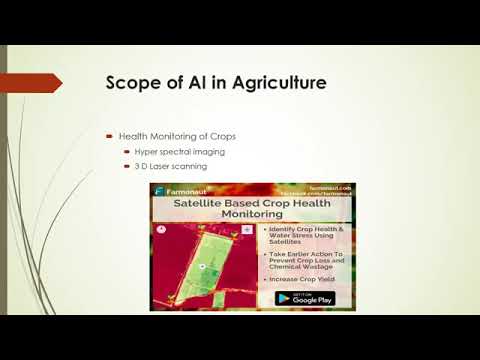
Farmonaut’s satellite-based crop health monitoring delivers NDVI maps, soil moisture readings, and input recommendations through Android, iOS, a carbon footprinting module, web app, and a developer API. That multi-channel access matters for the adoption gap USDA ERS documented: a midsize farm priced out of a $150,000 guidance-and-sensor equipment package can still access satellite-derived field data through a subscription model instead of a capital purchase.
FarmWise Labs approaches the same category from the robotics side: its AI and computer vision system powers automated weeding robots, including the Titan FT-35, that identify and remove weeds mechanically rather than chemically — a complementary approach to the herbicide-reduction figure AEM measured across precision ag adoption broadly.
2. Vertical Farming Solutions: Efficiency in Land- and Water-Constrained Regions
Vertical farming stacks crop production in controlled indoor environments, and its value proposition is specific: it solves for land scarcity and water scarcity simultaneously, at the cost of higher energy input than field production. Key benefits of vertical farming include:
- Producing food on a fraction of the land footprint of field agriculture, viable on urban or marginal sites
- Recirculating hydroponic and aquaponic systems that substantially cut water use versus open-field irrigation
- Year-round production independent of growing-season length or weather variability
- Reduced or eliminated pesticide use in a sealed indoor environment
Stacked Farm in Australia operates a fully automated vertical farm for herbs and leafy greens — a useful international reference point, though its water-use figures are company-reported rather than independently audited, so treat them as a directional claim rather than a benchmark to plan against. For US and European readers evaluating vertical farming, the more durable comparison point is your regional water utility or state agricultural extension office’s current irrigation cost per acre-foot, set against the capital and energy cost of an indoor system at your target production volume.

3. Open-Source Farming Projects: Democratizing Technology Access
Open-source farming hardware exists specifically to answer the affordability gap USDA ERS documented between large farms (70% autosteering adoption) and midsize operations (52%). FarmBot publishes open-source CNC farming machine designs and software, with full documentation that lets individuals, schools, and community groups automate seeding, irrigation, and weeding on small plots without buying proprietary equipment.
- Removes the licensing and capital barriers that gate proprietary precision-ag hardware
- Encourages local adaptation through shared, modifiable designs
- Supports self-sufficiency and urban agriculture at a scale commercial systems don’t target
By democratizing access to agricultural automation, open-source projects extend precision techniques to growers who would never clear the ROI threshold on a commercial system built for 1,000-plus acre operations.
4. Robotics in Agriculture & Farm Automation Technologies
Farm robotics addresses a labor problem precision software alone can’t: physical, repetitive field tasks. Agtech startups building in this category are combining AI with solar power and autonomous navigation to deliver:
- Continuous field monitoring without scheduled manual passes
- Real-time data collection on plant health and pest pressure during the same pass that performs the task
- Precision execution of weeding and spraying at the plant level rather than the field level
- Lower dependence on chemical inputs, consistent with the 9% herbicide reduction AEM attributes to precision ag adoption broadly
Solinftec’s Solix Ag Robotics platform runs solar-powered autonomous units that scan crops for nutrient deficiency and pest damage as they move through a field. Farmonaut approaches the automation problem from the fleet side: its Fleet Management module tracks tractors, harvesters, and drones to cut downtime and fuel use across a mixed equipment fleet, which is a distinct but complementary problem to robotic field execution.
5. Blockchain in Agriculture: Transparency from Farm to Buyer
Blockchain’s role in agriculture is narrower than the hype around the word suggests: it’s a tamper-evident record of custody, not a magic transparency machine. Its practical use is verifying that a claim made at the farm gate — organic status, origin, handling conditions — still holds by the time the product reaches a buyer or auditor.
- Hectare Agritech runs blockchain-based grain and livestock trading platforms in the UK, enabling direct sales and faster payment settlement between growers and buyers
- Farmonaut’s product traceability system logs crop origin, transport, and handling data for compliance, food-safety audits, and organic certification
- Shorter, verifiable supply chains reduce the disputes and delays that drive food loss between farm and retail
For exporters and processors serving retail brands with traceability requirements, this is a compliance tool first and a marketing tool second — the audit trail is what a certifier or buyer actually checks.
New Ag Technologies Worth Watching
Beyond the five established categories above, three adjacent developments are worth tracking because they change the economics of adoption rather than adding a new feature:
- Subscription-based satellite access is lowering the entry cost for precision monitoring below the price of purpose-built farm sensors, which directly targets the midsize-farm adoption gap USDA ERS measured (52% vs. 70% for autosteering).
- Carbon and sustainability reporting tools, like Regrow’s satellite-and-ML emissions modeling, are being pulled into agriculture by corporate supply-chain reporting requirements rather than by farmer demand alone — worth watching because the buyer isn’t always the farmer.
- Satellite-verified finance is a smaller but concrete trend: independent crop and yield verification is starting to substitute for on-site inspection in crop loan and insurance underwriting, which matters most for farmers who previously couldn’t get financed without a physical inspection visit.
For live tracking of where investment is actually flowing across these categories, PitchBook and CrunchBase both track agtech venture deals as they close, and CropLife publishes a quarterly rollup with deal-by-deal detail — useful because the 0.57% global VC share figure cited earlier is a single snapshot, not a trend line.
ROI Calculator: What Precision Ag Could Return on Your Acres
The AEM figures above ($66,000/year in added revenue and $52,000/year in input savings on a 1,000-acre operation) scale roughly linearly with acreage — use the calculator below to apply those same per-acre rates to your own operation size and current input spend.
Run your own numbers
Assumptions: applies the AEM-reported 5% average yield gain and 8% average input-cost reduction (blended across fertilizer, herbicide, fuel, and water) uniformly across your acreage. It excludes financing costs, learning-curve losses in year one, and the fact that AEM’s underlying study measured aggregate, not per-region, results — actual results vary by soil type, crop, and how much of your current operation is already optimized. Use your own NASS Quick Stats input prices for a more precise baseline.
Farmonaut: A Satellite-First Agriculture Technology Company
Farmonaut is an agriculture technology company built around making satellite-based precision agriculture accessible below the capital threshold of hardware-based systems. Its product set maps onto the adoption gap the USDA ERS data documents between large and midsize farms:
- Satellite-Based Crop Health Monitoring: Multispectral imagery and NDVI analytics surface vegetation health, soil moisture, and nutrient status via mobile, web, and API integration.
- AI-Driven Jeevn Farm Advisory: Combines weather forecasts with satellite data for field-specific management recommendations.
- Blockchain-Powered Traceability: Secures origin, transport, and handling data for exporters and certification programs — see Farmonaut Traceability.
- Fleet Management: Machinery deployment optimization for agribusinesses running mixed equipment fleets.
- Carbon Footprinting: Satellite-derived emissions tracking via the carbon footprint tool, relevant to the sustainability-reporting trend covered above.
- Financial Verification: Independent satellite crop verification for banks and insurers underwriting crop loans and insurance.
For large-scale operations and government programs, Farmonaut’s Agro-Admin App extends the same satellite data layer to fleet- and jurisdiction-level monitoring rather than single-field use.
Why Agtech Startups Struggle to Scale
The 0.57% share of global venture capital that agtech receives (Market Research Future) is a useful proxy for why so many promising agriculture startups stall before reaching the adoption levels USDA ERS documents for established technology like autosteering. The recurring constraints:
- High capital requirements to develop, validate, and manufacture field-ready hardware
- Regulatory hurdles around food safety, data ownership, and land use that vary by US state and by EU member country
- The adoption gap between large farms (70% autosteering) and midsize farms (52%) that persists even where the ROI case is strong
- Farmer education and support requirements that most seed-stage startups can’t fund at scale
- Localization needs — crop variety, soil type, and regional input pricing that a one-size model doesn’t capture
Progress on closing that gap will show up first in the ARMS adoption data USDA republishes annually, not in venture funding totals — funding measures enthusiasm, adoption measures whether the product actually works on a working farm.
Curious how this plays out in an adjacent sector using nearly identical satellite and monitoring technology applied to mining rather than farming? The overlap explains why the same core sensing technology reaches both industries at similar price points.
Frequently Asked Questions
What is an agtech startup?
An agtech startup is a company developing and deploying technology specifically for agriculture — AI, satellite imaging, blockchain, or robotics — aimed at raising productivity or cutting input costs. Most target one narrow problem: precision input management, indoor crop production, autonomous field tasks, or verified supply-chain records.
Is precision agriculture harmful to farmers?
Published USDA ERS and AEM data show precision agriculture correlating with higher net returns (13% for dairy robotic milking, per USDA ERS) and lower input costs (8% fertilizer, 9% herbicide reduction, per AEM), not worse farmer outcomes. The legitimate concern is affordability and contract terms for midsize and small operations, not the technology’s effect on yield or income.
What are the leading agriculture startups by category?
By category: Farmonaut and Regrow in satellite-based precision agriculture, FarmWise Labs and Solinftec in field robotics, Stacked Farm in vertical farming, FarmBot in open-source hardware, and Hectare Agritech in blockchain-based trading. No independent, audited ranking of these companies by revenue or market share is currently published — treat vendor-reported figures as directional.
How much does precision agriculture actually save?
AEM’s February 2026 study found average reductions of 8% in fertilizer, 9% in herbicide, 7% in fuel, and 5% in water use, alongside a 5% productivity gain — translating to roughly $52,000/year in combined input savings and $66,000/year in added revenue on a 1,000-acre row-crop farm. Use the calculator above with your own acreage and current input costs for a farm-specific estimate.
How does Farmonaut make agtech accessible?
Farmonaut offers satellite-based monitoring, AI advisory, blockchain traceability, and carbon tracking through subscription pricing rather than hardware purchase, via mobile and web apps and a developer API — positioned specifically to reach the midsize-farm segment USDA ERS shows adopting precision technology at lower rates than large operations.
What new ag technologies should I watch?
Subscription-priced satellite access, corporate-driven carbon and sustainability reporting tools, and satellite-verified crop financing are the three developments most likely to change adoption economics in the near term, since each targets a specific cost or access barrier rather than adding a new sensor category.
Where can I access satellite crop data or start with Farmonaut?
Download the Android app or iOS app, use the web application, or visit the API page for satellite and weather data integration.
Further reading:
Conclusion: Choosing an Agtech Partner on Evidence, Not Hype
The strongest case for adopting agtech isn’t a startup’s pitch — it’s the USDA ERS and AEM data showing measurable, sourced returns: 70% large-farm autosteering adoption, 13% higher dairy net returns from robotics, and a combined roughly $118,000 annual swing in revenue and input savings on a 1,000-acre operation. Startups across precision agriculture, vertical farming, robotics, open-source hardware, and blockchain traceability are each solving a distinct piece of that picture, and the right one for a given farm depends on which constraint — capital, labor, land, water, or buyer trust — is binding first.
Before committing capital, pull current numbers for your own operation: USDA NASS Quick Stats for input prices, the annual ARMS release for adoption benchmarks by farm size, and a direct ROI calculation using your own acreage rather than a national average.
Start Your Journey with Precision Agriculture—Explore Farmonaut’s Solutions Today
Discussion
Questions, corrections or field experience? Share them below. First-time comments are reviewed before they appear, and your email is never published.
No comments yet. Be the first to add a question or your experience.

 Click2Cloud
 TVS Electronics
 BW Pipelines
 WICO
 Gen Chayat
 Chimera Innovation
 SkyHarvest
 Polaris Digitech
 Teledarbas
 Wild Oak Farm
 SFX
 BACF Africa
 Doodlakine
 Exurbia Geospatial
 FieldZero
 Indico Company

 Licence holder · Niger · Gold










