

Reviewed August 2026 against Our World in Data / FAO emissions series, FAO GIEWS country briefs, and the IIETA Journal of Sustainable Development and Planning survey on precision agriculture in Algeria.
Try it: Run your own numbers →
Algeria’s agricultural GHG emissions reached 19,575.24 ktCO₂eq in 2020, up 74.3% from 1990, according to Our World in Data’s national emissions series sourced from FAO. Over the same three decades, methane from livestock intensification rose 68.5% and nitrous oxide from fertilizer and soil management rose 85.5%. Those two trend lines — output that has to keep growing to feed a country that imports the majority of its grain, and emissions that have grown faster than the sector itself — are the real story behind every search for “Algeria agriculture.”
Table of Contents
- Introduction: Where Algeria’s Agriculture Industry Stands
- The Scale and Sources of Agricultural Emissions
- Production, Trade, and the Cereal Import Gap
- Comparative Data: Emissions, Practices & Reductions
- Agro Drones and Precision Agriculture Adoption
- Policy Response & Emission Reduction Strategies
- Innovation & Agro-Based Industry Opportunities
- Calculator: Precision Input Savings for Algerian Farms
- Socioeconomic Impacts & Future Outlook
- Essential Apps and Satellite Solutions
- Farmonaut: Satellite Technology for Algeria’s Agro Sector
- FAQ: Algeria Agriculture Industry & Emissions
- Conclusion: A Verifiable Path Forward
1. Introduction: Where Algeria’s Agriculture Industry Stands
The Algeria agriculture industry employs a substantial share of the rural workforce and anchors food security in a country where domestic cereal production covers only a fraction of consumption. Algeria produced 3.5 million tonnes of cereals in the 2024 season, per the FAO GIEWS Country Brief, while importing 14 million tonnes of cereal grain in the 2023/24 marketing year to close the gap — a ratio of roughly four import tonnes for every domestic tonne grown. That structural dependence on imports, combined with a semi-arid climate and a livestock sector that drives most of the country’s agricultural methane, defines both the opportunity and the emissions challenge covered below.
- ✔ The agricultural industry is a measurable source of national GHG emissions, tracked annually by FAO and reflected in Our World in Data’s country profile.
- 📊 Livestock and fertilizer application are the leading contributors to methane (CH₄), nitrous oxide (N₂O), and CO₂.
- ⚠ Cereal self-sufficiency remains low: domestic production covers a minority of national consumption.
- 💡 Precision agriculture awareness is high among Algerian agricultural engineers, but actual field implementation lags far behind.
- 🌍 Alignment with Paris Agreement NDC targets is now a stated national priority for the agricultural sector.
- Try it: Run your own numbers

2. The Scale and Sources of Agricultural Emissions
Algeria’s agricultural GHG emissions stood at 19,575.24 ktCO₂eq in 2020, the most recent year in Our World in Data’s national emissions series (sourced from FAO data). That figure represents a 74.3% increase since 1990 — faster growth than the sector’s output over the same period, which is the clearest sign that emissions intensity, not just farmed area, has risen. Two sub-sources account for most of that growth:
Key Greenhouse Gas Sources
- Methane (CH₄): Livestock intensification — cattle, sheep, and goats via enteric fermentation and manure — drove a 68.5% increase in methane emissions between 1990 and 2020, per FAO’s emissions database as cited by FAO’s Greenhouse Gas Emissions from Agrifood Systems report.
- Nitrous Oxide (N₂O): Fertilizer application and soil management pushed N₂O emissions up 85.5% over the same three decades, the fastest-growing category in the national inventory.
- Carbon Dioxide (CO₂): Land-use change, mechanization, and irrigation energy use contribute the balance, though FAO’s country-level breakdown for Algeria does not isolate a standalone CO₂ figure separate from the CH₄ and N₂O totals above.
To put Algeria’s 2020 total in continental context: FAOSTAT reports agricultural emissions across the whole of Africa at roughly 2.2 gigatonnes CO₂eq in 2018. Algeria’s 19,575.24 ktCO₂eq — about 0.02 gigatonnes — is a small slice of that continental total, but its 74.3% growth rate since 1990 outpaces the global average rate of agricultural emissions growth over the same window, per Our World in Data’s Algeria emissions profile.

Compounding pressures on the ground include:
- ✔ Irrigation practices that increase water stress and soil salinization in semi-arid zones.
- 📊 Fertilizer and pesticide overuse, which raises N₂O emissions while degrading soil fertility and water quality over time.
- ⚠ Land degradation in semi-arid regions, where vegetation cover and soil organic carbon are already thin.
- 🐄 Livestock (Cattle, Sheep, Goats)
- 🧪 Fertilizers (Chemical, Organic)
- 🌱 Cropland Expansion
- 🌳 Deforestation
- 🚜 Mechanization (Fossil Fuels)
- 💧 Irrigation Inefficiencies
- 🗑️ Organic Waste/Residues
- 💨 Manure Mismanagement
3. Production, Trade, and the Cereal Import Gap
Wheat production in Algeria reached 2.2 million metric tons in 2021, per FAO/USDA figures, before total cereal output (wheat, barley, and other grains combined) settled at 3.5 million tonnes in the 2024 FAO GIEWS Country Brief. Barley — a crop more tolerant of Algeria’s rainfall variability than wheat — is grown across 978 thousand hectares nationally, according to FAO and national statistics. Olive oil and olive production add 700,000 to 1,000,000 metric tons annually in recent years, per FAO, making olives one of the few crop categories where Algeria is closer to self-sufficient.
The gap that matters most for national food security is cereals: 14 million tonnes of cereal grain were imported in the 2023/24 season against 3.5 million tonnes produced domestically the following year. That import dependence is driven by rainfall variability across the wheat- and barley-growing north, and it is precisely the kind of exposure that satellite-based yield monitoring and irrigation scheduling are built to reduce — by catching moisture stress and nutrient deficiency early enough to act on, rather than after harvest.
4. Comparative Data Table: Emissions, Practices & Reductions
The table below separates what the research brief confirms with hard numbers from what remains a documented gap. Where Algeria-specific emissions-by-activity breakdowns are not published in the sources reviewed for this article, that is stated directly rather than filled with an invented figure.
| Metric | Figure | Period | Source |
|---|---|---|---|
| Total agricultural GHG emissions | 19,575.24 ktCO₂eq | 2020 | Our World in Data / FAO |
| Growth in agricultural GHG emissions | +74.3% | 1990–2020 | Our World in Data |
| Methane growth (livestock intensification) | +68.5% | 1990–2020 | FAO emissions database |
| Nitrous oxide growth (fertilizer & soil mgmt.) | +85.5% | 1990–2020 | FAO emissions database |
| Cereal grain imports | 14 million tonnes | 2023/24 season | FAO GIEWS |
| Total cereal production | 3.5 million tonnes | 2024 | FAO GIEWS Country Brief |
| Emissions per farmed activity (livestock, fertilizer, irrigation breakdowns in MtCO₂e) | Not published in reviewed sources | — | Gap — see FAOSTAT refresh method above |
| Fertilizer application rates (kg/hectare) and nitrogen leaching | Not published in reviewed sources | — | Gap — request from national agricultural ministry or FAOSTAT input-use tables |
The two “not published” rows are deliberate: no credible per-activity emissions breakdown (livestock vs. fertilizer vs. irrigation, in MtCO₂e) for Algeria specifically was found in the sources available for this review. A reader who needs that granularity should query FAOSTAT’s “Emissions by sector” tables filtered to Algeria, which break the national total into IPCC-standard categories.

5. Agro Drones and Precision Agriculture Adoption
The clearest published evidence on Algeria’s precision-agriculture readiness — which covers agro-drone use as one input among several — comes from a survey of agricultural engineers published in the IIETA Journal of Sustainable Development and Planning. It found that 84.3% of surveyed agricultural engineers in Algeria were aware of precision agriculture methods, but only 19.7% were actively implementing them in the field. That 64.6-percentage-point gap between awareness and implementation is the single most useful number in this space: it says the barrier is not knowledge, it is deployment — equipment cost, technical support, and a lack of the kind of ready-to-use monitoring platforms that reduce the skill floor for adoption.
On agro-drone use specifically: no published market-size figure, per-hectare drone service rate, or crop-specific (wheat, barley, date palm) drone adoption rate for Algeria was found in the sources reviewed for this article. That is a genuine data gap, not an oversight — drone market reports for North Africa tend to aggregate regionally rather than break out Algeria, and no national drone-adoption census appears in the FAO or IIETA material used here. A reader trying to size the opportunity locally should treat the 19.7% precision-ag implementation rate as the closest available proxy and look for drone-specific figures in equipment-import statistics from Algeria’s customs authority, which would capture agricultural drone imports by HS code.
Where satellite monitoring fits alongside drones: drones give high-resolution imagery on demand for a single field visit, while satellite platforms like Farmonaut provide the same NDVI-style vegetation and moisture signal on a recurring schedule without a flight crew, which matters for a country where only one in five aware engineers has moved past the awareness stage. For farms that cannot yet justify drone-service costs, satellite-based monitoring is the lower-cost entry point into the same precision-agriculture category the IIETA survey measured.
6. Policy Response & Emission Reduction Strategies
Algeria’s government has framed agricultural emissions within its nationally determined contributions (NDCs) to the Paris Agreement, pairing regulatory targets with incentive-based mechanisms aimed at the same two categories driving emissions growth: livestock methane and fertilizer-related nitrous oxide.
Key Government Strategy Areas
- ✔ Promotion of sustainable practices: precision agriculture, reduced tillage, and optimized fertilizer use — directly targeting the 85.5% N₂O growth driver.
- 📊 Livestock emissions reduction: improved feeding, breeding, and manure management to address the 68.5% methane growth driver.
- 🌳 Afforestation and agroforestry expansion: restoring degraded land and building carbon sinks.
- 🔄 Biomass energy and waste valorization: incentives for biogas and renewable energy in rural areas.
- 📋 Regulatory alignment: sectoral targets tied to NDC commitments under the Paris Agreement.

Afforestation, Agroforestry & Carbon Sequestration
Agroforestry and afforestation initiatives serve both emission reduction and rural income goals:
- 🌳 Local carbon sequestration that offsets a share of GHG emissions from intensive agriculture.
- 🌱 Diversified income streams for rural households alongside primary crop or livestock production.
- 💧 Improved soil moisture retention and biodiversity restoration in degraded semi-arid land.

Technological Enablers for Policy Success
Turning NDC commitments into measured reductions depends on monitoring infrastructure that can verify, not just estimate, progress. Real-time monitoring and adaptive management:
- ✔ Improve policy targeting and evaluation against the 2020 emissions baseline.
- 📊 Measure emission reductions with field-level precision rather than national estimates.
- ⚡ Enable faster response to environmental stress and climate extremes.
Learn more about digital carbon footprinting for your agricultural operation — use satellite data and analytics to benchmark, reduce, and report emissions with field-level accuracy rather than relying on national averages.
Modern agro-tech adoption, guided by the IIETA survey’s finding that implementation — not awareness — is the binding constraint, is the most direct lever available for closing Algeria’s precision-agriculture gap between 84.3% aware and 19.7% implementing.
7. Innovation & Agro-Based Industry Opportunities
The agro-based industry’s growth is tied to how quickly Algeria can convert precision-agriculture awareness into field-level implementation, and to how effectively agricultural residues and waste streams are redirected away from open burning and toward energy or compost.

Key Opportunities for Emission Reduction and Value Addition
- ✔️ Valorizing Agricultural Residues: Converting crop waste into biogas, compost, and bio-based products cuts methane emissions and builds circular-economy value from barley straw and olive processing waste.
- ✔️ Renewable Energy-Powered Irrigation: Solar- and wind-powered irrigation reduces the fossil-fuel dependency behind part of the sector’s CO₂ footprint.
- ✔️ Precision Agriculture: GIS, remote sensing, and IoT devices help close the 64.6-point gap between precision-ag awareness (84.3%) and implementation (19.7%) documented by the IIETA survey.
- ✔️ Drought-Resilient Crops: Varieties suited to rainfall variability reduce both irrigation demand and the risk behind Algeria’s 14-million-tonne cereal import bill.
- ✔️ Digital Traceability: Platforms such as Farmonaut give food processors, exporters, and retailers reliable traceability from field to consumer (Blockchain Traceability for Food & Agro Industry).




Farmonaut delivers satellite-driven advisory and environmental monitoring tools that lower the deployment barrier the IIETA survey identified — the gap between engineers who know precision agriculture exists and those who can actually run it on a farm. That gap narrows fastest where the entry cost of the tooling itself falls, from smallholder plots up to large agribusinesses and government agencies.
Streamline your agricultural financing or insurance processes — use Farmonaut’s satellite verification for bank loans and crop insurance, improving access to finance while cutting risk and fraud.
Waste to Energy: Turning Challenges into Opportunity
- 🗑️ Composting reduces methane emissions from raw crop residues such as barley straw.
- ⚡ Rural biogas plants offer clean energy and new income streams from livestock manure.
- 🔋 Straw and olive-processing waste, often burned in open fields, can generate bioelectricity or industrial fuel for agro-processing.
Developers and agribusinesses seeking deeper integration can tap into the Farmonaut Satellite API and use the API Developer Docs to embed real-time crop, weather, and emissions analytics within local farm management systems.

🌐 Leading Digital Tools for Emission-Focused Agro Industry
- Satellite-Based Crop Health Analytics (NDVI, moisture, pest risk detection)
- AI-Driven Advisory Systems for optimal resource management
- Blockchain Traceability for food exports and input verification
- Fleet & Resource Management for input logistics and emission reduction
8. Calculator: Precision Input Savings for Algerian Farms
The IIETA survey found 19.7% of Algerian agricultural engineers are actively implementing precision agriculture against 84.3% who are aware of it — the tool below lets you estimate what closing that gap on fertilizer and irrigation input alone could be worth on a specific farm, using your own area, input cost, and expected reduction range.
Run your own numbers
Assumptions: savings are calculated only against the share of area actually under precision monitoring, reflecting the IIETA survey’s 19.7% implementation rate rather than the 84.3% awareness rate. This excludes labor cost changes, equipment financing, yield effects, and any government incentive payments — it estimates input-cost savings only, not total return on investment.
9. Socioeconomic Impacts & Future Outlook
Addressing agricultural industry emissions is an economic question as much as an environmental one for Algeria’s rural communities. Sustainable practices bring compound benefits:
- ✔ Job Creation: New roles in precision agriculture, agri-tech service delivery, and green agro-processing.
- 📊 Improved Soil and Food Security: Enhanced fertility and yield resilience against the rainfall variability behind the 14-million-tonne cereal import figure.
- 🌍 Greater Inclusion: Rural communities gain access to digital tools for participation in local and international value chains.
- ✅ Stronger Climate Resilience: Farms using monitoring tools can respond to drought and pest pressure faster than those relying on visual inspection alone.
- 💰 Economic Diversification: Less reliance on hydrocarbons, more stable livelihoods from agriculture and allied industries.
Extension workers and researchers need capacity building to translate the IIETA survey’s 84.3% awareness rate into deployed tools. Farmonaut satellite solutions are built to lower that specific barrier, making emissions monitoring and resource management accessible at the smallholder scale where the 19.7% implementation rate needs to grow fastest.
Future Roadmap: Enablers for the Years Ahead
- 🔑 Access to Finance: Satellite risk verification and carbon reporting to connect farmers and SMEs with green finance.
- 💡 Policy-Private Collaboration: Multi-stakeholder alliances to widen adoption beyond the current 19.7% implementation rate.
- 🧑🏫 Ongoing Training: Upskilling extension agents and rural entrepreneurs to close the awareness-to-implementation gap directly.
- 📱 Platforms for Scale: Mobile and digital app adoption, such as Farmonaut, for monitoring, analysis, and advisory services.
- 🌍 Global Alignment: Measurable, transparent progress against NDC and food-security targets.
10. Essential Apps and Satellite Solutions for Algeria’s Agro Industry
Emissions tracking, mitigation, and sustainable development in Algeria’s agricultural sector require accessible technology platforms serving farms, cooperatives, banks, and government departments alike.
- ✔ Monitoring GHG and carbon emissions at field, farm, and regional level
- 📊 Optimizing fertilizer, irrigation, and crop management decisions
- 📉 Tracking reductions and improvements for carbon markets or compliance
- 🔒 Blockchain traceability for food safety and exports (Read more on Traceability)
- 📱 Access via mobile app, desktop browser, or direct API
11. Farmonaut: Satellite Technology for Algeria’s Agro Sector
As Algeria’s agriculture industry works to reduce emissions and close the precision-agriculture implementation gap, Farmonaut supports farmers, businesses, government bodies, and value chain actors with:
- ✔ Satellite-Based Monitoring: Multispectral imagery of crops, water resources, and infrastructure delivering data on soil health, vegetation vigor, and field productivity.
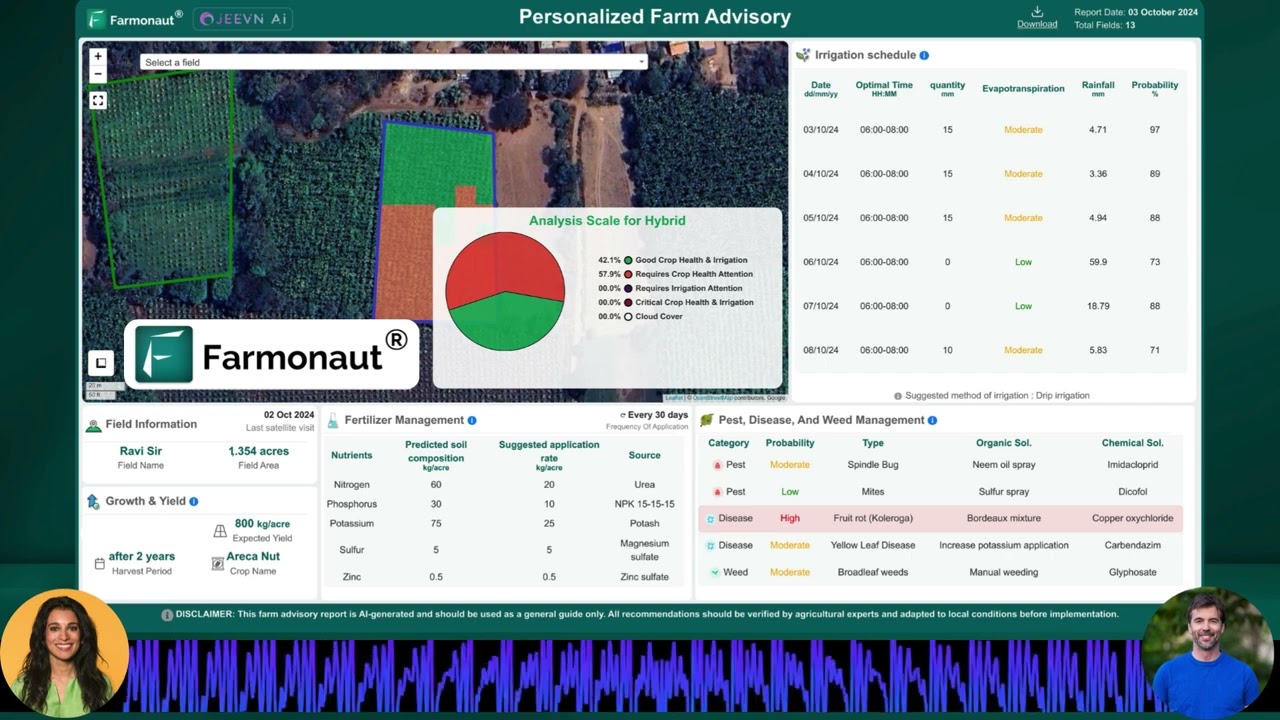
- ✔ AI-Powered Advisory: Jeevn AI provides climate-smart recommendations, crop-specific guidance, and early warnings tailored for Algeria’s semi-arid landscape.
- ✔ Blockchain Traceability: Product authenticity, supply chain transparency, and food safety for exports and local markets.
- ✔ Fleet & Resource Management: Track movement, optimize machine usage, and cut fuel wastage in agricultural logistics. Explore Fleet Management solution for large-scale operations.
- ✔ Environmental Impact Tracking: Monitor and report carbon footprints, NDC progress, and sustainability metrics for compliance and market access.
The modular, API-first architecture lets users in Algeria’s agro-based industry tailor digital solutions to their specific needs. Learn more about carbon footprinting and environmental monitoring as part of the sector’s ongoing shift toward measurable, verifiable emissions reduction.
12. FAQ: Algeria Agriculture Industry, Emissions & Sustainability
A1: Enteric fermentation in livestock (methane grew 68.5% from 1990–2020) and fertilizer/soil management (nitrous oxide grew 85.5% over the same period) are the two documented drivers, per FAO’s emissions database. Total agricultural emissions reached 19,575.24 ktCO₂eq in 2020, up 74.3% since 1990.
Q2: How dependent is Algeria on cereal imports?
A2: Algeria imported 14 million tonnes of cereal grain in the 2023/24 season against 3.5 million tonnes produced domestically in 2024, per FAO GIEWS. Wheat production alone was 2.2 million metric tons in 2021 (FAO/USDA).
Q3: How widely is precision agriculture used in Algeria?
A3: An IIETA Journal survey of Algerian agricultural engineers found 84.3% were aware of precision agriculture methods, but only 19.7% were actively implementing them — a gap driven by deployment cost and technical support rather than lack of knowledge.
Q4: Is there published data on agro-drone use in Algeria?
A4: No Algeria-specific drone market size, adoption rate, or per-crop usage figure was found in the sources reviewed for this article. The closest available proxy is the 19.7% precision-agriculture implementation rate from the IIETA survey; drone-specific data would need to come from customs import statistics or a dedicated market study not yet published in English-language sources.
Q5: What role does technology play in Algeria’s emission reduction strategy?
A5: Satellite and AI-driven platforms enable real-time monitoring, carbon emissions reporting, resource optimization, and traceability — directly addressing the implementation gap the IIETA survey identified.
Q6: Where can I find the most current emissions and production figures for Algeria?
A6: FAOSTAT (fao.org/faostat) publishes updated Agrifood Systems emissions data by country, typically refreshed by mid-year; FAO GIEWS issues periodic country briefs with the latest cereal production and import figures. Compare any new figure against the 2020 emissions baseline (19,575.24 ktCO₂eq) and 2024 cereal production baseline (3.5 million tonnes) cited in this article.





13. Conclusion: A Verifiable Path Forward
Algeria’s agriculture industry sits between two documented trends: agricultural GHG emissions that grew 74.3% between 1990 and 2020 to reach 19,575.24 ktCO₂eq, and a precision-agriculture implementation rate of just 19.7% despite 84.3% awareness among agricultural engineers. Closing that adoption gap is the most direct lever available for slowing both the 68.5% methane growth from livestock and the 85.5% nitrous oxide growth from fertilizer use documented over the same three decades.
The durable checklist for tracking this sector going forward:
- ✔ Check FAOSTAT (fao.org/faostat) for the current agricultural emissions total against the 19,575.24 ktCO₂eq (2020) baseline.
- ✔ Check FAO GIEWS country briefs for the current cereal production figure against the 3.5 million tonnes (2024) baseline and import volume against 14 million tonnes (2023/24).
- ✔ Watch for any replication of the IIETA precision-agriculture survey to see if the 19.7% implementation rate has moved from its 84.3%-aware baseline.
- ✔ Treat any Algeria-specific agro-drone market figure with caution until a dedicated study is published — none exists in the sources reviewed here.
Farmonaut continues to build affordable satellite-driven tools aimed at closing the precision-agriculture implementation gap this article documents — from smallholder plots up to national-scale monitoring.
For further tools, advisory and digital solutions for the Algerian agro sector, explore:
- Carbon Footprinting
- Traceability Solutions
- Crop Loan & Insurance Verification
- Fleet Management
- Large Scale Farm Management

 Godrej Agrovet
 Hayleys Agriculture
 Linx Agritech
 Adinet
 Save Your Soils
 GalaxEye Space
 Grandstream Algérie
 XOS Realty
 Geospatial Lab Africa
 Agro La Gándara
 HIPSAC
 ZOL Zimbabwe
 Juligerm
 AdBio
AdBio MISE Maroc
 NWNS
NWNS Red August Group
 Farm Inc
 WeMe Global
 Agrotoken
 Blue BearX
 Insignito
 DnCubed
 Indosistim Teknologi
 Liquify Digital
 CU Foods
 BeyondTech Global
 Rouge VC
 AgroRisk
 Oath Inc
 Esri North East Africa
 MDCV UK
 Etech Consulting Madagascar
 Vestlandsforsking
 WB Dev
 Sama Premium
 Tres Valles
 Blickwinkel
 Agricultural Credit Policy Council
 eKGIS
eKGIS Mostas Tech
 Andex
Andex Deluxe Conseil
 WICO
WICO Chimera Innovation
 SkyHarvest
 Teledarbas
 Exurbia Geospatial
 FieldZero
