

South Africa · Agribusiness guide
Agriculture Companies in South Africa: Revenue & Investors
The largest listed agriculture companies in South Africa by latest revenue are RCL Foods (R24.5 billion, June 2026), Omnia (R24.2 billion, March 2026), Astral Foods (R22.6 billion, September 2025) and KAL Group (R20.3 billion, September 2025). Here is each one’s farm business, plus who invests in the sector.
Key takeaways
- Latest annual revenue: RCL Foods R24.5 billion (year to June 2026), Omnia R24.2 billion (to March 2026, R13.1 billion from agriculture), Astral R22.6 billion and KAL Group R20.3 billion (both to September 2025).
- Smaller listed groups: Quantum Foods (R7.15 billion), Crookes Brothers (headline earnings per share down 93-99% to March 2026) and investment company Zeder. Senwes and AFGRI are not on the JSE.
- Farming grew 17.4% in 2025 and added 0.4 of a point to GDP growth of 1.1% (Stats SA); it was about 2.8% of GDP (World Bank).
- State funding is tight: the Blended Finance Scheme needs about R1.5 billion a year but had R613 million for 2026/27 (Parliament), and the Land Bank paused new applications.
- Tractor sales were 8.8% lower in January to September 2026 than a year earlier (SAAMA), after 7,668 units in 2025.
In this article
- Agriculture companies in South Africa at a glance
- How we chose and checked the companies
- The main listed agriculture companies in South Africa
- Large co-ops and unlisted agri groups
- How big is farming in the South African economy?
- Who invests in South African agriculture?
- Agricultural machinery suppliers in South Africa
- Farm investment return calculator in rand
- How to judge an agriculture company or farm investment
- FAQ
The largest listed agriculture companies in South Africa by latest annual revenue are RCL Foods (R24.5 billion, year to June 2026), Omnia (R24.2 billion, year to March 2026, of which R13.1 billion came from agriculture), Astral Foods (R22.6 billion, year to September 2025) and KAL Group (R20.3 billion, year to September 2025). Behind them sit smaller listed groups such as Quantum Foods, Crookes Brothers and Zeder, and large unlisted grain and input groups such as Senwes and AFGRI.
This guide lists each company with its main business, its latest reported figures and the date of the report. It then covers who puts money into South African farming (the Land Bank, the state’s Blended Finance Scheme, the Industrial Development Corporation and listed investors), gives a short look at the machinery market, and ends with a calculator that tests a farm investment in rand. Where a company does not publish a number, we say “not disclosed”.
Agriculture companies in South Africa at a glance
The table gives the latest full-year figure each company had published by 16 October 2026. Year ends differ, so compare the dates as well as the amounts.
| Company | Listing | Main agri business | Latest annual revenue | Financial year end |
|---|---|---|---|---|
| RCL Foods | JSE | Sugar, milling and baking, animal feed, groceries | R24.5 billion (down 4.1%) | June 2026 |
| Omnia | JSE | Fertilizer and crop nutrition (plus mining and chemicals) | R24.2 billion group; R13.1 billion agriculture | March 2026 |
| Astral Foods | JSE | Poultry and animal feed | R22.6 billion (up 10%) | September 2025 |
| KAL Group | JSE | Farm input retail, fuel and convenience stores | R20.3 billion (down 6.6%) | September 2025 |
| Quantum Foods | JSE | Animal feed, broiler and layer farming, eggs | R7.15 billion (up 12.9%) | September 2025 |
| Crookes Brothers | JSE | Sugar cane, macadamias, bananas, land | Not given in the trading statement | March 2026 |
| Zeder | JSE | Investment holding in agri businesses | Reports net asset value, not sales | February (half year to August) |
| Senwes | Not on the JSE | Grain handling, inputs, equipment, credit | Not disclosed in the interim report we used | April (half year to October) |
| AFGRI | Unlisted since 2014 | Grain storage, equipment, finance | Not disclosed | Not disclosed |
Chart
Latest annual revenue, selected listed agri groups
R billion, group revenue for each company’s latest published financial year (year end in brackets)
How we chose and checked the companies
We included companies that earn most of their money from farming, farm inputs or the first stage of food processing, and that publish results. That rules out large retailers and consumer brands that only buy farm products. We took every figure from the company’s own results release, its stock exchange (SENS) announcement or a dated news report of those results. Revenue is the group figure unless we say it is a segment. We did not rank companies on profit, because profit swings a lot from year to year in this sector and the companies use different measures.
Some groups are missing on purpose. Co-operatives and private companies that do not release results, and family farming groups, have no public numbers we could check. If you need them, ask the company for its latest annual financial statements.
The main listed agriculture companies in South Africa
1. RCL Foods: sugar, baking and feed
RCL Foods is a Durban-based food producer with three business units: Sugar (which includes the Molatek animal feed brand), Baking and Groceries. In the year to June 2026, revenue fell 4.1% to R24.5 billion and headline earnings per share fell 32.8% to 105.1 cents, according to the RCL Foods results release of 31 August 2026. The prior year was R25.5 billion.
Chart
RCL Foods revenue by business unit
R billion, year to June 2026
Sugar is the unit with the closest link to farming. Its revenue dropped 8.2% to R9.89 billion. The company blamed deep-sea sugar imports of 212,684 tons, up 24.2%, and a tariff it called ineffective. Baking was flat at R9.29 billion, and Groceries fell 3.2% to R5.24 billion after a pet food recall.
Why it matters to farmers: RCL’s mills buy cane from growers, and its results show how import prices feed back to cane growers and millers.
2. Omnia: fertilizer and crop nutrition
Omnia makes and sells fertilizer, crop nutrition products and biostimulants, and it also has mining explosives and chemicals units. For the year to 31 March 2026, group revenue rose 6% to R24.2 billion. The Agriculture segment grew revenue by 13% to R13.1 billion, and its operating profit rose 28% to R1.3 billion, at a margin of 9.6%, according to Omnia’s results statement of 8 June 2026. Mining revenue was R9.8 billion.
Omnia said South African volumes rose at higher average prices, and that its businesses in Zambia and Zimbabwe recovered. Abroad, it reported more biostimulant exports, including to China, strong output in Australia and higher volumes in the USA.
Why it matters to farmers: Omnia is a large local fertilizer supplier, so its volumes and prices are a guide to input costs before planting.
3. Astral Foods: poultry and feed
Astral is an integrated poultry group: it runs feed mills, breeding farms, broiler farms and processing plants. In the year to 30 September 2025, revenue rose 10% to R22.6 billion and headline earnings per share rose 14% to 2,193 cents, according to Astral’s audited results announcement of 17 November 2025.
The next year started strongly. In a trading statement on 29 April 2026, Astral said it expected headline earnings per share for the six months to March 2026 to rise by 450% to 470%, to between 2,250 and 2,331 cents. It gave no reason, but had said in March that strong poultry demand had lifted sales and let it produce more broilers. Full-year results to September 2026 had not been published by 16 October 2026.
Why it matters to farmers: poultry farms buy large amounts of maize and soybean meal for feed, so Astral’s feed costs and volumes link straight back to grain growers.
4. KAL Group (formerly Kaap Agri): inputs, retail and fuel
KAL Group, the JSE-listed successor of Kaap Agri, runs farm input stores, fuel stations and convenience shops in southern Africa. In the year to September 2025, revenue fell 6.6% to R20.3 billion. The company said lower fuel prices accounted for 5.8 percentage points of that fall. Headline earnings per share rose 10.6% to 620.98 cents, and the dividend rose 16.7% to 210 cents (BusinessDay and Business Report, 27 November 2025).
Why it matters to farmers: KAL’s results mix farm sales with fuel, so revenue tells you little about farm demand on its own. Look at gross profit and the agri trade comments instead.
5. Quantum Foods: feed, eggs and broilers
Quantum Foods sells animal feed, farms layers and broilers, and markets eggs under the Nulaid brand. In the year to September 2025, revenue rose 12.9% to R7.15 billion, operating profit rose 55.3% to R361 million and headline earnings per share rose 67.1% to 134.4 cents (BusinessDay, 30 November 2025). Feed revenue grew 5.6% to R3.3 billion and farming revenue grew 8.5% to just over R2 billion. Egg prices fell 17.1%, but higher volumes kept the egg unit profitable.
Why it matters to farmers: the group sells feed to other livestock farmers, so it is both a competitor and a supplier.
6. Crookes Brothers: cane, macadamias and land
Crookes Brothers grows sugar cane, macadamias and bananas, and sells land. In a trading statement for the year to 31 March 2026, it said headline earnings per share would fall by 93% to 99%, to between 2.35 and 27.85 cents. It named lower sugar prices and delayed land sales, plus a R256 million impairment on its macadamia business, which affects basic earnings but not headline earnings (trading statement, 12 June 2026). Revenue was not given in that statement.
Why it matters to farmers: much of its income comes from its own orchards and cane fields, so its results show farm-gate pressure clearly.
7. Zeder: an investor in agribusiness
Zeder is a JSE-listed investment company. It does not report sales; it reports the value of its holdings. Net asset value fell 21.9% to R1.68 per share in the six months to 31 August 2025, partly because of a 31-cent special dividend and lower valuations. Its seed business, Zaad, was valued at R2 billion, and Zeder agreed to sell Zaad operations in Zimbabwe, Mozambique and Zambia to ETG Inputs (Business Report, 21 October 2025).
Why it matters to investors: Zeder gives exposure to several agri businesses through one JSE share, though it has been selling assets.
For a wider look at buying shares in food and farm companies, see our guide on ways to invest in agriculture stocks.
Large co-ops and unlisted agri groups
Several of the biggest farm businesses are not on the JSE. They began as farmer co-operatives and still serve grain and livestock farmers through silos, input stores, mechanisation dealers and credit.
Senwes
Senwes handles grain, sells inputs and equipment, and lends to farmers. In the six months to October 2025, its profit after tax rose 34.5% to R325 million, and its total assets rose to R16.0 billion, mostly because it held more grain in storage (Farmer’s Weekly, reporting the interim results). Grain deliveries rose 58.9% after a bigger 2024/25 crop. Its equipment arm, Falcon Agricultural Equipment, which includes Staalmeester, reported solid sales, and Senwes bought the dealer Trekker en Diesel Oudtshoorn. Group revenue for the period: not disclosed in that report.
AFGRI
AFGRI runs grain storage, sells equipment and offers finance to farmers. It left the JSE in 2014, so it no longer publishes JSE results. Revenue, profit and storage capacity figures: not disclosed in any dated public report we could find.
Other co-op successors
Other former co-ops trade inputs, grain and fuel in their own regions. Most report only to their own shareholders. Before you deal with one as a supplier, buyer or lender, ask for its latest audited statements and its credit terms in writing.

▶ A tour of the Farmonaut Agro Admin app for managing many farms and field teams from one dashboard. · 7:27
How big is farming in the South African economy?
Agriculture is small as a share of GDP but large in jobs and exports. Agriculture, forestry and fishing made up about 2.8% of GDP in 2025, up from 2.4% in 2016, according to World Bank data on agriculture value added. The share moves with rainfall and prices: it dipped to about 1.95% in the drought-hit year of 2019.
Chart
Agriculture’s share of South Africa’s GDP
Agriculture, forestry and fishing value added, % of GDP
2025 was a strong year. Stats SA’s GDP release for the fourth quarter of 2025 shows that agriculture, forestry and fishing grew 17.4% in real terms in 2025 and added 0.4 of a percentage point to national growth of 1.1%. Farm exports reached a record 15.1 billion US dollars (about R243 billion), up 10%, according to Agbiz figures reported by Business Report in February 2026.
Jobs have held up better than in other sectors. The Quarterly Labour Force Survey for the second quarter of 2026 counted about 944,000 people working in agriculture, up 39,000 on a year earlier (EWN, 12 August 2026). Stats SA also reported that farm employment fell by 15,000 from the first quarter. The last census of commercial agriculture (2017) counted 40,122 commercial farming units.
Who invests in South African agriculture?
Money for farms and agribusiness comes from four main places: state-owned lenders, state grant schemes, listed and private investors, and commercial banks. Each has a different cost and a different set of rules.
Land Bank
The Land and Agricultural Development Bank (Land Bank) is the state’s farm lender. It defaulted on part of its debt in 2020 and has since shrunk. Its own credit pack shows a gross loan book of about R16.6 billion in September 2024, down from about R17.5 billion in March 2024. In a briefing to Parliament in June 2026, the bank said it had cut its debt from R41 billion to R6.7 billion and would make a formal request to National Treasury for new capital (BusinessDay, 9 June 2026). It told Parliament in May 2026 that it had disbursed R1 billion in blended-finance loans in the last financial year, more than 70% up on the year before.
The Blended Finance Scheme
The Blended Finance Scheme mixes a state grant with a Land Bank loan to lower the cost of finance for black producers. Demand is larger than the money. A statement from Parliament’s agriculture committee on 3 June 2026 said the scheme needs about R1.5 billion a year, but only R613 million was set aside for 2026/27. The Land Bank then paused new applications. On 4 October 2026, SAnews reported that the Department of Agriculture had added R150 million on top of a R325 million grant already paid to the Land Bank for 2026/27, and that the bank remained open for loans that cover 100% of a project while the pause lasts.
Industrial Development Corporation (IDC)
The IDC is a state-owned development finance institution that lends to and invests in industry, including agro-processing. In its 2024/25 financial year, it approved R13.4 billion of funding and disbursed R16.3 billion. Of that, R6.1 billion went to agriculture, covering both farming and agro-processing (IDC Annual Results 2025).
Listed and private investors
Investors can buy shares in the listed companies above, or in an investment company such as Zeder. Private equity funds, pension funds and foreign development lenders also put money into farms and processors, but most do not publish deal sizes. The Land Bank said in May 2026 that it was talking to international development finance institutions about longer-term funding. For lenders and insurers who want to check what is growing on a field before they pay out, satellite crop records are one tool; see our page on crop loan and insurance verification.
Commercial banks and interest rates
Commercial banks also lend to farmers, usually at rates linked to the prime rate. The South African Reserve Bank raised its repo rate by 0.25 of a percentage point to 7.25% on 23 September 2026 (Trading Economics report of the decision). Higher rates raise the cost of land, machinery and production loans, so test your plan at more than one rate.
Agricultural machinery suppliers in South Africa
Machinery sales are a quick read on how confident farmers feel. Tractor sales in South Africa reached 7,668 units in 2025, up 19%, and combine harvester sales reached 207, up 3% (Agbiz, quoted by Business Report, March 2026). 2026 has been weaker. The South African Agricultural Machinery Association (SAAMA) reported 623 tractors sold in September 2026, 17.8% fewer than a year earlier, and 5,263 for the year to date, down 8.8%. Combine sales were 182 for the year to date, up 1.1%. SAAMA’s chairman, Arthur Bezuidenhout, said the association expected 2026 tractor sales to end about 10% below 2025 (SAAMA press release, 7 October 2026).
Agbiz’s chief economist Wandile Sihlobo has linked the slowdown to high input costs and the risk of an El Niño drought in the 2026/27 season. Global brands sell through dealer networks, and several of the agri groups above own dealers: Senwes owns Falcon Agricultural Equipment, for example. For a guide to the machines themselves, see our page on farming equipment in South Africa.
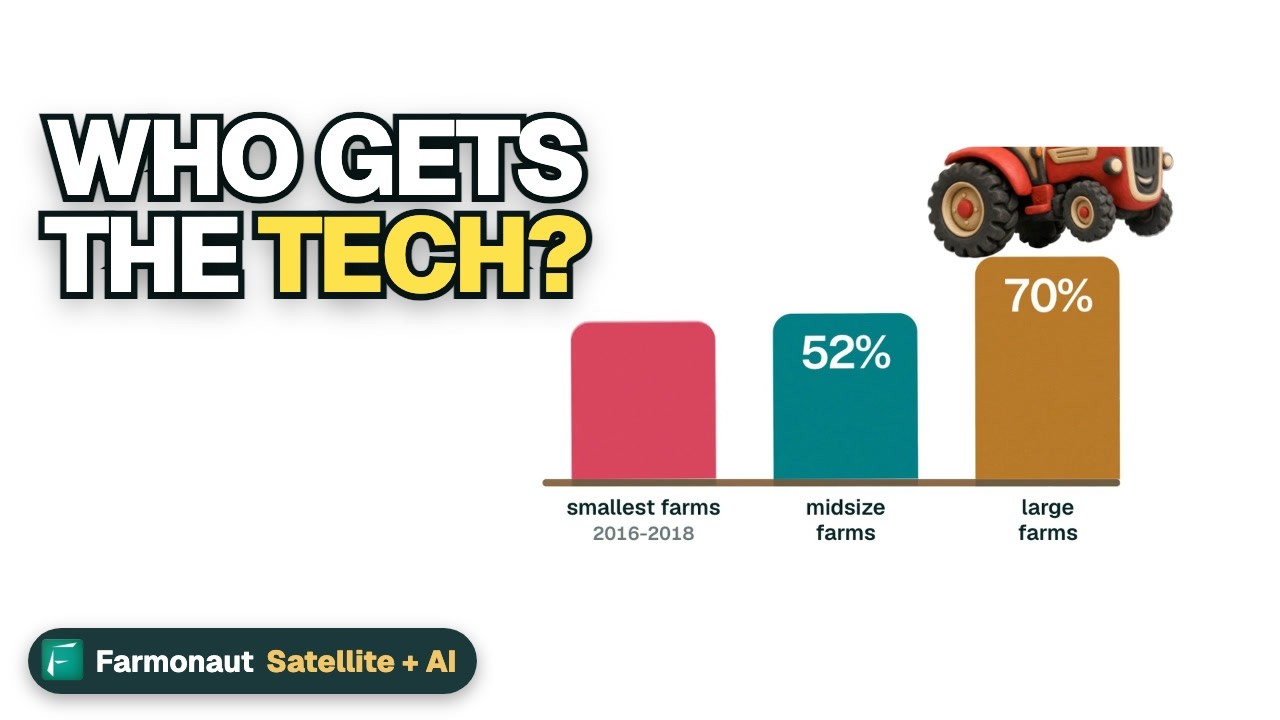
▶ What farm technology and machinery mean for jobs, money and internet in rural towns. · 3:50
Farm investment return calculator in rand
Before you buy land or machinery, check whether the farm can pay its interest and wear and tear and still give you a return on your own money. The calculator below does that in rand. Enter your own area, prices, costs and loan terms. The defaults are round examples near break-even, not benchmarks for any crop or region.
Try the numbers for your own farm below.
Calculator
Will this farm pay its interest and give you a return?
Enter your own area, land price, machinery, income, costs and loan terms in rand.
- Total capital (land plus machinery): 7,000,000 R
- Interest per year: 385,000 R
- Return on your own money: 0.4%
- Break-even gross income per hectare: 11,925 R per ha
Example values only, near break-even, not a benchmark or forecast for any crop or region. Every number is your input. Machinery is written off over a fixed 10 years (equipment cost divided by 10); the land is not written off. Interest is charged on the financed share of land plus machinery. Taxes, land price changes, living costs and loan capital repayments are not included. For reference, the South African Reserve Bank set the repo rate at 7.25% on 23 September 2026 (Trading Economics); banks lend above that, so enter the rate your lender quotes. This is not financial advice.
How to judge an agriculture company or farm investment
Whether you are picking a supplier, buying shares or putting money into a farm, the same few checks help.
- Read the date and the basis. Year ends run from February to September. Revenue for a fuel retailer or grain trader moves with prices, so look at gross profit and volumes too.
- Check the exposure to one crop. RCL and Crookes Brothers show how much sugar imports and prices can move results in a single year.
- Check the debt and the rate. Model your plan at the current rate and at a rate at least one or two points higher.
- Look at weather risk. Agbiz flagged an El Niño risk for the 2026/27 season. Ask what a drought year would do to yield and cash flow.
- Ask for records, not promises. Audited accounts, yield history per field and water rights matter more than a sales deck.
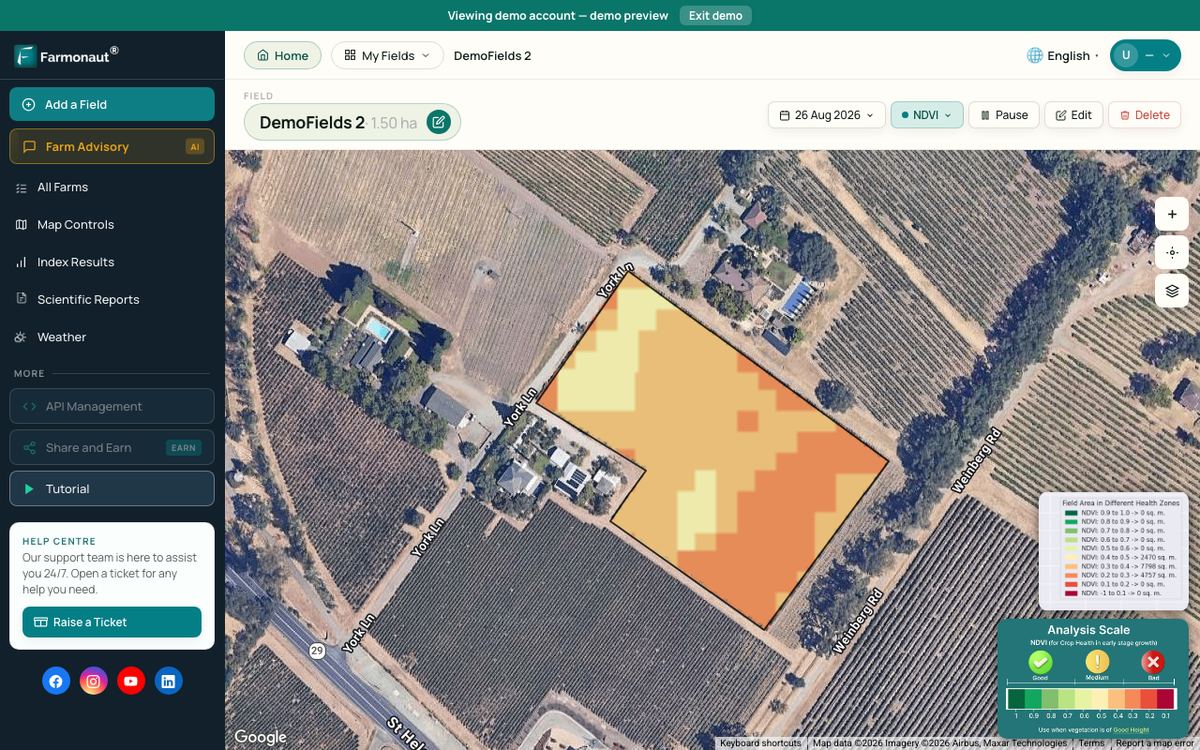
- Watch the fields. Satellite images show where crops grow well or poorly on each field over the season. Farmonaut’s satellite crop monitoring maps vegetation health for every field you draw, and companies can pull the same data into their own systems through the Farmonaut API and its API developer docs.
Lending and investment involve risk. These checks are general information, not financial advice: get advice from a qualified adviser and check local rules before you invest.
Related pages on our site: large-scale farm management app · product traceability · carbon footprinting · climate-smart farming examples · farm technology innovations · satellite data API sign-in · web and mobile apps
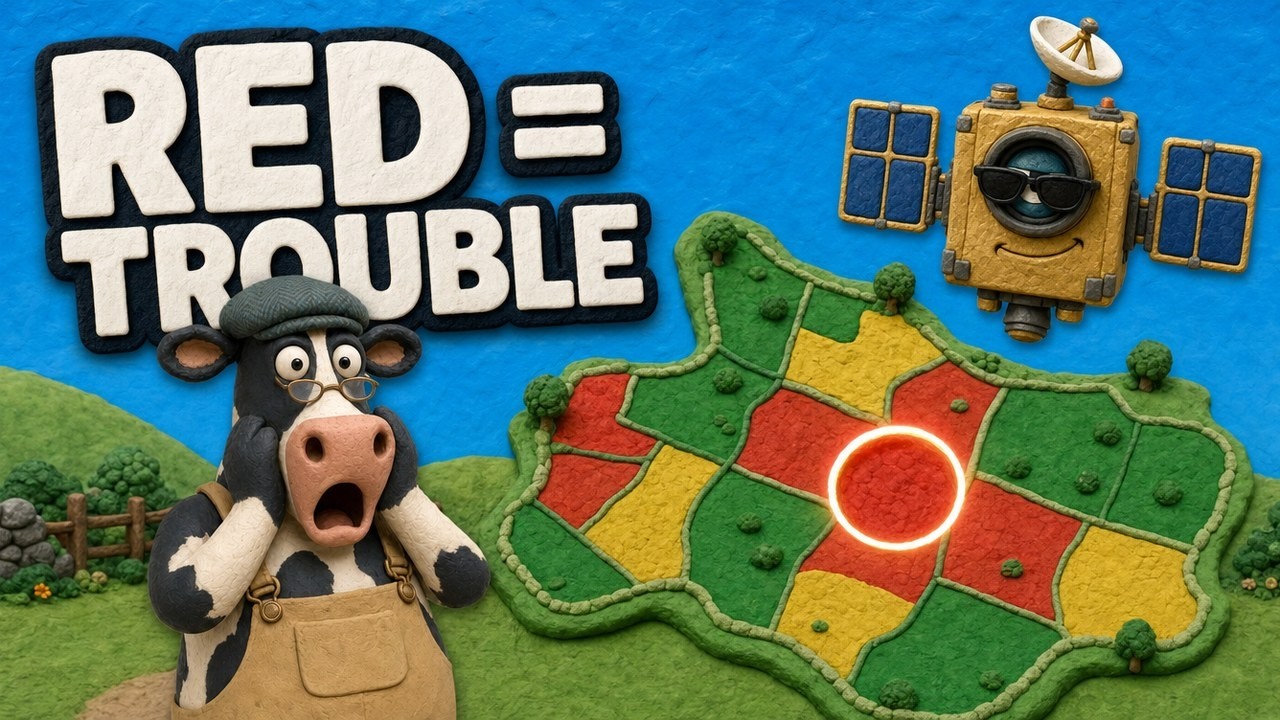
▶ How satellite NDVI maps show crop stress across a farm before it is visible on foot. · 4:09
FAQ
What is the biggest agriculture company in South Africa?
On the latest full-year revenue, RCL Foods (R24.5 billion to June 2026) and Omnia (R24.2 billion to March 2026) are the largest of the listed groups in this guide. If you count only farm-linked revenue, Omnia’s agriculture segment was R13.1 billion and RCL’s sugar unit was R9.89 billion. Unlisted groups such as AFGRI do not disclose comparable figures.
Which agriculture companies are listed on the JSE?
Listed agri and agri-processing companies include RCL Foods, Omnia, Astral Foods, KAL Group, Quantum Foods, Crookes Brothers and the investment company Zeder. Senwes is not on the JSE, and AFGRI delisted in 2014.
Who finances farmers in South Africa?
The main sources are the commercial banks, the state-owned Land Bank, the Blended Finance Scheme (a grant plus a Land Bank loan for black producers), the IDC for agro-processing, and the credit arms of agri groups such as Senwes. Terms differ, so compare the full cost, not only the rate.
Are tractor sales in South Africa going up or down?
Down in 2026 after a strong 2025. SAAMA counted 5,263 tractors sold from January to September 2026, 8.8% fewer than a year earlier, and expects the full year to be about 10% lower than 2025’s 7,668 units.
Is buying a farm in South Africa a good investment?
It depends on the land price, the crop, water, the interest rate and the weather. Use the calculator above with your own figures and test a drought year and a higher rate. Get independent financial and legal advice before you buy land.
Farmonaut agriculture API
Add field-level crop data to your platform
Agribusinesses, lenders and agtech teams can pull satellite vegetation and weather layers for the fields they choose into their own systems through the Farmonaut agriculture API (farmonaut.com/farmonaut-agriculture-api).



Keep reading
Sources
- RCL Foods, media release: annual results for the 12 months ended June 2026 (31 August 2026): rclfoods.com
- Omnia Holdings, audited results for the year ended 31 March 2026 (8 June 2026): omnia.co.za
- Astral Foods, audited results and final dividend for the year ended 30 September 2025, JSE SENS via ShareData (17 November 2025): sharedata.co.za
- BusinessDay, Astral earnings to rise more than fivefold (trading statement, 29 April 2026): businessday.co.za
- BusinessDay, KAL hikes dividend on strong trading performance (27 November 2025): businessday.co.za
- Business Report, KAL Group reports strong recovery with 16.7% dividend increase (27 November 2025): businessreport.co.za
- BusinessDay, Quantum Foods profit boosted by animal feeds and African operations (30 November 2025): businessday.co.za
- FilingReader, Crookes Brothers trading statement for the year ended 31 March 2026 (12 June 2026): filingreader.com
- Business Report, Zeder reports 21.9% decline in net asset value (21 October 2025): businessreport.co.za
- Farmer’s Weekly, Senwes reports strong rebound as profits jump 34.5% (interim results to October 2025): farmersweekly.co.za
- World Bank, World Development Indicators: agriculture, forestry and fishing value added (% of GDP), South Africa (data to 2025): api.worldbank.org
- Statistics South Africa, GDP fourth quarter 2025 press release (P0441, 2026): statssa.gov.za
- Statistics South Africa, Census of Commercial Agriculture 2017 (Report 11-02-01): statssa.gov.za
- Business Report, Agbiz reports strong agricultural export performance in 2025 (22 February 2026): businessreport.co.za
- EWN, SA farming defies job market slump with 39,000 annual growth (12 August 2026): ewn.co.za
- SAnews (government news service), Official unemployment rate rises to 33.6%, Q2 2026 QLFS (11 August 2026): sanews.gov.za
- Land Bank, investor credit pack, September 2024 (November 2024): landbank.co.za
- BusinessDay, Funding not a bailout but sector support, Land Bank says (9 June 2026): businessday.co.za
- Personal Finance / Business Report, Land Bank targets sharp reduction in bad loans (7 May 2026): persfin.co.za
- Parliament of South Africa, Portfolio Committee on Agriculture statement on the Blended Finance Scheme (3 June 2026): parliament.gov.za
- SAnews, Engagements underway to resolve Blended Finance Scheme pause (4 October 2026): sanews.gov.za
- Industrial Development Corporation, Annual Results 2025 (financial year 2024/25): idc.co.za
- Trading Economics, South African Reserve Bank delivers rate hike (23 September 2026): tradingeconomics.com
- South African Agricultural Machinery Association (SAAMA), tractor and combine harvester sales press release, September 2026 (7 October 2026): assets.lightstoneauto.co.za
- Business Report, South African agricultural machinery sales show strong growth in February (9 March 2026): businessreport.co.za
- Wandile Sihlobo (Agbiz chief economist), Tractor sales remain sluggish (12 October 2026): wandile.substack.com
- Agbiz, SA agri market viewpoint (14 September 2026): agbiz.co.za
Discussion
Questions, corrections or field experience? Share them below. First-time comments are reviewed before they appear, and your email is never published.
No comments yet. Be the first to add a question or your experience.

 SatSure
 Geno
Geno Hayleys Agriculture
 Linx Agritech
 Adinet
 Save Your Soils
 Grandstream Algérie
 XOS Realty
 Geospatial Lab Africa
 Agro La Gándara
 HIPSAC
 ZOL Zimbabwe
 Juligerm
 AdBio
AdBio MISE Maroc
 NWNS
NWNS Red August Group
 Licence holder · Niger · Gold










