

Farming systems · Plain guide
What Are the 4 Types of Farming? Definitions and Data
The four types are subsistence, commercial, organic and integrated (mixed) farming. Eurostat classed 20.0% of the EU’s 8.8 million farms as mixed in 2023, and the USDA counted 1,900,487 US farms in 2022.
Key takeaways
- Subsistence farms grow food mainly for the family; the FAO estimated more than 500 million family farms worldwide (2014).
- US farms keep getting bigger: the average size rose from 441 acres in 2017 to 463 acres in 2022 (USDA Census of Agriculture).
- Organic land reached 98.9 million hectares worldwide in 2023, with Australia leading at 53 million hectares (FiBL, 2025).
- Organic yields average about 19–25% below conventional (Ponisio 2015; Seufert 2012), but premiums of 29–32% made organic 22–35% more profitable in a PNAS review (2015).
- Mixed farms made up 20.0% of EU farms in 2023 and 30–41% in Latvia, Lithuania, Croatia and Romania (Eurostat).
In this article
- What are the 4 types of farming? The short answer
- How we checked the numbers
- 1. Subsistence farming
- 2. Commercial farming
- 3. Organic farming
- 4. Integrated (mixed) farming
- Types of farming compared side by side
- Other ways to classify farming systems
- How to choose a type of farming
- Where satellite monitoring fits
- FAQ
The 4 types of farming taught in many guides are subsistence farming, commercial farming, organic farming and integrated (mixed) farming. Official statistics show how these groups look in practice: the Eurostat farm structure survey counted 8.8 million EU farms in 2023 and classed 20.0% of them as mixed farms, while the USDA 2022 Census of Agriculture counted 1,900,487 US farms with an average size of 463 acres.
This guide explains each type in plain words, with dated numbers from the US, the UK and Europe, Australia and one West African example. It also compares the four types in one table, shows other ways experts group farms, and gives a calculator to test whether a switch to organic would pay on your own figures.
What are the 4 types of farming? The short answer
The four groups describe why a farm produces food and how it manages land. They are not legal categories. One farm can belong to two groups at once, for example a certified organic farm that also keeps cattle and sells its whole crop.
- Subsistence farming: the family grows food mainly to eat, with little left to sell.
- Commercial farming: the farm grows crops or raises animals to sell, often at large scale.
- Organic farming: the farm follows certified rules that ban most synthetic fertilizers and pesticides.
- Integrated (mixed) farming: the farm combines crops, livestock and sometimes trees or fish, so each part supports the others.
| Type | Main goal | Where it is common | Best for |
|---|---|---|---|
| Subsistence | Feed the household | Rural Africa, Asia, parts of Eastern Europe | Families with small plots and weak market access |
| Commercial | Sell for profit | US, Canada, Australia, Western Europe | Farms with capital, machinery and buyers |
| Organic | Sell at a premium under certified rules | Australia (by area), Europe, US | Growers with access to organic buyers |
| Integrated | Spread risk across several products | Baltic states, Romania, many family farms | Farms that can use manure, feed and labor across enterprises |
How we checked the numbers
We used national statistics offices and peer-reviewed studies. Farm counts come from the USDA Census of Agriculture, Eurostat and the Australian Bureau of Statistics. Organic figures come from the FiBL yearbook, the European Environment Agency and USDA’s Economic Research Service. Yield and profit comparisons come from meta-analyses in Nature, PNAS and Proceedings of the Royal Society B. Every chart names its source and year. Where no reliable figure exists, for example income per farm type across countries, we say so instead of guessing.
1. Subsistence farming
Subsistence farming means a household grows food mainly for its own table. Any surplus is small and sold locally. Plots are small, tools are simple, and crops depend on rain.
This type is rare in the US, Canada, the UK and Australia, but it has not vanished from Europe. Eurostat describes three broad groups of EU farms, starting with semi-subsistence farms that grow a high share of food for the farm family. In Romania, the EU country with the most farms, 90.2% of holdings were smaller than 5 hectares in 2023, according to the same Eurostat statistics page.
Worldwide, small family plots are still the norm. The FAO report The State of Food and Agriculture 2014 estimated more than 500 million family farms, about nine in ten of the world’s farms. Not all of these are subsistence farms, but many grow mostly for home use.
Shifting cultivation: an older form
Some subsistence farmers clear a plot, crop it for a few years, then leave it fallow so the soil can recover. A global review of shifting cultivation estimated that these landscapes cover roughly 280 million hectares, counting both fields and fallows. Rural Liberia is one example: families grow upland rice and cassava on rotating plots, mainly to eat.
Strengths: low cash costs, a varied diet, local knowledge. Weak points: low yields, little income, high exposure to drought or flood.
2. Commercial farming
Commercial farming grows crops or livestock to sell. Farms are larger, use machinery, buy seed and fertilizer, and often focus on one or two products. Grain farms in Iowa, cattle stations in Queensland and arable farms in East Anglia all fit here.
Scale keeps growing. The USDA census found the number of US farms fell 6.9% between 2017 and 2022, while average size rose from 441 to 463 acres. Land in farms was 880.1 million acres, or 39% of all US land. In Australia, the Australian Bureau of Statistics counted 87,800 agricultural businesses on 369 million hectares of agricultural land at 30 June 2022.
Plantations are a special case of commercial farming. Bananas, oil palm and rubber are often grown in large blocks of one crop, with packing and export handled on site. So if you ask what type of agriculture banana farming is, export banana plantations are commercial farming, while a few banana plants beside a house in a village garden are subsistence.
How commercial farms work
- Specialisation: one crop or animal per enterprise, which brings scale but also risk.
- Machinery and data: tractors, combines, GPS guidance and yield maps.
- Bought inputs: fertilizer, crop protection, feed and fuel.
- Contracts: sales to processors, co-ops, packers or exporters.
Pesticide and fertilizer use on any farm must follow the product label and local rules; get professional advice before changing a programme.
Strengths: high output per worker, steady supply for cities. Weak points: high cash costs, debt and price risk, pressure on soil and water when one crop is grown year after year.
Chart
Number of US farms by census year
Millions of farms, USDA Census of Agriculture 2002 to 2022
▶ The difference between a plantation and a farm, explained simply. · 4:29
3. Organic farming
Organic farming follows certified rules. In the US the rules are set by USDA’s National Organic Program, in the UK by approved control bodies, and in the EU by the EU organic regulation. Farms rely on crop rotation, compost, cover crops and biological pest control. Synthetic fertilizers, most synthetic pesticides and GMOs are not allowed. Check your certifier’s standard before you change any input.
Chart
Organic farmland by region
Million hectares, 2023, selected regions
The FiBL World of Organic Agriculture release put the global organic area at 98.9 million hectares in 2023, managed by 4.3 million producers. Australia leads by country with 53 million hectares. Globally, 2.1% of farmland was organic.
In Europe, the European Environment Agency reports that the organic share of EU farmland rose from 5.9% in 2012 to 10.8% in 2023. The EU target is 25% by 2030, which the agency says would need the pace to more than double.
In the US, the USDA Economic Research Service notes that certified organic cropland rose 79% to 3.6 million acres between 2011 and 2021, and certified operations rose to 17,445 farms. It also cites Argus data showing 7.2 million total certified organic acres (cropland and pasture) in 2025, down about 9% from 2024.
Do organic farms yield less?
Yes, on average, but the gap depends on the crop and the method. A meta-analysis in Nature (Seufert and colleagues, 2012) found organic yields about 25% lower overall. A larger analysis by Ponisio and colleagues (2015) found a 19.2% gap, which shrank to about 9% with multi-cropping and 8% with crop rotations.
Do organic farms earn more?
Often, but only with a price premium. A PNAS study by Crowder and Reganold (2015) covered 40 years of studies on 55 crops. Without premiums, organic was less profitable. With the actual premiums of 29–32%, organic was 22–35% more profitable. Use the calculator below to test your own case. It is a planning aid, not financial advice.
Strengths: price premiums, lower synthetic input bills, soil and biodiversity benefits. Weak points: lower yields, more labor, a conversion period before you can sell as organic.
Chart
Organic yield gap: overall vs with diversification
% lower yield than conventional, Ponisio et al. 2015 meta-analysis
Try the numbers for your own farm below.
Calculator
Would organic pay on your farm?
Enter your own yield, prices and costs per acre.
- Conventional margin per acre: $100
- Organic margin per acre: $100
- Premium needed to break even: 30.0%
Example values only, not a benchmark or a forecast. Defaults are round numbers set near break-even. The yield gap and premium are your inputs; for reference, Ponisio et al. (2015) found an average gap of 19.2% and Crowder and Reganold (PNAS, 2015) found actual premiums of 29–32%. Costs exclude the certification and conversion period. Not financial advice.
4. Integrated (mixed) farming
Integrated farming, also called mixed or diversified farming, combines several enterprises on one farm. A common pattern is crops plus livestock: the animals eat crop residues and forage, and their manure feeds the soil. Other forms add trees (agroforestry and silvopasture) or fish ponds.
Chart
EU farms by type of farming
Share of all EU farms, 2023 (%)
Mixed farms are common in Europe. Eurostat classed 20.0% of EU farms as mixed in 2023 (a group that also includes farms mixing several crops or several kinds of livestock), against 58.9% crop specialists and 20.6% livestock specialists. Between 30% and 41% of farms were mixed in Latvia, Lithuania, Croatia and Romania. In the UK, many family farms in the west and in Wales combine grassland livestock with some arable or forage crops.
Common practices on mixed farms
- Crop–livestock links: manure goes on fields; straw and stubble feed cattle or sheep.
- Rotations with grass: a grass or clover break rests the soil between cash crops.
- Silvopasture: trees, pasture and livestock on the same land.
- Intercropping: two crops grown together, such as cereals with legumes.
The Ponisio study above suggests diversification also helps yields: multi-cropping and rotations cut the organic yield gap by more than half. That is one reason many organic farms are also mixed farms.
Strengths: several income streams, less reliance on bought fertilizer, lower risk from one bad crop or price. Weak points: more skills and labor needed, less scale in each enterprise, more fencing and buildings.
▶ Why mixing crops and cattle can help a farm through a bad year. · 2:55
Types of farming compared side by side
The table below compares the four types on the points that matter most when you choose. It is qualitative on purpose: income and emissions vary too much by crop and country for one honest figure.
| Feature | Subsistence | Commercial | Organic | Integrated |
|---|---|---|---|---|
| Main purpose | Food for the family | Sales and profit | Premium sales under certified rules | Stable income from several products |
| Typical scale | Very small plots | Large and growing (US average 463 acres in 2022) | Any size | Small to medium |
| Bought inputs | Low | High | Medium, from an approved list | Medium |
| Yield per acre | Low | High | About 19–25% below conventional on average | Depends on the mix |
| Market risk | Low cash exposure, high food risk | High price and debt exposure | Depends on premium buyers | Spread across products |
| Labor | Family labor | Low per acre, machinery heavy | Higher per acre | Higher per acre |
Other ways to classify farming systems
The four-type list is a teaching tool. Statisticians and advisers use other groupings, and you may meet them in exams or grant forms.
By what the farm produces
Arable farming grows crops. Pastoral farming raises livestock on grass. Mixed farming does both. Eurostat uses this logic, splitting farms into crop specialists, livestock specialists and mixed farms.
By how intensively land is used
Intensive farming puts a lot of labor, capital or inputs into each acre, as in greenhouses, dairies or orchards. Extensive farming uses large areas with few inputs, such as Australian rangeland grazing.
By size and sales
The USDA groups farms by sales and by who owns them, from small family farms to very large family farms and nonfamily farms. Eurostat groups EU farms by size and by standard economic output. These groups matter for loans, insurance and support payments.
By method
Some guides add types such as precision farming, regenerative farming, agroforestry, hydroponics or vertical farming. These describe methods that can sit inside any of the four main types. A commercial grain farm can use precision tools; a mixed farm can be regenerative.
How to choose a type of farming
If you are starting or changing a farm, work through these steps in order.
- Set your goal. Do you need food for the household, a full-time income, or a side income?
- Check your land. Soil, slope, rainfall and water rights limit what you can grow. Small or steep land often suits mixed or grazing systems.
- Find your buyers first. Organic and specialty crops only pay if a buyer pays the premium. Talk to co-ops, packers and certifiers before you plant.
- Count your labor. Organic and mixed farms need more hours per acre than a specialist arable farm.
- Run the numbers. Use the calculator above with your own yields, prices and costs.
- Plan for risk. Look at crop insurance, contracts and a second enterprise. Get advice from your extension office, a farm business adviser or a lender.
Where satellite monitoring fits
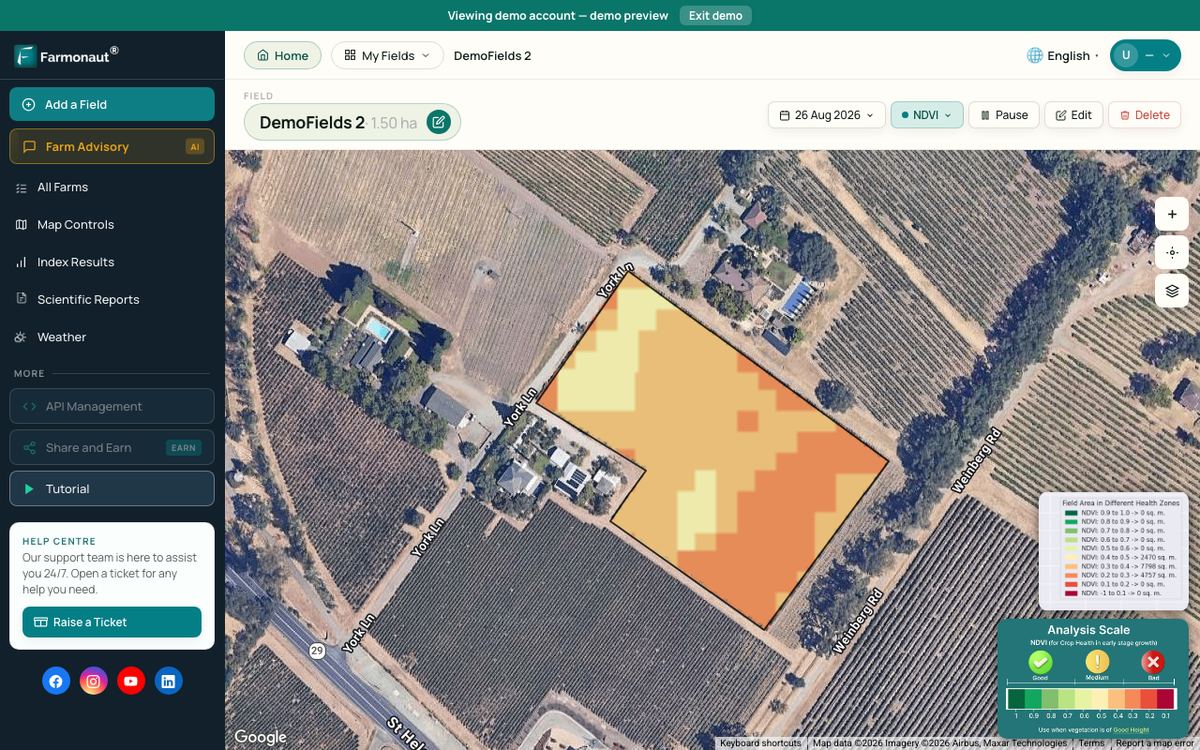
Every type of farm gains from knowing which parts of a field are doing well. Satellite images show changes in plant cover across the season, which helps you check fields you cannot walk every week. They show where crops look stressed, not the cause, so a field visit is still needed. Farmonaut offers satellite vegetation maps for your own fields on web, Android and iOS.
▶ Six plain steps to start precision farming, from field maps to satellite monitoring. · 4:18
Related pages on our site: farming methods in Liberia, types of farming in East Africa, web app, mobile app, large-farm admin app, carbon footprinting, product traceability, fleet management, crop loan and insurance verification, satellite API and API developer docs.
FAQ
What are the 4 types of farming?
Subsistence farming (food for the family), commercial farming (production for sale), organic farming (certified methods without most synthetic inputs) and integrated or mixed farming (crops, livestock and sometimes trees on one farm).
How many types of farming are there?
There is no single official number. Teaching guides often use four. Statistics offices use their own groups: Eurostat, for example, splits farms into crop specialists, livestock specialists and mixed farms, and the USDA groups farms by sales and ownership.
Which type of farming is most common in the US?
Commercial farming. The USDA counted 1,900,487 farms in 2022, and nearly all produce for sale. Organic is a small share: ERS reports 17,445 certified operations in 2021.
What type of agriculture is banana farming?
Export banana plantations are commercial farming, with large single-crop blocks and on-site packing. Bananas grown on small plots for home use are part of subsistence or mixed farming.
Is mixed farming the same as integrated farming?
Mostly, yes. Both mean combining crops and livestock on one farm. “Integrated” stresses the links between them, such as manure for crops and crop residues for animals.
Farmonaut crop monitoring
See your own fields from space
Draw your fields once and Farmonaut shows satellite vegetation maps for them through the season, on web, Android or iOS.



Keep reading
Sources
- USDA NASS, 2022 Census of Agriculture Highlights: Farms and Farmland (2024): nass.usda.gov
- Eurostat, Farms and farmland in the European Union – statistics (2026): ec.europa.eu
- FAO, The State of Food and Agriculture 2014: Innovation in family farming: fao.org
- Heinimann et al., A global view of shifting cultivation, PLOS ONE (2017): pmc.ncbi.nlm.nih.gov
- Australian Bureau of Statistics, Agricultural Commodities, Australia, 2021-22: abs.gov.au
- FiBL, Global organic area nears 99 million hectares (media release, February 2025): fibl.org
- European Environment Agency, Agricultural area used for organic farming (2025): eea.europa.eu
- USDA ERS, Organic Agriculture topic page (2026): ers.usda.gov
- Seufert, Ramankutty and Foley, Comparing the yields of organic and conventional agriculture, Nature (2012): nature.com
- Ponisio et al., Diversification practices reduce organic to conventional yield gap, Proc. R. Soc. B (2015): pmc.ncbi.nlm.nih.gov
- Crowder and Reganold, Financial competitiveness of organic agriculture on a global scale, PNAS (2015): pmc.ncbi.nlm.nih.gov
Discussion
Questions, corrections or field experience? Share them below. First-time comments are reviewed before they appear, and your email is never published.
No comments yet. Be the first to add a question or your experience.

 AgroRisk
 Oath Inc
 Reddane Farming
 Esri North East Africa
 Farmer Amigo
 Cresol
 Atur Kuliner
 MDCV UK
 Zerella Group
 Etech Consulting Madagascar
 Vestlandsforsking
 Agritein
 Delicio
 WB Dev
 Sama Premium
 Prochecker
 Tres Valles
 LACOS Geoinformation
 Magrifly
 LatConnect 60
 Blickwinkel
 Agricultural Credit Policy Council
 Exploration consultancy · South Africa · Gold
 Licence holder · Niger · Gold
 Licence holder · Nigeria · Gold + lithium










