

Agricultural Land in West Bengal: 7 2026 Sustainability Tips
Intro: A 2025 Perspective on Agricultural Land in West Bengal
West Bengal, truly nestled in the eastern part of India, is justifiably renowned for its fertile alluvial plains, highly favorable soil types, and diverse agricultural patterns. In 2025 and looking ahead to 2026 and beyond, the state‘s agricultural land remains critical for food security, livelihoods, and regional economy. However, both opportunities and challenges shape how farmers utilize land today, ranging from climatic fluctuations to infrastructural constraints.
Understanding the dynamics of agricultural land in West Bengal is indispensable for grasping the region’s future trajectory in sustainable agriculture. With major crops like rice, jute, pulses, oilseeds, potatoes, and horticultural vegetables dominating, patterns of use, soil management, and climatic adaptation define the state’s evolving agrarian profile.

Geographical & Soil Profile: Understanding Land Types in West Bengal
Agricultural land in West Bengal is remarkably diverse, both in geographical features and soil compositions. This variety stems from its unique position, largely shaped by the Ganges delta and Himalayan foothills. Several districts—notably Nadia, Murshidabad, Hooghly, North and South 24 Parganas—feature alluvial plains, dominated by loamy and silty soils that retain moisture extremely well, enabling multiple cropping cycles and supporting crops like rice, jute, and vegetables.
In contrast, the western and northern belt—including Purulia, Bankura, and Birbhum—have red and laterite soils. These are comparatively less fertile, yet ideal for pulses, oilseeds, and millets. Additionally, the hilly Darjeeling district facilitates terraced farming, thriving in tea gardens and horticultural crops.
- 🌾 Alluvial Plains: Nadia, Murshidabad, Hooghly, North/South 24 Parganas (High moisture, supports rice/jute/vegetables)
- 🧱 Lateritic/Red Belt: Purulia, Bankura, Birbhum (Pulses, millets, oilseeds cultivation)
- 🌄 Hilly Terrain: Darjeeling (Tea, horticulture via terraced fields)
This geographical and soil profile determines how various agricultural areas across the state are utilized. Each region is characterized by its own topography, soil qualities, and cropping intensity—resulting in a long-recognized, diverse agricultural landscape.
The highly fertile alluvial plains of West Bengal are pivotal for India’s food security, being some of the most productive areas for multi-cropping.
Current Agricultural Practices & Key Crops
In 2025, paddy (rice) remains the principal crop on agricultural land in West Bengal, occupying nearly 75% of the cultivated area. Favorable climatic conditions, soil moisture retention, and extensive irrigation facilities support this dominance. The state is not only a regional, but also a national leader, trailing only by a slim margin as India’s second-largest rice producer.
Jute cultivation is also crucial, especially across North/South 24 Parganas, Nadia, and Murshidabad, underscoring West Bengal’s historic and economic linkage to this fiber crop. Other significant crops in the cropping pattern include potatoes, oilseeds, pulses, and various vegetables. The horticulture sector (fruits, flowers, tea) further enhances agricultural diversity.

Adoption of Modern and Sustainable Practices
Emerging practices are reshaping how farmers use land. These include:
- ✔ System of Rice Intensification (SRI)—boosting yields while reducing water consumption
- ✔ Integrated Pest Management—minimizing chemical pesticide use
- ✔ Micro-irrigation and drip systems—optimized resource efficiency
- ✔ Adoption of High-Yielding Varieties & Organic Cultivation
- ✔ Digital extension services for real-time advisories
The government is actively promoting climate-smart agriculture and organic farming to reduce chemical dependency and improve long-term sustainability.
- 🌱 Reduces input costs & soil degradation
- 💧 Conserves water resources (critical in low rainfall districts)
- 🔬 Enhances pest and disease resilience naturally
- 📈 Boosts productivity over multiple cycles even on less fertile soils
- 🚜 Enables mechanization on consolidated fields
Land Fragmentation & Urbanization Challenges
A persistent, critical challenge for agricultural land in West Bengal is land fragmentation. The average operational holding size shrinks annually due to population pressure and inheritance laws. This leads to smaller, scattered plots that:
- ⚠ Limit large-scale mechanized farming
- ⚠ Reduce economies of scale and farm incomes
- ⚠ Hinder effective infrastructure investment
Urbanization and industrial expansion—notably around Kolkata and the suburbs—result in conversion of prime agricultural land to non-agricultural uses. As infrastructural growth continues, balanced policies are critical to protect cultivable agricultural areas while serving the expanding urban population.
Overlooking the negative impact of land fragmentation when evaluating agricultural productivity. Consolidation and co-operative models are needed to realize full potential.
Climate Impact on Agriculture & Soil Health in West Bengal
Climate change is among the biggest threats to agricultural land in West Bengal in 2025–2026. Erratic monsoon patterns, rising temperatures, salinity intrusion (especially in Sundarbans), and unexpected flooding affect every district uniquely. Farmers have observed:
- 🌧 Delayed or unpredictable rainfall, disrupting sowing/harvesting cycles
- 🦟 New pest and disease patterns caused by higher temperatures/humidity
- 🌊 Flooding and waterlogging in low-lying Ganges delta areas
- 💨 Salinization of coastal soils—threatening rice and jute yields
The government and local communities are increasingly adopting climate-resilient strategies:
- ✔ Salt-tolerant rice/jute cultivars for the Sundarbans and coastal 24 Parganas
- ✔ Rainwater harvesting & improved watershed management
- ✔ Promotion of agroforestry to maintain soil fertility & biodiversity

Infrastructural Dynamics & Market Access
The right infrastructure can transform the agricultural land in West Bengal by reducing post-harvest losses, ensuring food security, and connecting farmers to regional and national markets. Ongoing construction of rural roads, storage and cold-chain facilities, and digital marketplaces is creating new opportunities for growth.
- 🏗 Rural road upgrades—critical for moving crops to market quickly
- ❄ Cold chain/storage—helps reduce spoilage for vegetables, potatoes, and horticultural products
- 📱 Online price discovery platforms—empowering farmers via real-time access to price/advisory information
Farmers should leverage digital extension tools and mobile apps to access real-time market prices and weather advisories, making marketing decisions more profitable.



Explore Farmonaut’s Agricultural Satellite API |
Developer Docs
7 Sustainability Tips for Agricultural Land in West Bengal (2026)
As West Bengal pushes towards 2026, sustainability is the guiding principle for maximizing crop production, soil fertility, and climate resilience. Here are 7 expert tips relevant for the emerging trajectory of agriculture in the state:
-
Promote Conservation Agriculture Practices
Conservation agriculture such as minimum tillage, cover cropping, and crop residue management increase soil organic matter and water retention, especially important in western parts with red/laterite soils.
Example: Implement legume cover crops post-harvest to enhance soil nitrogen sustainably. -
Adopt Precision Water Management
Leverage micro-irrigation (drip, sprinkler) in both rice and vegetable cultivation to reduce water wastage.
Benefit: Up to 40% water saving compared to traditional systems. -
Switch to Climate-Resilient Crops & Cultivars
Use salt-tolerant rice for coastal Sundarbans, flood-resistant jute in delta districts, and short-duration varieties in flood-prone or dry tracts.
Insight: Cultivar choice is critical to match local climatic and soil conditions. -
Implement Integrated Pest & Nutrient Management
Combine biological pest control, crop rotation, and organic manures to minimize chemical use. Incorporate data-driven monitoring for early alerts.
Tool: Use Farmonaut Large-Scale Farm Management App to monitor pest hotspots and nutrient deficiencies remotely! -
Invest in Digital Tools & Satellite-Based Monitoring
Satellite imagery and AI-driven analytics help track crop health, manage irrigation, and assess fragmentation impact. This approach empowers both smallholders and large cooperatives.
Resource: Learn about Farmonaut’s Carbon Footprinting tools for sustainable farm reporting and compliance! -
Pursue Crop Diversification & Mixed Farming
Inclusive of pulses, oilseeds, vegetables, and horticulture, crop diversification improves income stability and soil regeneration in both alluvial and laterite zones. -
Join/Build Local Co-operatives for Input, Marketing, and Credit
Consolidated efforts enhance input procurement, mechanization, access to government support, and efficient market linkage.
Link: Facilitate access to loans and insurance with Farmonaut Crop Loan & Insurance Verification solutions.

Upgrading rural infrastructure, investing in climate-resilient farming, and incorporating satellite monitoring present profound opportunities for sustainable agribusiness in West Bengal.
Sustainable Practices Impact Table
The table below compares traditional agricultural practices with their sustainable counterparts across West Bengal’s major crops. Estimated values for water usage, yield, climate impact, and adoption rates reflect the expected landscape in 2026:
| Crop Type | Traditional Practice | Sustainable Practice (2026 Estimate) | Est. Water Usage (liters/ha) | Est. Yield (tons/ha) | Climate Impact Reduction (%) | Adoption Rate in WB (2026, %) |
|---|---|---|---|---|---|---|
| Rice (Paddy) | Flood Irrigation, Chemical Fertilizers, High Pesticide Use | SRI, Drip Irrigation, Organic Inputs, Salt-Tolerant Varieties | ~14,000,000 | 4.2 | 30-35 | 45 |
| Jute | Broadcast Sowing, Mono-Cropping, Chemical Inputs | Line Sowing, Crop Rotation, Integrated Pest Management | ~7,500,000 | 2.6 | 28-32 | 41 |
| Potato | Flood Irrigation, Heavy Tillage, Synthetic Fertilizers | Drip Irrigation, Mulching, Organic Nutrient Management | ~4,100,000 | 27.5 | 35-40 | 38 |
| Vegetables | Flood Irrigation, Single Season Cropping | Micro-Irrigation, Intercropping, Integrated Nutrient Mgmt | ~3,200,000 | 22.3 | 40-42 | 36 |

How We at Farmonaut Empower Sustainable Agriculture in West Bengal
At Farmonaut, our mission is to make satellite-driven agricultural insights accessible and affordable. Using a combination of multispectral satellite imagery, artificial intelligence, and blockchain-based traceability, we empower farmers, agribusinesses, and government agencies to realize real-time, actionable benefits on agricultural land in West Bengal and across India.
Our Key Offerings for Agricultural Land in West Bengal
- Real-Time Satellite Monitoring – Regular updates on crop health, soil moisture, and pest/disease hotspots.
- AI-Driven Advisory with Jeevn System – Personalized recommendations for crop management, irrigation scheduling, and harvesting, optimized for West Bengal’s agro-climatic conditions.
- Blockchain Traceability – Authenticate your crop’s farm-to-market journey with Farmonaut Product Traceability solutions, enhancing transparency for rice jute, and other crops.
- Environmental Impact Tracking – Integrate carbon footprinting features to support climate-compliance and promote sustainable practices.
- Resource & Fleet Management Tools – Fleet management for agro-machinery, optimizing usage on fragmented lands.
- Access to Finance – Leverage satellite-based crop loan and insurance verification for easier financial inclusion.
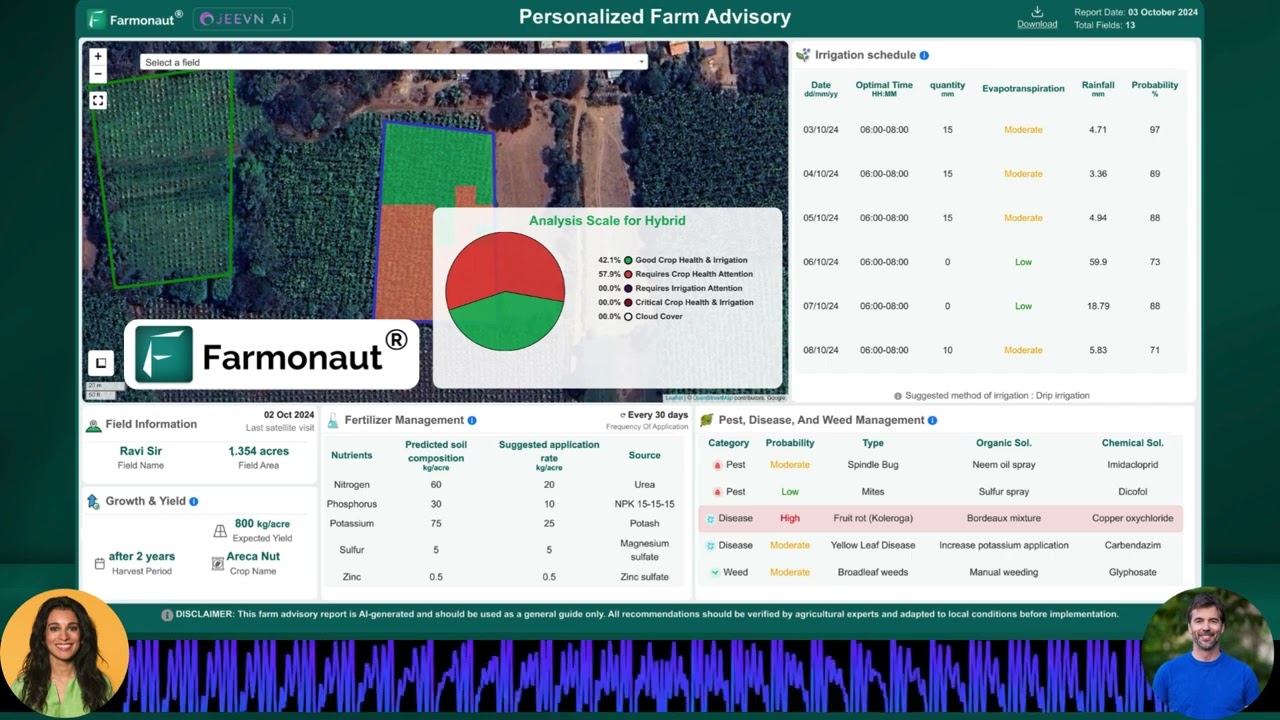
Farmonaut combines AI, blockchain, and satellite data to help West Bengal’s farming community thrive in a changing climate—and at a fraction of traditional costs.

- 🚀 Remote sensing detects early signs of stress—effortlessly covering vast fragmented plots.
- 📉 Blockchain traceability boosts market trust for export-quality jute and rice.
- 📊 Carbon tracking supports farm eligibility for climate-linked incentives.
- 💡 AI weather insights help proactively adapt to monsoon fluctuations.
- 💻 Scalable APIs ensure integration for both individual micro-farms and large agribusinesses.
Key Insights, Pro Tips & Industry Notes
Underutilizing satellite imagery and digital decision aids—especially crucial for fragmented or climate-risk zones.
Adoption of sustainable agricultural systems—especially when digitally powered—improves ROI by reducing crop losses and qualifying for global green supply chains.
Visual Lists: Data Insights & Benefits
- ✔️ Faster market access through digital sales and remote verification
- 📊 Real-time land health analytics driving more precise interventions
- ⚠️ Immediate risk alerts for flooding, waterlogging, or pest upsurge
- 📋 Regulatory compliance for carbon credits and government schemes
- 🗂️ Data-powered insurance claims reduce disputes and ensure timely payouts
- 🔥 Climate Adaptation: Prioritize salt/flood/drought-resistant crops
- 💲 Financial Inclusion: Swift loan/insurance verification
- 🛣 Market Connectivity: Leverage improved infrastructure for profit
- 🌎 Sustainability Reporting: Document and monetize eco-friendly practices
- 🌳 Agroforestry: Enhance biodiversity and land use efficiency
FAQ on Agricultural Land in West Bengal
1. What makes agricultural land in West Bengal especially fertile?
The alluvial plains stretching across Nadia, Murshidabad, Hooghly, and the 24 Parganas are shaped by the Ganges delta and feature loamy/silty soils that retain moisture—ideal for rice and jute. Fertility is also maintained by seasonal flooding that replenishes nutrients.
2. What are the main sustainability challenges for farmers in the state?
Key challenges include land fragmentation, climate-induced flooding/salinity, shrinking cultivable area due to urban expansion, and pest/disease shifts caused by changing weather.
3. How can technology help reduce agricultural risk in West Bengal?
Satellite data, AI advisories, and blockchain enhance risk forecasting, verify insurance claims, facilitate climate adaptation, and ensure sustainable land use—making farming more resilient and profitable.
4. What are the benefits of crop diversification for this region?
Diversification (rice, jute, vegetables, pulses, oilseeds) spreads risk, improves soil health, and supports income stability—even in areas with variable climate or fragmented plots.
5. How can I access Farmonaut’s satellite and AI tools as a West Bengal farmer or agribusiness?
You can download our web, Android, or iOS app using the buttons above. We also offer an open API for integration, plus tiered subscriptions for individuals, businesses, and governments.
Conclusion: Ensuring Prosperity and Sustainability for Agricultural Land in West Bengal (2026–Future)
Agricultural land in West Bengal will remain a cornerstone of the region’s food security, livelihoods, and economy as we move into 2026 and beyond. The state’s varied soil types, favorable climate, and unique topography offer both opportunities and challenges for its agrarian community.
With climate impacts intensifying and land fragmentation increasing, the adoption of sustainable practices like conservation agriculture, precision water management, climate-resilient crops, and digital monitoring is not just beneficial, but critical. Strengthening infrastructure, boosting market access, and leveraging digital tools will drive the next era of growth for both smallholder and commercial farmers in West Bengal.
We at Farmonaut are committed to providing affordable, scalable, and high-impact technology to all those seeking a sustainable future for agriculture in the eastern part of India. By embracing these solutions, West Bengal’s agricultural heartland can thrive—turning local challenges into a springboard for national and global leadership in sustainable farming.
Farmonaut Subscription Plans for Sat-Tech Empowered Farming
Choose the Farmonaut subscription best suited for your needs (individual, business, or government)—unlocking continuous, real-time insights for agricultural land in West Bengal!

 Lunar Edge IT
 FieldZero
 Indico Company
 Kubota
 FFBS
FFBS Jontra
 Kalustyan
 Tucor
Tucor Geno
Geno Hayleys Agriculture
 Linx Agritech
 Adinet
 Save Your Soils
