

Rare earths · Australia mines and costs
Rare Earth Mining in Australia: Mines, Owners, Costs
Mt Weld in Western Australia is the one large operating rare earth mine, run by Lynas; Eneabba, Nolans, Yangibana, Browns Range and Dubbo are next. This page covers owners, WA EPA and NT rules, and capital and royalty costs.
Key takeaways
- Geoscience Australia counts one operating rare earth mine and 34 kt of oxide produced in 2025; the USGS estimates 29,000 t, behind China and the US.
- Lynas reported 3,481 t of rare earth oxide and an average price of A$98.2/kg in the June 2026 quarter (ASX, 22 July 2026).
- The WA EPA’s Mt Weld report allows up to 2,241.6 ha of disturbance and 2.8 GL a year of groundwater for a 30-year mine (November 2023).
- Iluka’s Eneabba refinery has spent A$1,101m of an A$1.7-1.8bn estimate; Nolans took its investment decision on 21 May 2026.
- Western Australia charges a 2.5% rare earth royalty and a rehabilitation levy on disturbed land (GSWA; WA Government).
In this article
- Rare earth mining companies in Australia: mines and projects compared
- Mt Weld: Australia's one large operating rare earth mine
- Eneabba, Nolans, Yangibana, Browns Range and Dubbo: the pipeline
- How much rare earth oxide does Australia produce and hold
- Environmental rules for rare earth mines: who approves what
- What a Western Australian approval asks for: Mt Weld in numbers
- Economics of Australian rare earth projects: capital, revenue and risk
- How satellite data helps with rare earth tenements
- What to check before you rely on an Australian rare earth figure
- Frequently asked questions
Australia has one large operating rare earth mine, Mt Weld in Western Australia, owned by Lynas Rare Earths, and a short list of projects that are being built or are close to a decision. Geoscience Australia counts one operating rare earth mine and reports 34 thousand tonnes of rare earth oxide produced in 2025; the USGS puts the figure at 29,000 tonnes for 2025 (estimate) of a world total of 390,000 tonnes, behind China (270,000) and the United States (51,000). This page lists each mine and project, who owns it, what regulators asked for, and what the money looks like.
Rare earth elements are the lanthanides plus yttrium, a group of metals that the USGS fact sheet on rare earths describes as chemically similar and usually found together. Producers report them as TREO (total rare earth oxides), the combined weight of all the oxides in a sample, and sell mainly NdPr (neodymium and praseodymium oxide) for magnets, with small volumes of heavy elements such as dysprosium (Dy) and terbium (Tb). For the geology and for world deposit maps, start with our rare earth deposits map guide; this page stays with Australia.
The page is written for mining business owners and licence holders who want to know who runs what, how much land and water these operations use, and which costs sit before a tonne of oxide is sold. Company figures are quoted as reported on the dates shown, and they use different bases.
Rare earth mining companies in Australia: mines and projects compared
Only Mt Weld is a mine producing at scale today. The others are a refinery under construction, a mine under construction and projects at feasibility stage. Resource figures below come from the Geological Survey of Western Australia (GSWA) table of JORC-reported resources, except where another source is named. A resource is a mineral occurrence with reasonable prospects of economic extraction; it is not the same as a reserve, which has been shown to be economic.
| Project | State | Owner or operator | Stage (dated) | Key figure |
|---|---|---|---|---|
| Mt Weld | Western Australia | Lynas Rare Earths | Operating; expansion ramping up (June 2026 quarter) | 109.69 Mt at 4.24% TREO resource (30 June 2024) |
| Eneabba refinery | Western Australia | Iluka Resources | Under construction; commissioning scheduled mid-2027 | Capital estimate A$1.7 to 1.8 billion |
| Nolans | Northern Territory | Arafura Rare Earths | Final investment decision 21 May 2026; construction starting from September 2026 | Planned average 4,440 t a year of NdPr oxide |
| Yangibana | Western Australia | Wyloo (60%, operator) and Hastings Technology Metals | Feasibility (GSWA, January 2026) | 29.93 Mt at 0.93% TREO resource (January 2023) |
| Browns Range | Western Australia | Northern Minerals | Feasibility study done; funding talks (July 2026) | 11.77 Mt at 0.77% TREO resource (30 June 2025) |
| Dubbo | New South Wales | Australian Strategic Materials, now part of Energy Fuels | Pre-decision; heap-leach option under study (December 2025 report) | 75.18 Mt resource (company, 31 December 2025) |
Sources for the table: the GSWA rare earth fact sheet for Mt Weld, Yangibana and Browns Range resources, and the company filings cited in the sections below. The rest of this page takes each in turn.
Mt Weld: Australia’s one large operating rare earth mine
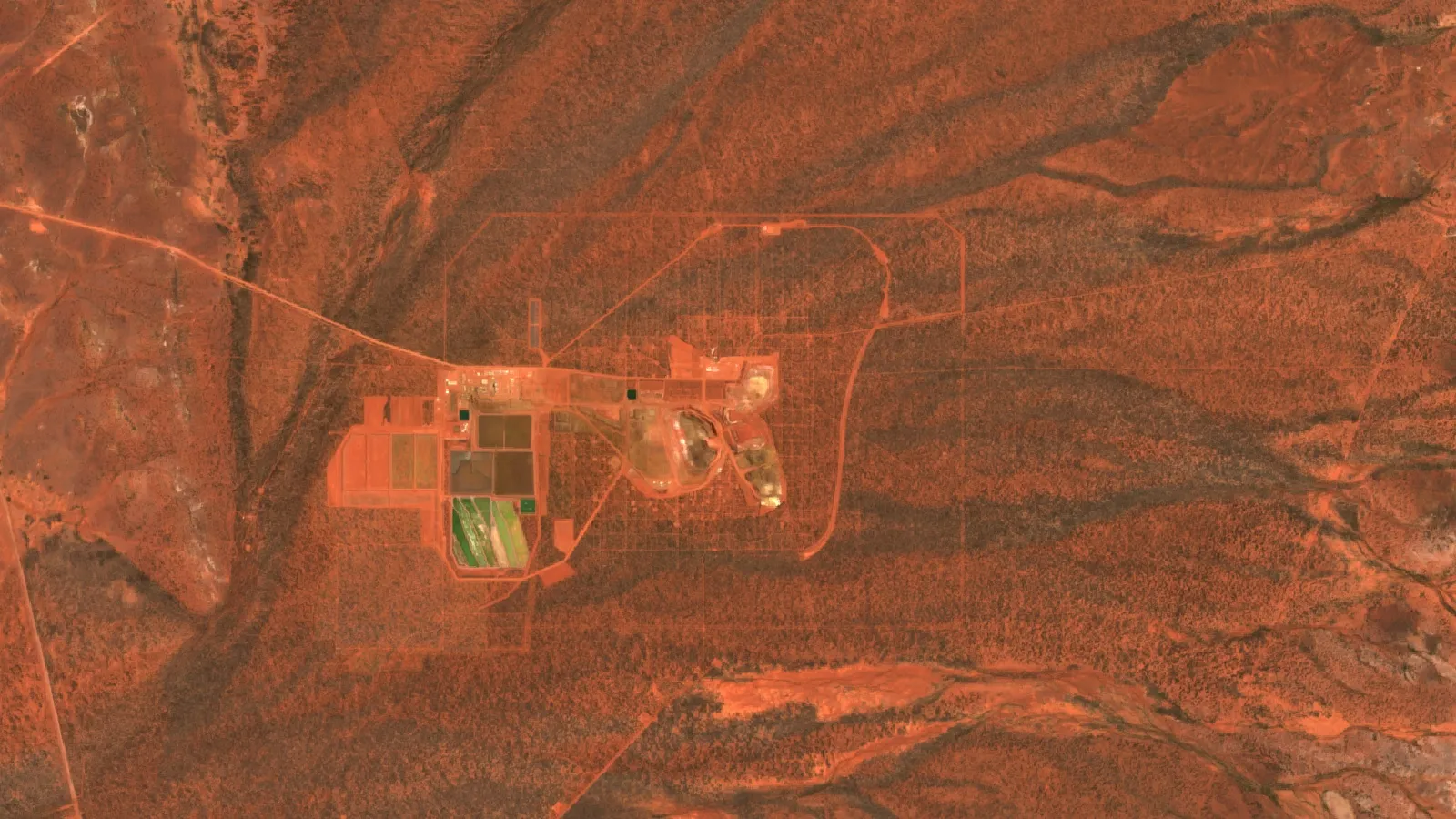
Mt Weld sits 35 km south-east of Laverton in the Northern Goldfields of Western Australia. The operator is Mt Weld Mining Pty Ltd, a subsidiary of Lynas, and the Western Australian EPA’s assessment report (November 2023) describes a life-of-mine proposal of 30 years. The GSWA table lists its resource at a grade of 4.24% TREO, far above the 0.05 to 1.03% of the other projects in the same table.
Infographic
From Mt Weld ore to separated oxide in 5 steps
- 1Mine and concentrateOre is mined and concentrated at Mt Weld, near Laverton.
- 2Concentrate to KalgoorlieConcentrate goes to the Kalgoorlie processing facility.
- 3Crack and leachChemical treatment makes a mixed rare earth carbonate.
- 4Ship from FremantleThe carbonate is exported for separation.
- 5Separate in MalaysiaLynas Malaysia splits it into NdPr and heavy oxides.
Chart
Lynas production by quarter: NdPr and total oxide
Tonnes ready for sale, fiscal quarters (FY ends 30 June)
Lynas does not finish the product at the mine. Concentrate goes to the Kalgoorlie Rare Earths Processing Facility, where cracking and leaching turn it into a mixed rare earth carbonate, and the carbonate is shipped through Fremantle to Lynas Malaysia for separation into oxides. In the June 2026 quarter Lynas reported 3,481 tonnes of total rare earth oxide, of which 1,857 tonnes was NdPr and 19 tonnes was dysprosium plus terbium, on sales revenue of A$288.9 million. The company also reported ore variation and a crusher change that lowered concentrate quality and slowed leaching that quarter, which shows how a mine-side problem passes straight to the downstream plants.
The GSWA fact sheet records first dysprosium and terbium from the new heavy rare earth circuit at Lynas Malaysia in October 2025 and describes Lynas as the only commercial producer of separated heavy rare earth products outside China. Our guide to neodymium and the radioactivity of rare earth minerals explains why thorium follows the ore through every step.
Eneabba, Nolans, Yangibana, Browns Range and Dubbo: the pipeline
Eneabba (Iluka Resources, Western Australia)
Eneabba is a refinery, not a new mine. Iluka stores a stockpile of monazite and xenotime there, rare earth minerals recovered as by-products of mineral sands processing and kept since the early 1990s, and its 2022 investment decision presentation gives a feed rate of 55 thousand tonnes a year and a modelled capacity of 17.5 thousand tonnes of TREO. In its June 2026 quarterly report Iluka states capital spent to 30 June 2026 of A$1,101 million against an estimate of A$1.7 to 1.8 billion, with construction nearing 60% complete. It also lists third-party feed agreements with Northern Minerals, Lindian Resources and VHM. For the mineral itself, see our monazite and xenotime concentrate guide.
Chart
Capital cost of recent rare earth builds by Australian companies
A$ million; figures differ in date and scope (see caption)
Financing is public: an Iluka release of 22 June 2026 confirms access to the full A$1.65 billion non-recourse loan from the Australian Government through Export Finance Australia. Non-recourse means the lender can claim against the project’s assets and cash flows but not against the rest of the company.
Nolans (Arafura Rare Earths, Northern Territory)
Nolans lies 135 km north of Alice Springs. Arafura’s decision announcement of 21 May 2026 describes it as Australia’s first fully integrated ore-to-oxide rare earths operation, with a planned average of 4,440 tonnes a year of NdPr oxide over an initial 38-year life, 600-plus construction jobs and about 350 permanent jobs. Offtake is contracted with Hyundai and Kia (1,500 t a year), Siemens Gamesa (520 t) and Traxys (800 t across two entities), and the Export Finance Australia letter of support covers up to 500 t a year under the government’s Critical Minerals Strategic Reserve. Groundbreaking took place on 8 October 2026, according to Australian Resources & Investment, which also reports a three-year build.
The capital figure on record is Arafura’s November 2022 estimate of A$1,590 million, repeated in its March 2024 quarterly report. Arafura said in that report that its ongoing review of capital costs did not indicate a material change, but treat the figure as a dated reference point and not a current budget.
Yangibana and Browns Range (Western Australia)
Yangibana is held through an unincorporated joint venture in which Wyloo Gascoyne is manager and 60% owner and Hastings Technology Metals holds 40%, as Hastings states in its updated feasibility study of 13 July 2026 (the deal was reported on 22 May 2025). That study covers Stage 1, an open pit and flotation plant making 37,000 t a year of concentrate at 27% TREO, on an ore reserve of 20.93 Mt at 0.90% TREO over a 19-year life. Hastings gives an initial capital cost of A$333.4 million, a pre-tax NPV of A$649 million at an 8% discount rate and a pre-tax IRR of 34%, says environmental and statutory approvals are secured, and targets first concentrate about two years after the plant contract is awarded, subject to a final investment decision. Browns Range in the East Kimberley is held 100% by Northern Minerals, whose deposits are rich in dysprosium and terbium; the company’s 23 July 2026 presentation says the feasibility study is complete and funding talks are under way. The GSWA fact sheet notes an 11-year mine life in that study.
Dubbo (New South Wales)
Dubbo is a rare earths and critical minerals project in New South Wales. Its owner, Australian Strategic Materials (ASM), reported a 75.18 Mt resource and a switch to a lower-cost heap leach first phase in its half-year report to 31 December 2025. The Federal Court approved the schemes of arrangement under which Energy Fuels acquires ASM, and Motley Fool Australia reported them effective on 19 August 2026. For cobalt and other critical minerals listed alongside rare earths, see our page on Australian cobalt and rare earth mining companies.
How much rare earth oxide does Australia produce and hold
Three agencies publish numbers, and they differ because they count different things. Geoscience Australia’s preliminary tables (data to 31 December 2025) show one operating mine, reserves at operating mines of 2.05 million tonnes of oxide, mine production of 0.034 million tonnes and a reserve life of 60 years. Its wider reserve table shows 4.39 million tonnes of oxide in proved and probable reserves across all projects. The USGS shows Australian mine production of 29,000 tonnes in 2024 and 2025 (estimate) and reserves of 6.3 million tonnes, noting that reserves reported under JORC rules or equivalent were 3.3 million tonnes. The GSWA reports 33,850 tonnes sold in the 2024-25 financial year and ranks Western Australia third in world production.
Chart
Contained TREO in Western Australian projects
Thousand tonnes TREO, eight largest of 20 listed JORC-reported resources (resource dates 2022-2025)
The practical message: use one source for any comparison, quote its date and say whether the figure is mined, sold or contained in concentrate. The chart above uses the GSWA table of contained TREO in Western Australian projects, which shows how much of the known resource sits in one deposit.
Environmental rules for rare earth mines: who approves what
In Western Australia a project that may have a significant effect on the environment is referred to the state EPA, which decides whether to assess it and at what level, then advises the Minister. The EPA’s rare earth sector page lists the assessments in this sector, including the Mt Weld life-of-mine proposal, the Eneabba refinery, Yangibana Expansion 1 and Tabba Tabba. The EPA report also points to the state mines department’s closure planning guidance, and radiation work is governed by the Radiation Safety Act 1975, with the Radiological Council administering it, as the EPA report notes.
In the Northern Territory the NT EPA assesses large proposals. For Nolans, the NT EPA had completed its assessment by the time Arafura announced the approval recommendation on 5 January 2018; Mining Technology reported that the NT EPA recommended approval subject to controls, expected radioactive mining waste to be stored permanently on site, and asked for more groundwater work, with its chairman saying the proposal carries long-term risks needing ongoing scrutiny. Arafura said in a company-sponsored article in November 2022 that the Territory’s Mining Authorisation and Mining Management Plan were in place, with a few federal and water-licence steps left.
The overseas link: Malaysia’s licence for Lynas
Because Australian concentrate is separated abroad, part of the environmental cost is set by another country. Reuters reported that Malaysia renewed the Lynas operating licence for 10 years from 3 March 2026. After five years Lynas must stop producing radioactive waste, any earlier residue must be neutralised by thorium extraction or other approved methods, and 1% of annual gross sales goes to local rare earth research. Lynas reported a Malaysian environmental audit with 31 best practices and no non-compliances in the June 2026 quarter.
▶ The seven environmental impacts of mining, explained as a short claymation. · 2:31
What a Western Australian approval asks for: Mt Weld in numbers
The Mt Weld assessment is the best public example of what an approval contains, because it is a full regulator report. The figures below are from the EPA’s November 2023 report and describe permitted limits, not measured performance.
- Footprint: combined ground disturbance of up to 2,241.6 hectares inside a 2,802 hectare development envelope, of which up to 170 hectares is tailings storage (tailings are the finely ground waste left after minerals are extracted).
- Throughput: ore processing up to 1.3 million tonnes a year, concentrate up to 300,000 tonnes a year and tailings deposition up to 1.15 million tonnes a year.
- Water: groundwater abstraction up to 2.8 gigalitres a year and raffinate (liquid waste) evaporation up to 1.2 gigalitres a year. A new water recycling plant had start-up problems in the June 2026 quarter, which Lynas says are resolved.
- Power: a 22 MW hybrid solar and wind station; Lynas reports renewable content averaging 90% in the June 2026 quarter.
- Fauna: the EPA found the loss of foraging habitat for the long-tailed dunnart not likely to be significant, with the combined impact on 39.38 hectares of stony rise habitat; the EPA noted this habitat extends at least 5 km north-west of the proposal area.
- Radiation: concentrate carries about 1,630 ppm thorium and 43 ppm uranium, or 6.3 becquerels per gram, so a radiation management plan, a transport plan and a radiation waste plan apply. Waste from Kalgoorlie is returned to the mine site and stored in engineered landforms.
- Closure: the EPA recommended an outcomes-based closure and rehabilitation condition with five-yearly performance reporting for a 30-year mine.
Tailings are the long-term liability in every case here; our guide to tailings management covers the engineering options, written for gold but applicable to storage design in general.
Rehabilitation and royalty costs
Western Australian tenement holders report disturbance and pay into the state Mining Rehabilitation Fund, an annual levy based on a rehabilitation liability estimate; the state’s fund page says holders with an estimate at or below A$50,000 report but do not pay, and progressive rehabilitation lowers the levy. The fund does not remove the operator’s own legal duty to rehabilitate. The state royalty rate for rare earths is 2.5%, according to the GSWA fact sheet. Both are cost lines to carry in any model, alongside carbon accounting; our page on carbon footprinting is a starting point for the emissions side.
Economics of Australian rare earth projects: capital, revenue and risk
The capital numbers are large for the volumes involved. Lynas completed a A$1.5 billion growth programme that includes the expanded Mt Weld plant, and it has raised the estimate for its Malaysian heavy rare earth facility from about A$180 million to about A$294 million including contingency, citing extra equipment, higher costs for sourcing equipment outside China and escalation. Iluka’s refinery and Arafura’s Nolans each sit at roughly A$1.6 to 1.8 billion on the dated figures above.
Chart
Lynas average selling price, all rare earth products
A$ per kg, by fiscal quarter
Revenue depends on price and product mix. Lynas reported an average selling price across all rare earth products of A$98.2 per kilogram in the June 2026 quarter, up 63% on the same quarter a year earlier, and attributes it to better NdPr prices, more heavy rare earths in the mix and higher premiums over the index. The market for NdPr outside China is weaker than the heavy elements: Benchmark Minerals reported on 21 August 2026 that ex-China NdPr oxide fell to US$95,000 per tonne, below the US$110 per kilogram floor set for Lynas and MP Materials in their agreements with the US Department of Defense. That floor is why price falls land differently on contracted and uncontracted producers.
Government finance is part of the cost base. The A$1.65 billion Iluka loan, the National Reconstruction Fund and Export Finance Australia money in Nolans, and the A$1.2 billion Critical Minerals Strategic Reserve, which the ABC reports is being used for the first time for Nolans, change who carries the risk. A project that relies on a price floor or a government offtake has a different risk profile from one selling at spot. For a general method to stress-test a mining case, see our downside risk assessment guide, which is gold-focused but uses a method that carries over. The calculator below lets you test a simple ore-to-revenue case with your own numbers.
Spodumene is a separate commodity with its own producers; if you are comparing Australian critical minerals, read our list of Australian hard-rock lithium producers.
Calculator
What does a year of ore earn before capital and tax?
Enter your own ore tonnes, grade, recovery, price and cost.
- Revenue (A$): $1,200,000,000
- Royalty (A$): $30,000,000
- Operating cost (A$): $600,000,000
- Margin before capital and tax (A$): $570,000,000
Example values only, not a forecast or a project benchmark. Price is an input: example, use today’s price in A$ per kg of oxide basket. The 2.5% royalty is the Western Australian rate given by the Geological Survey of Western Australia; the real royalty is charged on a defined royalty value, so confirm the basis with the regulator. Cost per tonne of ore is your all-in cost from mine to oxide. Excludes capital, tax, freight and financing.
How satellite data helps with rare earth tenements
Most of the Western Australian projects in the GSWA table are still exploration stage, and the first questions on a tenement are where the carbonatite or alkaline intrusive outcrops, where ground has been disturbed and how vegetation is recovering after clearing. Multispectral imagery from Sentinel-2 and Landsat shows clay, iron oxide and vegetation patterns that guide where to sample, and repeat images can show clearing, tailings footprints and revegetation over time, useful context for rehabilitation monitoring. A satellite screen produces exploration targets to test with drilling; it is not an assessment of resources and not an environmental or social clearance. Long hauls such as Mt Weld to Kalgoorlie are a logistics topic of their own; see our pages on fleet management and product traceability.
▶ Remote sensing for mining in three minutes, with no jargon. · 2:01
What to check before you rely on an Australian rare earth figure
- Basis: is the number mined, sold, contained in concentrate or separated oxide, and is it TREO or NdPr?
- Date: resources in the GSWA table range from 2015 to 2025; a 2023 estimate may already have been superseded.
- Category: resource, reserve and production target are different; inferred resources have a low level of geological confidence.
- Who processes it: a mine in Western Australia may be separated in Malaysia, and its licence terms there affect cost.
- Funding status: a final investment decision is not the same as full funding; Arafura’s own announcement lists remaining financing steps after the decision.
- Tenure: before approaching a tenement, check it in the state register; see our guide to Western Australian mining tenements.
We cover a connected topic in Silver Mines in Australia: 7 Mines and Projects.
Frequently asked questions
Where is rare earth mining in Australia today?
The only large operating mine is Mt Weld, 35 km south-east of Laverton in Western Australia, run by Lynas. Geoscience Australia counts one operating rare earth mine in its preliminary tables.
Which companies mine rare earths in Australia?
Lynas Rare Earths is the producer. Iluka Resources is building the Eneabba refinery, Arafura Rare Earths is building Nolans, Wyloo and Hastings hold Yangibana, Northern Minerals holds Browns Range, and Energy Fuels has acquired Australian Strategic Materials, which owns the Dubbo project.
How much rare earth oxide does Australia produce?
Geoscience Australia reports 34 thousand tonnes in 2025 and the USGS estimates 29,000 tonnes. The GSWA reports 33,850 tonnes sold in the 2024-25 financial year. The sources differ in definition and date.
Is Australia the largest rare earth producer outside China?
In the USGS 2025 table the United States (51,000 tonnes) mines more than Australia (29,000 tonnes), so Australia is not the largest by mined volume alone; China mines 270,000 tonnes. Lynas describes itself as the only commercial producer of separated light and heavy rare earth oxides outside China.
Where is Nolans and when will it produce?
Nolans is 135 km north of Alice Springs in the Northern Territory. Arafura took a final investment decision on 21 May 2026 and described a three-year build in October 2026, so commissioning is still ahead.
What is the Eneabba refinery?
A rare earths refinery that Iluka is building in Western Australia. It is designed to separate NdPr, dysprosium and terbium oxides, is supported by a A$1.65 billion government loan and is scheduled for commissioning in mid-2027.
Are Australian rare earth mines radioactive?
The ore and concentrate contain thorium and uranium at low levels. Mt Weld concentrate is about 6.3 becquerels per gram, which is why radiation management, transport and waste plans are conditions of the approval.
How much land does a rare earth mine use?
The Mt Weld approval allows combined disturbance of up to 2,241.6 hectares within a 2,802 hectare envelope. Other projects differ, so check each assessment report.
What royalty do rare earths pay in Western Australia?
The GSWA fact sheet gives the rate as 2.5%. Royalty values are calculated on a defined royalty value of the product, so confirm the basis with the state mines department.
Why is rare earth refining a separate environmental issue?
Separation uses acids and generates residues that contain thorium. Malaysia’s licence for Lynas requires radioactive waste production to stop after five years, which shows how refining rules can set project costs.
Can I explore for rare earths in Australia?
Exploration needs a granted tenement from the state or territory, plus other approvals that vary by state. Satellite screening can narrow targets first, but tenure rules are set by the regulator.
This page is for information only. It is not investment advice, and it does not recommend buying or selling any company’s shares. It is not legal advice: confirm tenement, royalty and environmental rules with the state or territory regulator. Company figures are as reported on the dates shown and use different bases.
Farmonaut mining
Get a quote for satellite screening of your licence
Send your licence boundary and request a quote for satellite-based mineral screening that ranks exploration targets to test before you drill.

Mining Pro sample view, synthetic data
Keep reading
Sources
- Geoscience Australia, Australia’s Identified Mineral Resources 2026 preliminary tables (updated 12 Oct 2026): ga.gov.au
- USGS, Mineral Commodity Summaries 2026: Rare Earths: pubs.usgs.gov
- USGS, Rare Earth Elements: Critical Resources for High Technology (Fact Sheet 2014-3078): pubs.usgs.gov
- Geological Survey of Western Australia, Rare Earth Elements investment opportunities fact sheet: wa.gov.au
- EPA Western Australia, Report 1752: Mt Weld Rare Earths Project, Life of Mine Proposal (Nov 2023): epa.wa.gov.au
- EPA Western Australia, Rare earth elements sector page: epa.wa.gov.au
- Lynas Rare Earths, Quarterly Report for the period ended 30 June 2026 (ASX, 22 Jul 2026): announcements.asx.com.au
- Iluka Resources, Eneabba Rare Earths Refinery Final Investment Decision presentation (ASX, 4 Apr 2022): announcements.asx.com.au
- Iluka Resources, Quarterly report to 30 June 2026 (ASX, 28 Jul 2026): announcements.asx.com.au
- Iluka Resources, Rare earths update (ASX, 22 Jun 2026): announcements.asx.com.au
- Arafura Rare Earths, Final Investment Decision for Nolans (ASX, 21 May 2026): announcements.asx.com.au
- Arafura Rare Earths, Quarterly Activities Report to 31 March 2024 (ASX): wcsecure.weblink.com.au
- Australian Resources & Investment, Nolans breaks ground (9 Oct 2026): australianresourcesandinvestment.com.au
- ABC News, Arafura Rare Earths mine green-lit (21 May 2026): abc.net.au
- Mining Magazine Australia, Wyloo and Hastings team up at Yangibana (22 May 2025): miningmagazine.com.au
- Northern Minerals, Noosa Mining Investor Conference announcement (ASX, 23 Jul 2026): bulletin.webull.com
- Australian Strategic Materials, Interim Financial Report 31 December 2025 (ASX, 11 Mar 2026): announcements.asx.com.au
- Motley Fool Australia, ASM confirms scheme effectiveness (20 Aug 2026): fool.com.au
- Mining Technology, Australian regulator recommends approval for rare earth elements project (Nolans): mining-technology.com
- Stockhead, Mining Authorisation puts Arafura on the home stretch (17 Nov 2022, company-sponsored): stockhead.com.au
- Reuters via Kitco, Malaysia renews Lynas operating licence for 10 years (2 Mar 2026): kitco.com
- Government of Western Australia, About the Mining Rehabilitation Fund: wa.gov.au
- Benchmark Minerals, Ex-China NdPr prices slip below US$110/kg price floor (21 Aug 2026): source.benchmarkminerals.com
- Hastings Technology Metals, Updated DFS for Yangibana Stage 1 (ASX, 13 Jul 2026): bulletin.webull.com
- Arafura Resources, Nolans recommended to NT Government for final environmental approval (ASX, 5 Jan 2018): wcsecure.weblink.com.au
Discussion
Questions, corrections or field experience? Share them below. First-time comments are reviewed before they appear, and your email is never published.
No comments yet. Be the first to add a question or your experience.

 Double A Trading
 GemSprout Metals Limited
 Qader Group
 Ileys General Trading
 SG Gold Mining LLC
 VRV Global Pte Ltd
 Omsri International FZE
 G.I.T.T.
 Jaunita Erss Ltd
 Almosi SARL
 SRK Consulting
 Berks Gold Limited
 Mwerezi Minerals Company Limited
 Mining SARL
 SenGold Invest SAS
 Sean Mining Limited
 NTS Group (Pty) Ltd
 Mine4Africa











