
Farm skills · Beginner guide
Farming Skills: 10 Basic Skills Every Farmer Needs
The ten basic farming skills are soil testing, crop rotation, water timing, pest scouting, crop care, seed testing, harvest handling, records, safety and monitoring. Each has a first step, and several come with dated figures from named sources.
Key takeaways
- The BLS lists analytical, critical-thinking, interpersonal and mechanical skills, initiative and stamina as the qualities farm managers need (BLS Occupational Outlook Handbook).
- In a Nebraska trial, fertilized corn yielded 29% more in a two-year rotation than in continuous corn, and up to 48% more in a four-year rotation (USDA ARS, 2021).
- Farmers, ranchers and ag managers had a fatal injury rate of 19.0 per 100,000 full-time workers in 2023, against 3.5 for all workers (BLS).
- FAO puts global food loss between harvest and retail at 13.3% in 2023, from 10.0% in Northern America and Europe to 23.0% in sub-Saharan Africa.
- A germination test matters: 90% germination and 90% field emergence leave 81% of seeds as plants (Purdue Extension).
In this article
- Farming skills at a glance
- Farmer skills beyond the field
- 1. Soil testing and soil health
- 2. Crop selection and rotation
- 3. Irrigation and water management
- 4. Pest and disease control
- 5. Crop care and canopy management
- 6. Seed selection and germination testing
- 7. Harvest and post-harvest handling
- 8. Farm records and money management
- 9. Farm safety and worker training
- 10. Monitoring and adapting
- How to learn farming skills
- A season checklist for the ten skills
The basic farming skills are reading your soil, choosing and rotating crops, timing water, scouting for pests, caring for the crop, choosing good seed, handling the harvest, keeping records, working safely and watching your fields all season. The US Bureau of Labor Statistics says farmers also need analytical, critical-thinking, interpersonal and mechanical skills, plus physical stamina (BLS Occupational Outlook Handbook).
This guide sets out ten field skills in plain steps, with dated numbers from US agencies, universities and the UN Food and Agriculture Organization (FAO). It adds four charts and a seed-order calculator, so you can test one skill with your own numbers. It is written for US, Canadian, UK, European and Australian and New Zealand readers, but the steps hold on any farm.
Farming skills at a glance
The table lists the ten skills and the first practical step for each. Each skill has its own section below.
| Skill | What it means | First step |
|---|---|---|
| 1. Soil health | Know pH and nutrient levels in each field | Take a soil test |
| 2. Crop rotation | Change the crop in each field over the years | Draw a three-year plan |
| 3. Water | Give water when the crop needs it | Check soil moisture, not only leaves |
| 4. Pests | Act on evidence, not on habit | Scout weekly and count |
| 5. Crop care | Spacing, pruning, weed control | Walk every row at key stages |
| 6. Seed | Choose adapted seed and test it | Run a germination test |
| 7. Harvest | Pick on time and cut losses | Set maturity checks |
| 8. Records | Track costs, yields and tax papers | Keep one log per field |
| 9. Safety | Train people, use protective gear | Walk the farm for hazards |
| 10. Monitoring | Spot change early and adjust | Compare fields every week |
Farmer skills beyond the field
Growing a crop is only part of the job. The BLS lists the qualities that matter for farmers, ranchers and other agricultural managers:
- Analytical skills to monitor and assess the quality of land or livestock.
- Critical thinking to decide how to improve a harvest while conditions change.
- Initiative, because many farmers are self-employed.
- Interpersonal skills to supervise workers and deal with buyers and suppliers.
- Mechanical skills to run complex machinery and do routine maintenance.
- Physical stamina for strenuous, repetitive tasks.
The same BLS profile gives the scale of the trade: 836,100 jobs in 2024, a median pay of $87,980 a year in May 2024, and about 85,500 openings a year from 2024 to 2034, all expected to replace people who retire or leave. It says the usual entry route is a high school diploma and five years or more of related work experience, and that a college degree can help as farms become more complex (BLS, 2024 data). Two skills that new farmers often underrate are record-keeping and marketing. A good crop sold badly can still lose money.
▶ Twenty careers in agriculture and what each one pays, for readers weighing which farm skills to build. · 7:04
1. Soil testing and soil health
Soil is the first thing to learn. A soil test shows pH and the main nutrients, and a lab report tells you how much lime or fertilizer to add and where it will not pay. Iowa State University Extension suggests planning a new soil test every two years for most cropping systems, and says sampling every three or four years may be acceptable when fields are near optimum levels and on maintenance fertilization (Iowa State University Extension, nutrient and limestone guide). Your own state or national extension service gives the local rule.
- Sample each field on its own. Take the same depth, from the same pattern of spots, in the same season.
- Read the report as a plan. Turn each value into an action: lime, phosphorus, potassium or nothing.
- Add organic matter. Compost, manure and crop residue feed soil life and help hold water.
- Disturb the soil less. Reduced tillage protects structure and worms.
- Keep the soil covered. Cover crops reduce erosion and suppress weeds.
Cover crops are growing in the US. The USDA Economic Research Service reports that cover-crop area rose 17 percent between the 2017 and 2022 Censuses of Agriculture, from 15.4 million to 18.0 million acres, or 4.7 percent of cropland (USDA ERS). University of Illinois analysts note that the earlier rise, from 2012 to 2017, was larger, about 5.1 million acres (farmdoc daily, 2024).
Chart
US cropland planted to cover crops
Million acres, Census of Agriculture years (2012 value derived, see source)
2. Crop selection and rotation
Pick crops that suit your climate, soil and nearest market, then change the crop in each field from year to year. A rotation breaks pest and disease cycles and puts legumes, cereals and root crops to different jobs. For a step-by-step view of a full season, see our guide to the steps of farming.
Chart
Yield gain from rotation over continuous cropping
Percent higher yield than continuous cropping, fertilized plots, rainfed no-till site in Nebraska, 2007 to 2013; four-year bars are the ‘up to’ figures
The strongest evidence is long-term field trials. In a USDA Agricultural Research Service study at the University of Nebraska-Lincoln, fertilized corn yielded 29 percent more in a two-year corn-soybean rotation than in continuous corn, and up to 48 percent more in a four-year rotation with a legume winter cover crop. Grain sorghum gained 20 and 29 percent. The authors also report that rotation cut crop losses in drought by 14 to 90 percent compared with continuous cropping (Nebraska CropWatch, 2021). It was one rainfed, no-till site (2007 to 2013 crop data), so use it as a guide and check what your own extension service finds locally.

▶ Six benefits of mixing crops and animals on one farm, explained in under three minutes. · 2:55
3. Irrigation and water management
Water skill means giving the crop what it needs, when it needs it, and no more. The tools are soil moisture sensors, a weather-based water budget and a sound method for your field: drip, sprinkler or furrow. Drainage and runoff matter too, because they carry soil and nutrients away.
Many growers still judge water by feel. University of Nebraska-Lincoln researchers report that soil moisture probes are used in only 7 to 12 percent of fields (USDA NASS survey, 2019), while plant and soil appearance remain popular. They add that this uncertainty leads growers to apply extra water as insurance (Nebraska CropWatch, 2022). A cheap start is one soil probe per irrigation zone and a note of the reading before each irrigation.
4. Pest and disease control
The skill here is to decide, not to spray. The US Environmental Protection Agency describes integrated pest management (IPM) as a series of evaluations, decisions and controls, built on four steps: set action thresholds, monitor and identify pests, prevent problems, and then control (US EPA, IPM principles). EPA adds that seeing one pest does not always mean control is needed, and that many organisms are harmless or helpful.
- Scout on a schedule. Walk the same route each week and count, do not guess.
- Identify first. Use extension guides or a diagnostic lab for unknown symptoms.
- Prevent. Rotate crops, use clean seed and keep tools clean.
- Use the lightest control that works. Traps, timing and beneficial insects come before chemicals.
Pesticide rules differ by country and by product. Always follow the product label and your local rules, and get advice from a licensed adviser before you spray.
5. Crop care and canopy management
Crop care goes on after sowing. Check plant spacing, thin crowded rows and remove diseased plants. In orchards and vineyards, pruning and training open the canopy to sun and air. Yellow leaves can signal a nutrient problem, and patchy stands can point to poor emergence, so write down where and when you see them and match the notes to your soil test and sowing records.
- Walk every field at emergence, flowering and fill stages.
- Use mulch or inter-row cover to hold moisture and cut weeds.
- Clean and disinfect pruning tools between plants when disease is present.
- Photograph the same spot each week so change is easy to see.
6. Seed selection and germination testing
Good seed sets the ceiling for the crop. Choose varieties adapted to your region, with resistance to the diseases you know are local, and keep a record of the seed source and lot. Store seed cool and dry, and check it for mould and insects.
Test germination before you plant, because not every seed that goes in the ground becomes a plant. Purdue University Extension explains that final emergence equals the percent warm germination multiplied by the percent expected emergence in the field; at 90 percent germination and 90 percent emergence, only 81 percent of seeds become plants (Purdue Extension, publication AY-217). That publication is about soybeans, but the arithmetic works for any seed crop. The calculator below does the sum for your field.
Try the numbers for your own farm below.
Calculator
How much seed should you order after a germination test?
Enter your own area, target plant count, test results and seed price.
- Final emergence: 81.0 %
- Seeds to plant per acre: 123,457 seeds
- Total seeds to buy: 12,346 thousand
- Extra seed cost vs 100% emergence: $704
Example values only, not a benchmark or a recommendation; the price is an example, use today’s price in US$ from your seed dealer. Final emergence is germination percent multiplied by expected field emergence percent, as described by Purdue Extension (AY-217). Use your own test result and a field emergence figure from your extension service. The sum treats each seed lot the same and ignores seed treatment and planter loss.
7. Harvest and post-harvest handling
A crop is not yours until it is stored or sold. Pick at the right maturity, handle it gently, clean and sort it, cool it quickly if it is fresh produce, and move it without long waits. Pack in clean, labelled containers so each lot can be traced back to a field.
Chart
Share of food lost between harvest and retail
Percent of food lost across a basket of main commodities, selected regions
Losses after harvest are large. FAO estimates that 13.3 percent of food, measured across a basket of main commodities, was lost globally in 2023 between production and the retail level (not including retail), up from 13.0 percent in 2015. Northern America and Europe had the lowest regional loss, at 10.0 percent. Sub-Saharan Africa had the highest, at 23.0 percent (FAO, SDG 12.3.1 Food Loss Index). FAO links the high rates to weak post-harvest infrastructure and supply chains, which is where storage, cold-chain and handling skills matter.
8. Farm records and money management
Records turn each season into a lesson. The BLS says farm managers record financial, tax, production and employee information. The Internal Revenue Service adds that US farmers must keep records to prepare an accurate tax return (IRS Publication 225, Farmer’s Tax Guide). Tax and legal rules differ by country, so check with a qualified adviser.
- Keep one log per field: dates, inputs, rates, weather and yield.
- Set a budget before the season and compare it with actual costs each quarter.
- Record machine hours and repairs. Our guide to preventive maintenance of farm tools shows what to log.
- Keep receipts, contracts and training records together.
9. Farm safety and worker training
Farm work is hazardous, so safety is a core skill. BLS data for 2023 show a fatal work injury rate of 19.0 per 100,000 full-time-equivalent workers for farmers, ranchers and other agricultural managers (171 deaths), against 3.5 for all workers (BLS, Census of Fatal Occupational Injuries). The chart compares it with other jobs from the same table.
Chart
Fatal work injury rate, selected occupations
Deaths per 100,000 full-time-equivalent workers, 2023
- Check guards, brakes, hitches and lights before each machine use.
- Train every worker on machines, chemicals and emergencies, and keep a record of it.
- Provide the protective equipment named on each product label.
- Post emergency numbers and keep first-aid kits where people work.
In the US, the EPA Worker Protection Standard covers pesticide safety for more than 2 million agricultural workers and handlers on about 600,000 establishments (US EPA, WPS). Other countries have their own rules, so check your national work-safety agency.
10. Monitoring and adapting
The last skill ties the others together: look, record, compare and change the plan. Walk the fields, keep weekly notes and photos, review costs each quarter and join field days at your extension office or farmer group.
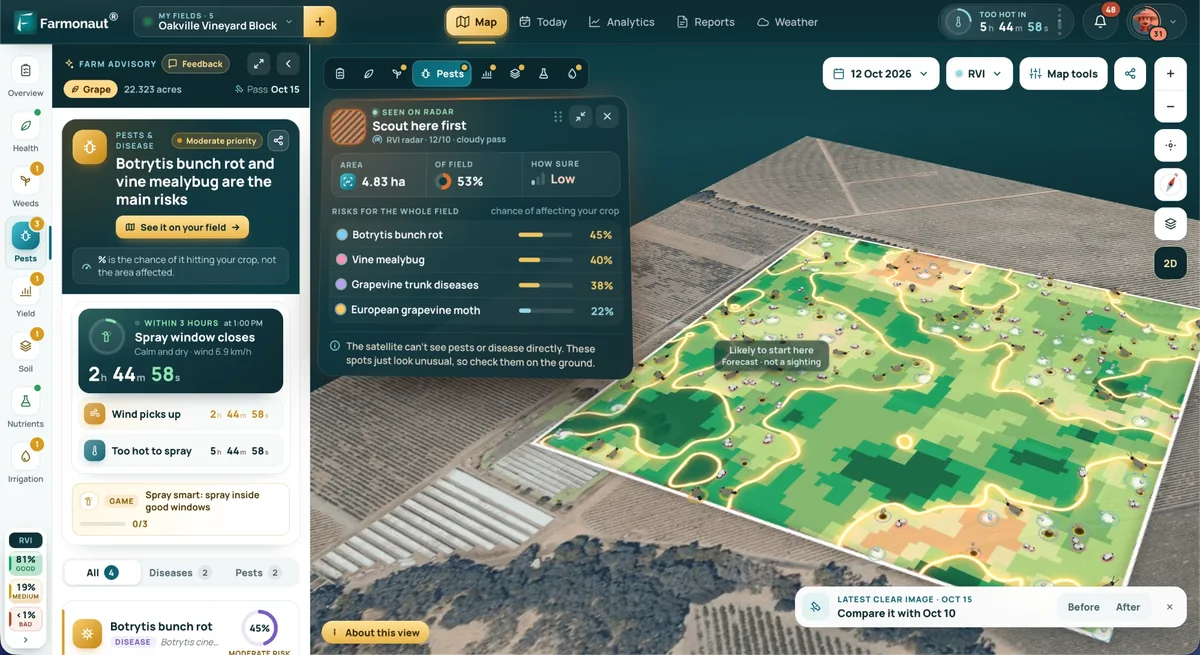
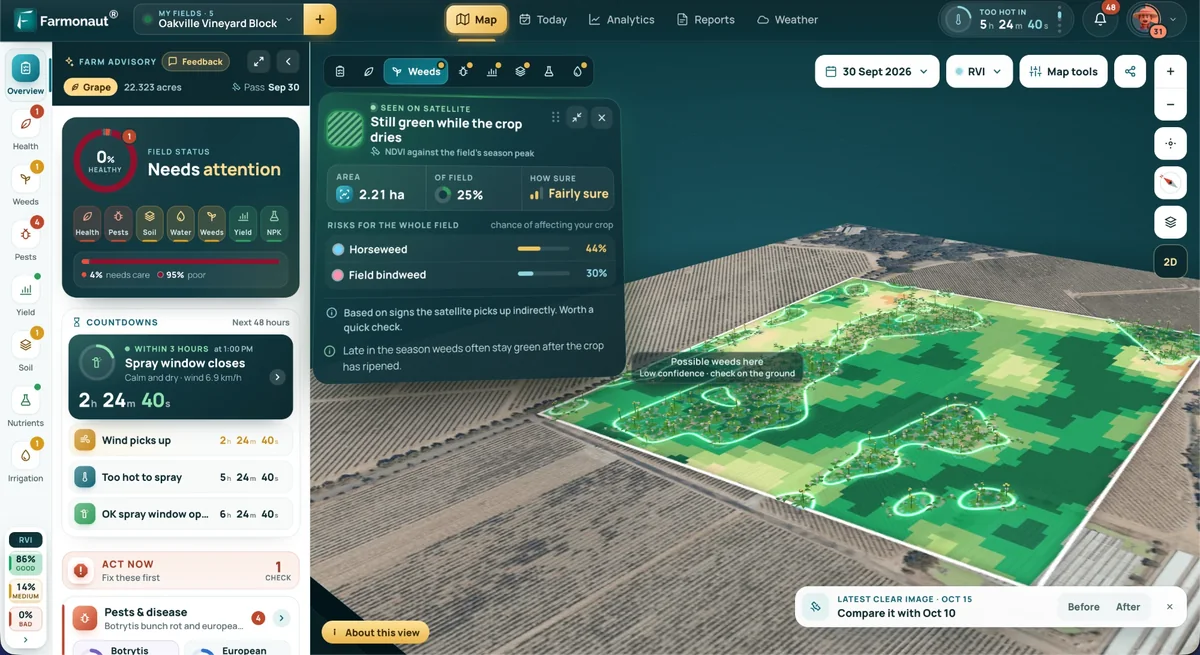
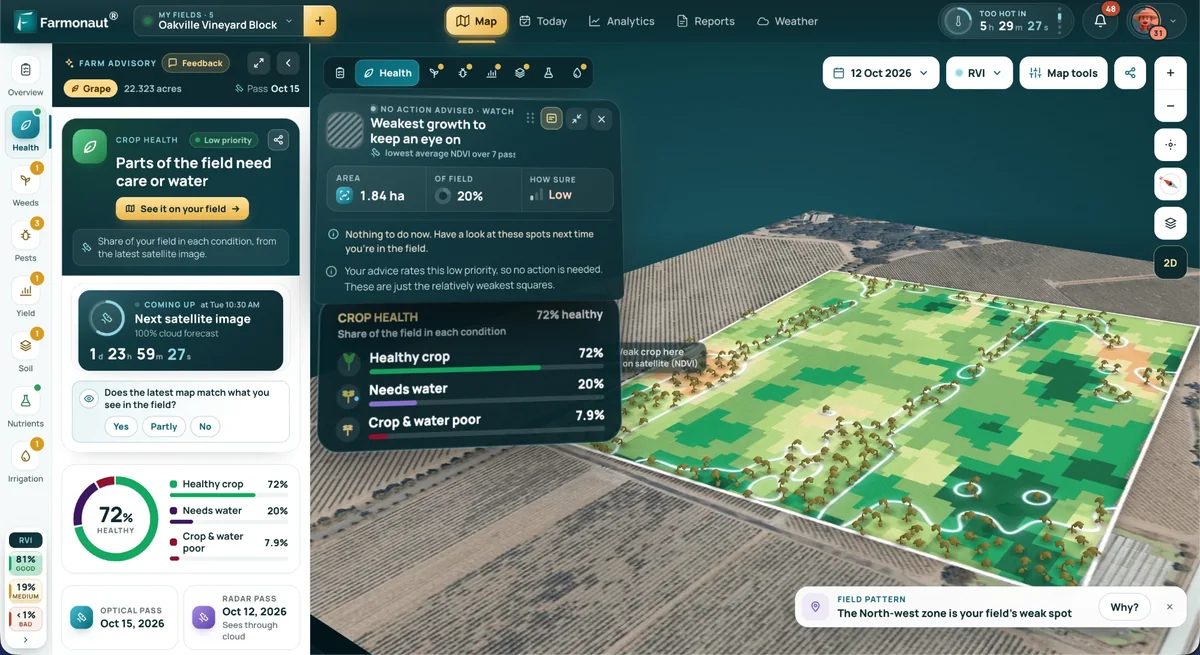
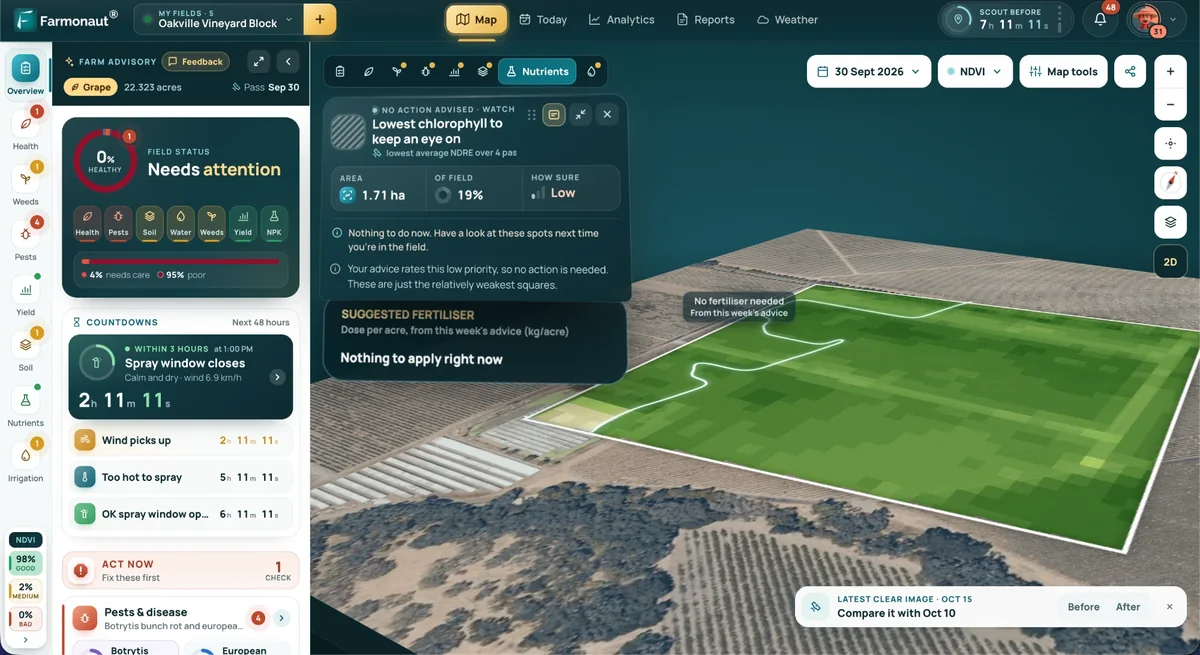
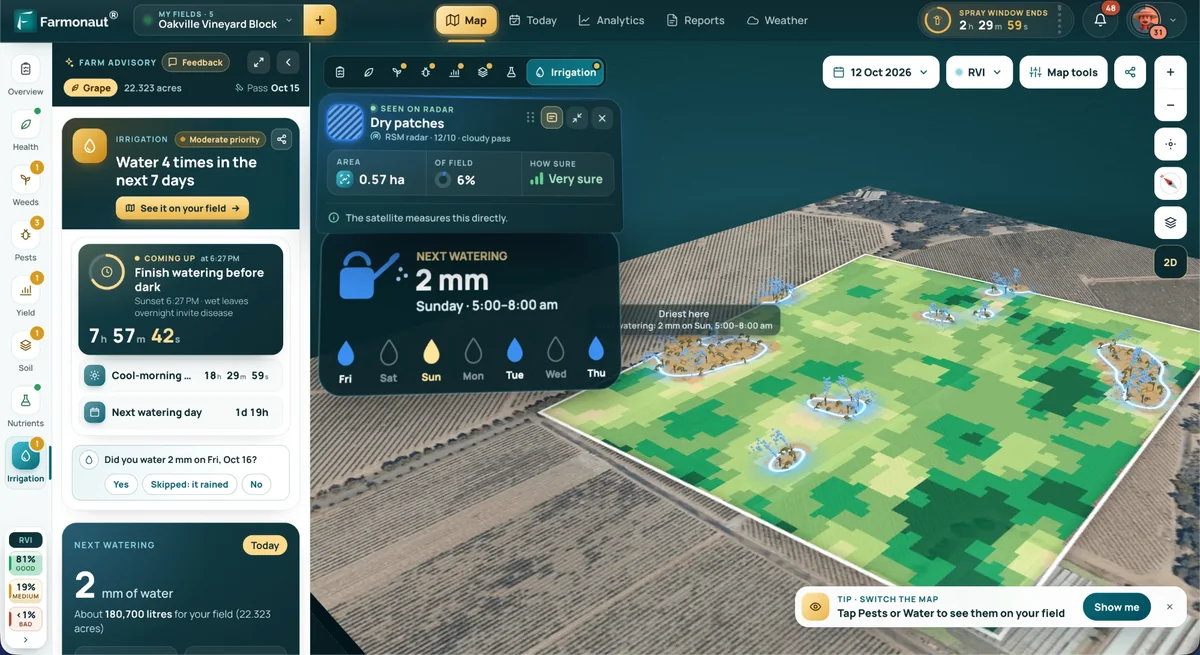
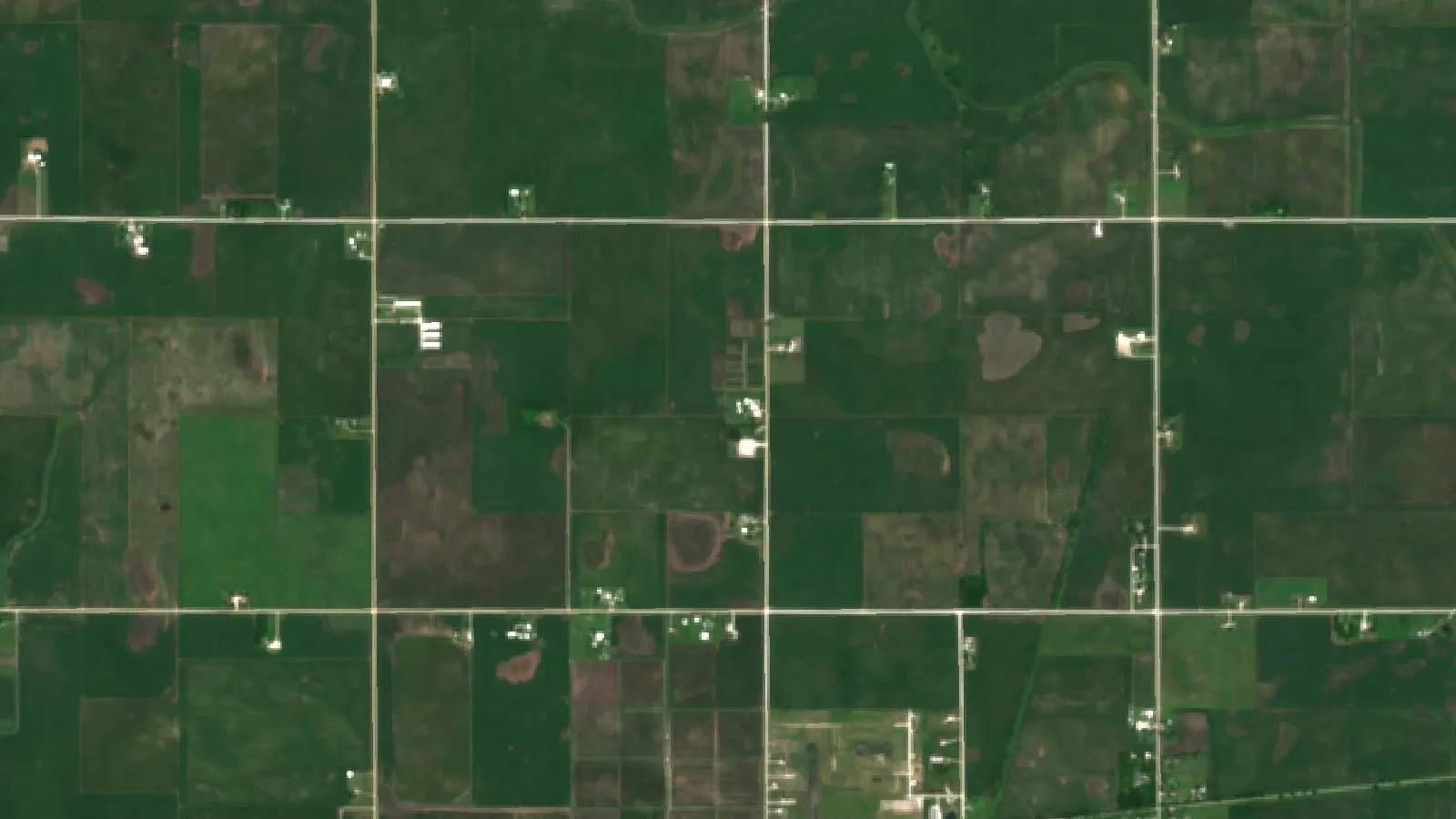
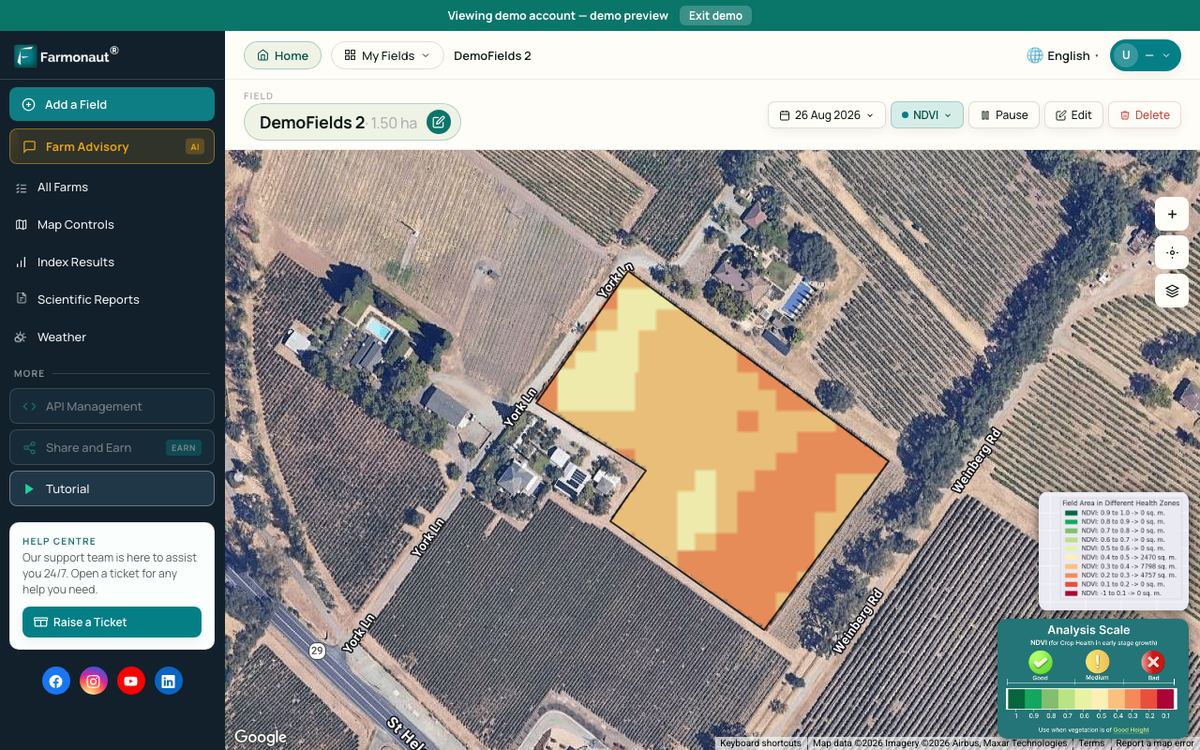
Satellite maps can help you decide where to walk first. The Farmonaut Satellite + AI Farm Monitoring System shows field-by-field vegetation maps over the season. A satellite shows change in plant cover, not its cause, so scout the spot before you act.

▶ Six plain steps to start precision farming without buying a robot. · 4:18
How to learn farming skills
Many farming skills are best learned by doing, beside someone who already has them.
- Work on a farm first. A season as a hired hand teaches machinery, timing and livestock handling.
- Use the extension service. US land-grant universities run soil labs, field days and short courses. Many countries have similar advisory services.
- Look for beginning-farmer help. USDA counts anyone who has farmed for under ten years as a beginning farmer (USDA Farmers.gov). Its Beginning Farmer and Rancher Development Program grants fund training, education, outreach and technical assistance for them (USDA NIFA).
- Take a course. Agricultural colleges offer certificates and degrees in crop science and farm business.
- Keep a farm diary. Dates, inputs, weather and yields make each season a lesson.
Start with the skill that costs most when done badly on your farm. For a vegetable grower that may be irrigation and post-harvest handling. For a grain farm it is often soil fertility and machinery.
A season checklist for the ten skills
The skills work best as a yearly cycle. Use this list as a prompt, then adjust it to your crop, climate and local rules.
- Before the season: take soil samples, read the reports, plan the rotation, set a budget and order tested seed.
- At planting: check machine settings, record the date and seeding rate, and note soil moisture.
- Early growth: walk each field soon after emergence, count plants in a few spots and compare the count with your target.
- Mid-season: scout for pests and disease on a fixed route, decide with thresholds, and time water to crop stage.
- Harvest: check maturity, plan labour and storage ahead, and label each lot with its field.
- After harvest: record yields and costs per field, sample the soil again where needed, and write down one change for next year.
Treat the list as a habit, not a one-off. A farm diary that follows these six stages gives you a field-by-field history, and that history is what lets you compare one season with the next.
Common gaps new farmers should check
Experience closes most gaps, but a few are easy to spot early.
- Skipping the soil test. Fertilizer bought without a test may be wasted on a field that does not need it, or too little on one that does.
- Planting every seed as if it will grow. Test germination and adjust the seeding rate, as the calculator above shows.
- Watering by habit. Check soil moisture before each irrigation, not the calendar.
- Spraying on sight. Count pests against a threshold, and follow the label and local rules if you decide to treat.
- Leaving records to memory. Write the date, the field and the action the same day.
- Working without a safety routine. Walk the site for hazards each season and train every new worker.
FAQ
What are the most important basic farming skills to learn first?
Start with soil testing, crop rotation, water timing and pest scouting, because they shape every other decision. Add record-keeping from day one, since it makes each later skill easier to judge.
What skills do you need for farming?
The BLS lists analytical, critical-thinking, interpersonal and mechanical skills, initiative and physical stamina. Field skills sit on top of them: soil, water, seed, pests, harvest, safety and records.
Can I learn farming skills without a farm background?
Yes. Work on a farm for a season, use your extension office, and ask about beginning-farmer programmes. In the US, the BLS notes five years or more of related work experience is usual for farm managers, so hands-on time counts most.
How do I reduce losses after harvest?
Harvest at the right maturity, handle produce gently, cool fresh crops quickly, keep storage clean and dry, and shorten the time between field and market. FAO figures show regional losses range from 10.0 to 23.0 percent.
Do small farms need these skills?
Yes. Every step scales down to a small plot. A soil test, a seed germination check, a weekly walk and a simple field log cost little.
Are farm skills different in the UK, Europe or Australia?
The skills are the same but rules differ, for example on pesticides, worker safety, tax and records. Check your national agriculture agency and local extension adviser.
Related pages on our site: types of agricultural land use, carbon footprinting, traceability, product traceability, large-scale farm management, fleet and equipment management, crop loan and insurance, weather API documentation and satellite data API.
Farmonaut crop monitoring
See your own fields from space
Draw your fields once and see satellite vegetation maps for them through the season, on web, Android or iOS.



Keep reading

Sources
- US BLS, Occupational Outlook Handbook: Farmers, Ranchers, and Other Agricultural Managers: bls.gov
- US BLS, Census of Fatal Occupational Injuries: occupations with high fatal work injury rates (2023): bls.gov
- Iowa State University Extension, nutrient and limestone recommendations in Iowa: naturalresources.extension.iastate.edu
- USDA ERS, 2022 Census of Agriculture: cover crop use (2024): ers.usda.gov
- University of Illinois, farmdoc daily: cover crops in the 2022 Census of Agriculture (2024): farmdocdaily.illinois.edu
- Nebraska CropWatch, More diverse crop rotations improve yield (2021): cropwatch.unl.edu
- Nebraska CropWatch, Sensors on the pivot for automated irrigation scheduling (2022): cropwatch.unl.edu
- US EPA, Integrated pest management principles: epa.gov
- Purdue Extension, AY-217 Plant populations and seeding rates for soybeans: extension.purdue.edu
- FAO, SDG indicator 12.3.1 Food Loss Index: fao.org
- IRS, Publication 225 Farmer’s Tax Guide: irs.gov
- US EPA, Agricultural Worker Protection Standard: epa.gov
- USDA Farmers.gov, Beginning farmers and ranchers: farmers.gov
- USDA NIFA, Beginning Farmer and Rancher Development Program: nifa.usda.gov
Discussion
Questions, corrections or field experience? Share them below. First-time comments are reviewed before they appear, and your email is never published.
No comments yet. Be the first to add a question or your experience.

 AgroStar
 Native Seeds
 Andex
 FCF India
 Unifrutti Gulf
 Deluxe Conseil
 TVS Electronics
 BW Pipelines
 WICO
 Gen Chayat
 Chimera Innovation
 SkyHarvest
 Polaris Digitech
 Teledarbas
 Wild Oak Farm

 Licence holder · Niger · Gold