

Farm policy · US guide
US Agriculture Policy: Farm Bill, Conservation, Insurance
As of 16 October 2026 the US has no new farm bill: the 2018 law lapsed on 30 September and new CRP contracts are paused. EQIP, CSP, crop insurance and ARC/PLC still run under the July 2025 budget law, with higher premium subsidies.
Key takeaways
- The 2018 farm bill was extended three times and lapsed on 30 September 2026; FSA cannot approve new CRP contracts until Congress acts (DTN, October 2026).
- The House passed H.R. 7567 on 30 April 2026 and the Senate Agriculture Committee approved its bill 12-11 on 16 September 2026.
- The 2025 budget law funds EQIP, CSP, ACEP and RCPP through FY2031 and extends ARC and PLC through the 2031 crop year.
- Crop insurance subsidies rose 3 to 5 points at most coverage levels; at 75% coverage on basic units the subsidy went from 55% to 60% (RMA, 2025).
- Conservation compliance can remove premium subsidies if highly erodible land or wetland rules are broken.
In this article
- US agriculture policy at a glance
- Where the farm bill stands
- How the money is split across the farm bill
- Conservation programs in US agriculture policy
- Crop insurance and conservation compliance
- Implements, precision tools and policy support
- How to use federal farm programs: 6 steps
- Premium and cost-share calculator
- Who benefits from current farm policy
- Agriculture policy in other markets
- FAQ
US agriculture policy for sustainable farming rests on three tools: conservation programs that pay for practices, federal crop insurance that shares risk, and conservation compliance rules that tie the two together. As of 16 October 2026 there is no new farm bill. The 2018 farm bill lapsed on 30 September 2026 after three one-year extensions, and new Conservation Reserve Program (CRP) contracts are on hold, according to DTN’s report on the CRP pause.
This guide explains where each piece stands, what changed under the July 2025 budget law, how crop insurance and conservation rules link up, and which equipment costs public programs can help with. It ends with a calculator for your own premium and cost-share numbers. For a plain guide to policy types and claims, see our separate page on agriculture insurance for crops and farms.
US agriculture policy at a glance
The table sums up the main parts of federal farm policy that affect sustainability decisions on a working farm. Dates and figures come from the Congressional Research Service (CRS), the USDA Risk Management Agency (RMA) and the American Farm Bureau Federation.
| Policy tool | What it does | Status (Oct 2026) | Who runs it |
|---|---|---|---|
| EQIP | Cost-share for conservation practices on working land | Funded through FY2031 by the 2025 budget law | NRCS |
| CSP | Annual payments for whole-farm stewardship | Funded through FY2031 | NRCS |
| CRP | Rent for land taken out of crops | Authority lapsed 30 Sept 2026; no new contracts | FSA |
| Crop insurance | Subsidized yield and revenue cover | Permanent law; higher subsidies since 2025 | RMA and private insurers |
| ARC and PLC | Payments when revenue or prices fall | Extended through the 2031 crop year | FSA |
| Compliance | Links benefits to soil and wetland rules | Permanent law | NRCS and FSA |
Where the farm bill stands
The farm bill is the multiyear law that sets most federal food and farm programs. The current one, the Agriculture Improvement Act of 2018, expired in 2023. Congress extended it three times, each time for one year: in November 2023, December 2024 and November 2025, according to the CRS comparison of the House and Senate bills (updated July 2026).
A new bill has moved part of the way. The House passed the Farm, Food, and National Security Act of 2026 (H.R. 7567) by 224 to 200 on 30 April 2026. The Senate Agriculture Committee approved its own Agriculture Act of 2026 by 12 to 11 on 16 September 2026, as reported by AgWeb. Neither chamber had passed the other’s text by mid-October, and the stopgap funding law that runs to 11 December did not extend the farm bill.
Some programs do not depend on the farm bill at all. Crop insurance is permanent law. The July 2025 budget reconciliation law (P.L. 119-21, often called the One Big Beautiful Bill Act) also extended commodity programs through the 2031 crop year and funded the large working-lands conservation programs through FY2031. So the lapse hits a narrower set of programs, with CRP the largest.
What the pending bills would change
- Both bills would bring back per-person payment limits for EQIP and CSP, which have not applied in FY2025 and FY2026 (CRS, 2026).
- The House bill would steer EQIP and CSP toward precision agriculture, composting and wildlife corridors, and would cut EQIP budget authority by about $1.0 billion over ten years to fund other programs.
- The Senate bill shares the precision agriculture language and adds a stand-alone soil health program of $50 million a year through FY2031.
- Both would create a Forest Conservation Easement Program and repeal the Healthy Forests Reserve Program.
How the money is split across the farm bill
Nutrition programs take most of the farm bill budget. CBO’s February 2026 baseline projects $1.374 trillion in mandatory outlays for FY2027 to FY2036, and nutrition alone is about $985 billion of that. Among the farm titles, crop insurance is the largest, followed by commodity programs and then conservation.
That split matters for sustainability. Conservation money is about half the size of crop insurance money, so the rules attached to insurance can reach more acres than conservation payments alone.
Chart
Projected farm bill spending by title, excluding nutrition
$ billion, 10-year mandatory outlays FY2027-FY2036; nutrition (about $985 billion) not shown
Conservation programs in US agriculture policy
Federal conservation programs are voluntary. They pay farmers and ranchers to plan and install practices that protect soil, water and habitat, and USDA groups them as working lands, land retirement, easements, partnerships and compliance, according to the CRS conservation title primer (April 2026).
EQIP and CSP: working lands
The Environmental Quality Incentives Program (EQIP) shares the cost of practices such as cover crops, nutrient management, irrigation upgrades and fencing. You work with NRCS on a conservation plan, apply by your state’s ranking date, sign a contract if selected, and are paid after the work is installed and checked against NRCS standards, as the NRCS EQIP page explains. Each state publishes its own payment schedule, so rates differ by state and practice.
The Conservation Stewardship Program (CSP) pays for keeping and raising the level of conservation across the whole operation. Both programs got long-term funding in the 2025 budget law. CRS notes that the law rescinded unobligated Inflation Reduction Act money for EQIP, CSP, ACEP and RCPP and moved it into the permanent farm bill baseline. It also dropped the IRA rule that the extra money go only to climate-focused practices.
CRP: land retirement
CRP pays landowners rent to take land out of crops, usually for 10 to 15 years, to protect soil, water and wildlife. CBO puts CRP outlays at about $2.0 billion a year. The national acreage cap rose step by step under the 2018 farm bill and was held at 27 million acres for FY2023 to FY2026.
Since 1 October 2026 FSA cannot approve new CRP contracts. Existing contracts approved before the deadline continue. If you were planning a new CRP or CREP enrollment, ask your county FSA office for the latest notice before you change field plans.
ACEP and RCPP
The Agricultural Conservation Easement Program buys long-term limits on land use, either to keep farmland in farming or to restore wetlands. The Regional Conservation Partnership Program pools USDA money with funds from states, companies and groups for local projects. Both are funded through FY2031 under the 2025 law.
Chart
CRP national acreage cap
million acres allowed, by fiscal year (2018 farm bill as extended)
Crop insurance and conservation compliance
The Federal Crop Insurance Program is the largest risk tool in US farm policy. In its 2019 data, CRS counted more than 2 million policies and insured crops and livestock worth more than $116 billion, with more than 90% of planted corn, soybean and cotton acres insured.
Higher premium subsidies since
The government pays part of each farmer’s premium, and the share falls as coverage rises. The 2025 law raised those shares by 3 to 5 percentage points at most coverage levels, according to the RMA bulletin on the One Big Beautiful Bill Act. At the 75% coverage level on basic or optional units, the subsidy rose from 55% to 60%. Enterprise units now get 80% up to the 75% level.
The same law raised the subsidy on the Supplemental Coverage Option (SCO) and the Enhanced Coverage Option (ECO) from 65% to 80%, and let farmers buy SCO whether they enrolled in ARC or PLC. RMA says the SCO cap rises from 86% to 90% for the 2027 crop year. Beginning farmers now qualify for 10 years instead of 5, with up to 5 extra percentage points of subsidy in their first two years (Farm Bureau, 2025).
The compliance link
Conservation compliance is where insurance and sustainability meet. A producer who farms highly erodible land without an approved plan, or drains a protected wetland can lose some federal benefits, including crop insurance premium subsidies (a separate “sodsaver” rule cuts premium subsidies on newly broken native sod), as the CRS conservation title primer (April 2026) explains. With more than 90% of corn, soybean and cotton acres insured (CRS, 2019 data), this rule reaches far more land than conservation payments do.
Insurance rules also shape practices such as cover crops. Follow the good farming practices in your policy and the termination guidance from RMA and NRCS, or a claim can be questioned. Rules change by crop year and county, so confirm details with your crop insurance agent and get professional advice before you sign.
Chart
Crop insurance premium subsidy by coverage level
% of premium paid by government, basic and optional units, before and after the 2025 law
Implements, precision tools and policy support
Precision equipment is now common on large row crop farms. Auto-steer and guidance systems were used on 5.3% of planted corn acres in 2001 and 58% in 2016, according to the USDA ERS report on precision agriculture adoption (February 2023). Yield monitors, yield maps, soil maps and variable rate technology (VRT) followed a similar path, with lower use on smaller farms.
Policy reaches this equipment in three ways. EQIP practice standards can pay for precision nutrient management and similar practices that use VRT or section control. FSA farm loans can finance equipment; both pending bills would raise the maximum loan amounts. And both bills would put precision agriculture into EQIP and CSP more directly.
Data from implements and satellites also helps with paperwork. Yield maps support crop insurance production records, and field imagery can show when cover crops were planted or terminated. Farm teams that manage machines across many sites sometimes add fleet management tools, and buyers who ask for proof of practices may use product traceability records. For soil data behind nutrient plans, see our guide to agricultural soil testing.
Satellite records for compliance and claims
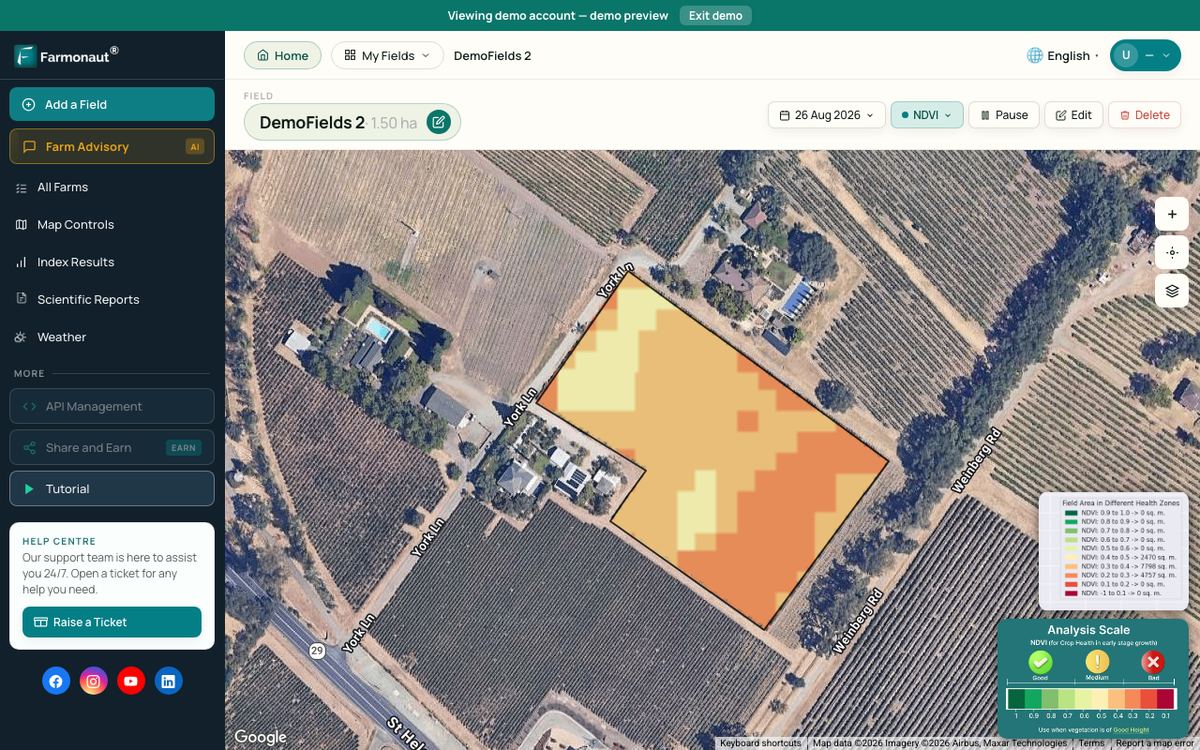
Satellite images do not replace an adjuster or an NRCS field visit. They show vegetation change over time, which helps you date events, spot problem zones and keep a record. Farmonaut provides satellite crop monitoring with vegetation index maps for each field; developers can use the satellite data API and the weather API developer docs.

▶ A beginner’s six-step path into precision agriculture. · 4:18
How to use federal farm programs: 6 steps
- Visit your USDA Service Center. Get a farm number and make sure your highly erodible land and wetland certification (form AD-1026) is on file.
- Ask NRCS for a conservation plan. The plan lists resource concerns and practices for your fields.
- Apply for EQIP or CSP before the state ranking date. Applications are taken all year, but only those in by the date compete in that round.
- Match practices to your insurance. Check cover crop and irrigation rules with your agent before you plant.
- Pick coverage level and unit structure. Compare basic, optional and enterprise units using the subsidy table below and your own premium quotes.
- Keep records. Planting dates, yields, receipts and field images support both conservation payments and claims.
▶ Seven simple sustainable farming practices, many of which conservation programs can help pay for. · 4:34
Premium and cost-share calculator
Enter your own acres, premium quote, subsidy rate and practice cost. The subsidy rate comes from the RMA table for your unit type and coverage level. The cost-share rate comes from your state EQIP payment schedule or contract.
Try the numbers for your own farm below.
Who benefits from current farm policy
Row crop farms with base acres gain most from the 2025 changes. Reference prices for major crops rose 10 to 21%, and up to 30 million new base acres can go to farms that planted program crops in 2019 to 2023 but had no base, according to Farm Bureau’s summary of the final law. Dairy farms gain from a higher Tier I cap in Dairy Margin Coverage, up from 5 million to 6 million pounds.
Farms that relied on CRP for new enrollment face the most uncertainty until Congress acts. Specialty crop growers gain from the Specialty Crop Research Initiative, which rises to $175 million in FY2026, and from higher Whole-Farm Revenue Protection coverage of up to 90%.
▶ How satellite crop health monitoring checks a large farm without walking every acre. · 4:09
Agriculture policy in other markets
Readers outside the US face similar tools under different names. Canada pairs AgriInsurance with AgriStability under its federal-provincial framework. The EU links direct payments to environmental conditions under the Common Agricultural Policy, and the UK pays for practices under its own land management schemes. Australia relies more on private crop cover and drought support. In each case, check the current scheme rules with your local agency, because terms change between program periods.
Related pages on our site: satellite data for crop loans and insurance, carbon footprinting, types of farming images and the Farmonaut app.
FAQ
Is there a new farm bill?
Not as of 16 October 2026. The House passed H.R. 7567 on 30 April 2026 and the Senate Agriculture Committee approved its bill on 16 September 2026, but no final bill has passed both chambers.
What happened to CRP when the farm bill expired?
FSA stopped approving new CRP contracts after 30 September 2026. Contracts approved before then continue. A new notice will follow if Congress restores the authority.
Can I lose crop insurance subsidies for breaking conservation rules?
Yes. Conservation compliance can remove premium subsidies if you farm highly erodible land without an approved plan or convert a protected wetland. Talk to NRCS before you clear, drain or break out new ground.
How much does the government pay toward my premium?
It depends on coverage level and unit type. Since the 2025 law, basic and optional units get 67% at 50% coverage and 41% at 85% coverage; enterprise units get 80% up to 75% coverage (RMA, 2025).
Does EQIP pay for precision farming equipment?
EQIP pays for practices, not for a machine as such. Some practices, such as precision nutrient management, can cover costs linked to precision tools. Check your state payment schedule and ask NRCS.
Farmonaut crop monitoring
Keep a satellite record of every field
Farmonaut maps crop vegetation change field by field, which helps you date events and keep records for your farm.



Keep reading
Sources
- DTN, CRP Enrollment Paused as Farm Bill Expires (October 2026): dtnpf.com
- CRS R48918, The 2026 Farm Bill: Comparison of the House and Senate Bills with Current Law (July 2026): everycrsreport.com
- AgWeb, Farm Bill Clears Senate Ag Committee (September 2026): agweb.com
- CRS IF12024, Farm Bill Primer: Conservation Title (April 2026): everycrsreport.com
- CRS IF13114, Agricultural Conservation After P.L. 119-21 (September 2025): everycrsreport.com
- USDA NRCS, Environmental Quality Incentives Program: nrcs.usda.gov
- USDA RMA, MGR-25-006 One Big Beautiful Bill Act Amendment (2025): rma.usda.gov
- CRS R46686, Federal Crop Insurance: A Primer: everycrsreport.com
- USDA ERS, Precision Agriculture in the Digital Era, EIB-248 (February 2023): ers.usda.gov
- American Farm Bureau Federation, One Big Beautiful Bill Act: Final Agricultural Provisions (2025): fb.org
- CBO, Baseline Projections for Selected Programs (February 2026): cbo.gov
Discussion
Questions, corrections or field experience? Share them below. First-time comments are reviewed before they appear, and your email is never published.
No comments yet. Be the first to add a question or your experience.

 Dextrago
 Kubota
 FFBS
FFBS Jontra
 Kalustyan
 Tucor
Tucor Geno
Geno Hayleys Agriculture
 Linx Agritech
 Adinet
 Save Your Soils
 Grandstream Algérie
 XOS Realty
 Geospatial Lab Africa
 Licence holder · Niger · Gold










