

Forage · Cattle feed guide
Baled Silage for Cows: Moisture, Wrap Layers and Cost
Baled silage (baleage) is wilted forage baled at 40 to 60% moisture and sealed in film to ferment. Here are the extension targets for cutting, wilting, wrapping and storing it, how it compares with hay and haylage, and what it costs per ton of dry matter.
Key takeaways
- Bale at 40 to 60% moisture, best at 50 to 60%; forage above about 65% risks butyric acid fermentation (University of Georgia B1508).
- Use at least six layers of 1-mil film at 45-60% moisture and eight layers outside that range (Ohio State).
- In a Kentucky trial, baleage had negligible storage loss while round hay bales stored outside lost 18.7% of dry matter (UK AGR-173).
- Custom round bale wrapping averaged $13.00 per bale in Maryland and Delaware in 2025, up from $7.75 in 2017 (FS-683).
- The US all-hay price received was $190 per ton in August 2026, $29 above a year earlier (USDA NASS).
In this article
- Baled silage at a glance
- What is baled silage?
- Why baled silage suits cows and cattle farms
- How to make baled silage, step by step
- How many layers of wrap does baleage need?
- Baled silage vs hay vs haylage
- Can you bale corn silage?
- What does baled silage cost?
- Buying or selling baled silage
- Plastic use and recycling
- Feeding baled silage to cows
- Using satellite maps to plan forage harvest
- Common baleage mistakes
- How we checked the numbers
Baled silage, also called baleage or round bale silage, is grass, legume or small-grain forage that is cut, wilted to about 40 to 60% moisture, baled and then sealed in stretch film so it ferments without air. Extension guides from Kentucky, Georgia and Ohio State agree on the core rules: bale at the right moisture, make dense bales, wrap the same day with at least six layers of film, and let the bales ferment for four to six weeks before feeding.
This guide is for beef and dairy producers in the US, Canada, the UK, Europe, Australia and New Zealand who want to make or buy baleage for cows. It explains the process step by step, how much plastic to use at each moisture level, how baleage compares with dry hay and haylage, and what it costs. A calculator lets you compare the cost of your own wrapped bales with buying hay, using your own numbers.
Baled silage at a glance
The table sums up the main targets from university extension guides. Each point has its own section below with the source behind it.
| Step | Target | Why it matters |
|---|---|---|
| Cut | Grasses at boot stage, legumes at about 10% bloom | Enough sugar for fermentation and good feed value |
| Wilt | 40 to 60% moisture, best at 50 to 60% | Too dry will not ferment well; too wet risks butyric acid |
| Bale | Slow ground speed, dense bales; a 4 x 5 ft bale is about 1,300 to 1,550 lb | Less trapped air, easier handling |
| Wrap | Within hours of baling, at least six layers of 1-mil film | Unwrapped bales heat within a day |
| Store | Four to six weeks before feeding | Time for fermentation to finish |
| Feed | Within a year; wetter bales sooner | Quality falls once film is damaged |
What is baled silage?
The University of Kentucky guide AGR-173, “Baling Forage Crops for Silage,” describes round bale silage as the wet product of cutting forage with normal hay equipment, wilting it to between 40 and 60 percent moisture, baling it and sealing the bales in plastic. Inside the film, bacteria turn plant sugars into acids. The acids preserve the forage, much like in a bunker or tower silo.
Baleage is not the same as haylage in a silo or chopped silage in a bag. The forage is long (unchopped) or only lightly cut by a baler’s knives. It is stored as single bales or as a long row of bales in a tube wrapper. That makes it a good fit for farms that already own hay equipment and do not want to build a silo.
The common terms can be confusing, so here is how they are used in this guide:
- Baleage, baled silage, wrapped silage, round bale silage: the same product, bales sealed in film.
- Haylage: wilted grass or legume silage, usually chopped and stored in a silo, bunker or bag. Some people also call wrapped bales “haylage.”
- Corn silage: the whole corn plant, chopped and ensiled. It is usually stored in bunkers, piles or bags rather than round bales.
- Cut silage: forage cut with knives in the baler or a chopper, which helps density and mixing in a feed wagon.
Why baled silage suits cows and cattle farms
The main benefit is timing. Dry hay often needs three or more dry days. Baleage can be baled within hours to a day of cutting, so you can harvest closer to the best stage even in a wet spring. The Ohio State Buckeye Dairy News article “Making High Quality Baleage” calls it a way to deal with short dry weather windows.
The second benefit is lower loss. Kentucky’s AGR-173 reports a trial in which baled alfalfa silage at three moisture levels had negligible dry matter loss in storage, while field-cured hay stored as round bales lost 18.7% of its dry matter. Digestibility of the baleage held at about 64 to 65%, while the hay fell from 67% to 52%.
For cows, that means feed with more of its protein and energy left. Beef cows, dairy heifers and dry cows can all use baleage, and lactating dairy cows can use well-made bales tested for quality. Kentucky’s Forage Extension Program notes that conserving some forage as baleage can help stretch the hay supply and save on supplement costs.
There are trade-offs. Baleage uses plastic, which costs money and must be disposed of or recycled. Wet bales are heavy and need a bale squeeze or spear that will not tear film. Poorly made bales can spoil, and spoiled silage can carry listeria or botulism risks, so moldy bales should not be fed. Talk to your veterinarian or nutritionist before feeding any doubtful bales.
Chart
Digestibility after storage: baleage vs round hay
Alfalfa digestibility (%) after storage, Kentucky trial

▶ Why mixing crops and cattle on one farm spreads risk, including using home-grown forage as feed. · 2:55
How to make baled silage, step by step
1. Cut at the right stage
The University of Georgia guide “Baleage: Frequently Asked Questions” (B1508) advises cutting legumes at about 10% bloom and grasses at the boot stage or just as the head emerges. This gives a good balance of yield and feed value and leaves enough sugar for fermentation.
2. Wilt to the right moisture
Baleage can be made at 40% to 60% moisture, but fermentation is best at 50% to 60%, according to the Georgia guide. Forage above about 65% moisture should not be baled for silage, because it raises the chance of butyric acid fermentation by clostridia. Forage below 40% will not ferment well, though it can still keep if the film stays airtight.
Ohio State suggests laying swaths as wide as the mower allows. University of Wisconsin research it cites found wide swaths reached 65% moisture 10.8 hours sooner. A quick check is the “dish rag” test: wring a handful of forage, and if juice runs out, it is likely above 65% moisture. A microwave oven test or a moisture meter gives a better number.
3. Make dense, even bales
Slow down when baling to make tight bales. Ohio State cites Penn State work showing that raising density from 6 to 8 lb per cubic foot added about 12 hours of bunk life. Kentucky’s AGR-173 says a typical 4 by 5 foot silage bale weighs 1,300 to 1,550 lb and holds 600 to 650 lb of dry matter, but it can weigh as much as a ton, so many farms keep bale diameter to 42 to 48 inches. Use plastic twine or net wrap, and avoid treated sisal twine, whose oils can damage the film.
4. Wrap within hours
Speed matters. In Wisconsin data cited by Ohio State, bales left unwrapped for 24 hours were already over 120°F. Wrapping later stopped the heating but did not bring the lost quality back. Ohio State sets a goal of wrapping within four hours, and ideally within two.
Kentucky’s AGR-173 calls for at least six layers of UV-stabilized film. With an individual bale wrapper, the Georgia guide says to apply two layers each full turn of the bale with a 50% overlap between layers. The film is stretched as it goes on, which keeps it tacky so the layers seal.
5. Store and let it ferment
Store bales on a well-drained site, away from trees and fence rows, and check them often for holes. Patch any tear with tape made for silage film. AGR-173 advises letting bales ferment for four to six weeks before feeding. Ohio State notes that baleage ferments more slowly than chopped haylage and often takes about six weeks.
6. Test and feed
Always test baleage before feeding so the ration meets the cows’ needs. Kentucky’s baleage FAQ (AGR-235) explains how to sample wrapped bales for a lab test. Ohio State recommends feeding bales within a year of wrapping, and bales above 60% moisture within about three months.
How many layers of wrap does baleage need?
Most bale wrap is 1-mil low-density polyethylene. Ohio State says bales need at least 5 mils of plastic to seal out oxygen, which means at least six wraps, and that stretching can cut film thickness by up to 25%. The table and chart below follow Ohio State’s general recommendations.
| Moisture at baling | Fermentation | Layers of 1-mil film |
|---|---|---|
| Under 30% | Possible but not ideal; some mold likely | 8 minimum |
| 30 to 45% | Possible but not ideal; some mold could occur | 8 minimum |
| 45 to 60% | Ideal for baleage | 6 |
| 60 to 70% | Possible; spoilage and lower intake risk | 8 |
| Over 70% | Too wet; do not bale | Wait for it to dry |
Stemmy forages, such as sorghum-sudangrass or mature small grains, can poke holes in film. Ohio State warns that forage which pokes through the plastic needs more layers.
Chart
Layers of 1-mil film by moisture at baling
Minimum layers recommended, by moisture range
Baled silage vs hay vs haylage
Each way of storing forage has a place. The table compares them in plain terms. Losses depend on weather, equipment and how well the job is done.
| Method | Moisture at storage | Main equipment | Strengths | Weak points |
|---|---|---|---|---|
| Dry hay (round bales outside) | Under about 20% | Mower, rake, baler | Cheap to store, easy to sell and ship | Needs dry days; high outdoor storage loss |
| Baleage (wrapped bales) | 40 to 60% | Baler for wet crop, wrapper, bale squeeze | Fast harvest, low storage loss, no silo | Plastic cost and disposal; heavy bales |
| Chopped haylage | About 40 to 65% | Forage harvester, silo, bunker or bag | Efficient at large scale, easy to mix | High equipment cost; needs fast feed-out |
| Corn silage | About 65% (35% dry matter) | Forage harvester, bunker, pile or bag | High energy per acre | Hard to bale; needs storage and packing |
If your farm already makes hay and feeds a modest number of cows, baleage is often the simplest way to add silage. If you chop large volumes of corn, a bunker, pile or bag is usually the better fit. For storage in bags, see our guide to silage in bags, and for corn harvest timing see our guide to chopping corn for silage.
Can you bale corn silage?
Yes, but it is a different job from baling grass. Chopped corn silage does not hold together in a normal round baler. It needs a fixed-chamber baler-wrapper built for chopped material, which compresses and wraps the bale in one pass. These machines are common in parts of Europe and are often run by contractors. In North America most corn silage still goes into bunkers, piles and bags.
Whole-plant corn is harvested at roughly 65% moisture, wetter than grass baleage, so good sealing and fast wrapping matter even more. Corn bales are also heavy. If you buy baled corn silage, ask for the dry matter, the date it was baled and a feed test, and check that the film has no holes.
What does baled silage cost?
The main extra costs over hay are the wrapper, the plastic and handling equipment. The Georgia guide puts bale wrappers at $6,000 to $25,000 or more. Bale squeezes cost more than spears but are needed to move bales that are already wrapped.
Chart
Custom round bale wrapping rate
Average US$ per bale charged by custom operators, Maryland and Delaware survey
If you hire the job out, custom rates give a guide. The Maryland and Delaware custom work survey (FS-683, updated 2025) put the average charge for round bale wrapping at $13.00 per bale in 2025, up from $7.75 in 2017. Large round baling averaged $15.01 per bale. These are survey averages of what custom operators charge, not quotes, and rates in your area will differ.
To compare with hay, put both on a dry matter basis. A 1,300-lb bale at 55% moisture holds about 585 lb of dry matter, while a ton of dry hay is about 88% dry matter. USDA’s Agricultural Prices report put the all-hay price received by US farmers at $190 per ton in August 2026, up $29 from August 2025. Alfalfa hay averaged $206 per ton. These are average prices received by farmers, not delivered prices for a buyer.
Prices change fast. Check local auction results or your extension service before you set a price for buying or selling baleage, and get professional advice on financing a wrapper.
Try the numbers for your own farm below.
Calculator
Baleage vs bought hay: cost per ton of dry matter
Enter your own bale weight, moisture, costs and hay price.
- Dry matter per bale: 585 lb
- Baleage cost per ton of dry matter: 186 $
- Bought hay cost per ton of dry matter: 216 $
Example values only, not a benchmark or a forecast. The defaults use the 2025 Maryland/Delaware average custom rates for baling and wrapping and the USDA August 2026 all-hay price; the standing forage value is an example. Hay dry matter is set at 88%. Feed value differs between baleage and hay, so test both. Get professional advice before buying equipment.
Buying or selling baled silage
Baleage for sale is usually priced per bale. Because bale weight and moisture vary, a per-bale price can hide large differences in feed. Ask for:
- Bale weight and moisture, or a forage test with dry matter, protein and energy.
- The crop, cutting date and stage at cutting.
- When the bales were wrapped and how many layers were used.
- A fermentation test if you plan to feed high-producing cows.
Convert every offer to a price per ton of dry matter before comparing it with hay. Wrapped bales do not ship as well as dry hay, so most sales are local. Move bales with care and patch any holes at once.
Chart
US hay prices received by farmers
US$ per ton, baled hay, average price received
Plastic use and recycling
Bale wrap is one of the main farm plastics. The FAO’s assessment of agricultural plastics lists silage film and bale wrap among the plastics used in feed and fodder production and notes that data on these films are scarce in many countries. Some US states, Canadian provinces, the UK and Ireland run collection schemes for farm film. Keep film clean and dry, and check local rules before burning or burying it, which is banned in many places.
Feeding baled silage to cows
Open bales only as needed, since they start to heat and spoil once exposed to air. In winter, a bale may last a few days; in warm weather, feed it faster. Remove and discard moldy patches. Do not feed bales that smell strongly of butyric acid (rancid butter), which lowers intake.
Many farms feed baleage in ring feeders or unroll it on pasture. Dairy farms often add it to a total mixed ration. In that case, a chopping baler or a bale processor helps mixing. Test every lot and balance the ration with your nutritionist.
Using satellite maps to plan forage harvest
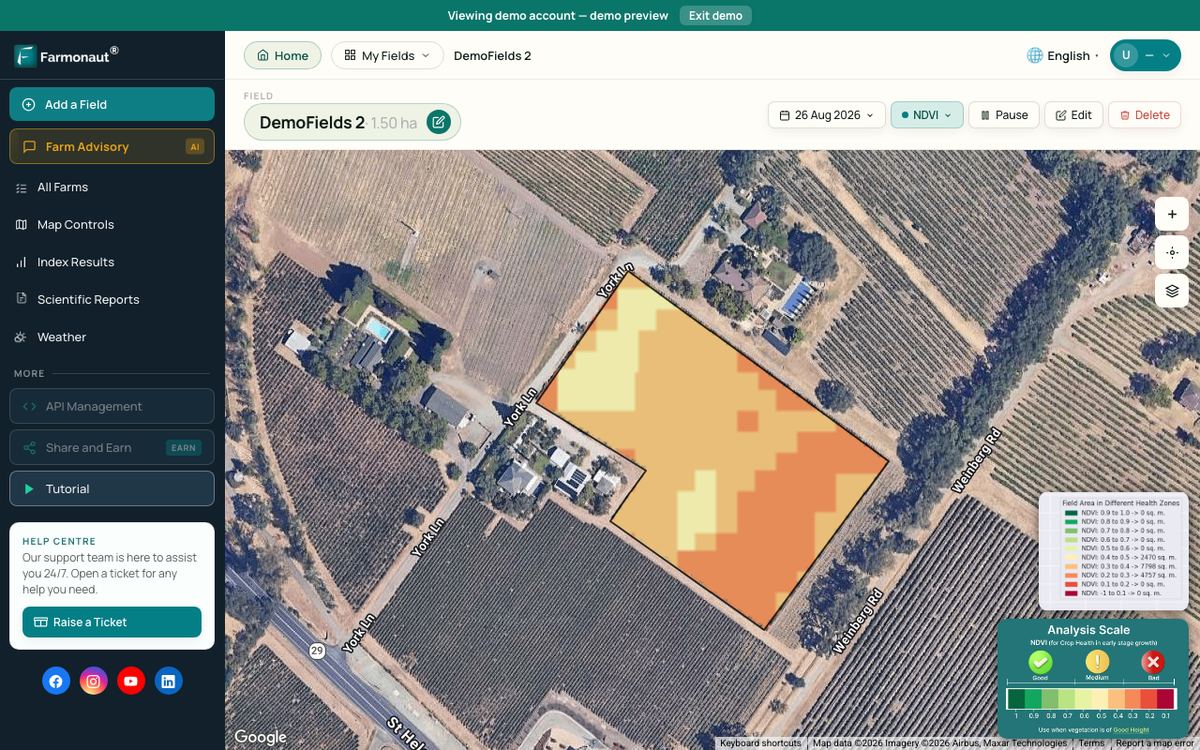
Good baleage starts with cutting at the right stage. Satellite vegetation maps can show which fields are growing fastest and which are stressed, so you can plan the cutting order and spot weak parts of a pasture before you walk it. Farmonaut provides satellite vegetation and weather data for each field on web, Android and iOS, and its admin app for large farms helps managers track many fields at once.
Weather is the other key input. A short dry window may be enough for baleage when it is not enough for hay. Farm software can pull forecasts through tools such as the satellite and weather API.
Related pages on our site: fleet management, carbon footprinting, crop loan and insurance, product traceability and the Farmonaut app.
▶ How satellite NDVI maps show crop stress across a large farm before you can see it. · 4:09
Common baleage mistakes
- Baling too wet. Above about 65% moisture, clostridia can take over and bales can leak and sag.
- Baling too dry. Below 40%, there is little fermentation and mold grows faster once air gets in.
- Loose bales. More air in the bale means more heating and a shorter life after opening.
- Slow wrapping. Bales left overnight start to heat and lose quality.
- Too few layers. Fewer than six layers of film often leads to spoilage.
- Rough handling. Holes from spears, stubble, birds or rodents let air in; patch them quickly.
- Feeding untested bales. Feed value varies a lot between fields and cuttings.
How we checked the numbers
Moisture, wrap and storage advice comes from university extension guides in Kentucky, Georgia and Ohio. Storage loss figures come from the Kentucky trial reported in AGR-173. Custom rates come from the Maryland and Delaware survey, and hay prices from the USDA National Agricultural Statistics Service. Rules differ by state and country, so check with your local extension office.
If this topic matters to you, read Milking Cows Near Me: 7 Powerful Dairy Innovations next.
FAQ
What moisture should baled silage be?
Between 40% and 60%, with the best fermentation at 50% to 60%. Do not bale forage above about 65% moisture.
How long before baleage can be fed?
Let bales ferment for four to six weeks. Feed them within a year, and feed wetter bales within about three months.
How many layers of plastic does baleage need?
At least six layers of 1-mil film for forage at 45% to 60% moisture, and eight layers for drier, wetter or stemmy forage.
Is baleage the same as haylage?
Both are wilted forage silage. Baleage is stored in wrapped bales; haylage is usually chopped and stored in a silo, bunker or bag. Some farmers use the two words for the same thing.
Is wrapped silage worth the cost?
It depends on your weather, herd size and hay price. Wrapping adds plastic and equipment costs, but storage losses are much lower than for round hay bales stored outside. Use the calculator above with your own numbers.
Farmonaut crop monitoring
Plan your next cutting from space
Draw your hay fields and pastures once and Farmonaut shows satellite vegetation maps and weather for them through the season, on web, Android or iOS.



Keep reading
Sources
- University of Kentucky, AGR-173 Baling Forage Crops for Silage: publications.ca.uky.edu
- University of Kentucky, AGR-235 Baleage: Frequently Asked Questions: publications.ca.uky.edu
- University of Georgia Extension, B1508 Baleage: Frequently Asked Questions: fieldreport.caes.uga.edu
- Ohio State University, Buckeye Dairy News, Making High Quality Baleage: dairy.osu.edu
- University of Kentucky Forage Extension Program, Hay and Storage: forages.ca.uky.edu
- University of Maryland and University of Delaware Extension, FS-683 Custom Work Charges in Maryland and Delaware (2025): udel.edu
- USDA NASS, Agricultural Prices (September 2026, PDF): release.nass.usda.gov
- USDA NASS, Agricultural Prices (September 2026, text): esmis.nal.usda.gov
- FAO, Assessment of agricultural plastics and their sustainability (2021): fao.org
- USDA NASS, Crop Production Annual Summary: release.nass.usda.gov
Discussion
Questions, corrections or field experience? Share them below. First-time comments are reviewed before they appear, and your email is never published.
No comments yet. Be the first to add a question or your experience.

 Tucor
Tucor Saraswati Agro
 Geno
Geno Hayleys Agriculture
 Linx Agritech
 Adinet
 Save Your Soils
 Grandstream Algérie
 XOS Realty
 Geospatial Lab Africa
 Agro La Gándara
 HIPSAC
 ZOL Zimbabwe
 Juligerm
 MISE Maroc
 NWNS
NWNS
 Licence holder · Niger · Gold










