

Ranch management · Buyer guide
Ranch Software: 7 Cattle Tools Compared With Prices
For a 200-head herd, published ranch software plans cost about $290 to $540 a year, or $1.45 to $2.70 a head (list prices, October and November 2026). Compare seven tools, then test the payback on your own herd.
Key takeaways
- Published plans for a 200-head herd run about $290 to $540 a year (vendor list prices, Oct-Nov 2026).
- Cattlytics, AgriWebb and Herdwatch need a quote, a form or your animal range for many herd sizes.
- USDA ERS put 2018 total economic costs at $910 to $2,099 a cow, with small herds highest, mostly because of unpaid labor and ownership costs.
- A University of Kentucky budget moved about $47 a cow for each 10-cent change in calf price, far more than the $1.45 to $2.70 a head shown for software.
- Test offline entry, reports and data export during a trial before you pay.
In this article
- Ranch software at a glance
- How we compared these tools
- Seven cattle ranch software tools compared
- What ranch software costs at your herd size
- Why the fee is a small part of the decision
- Will cattle ranch software pay for itself?
- Features to compare in cattle management software
- Sensors, GPS tags and satellite data
- Traceability rules your records must meet
- How to choose ranch software and switch from paper
- FAQ
Ranch software keeps cattle, pasture and money records in one place. For a 200-head herd, the published plans we compared cost about $290 to $540 a year, or $1.45 to $2.70 a head, at list prices checked in October and November 2026. Seven named tools are compared below, with what each does best and what it costs.
You also get something a vendor page will not give you: a calculator that shows how many extra calves a plan must save to pay for itself, and cost numbers from USDA and the University of Kentucky to test any forecast against.
Ranch software at a glance
The table sums up the seven tools. Each one has its own section below. Features and prices are what each company states on its own site, so confirm them before you buy.
| Tool | Best for | Published price (list) | Stand-out feature |
|---|---|---|---|
| CattleMax | Commercial and registered herds that want full records | $30 a month, billed yearly, up to 250 animals | Breed association links on the Registered plan |
| Farmbrite | Mixed-species farms and ranches | $29, $49 or $79 a month | Farm accounting inside the livestock plans |
| Smarter Cattle | Herds that want records tied to GPS tags | $19.99 to $89.99 a month by head count | Ceres Tag satellite tracking partnership |
| Cattlytics | Small herds, and large groups that need an ERP link | $7.99 a month up to 99 head | Microsoft and Oracle links at 5,000+ animals |
| Ranch Vision | Multi-year profit planning | $250 to $1,799 a year by herd size | 5-year forecast; no recordkeeping needed |
| AgriWebb | Grazing businesses that manage by mob or by animal | Shown after you enter animal numbers | Interactive farm map |
| Herdwatch | Producers in the UK, Ireland and US who work offline | By quote | Grass covers and stocking rate records |
How we compared these tools
We opened each company’s product and pricing pages in October and November 2026. We looked at four things a ranch manager has to decide on: what records the tool holds, whether it works where there is no signal, how the price changes with herd size, and which hardware it connects to.
This is a comparison, not a ranking. We found no independent study that ranks these platforms by return on investment, and we took no payment from any of them. The order below follows the type of ranch each one suits, starting with general herd records.
Seven cattle ranch software tools compared
1. CattleMax
Best for: commercial cow-calf herds and seedstock breeders who want complete animal records.
CattleMax is built around cattle records, pasture maps, an equipment log, income and expense tracking, and a calendar. The Registered plan adds breed association interfaces, 3-generation pedigrees, embryo inventory, and EPDs and EBVs. One subscription covers unlimited users, so family and hired hands do not share a login.
Price: CattleMax lists $30 a month for Commercial and $41 a month for Registered, billed yearly, up to 250 active animals, as read on 5 November 2026. The price moves with active animal count, and paying yearly saves about 20%. There is a 21-day trial and no long-term contract.
2. Farmbrite
Best for: operations with more than one species, or those that also want the farm books in the same system.
Farmbrite’s Essentials plan holds livestock health records, reminders, genealogy, tasks and farm accounting. Performance adds breeding and fertility tracking, grazing and pasture management, RFID scanning, and historic climate reports with satellite mapping. Premium adds timesheets, invoicing and online sales.
Price: Farmbrite’s list prices on 26 October 2026 were $29 a month ($290 a year) for up to 300 animals, $49 a month ($490 a year) for up to 500, and $79 a month ($790 a year) for up to 5,000 or more. The page also showed a 25% offer ending 30 November.
3. Smarter Cattle
Best for: ranchers who want tag location data and herd records on one screen.
Smarter Cattle covers calving, breeding, preg checks, weaning, treatments with withdrawal times, grazing rotations, and income and expenses tied to cattle and pastures. Through a partnership with Ceres Tag, it adds direct-to-satellite GPS tracking in the herd record. Ask what the tags cost, since the software price does not settle that.
Price: Smarter Cattle lists tiers by head count on 5 November 2026: $19.99 a month for 6 to 50 head, $49.99 for 176 to 250, and $89.99 for 751 to 1,000, with 10% off for a yearly subscription. Herds of 5 head or fewer pay nothing, and 1,000+ head is by contact.
4. Cattlytics
Best for: small herds at a low entry price, and large groups that need ranch data in their business system.
Cattlytics covers breeding, health, feeding, inventory, pasture, shipments, offline field recording and QuickBooks. Operations with 5,000 or more animals can connect it to Microsoft Dynamics 365 Business Central or Oracle NetSuite.
Price: Cattlytics lists $7.99 a month up to 99 head, or $6.79 a month on the annual plan, as read on 5 November 2026. Ask for the price at your own animal range.
5. Ranch Vision
Best for: owners who want to test a decision before they make it, such as keeping heifers or changing a sale date.
Ranch Vision is a planning tool more than a record book. It models cattle, sheep and goats in a 5-year profit forecast with more than 40 reports, and the company says no recordkeeping is required. A ranch that needs animal records would therefore run it beside a records tool, not in place of one.
Price: Ranch Vision lists $250 a year up to 50 cattle, $500 up to 200, $850 up to 500, $1,249 up to 1,100 and $1,799 for unlimited head, as read on 5 November 2026. All plans carry every feature, with a 14-day trial.
6. AgriWebb
Best for: grazing businesses that think in paddocks and mobs, with the option to go down to single animals.
AgriWebb offers two ways to work. Mob management gives you mapping, inventory, tasks and grazing records at group level. Individual management adds single-animal detail by EID or tag. The company says the app works offline.
Price: AgriWebb’s pricing page shows a price only after you enter animal numbers, across Essentials, Compliance and Performance plans. On 5 November 2026 it also showed 40% off the first year on annual plans until 30 November.
7. Herdwatch
Best for: producers who record in the yard or pasture without signal, and who manage grass closely.
Herdwatch records cattle moves, weights and notes offline and syncs later. Its pasture module maps fields and records herd moves, grass covers and stocking rate. The company’s UK page claims 20,000 farmers and 2.3 million cattle in the app. British readers can also see our separate review of livestock management software for UK farms.
Price: Herdwatch quotes by herd type and size, so we show no figure here. Its pasture page offers a 30-day trial.
What ranch software costs at your herd size
Annual fees look different once you put them on the same herd. The chart below uses a 200-head herd and each tool’s published yearly price for the plan that fits. A 200-cow herd with calves and bulls can count as more than 200 head and land in a higher tier. Cattlytics, AgriWebb and Herdwatch are left out because their pages do not show a figure at this size without a quote or a form.
Chart
Yearly list price for a 200-head herd
US$ a year, yearly billing, entry plan that covers 200 head
Pricing models differ, and that matters as a herd grows. CattleMax, Smarter Cattle and Ranch Vision step up by animal count. Farmbrite’s tiers are set by features, with an animal limit on each. Before you sign, ask each vendor these questions:
- What is the price at my head count, and does it count active animals or all records?
- Are RFID readers, scales, tags or collars extra?
- Does a first-year offer end at renewal, and what is the renewal price?
- Can I export all my records in a usable file if I leave?
The fee per head falls fast with herd size, as the second chart shows. That is why a tiny herd should look hard at low entry plans, and at 1,000 head the two tools charted cost about $1.08 to $1.25 a head.
Chart
List fee per head falls as the herd grows
US$ per head per year, at the plan that fits each herd size; our division of list prices
Why the fee is a small part of the decision
Software fees are small next to cow costs. USDA’s Economic Research Service used 2018 survey data and found total economic costs from $910 a cow on farms with 500 or more cows to $2,099 on farms with 20 to 49 cows. Those totals include the value of unpaid family labor and land. Operating costs alone ran from $552 to $615 a cow, and ERS found no statistically significant difference across herd sizes.
Chart
Where small herds carry extra cost
US$ per cow, 2018 survey data, largest and smallest herd groups
The gap between small and large herds comes mostly from unpaid labor and ownership costs, not feed. So a small herd may get more from software that cuts the owner’s hours than from software that promises feed savings, though we found no independent study that measures those hours.
Scale of the audience also matters when you read vendor claims. The same ERS article reports 622,162 US farms with at least one beef cow at the end of 2022. Of those, 79% had fewer than 50 cows and 1% had 500 or more. A tool designed for a feed yard group may be a poor match for a farm of under 50 cows. On the national herd, USDA NASS counted 86.2 million cattle and calves on 1 January 2026, including 27.6 million beef cows, and put the 2025 calf crop at 32.9 million head, down 2% on the year before.
Price per pound also moves the result more than any subscription shown here. A University of Kentucky budget published in February 2024 modeled a well-managed spring-calving herd selling 550 lb calves. Each 10-cent change in calf price shifted the return to land and labor by about $47 a cow. At $2.40/lb, the authors projected $388 a cow for 2024. That return excludes land and labor. After those costs, they estimated a true profit of $138.
These are old budgets for one state and one herd type, so treat them as a test and not as a forecast. Any profit tool should let you change the same inputs and reach a similar answer. If it cannot show how calf weight and price change the result, ask why. For decisions with real money behind them, get advice from your accountant or extension office.
Chart
Return to land and labor by calf price
US$ per cow, Kentucky spring-calving budget using 2023 costs and 550 lb calves
Will cattle ranch software pay for itself?
The honest test is simple: add the subscription to the value of the hours you will spend entering data, then ask how many extra calves or avoided losses you need to cover it. Use your own numbers below. The starting values sit at break-even on purpose and are examples, not benchmarks.
Try the numbers for your own farm below.
Calculator
How many calves must the software save?
Enter your herd, your plan and your own value for time and calves.
- Total yearly cost (US$): $1,300
- Cost per cow (US$): $6
- Calves needed to break even: 1.0
All values are examples, not benchmarks or forecasts. It counts the subscription and your data-entry time, and leaves out tags, readers and scales. Use today’s calf price, not the example.
Features to compare in cattle management software
Products differ on the six functions below. Check which are in the plan you can afford and which sit in a higher tier.
Animal ID and inventory
Every animal needs a permanent, readable ID. Alabama Extension’s guide to beef cattle record keeping says a good system should be practical and give each animal a unique, permanent and easily recognized ID. Look for tag reader support if you work cattle through a chute, and a quick manual entry screen if you do not.
Reproduction records
Alabama Extension sets out three measures that any herd can track: pregnancy, calving and weaning percentage. Each divides by the cows and heifers exposed at breeding. If a tool does not report these on its own, you will still be doing the math by hand.
Health and treatments
Good software logs the date, product, dose and withdrawal time for each treatment, and sets reminders for the next one. It records what you did; it does not replace your veterinarian. Follow the product label and your local rules for every animal health product.
Grazing and feed
Pasture records show how long each group spent in each field. Feed inventory shows what you have left against what the herd needs. Herdwatch, Farmbrite Performance, AgriWebb and CattleMax each list pasture or grazing tools, but the depth varies, so test them with a real rotation during your trial.
Money and forecasting
Income and expense tracking tied to animal groups gives you a real cost per head. Forecasting goes further and asks what happens if you change a decision. Ranch Vision is built for this, while CattleMax and Smarter Cattle focus on recording what already happened. Check whether the numbers can go to your accounting package.
Reports, exports and offline use
Ask for a sample sale report and a full data export before you commit. Mobile coverage can be patchy on a ranch, so test offline entry where you actually work. Cattlytics, AgriWebb and Herdwatch each state that they work offline; try syncing after a full day of entries.
Sensors, GPS tags and satellite data
Hardware can add data that a person cannot record by hand, but it also adds cost and upkeep. We found little published evidence on farm results. A modeling study of Scottish beef farms in Frontiers in Sustainable Food Systems (2024) found health sensors could cut emissions per unit of product by 10.5% in a grazing system and 12% in a housed system. That is a modeled emissions result for Scotland, not a measured profit gain for a US ranch.
Three types of data serve three questions:
- Tags and collars: where is this animal, and is it acting normally? Smarter Cattle’s Ceres Tag link is one example of tag tracking inside a herd record.
- Tag readers and scales: which animal is this, and what does it weigh? Check that your reader model is on the vendor’s supported list.
- Satellite images: how is the pasture growing, field by field? Farmbrite’s Performance plan lists satellite mapping, and separate services add vegetation maps with no hardware on the land.
Farmonaut is one such service. The Farmonaut Satellite + AI Farm Monitoring System gives vegetation maps of your fields, which can sit alongside a herd record tool. A map shows where vegetation has changed, not why, so walk the pasture before you move cattle. Developers can connect the data through the satellite and weather API docs.
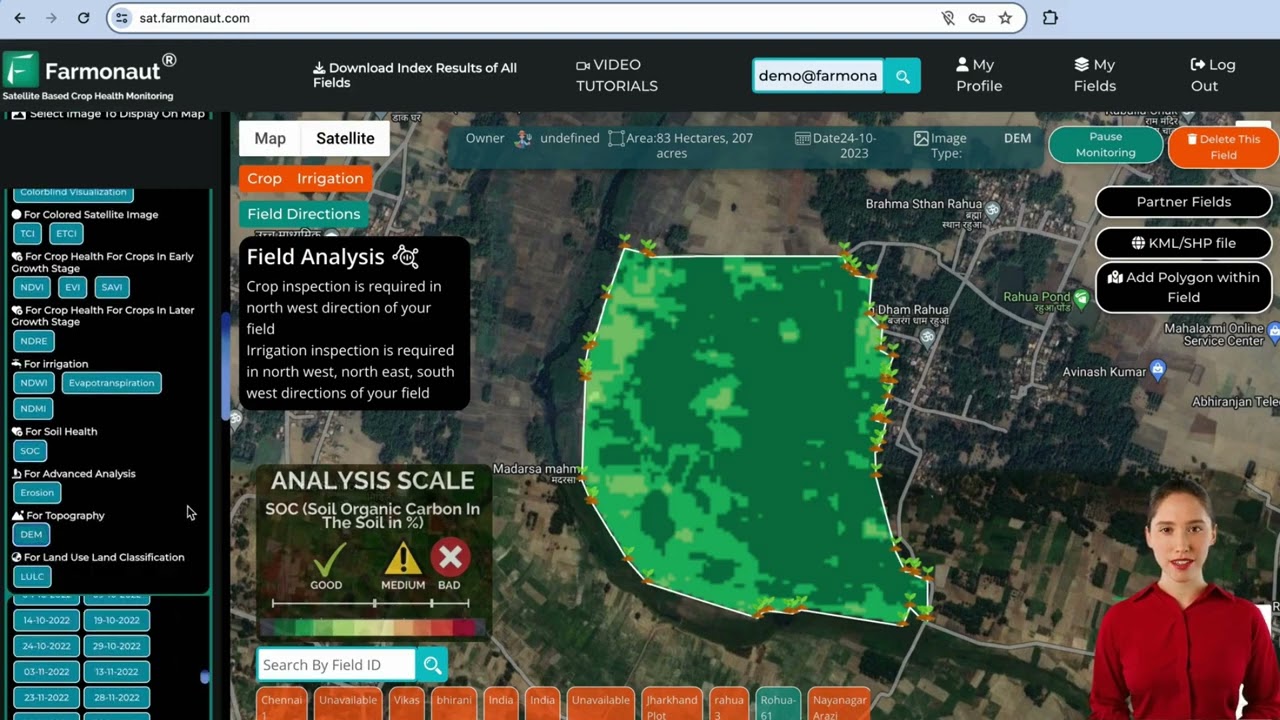
▶ A tutorial on using Farmonaut’s web app for satellite monitoring of your fields. · 8:02
Traceability rules your records must meet
Software does not make you compliant on its own, but it can hold the records the rules ask for. Rules differ by country, so check with your animal health authority.
- United States: a USDA APHIS final rule effective 5 November 2024 requires official eartags applied from that date to be both visually and electronically readable for covered cattle and bison moving interstate. Covered cattle include sexually intact animals 18 months or older, female dairy cattle of any age, dairy males born after 11 March 2013, and cattle used for rodeos or shows.
- England and Wales: government guidance for cattle keepers sets out rules so cattle can be traced at all times.
- Australia: the National Livestock Identification System combines a visual or electronic device on each animal, a Property Identification Code for each location, and a central database of movements.
Ask the vendor whether the tool reports directly to your national system or whether you still file separately. This is general information, so confirm your duties with your state, provincial or national authority.

▶ How an admin app supports task management on large farm operations. · 7:27
How to choose ranch software and switch from paper
Work through these steps during a trial. Several of the tools above offer one, and the trial lengths on their pages run from 14 to 30 days.

▶ Six plain steps to start with digital farming tools, without buying a robot. · 4:18
- Write down your one main problem. Missed treatments, unknown cost per head and lost breeding dates need different tools.
- Count your active animals, including calves and bulls if the vendor bills them. Add your expected growth over two years, then price each tool at that number.
- Enter one real group. Use 20 cows, not the demo data, and work them through a treatment and a pasture move.
- Test it where you work. Enter records at the chute or in the far pasture with the phone signal off.
- Run one report. Compare the calving or weaning percentage with what you work out by hand.
- Export your data. If you are looking for a CattleMax replacement or any other change, check the export and import paths on both sides first.
Budget time for a learning period. We found no independent US study that measures the hours gained or lost in the changeover. Ask who on the ranch will actually enter the data, as a tool that one person uses and others ignore leaves holes in the record. Teams spread over several sites might also want task and scouting tools, such as an admin app for large farms.
FAQ
What is the best ranch software for a small herd?
It depends on what you need to track. On published prices, Cattlytics starts at $7.99 a month up to 99 head, Smarter Cattle at $19.99 a month for 6 to 50 head, and CattleMax at $30 a month billed yearly up to 250 animals. Try two with your own cows before you pay.
What is the difference between cattle software and ranch software?
The terms overlap. “Cattle software” usually means animal-level records such as health, breeding and weights. “Ranch software” usually adds land, grazing, equipment, labor and finances. CattleMax, for example, lists both animal records and an equipment log, so check the feature list and not the label.
Is there cattle management software at no cost?
Smarter Cattle lists no charge for 0 to 5 head. Beyond that, the tools above charge a fee, though they offer trials. Alabama Extension also describes written record systems, which can suit a small herd if you keep them up to date.
Do any of these tools track cattle by GPS?
Smarter Cattle lists direct-to-satellite GPS tracking through a partnership with Ceres Tag. Tags are hardware with their own cost, so price the tags and any service plan as well as the software, and test coverage on your remote pastures.
How does profit forecasting work in ranch software?
The tool takes your herd size, calf weight, sale price and costs, then projects a margin per cow. Change one input to see the effect. As a check, a University of Kentucky budget published in 2024 moved about $47 a cow for each 10-cent change in calf price. A forecast is only as good as the costs you enter.
Can ranch software help with traceability rules?
It can store IDs, moves and treatments so you can find them fast. It may not file reports for you. Ask each vendor about your national system, and confirm your duties with your animal health authority.
Related pages on our site: product traceability; carbon footprinting; fleet management; satellite checks for farm loans and insurance; satellite data API; mobile and web apps; vertical farming lighting trends.
Farmonaut pasture monitoring
See your pastures from space
Add satellite vegetation maps of your fields alongside your herd records.




Keep reading

Sources
- USDA NASS, United States cattle inventory down slightly (30 January 2026): nass.usda.gov
- USDA ERS, Larger Beef Cow-Calf Farms Have Lower Costs per Cow (December 2024): ers.usda.gov
- University of Kentucky, Cow-Calf Profitability Estimates for 2023 and 2024: agecon.mgcafe.uky.edu
- Alabama Extension, Beef Cattle Record Keeping Basics (2019): aces.edu
- McNicol et al., Frontiers in Sustainable Food Systems (2024): frontiersin.org
- USDA APHIS, final rule on electronic eartags, Federal Register (9 May 2024): govinfo.gov
- GOV.UK, Keeping cattle, bison and buffalo in England and Wales: gov.uk
- Integrity Systems, National Livestock Identification System: integritysystems.com.au
- CattleMax pricing: cattlemax.com
- Farmbrite pricing: farmbrite.com
- Smarter Cattle plans: smartercattle.com
- Cattlytics cow-calf software: cattlytics.com
- Cattlytics pricing: cattlytics.com
- Ranch Vision pricing: ranchvision.io
- AgriWebb pricing: agriwebb.com
- Herdwatch pricing: herdwatch.com
- Herdwatch UK pricing: herdwatch.com
- Herdwatch pasture software: herdwatch.com
Discussion
Questions, corrections or field experience? Share them below. First-time comments are reviewed before they appear, and your email is never published.
No comments yet. Be the first to add a question or your experience.

 Unnati Agri
 Geno
 Hayleys Agriculture
 Linx Agritech
 Adinet
 Save Your Soils
 Grandstream Algérie
 XOS Realty
 Geospatial Lab Africa
 Agro La Gándara
 HIPSAC
 ZOL Zimbabwe
 Juligerm
 AdBio
 MISE Maroc
 NWNS
 Red August Group
 Farm Inc

 Licence holder · Niger · Gold










