

Fruit orchards · Grower guide
Lemon Orchard: How to Plant and Grow It in 7 Steps
Commercial lemon orchards plant about 150-155 trees per acre on well-drained, frost-light ground, pick a first crop in year three and reach full yield near year eight (UC Davis). Seven steps from soil to harvest, with US data and a calculator for spacing and margin per acre.
Key takeaways
- Spacing: UC sources use 20 x 14 ft (155 trees/acre) or 24 x 12 ft (151 trees/acre), about 373-384 trees per hectare.
- Yield: the UC Davis Ventura County study (2020) estimates 245 cartons per acre in year 3, rising to about 1,018 cartons of 37.5 lb at full production.
- US lemons covered 62,500 bearing acres in 2025-26, 54,000 of them in California (USDA NASS, August 2026).
- Mature lemon trees need 2-3 lb of nitrogen per tree per year and are among the most frost-tender citrus (UC Cooperative Extension).
- Huanglongbing, spread by the Asian citrus psyllid, has no cure, so certified trees and psyllid checks are vital (UC IPM).
In this article
- Lemon orchard at a glance
- Where lemon orchards grow in the US
- Step 1: Site selection and soil preparation
- Step 2: Planting and lemon tree spacing
- Step 3: Lemon tree irrigation
- Step 4: Lemon tree fertilization
- Step 5: Lemon tree pest and disease control
- Step 6: Maintaining lemon trees
- Step 7: When to harvest lemons
- Lemon orchard costs and returns
- Lemon orchard care timeline
- Using satellite monitoring in a lemon orchard
- FAQ
A lemon orchard is a block of lemon trees grown for fruit, planted in rows on well-drained soil in a frost-light climate. In commercial groves the trees usually sit 12 to 14 feet apart in the row, with 20 to 24 feet between rows. That gives about 150 to 155 trees per acre, or roughly 375 to 385 trees per hectare. The first crop comes in year three, and full yield arrives around year eight, according to the UC Davis sample cost study for Ventura County lemons (2020).
This guide walks through seven steps to plant and run a lemon orchard: site and soil, planting and spacing, water, feeding, pests and diseases, pruning and frost care, and harvest. It uses figures from University of California and USDA sources, gives a yield chart by tree age, and has a calculator for trees per acre and the margin per acre at your own prices.
Lemon orchard at a glance
The table sums up the key numbers. Each figure has its source in the step below it.
| Item | Typical figure | Source |
|---|---|---|
| Tree spacing | 20 x 14 ft (155 trees/acre) or 24 x 12 ft (151 trees/acre) | UC Davis cost study; UC Cooperative Extension |
| First fruit | Year 3 | UC Davis cost study |
| Full yield | About year 8; about 1,018 cartons of 37.5 lb per acre | UC Davis cost study |
| Water at full size | About 30 inches per acre per year (Ventura County) | UC Davis cost study |
| Nitrogen at full size | 2 to 3 lb N per tree per year | UC Cooperative Extension |
| Frost risk | Damage can start at about 29°F | UC Cooperative Extension |
| Orchard life | More than 40 years with good care | UC Davis cost study |
Where lemon orchards grow in the US
Lemons need warm days, mild winters and little frost. In the US, that limits commercial lemon orchards to a few places. The USDA NASS Citrus Fruits summary (August 2026) counts 62,500 bearing acres of lemons in the 2025-26 season: 54,000 in California, 5,100 in Florida and 3,400 in Arizona. California picked 26.0 million boxes, Florida 0.9 million and Arizona 0.72 million.
Chart
US lemon production by state, 2025-26
Million boxes picked (utilized production), 2025-26 season
The USDA Economic Research Service outlook of March 2026 says California accounts for 94% of US commercial lemon output. It forecast the 2025-26 crop at 1.08 million tons, 3% below the season before. The final NASS figure in August 2026 was 1.11 million tons, about 2% below 2024-25. Fresh US lemon exports peak from December to March, and Canada took 47% of them in the first half of the season.
Outside the US, the main lemon belts sit in Mediterranean and subtropical climates: southern Spain and Italy, coastal Australia, Argentina, Mexico and South Africa. In the UK and northern Europe, lemons are grown in pots that spend the winter under glass. The Royal Horticultural Society’s citrus guide says some lemons cope with about 5°C (42°F) indoors, and they need a frost-protected space over winter.
Value is large for a small area. NASS valued the 2025-26 US lemon crop at about US$749 million. The average price at the packinghouse door was US$27.12 per box for all uses, and the California on-tree equivalent was US$20.20 per box. These are season averages, not prices any one grower was paid.
Chart
US lemon production by marketing year
Thousand tons, August-July marketing years; 2025-26 is a forecast
Step 1: Site selection and soil preparation
Choose a warm site with good air drainage
Lemon trees grow best in full sun with shelter from strong wind. They are among the most frost-tender citrus. The UC Cooperative Extension citrus questions and answers guide defines frost risk as 29°F for 30 minutes or longer. It says limes and lemons, except Meyer, are the citrus most likely to be hurt by frost. Cold air flows downhill, so avoid low spots and frost pockets. A gentle slope with good air flow is best.
Check local frost records before you buy land. One hard freeze can cost a year of fruit on young trees. Wind also matters. Wind scars the fruit skin and lowers the share of fruit that packs as fresh grade.
Soil type and drainage
Lemons need well-drained soil. A sandy loam or loam with some organic matter works well. Heavy clay that stays wet can lead to root rot. To test drainage, dig a hole about 12 inches (30 cm) deep, fill it with water, and see how long it takes to drain. Water that stands for more than a day points to clay, a hardpan or compaction. In Ventura County, the UC Davis study says growers rip the soil twice, about 4 to 6 feet deep, before planting to break layers that block roots and water.
Soil pH and soil tests
Send soil to a lab before planting. A slightly acid to neutral soil suits citrus; a pH of about 6.0 to 6.5 is a common target. The UF/IFAS guide to citrus problems in the home landscape says that if soil pH is below 5, dolomite can raise it to 6.0-6.5 and add magnesium at the same time. On alkaline soils, sulfur lowers pH over time, and gypsum helps water soak in on some soils. Use the rates on your lab report.
Also test your irrigation water. Citrus leaves are sensitive to salt, and salty water or too much manure can burn leaf edges. If the land grew citrus before, test the soil for nematodes and Phytophthora before you plant. The UC Davis study warns that both can be severe problems in replanted citrus ground.
Add organic matter and clear the ground
Mix compost or well-rotted manure into the planting area to improve structure and water holding. Use manure with care. The UC guide warns that fresh manure can carry salts and release ammonia that injures roots. Use well-composted material, apply it in fall where rain can leach the salts, and do not pile it against trunks. Our guide to well-rotted manure covers how to source and use it.
Remove weeds, grass, rocks and old roots before you mark the rows. Weeds compete hard with young trees for water and nitrogen.
Soil preparation checklist
- Take soil and water samples, and test for nematodes on old citrus ground.
- Rip or deep-till to break hardpans and compacted layers.
- Correct pH and add compost based on the lab report.
- Clear weeds and debris, then level the ground.
- Lay out rows and install irrigation before the trees arrive.
Step 2: Planting and lemon tree spacing
Pick varieties and rootstocks
Eureka and Lisbon are the main commercial lemons in California. The UC Cooperative Extension guide describes Lisbon as vigorous, thorny, very heat tolerant and with some cold resistance. Eureka is nearly thornless and productive, but cold sensitive. Improved Meyer is a lemon hybrid with less acid that bears year round. It is more popular in home gardens than in packing orchards. The UC Master Gardener lemon fact sheet lists Eureka, Improved Meyer, Lisbon and Variegated Pink as recommended varieties.
The rootstock decides tree size, vigor and disease tolerance. The Ventura cost study models Eureka on macrophylla rootstock. Ask your nursery which rootstocks suit your soil, water and local disease risk. Buy only certified, disease-tested nursery trees. In areas under citrus quarantine, trees must come from approved nurseries.
Lemon tree spacing in feet and meters
Spacing sets tree numbers, light in the canopy and how easily machines and pickers can move. The UC Davis study plants trees 14 feet apart in rows 20 feet apart, which gives 155 trees per acre. The UC Cooperative Extension guide says commercial groves generally use 12 x 24 feet. Mature citrus on well-drained soil can reach a canopy of 18 to 30 feet, and lemons are among the largest.
| Spacing (tree x row) | In meters | Trees per acre | Trees per hectare |
|---|---|---|---|
| 12 x 24 ft | 3.7 x 7.3 m | 151 | 373 |
| 14 x 20 ft | 4.3 x 6.1 m | 155 | 384 |
| 15 x 22 ft | 4.6 x 6.7 m | 132 | 326 |
| 6 x 12 ft (dwarfing stock) | 1.8 x 3.7 m | 605 | 1,494 |
Trees per acre is 43,560 divided by tree spacing times row spacing, both in feet. Per hectare, divide 10,000 by the two distances in meters. The 6 x 12 ft row only fits trees on a dwarfing rootstock such as Flying Dragon, which the UC guide says can be planted that close. Closer spacing gives more fruit in early years but needs hedging sooner.
When and how to plant
Plant in spring after the danger of frost has passed. The UC fact sheet says spring trees have more time to grow before their first winter. In Ventura County, growers plant in February, per the Ventura cost study.
- Dig the hole as deep as the root ball and as wide or wider.
- Set the tree so the graft union stays well above the soil. Never bury it.
- Backfill with the native soil, firm it gently and water deeply to settle it.
- Wrap or paint young trunks with diluted white water-based paint to stop sunburn.
- Expect to replace 2-3% of trees in the second year, the rate the UC Davis study allows for.
Step 3: Lemon tree irrigation
Steady moisture is key for lemons. Drought at bloom makes flowers drop and cuts fruit set, the UC guide says. Too much water causes root rot. Most commercial groves use drip or micro-sprinklers. The Ventura cost study models micro-sprinklers with one 10-gallon-per-hour emitter per tree.
How much water a lemon orchard uses
Water needs rise as trees grow. In the Ventura cost study, water applied in Ventura County climbs from 4 inches per acre in year one to 30 inches per acre from year six on. Water is applied twice a week from April to October. Hotter, drier places need more. Use local evapotranspiration data, soil moisture probes or tensiometers to time each set.
For home and small orchards, the UC fact sheet says to wet the soil about three feet deep each time, every two to six weeks, depending on soil and season. Citrus feeder roots are mostly in the top 6 to 8 inches of soil, the UC guide notes, so keep that layer from drying out, but let it drain between sets.
Irrigation tips
- Water at dawn or at night to cut evaporation.
- Mulch under the canopy, kept a few inches off the trunk.
- Check emitters for clogs each month in the season.
- Leach salts with an extra deep watering if leaf edges burn.
- In frost areas, wet soil holds heat; the UC Davis study notes micro-sprinkler water is used on grove floors for frost protection.
Step 4: Lemon tree fertilization
Nitrogen drives growth and yield in lemons. The UC Cooperative Extension guide puts mature lemon trees at 2 to 3 lb of actual nitrogen per tree per year, more than oranges or grapefruit at 1 to 1.5 lb. Young trees need small, split doses. In the Ventura model, nitrogen rises from 0.09 lb per tree in year one to 1.20 lb per tree from year seven, fed through the irrigation system once a month from March to October.
Lemons also need potassium, magnesium, zinc, manganese and iron. The UF/IFAS guide shows how each deficiency looks on the leaves. Magnesium shortage, for example, starts as yellow patches near the base of older leaves. Leaf tests in late summer or fall show what the trees actually take up.
Feeding plan
- Base rates on soil and leaf tests, not a fixed recipe.
- Split nitrogen into small doses through the season.
- Do not feed late in the year in frost areas; soft new growth is easily damaged.
- Water fertilizer in, and keep dry fertilizer off the trunk.
- Read the label on every product, and follow local rules on nitrogen use and runoff.
Product names and rates in this guide are examples from extension sources, not advice for your farm. Check the label and ask a local agronomist or extension adviser before you apply.
Step 5: Lemon tree pest and disease control
Good spacing, clean nursery stock and regular scouting prevent most problems. Check trees every week or two in the growing season, and look at new flush, the undersides of leaves and the fruit.
Asian citrus psyllid and huanglongbing
The biggest threat to US citrus is huanglongbing (HLB), also called citrus greening. The UC IPM page on Asian citrus psyllid and huanglongbing says the psyllid spreads the disease as it feeds, all citrus types including lemons are affected, and there is no cure or effective control method for HLB. Infected trees found in California are destroyed, and quarantines limit plant movement. Check new leaves monthly from spring to fall for psyllid eggs, nymphs and adults. In California, report suspected finds to your county agricultural commissioner or the CDFA hotline.
Other common pests
- Citrus leafminer. Larvae tunnel in young leaves and make them curl. The UC IPM citrus leafminer guidelines say trees older than about four years generally tolerate the damage, but young trees are slowed.
- Citrus thrips. They scar fruit skin. For coastal lemons, UC IPM says groves with a history of wind scarring can accept more thrips before treatment.
- Scales, mites and whiteflies. Natural enemies keep many in check. Ants that guard scale and mealybugs reduce that control.
Diseases
- Brown rot. The main fruit disease in the UC Davis study. Spores splash onto fruit in cool, wet weather, and copper sprays before the rains are the usual control.
- Phytophthora root rot and gummosis. Linked to wet, poorly drained soil. Use tolerant rootstocks and avoid overwatering.
- Citrus tristeza virus. Spread by aphids. The EPPO datasheet on citrus tristeza virus notes that lemon seedlings are highly sensitive to some strains, and that tolerant rootstocks are the main defense where the virus is common.
- Mal secco. A fungal disease of lemons in the Mediterranean, described in the EPPO datasheet for Plenodomus tracheiphilus. Remove and burn infected wood.
Chemical options change often and differ by country and state. Check the label, and follow local rules and your adviser’s guidance before you spray.
Step 6: Maintaining lemon trees
Pruning and hedging
Most citrus needs little pruning, but lemons are an exception. The UC guide says lemons need thinning and heading back to control vigorous shoots. Do heavy pruning in winter so limbs are not sunburned. Prune after any chance of frost, the UC fact sheet adds. Remove dead wood, water sprouts and suckers below the graft. Skirt pruning lifts the lower canopy off the ground. That keeps fruit away from soil-borne disease and makes weeding and mulching easier. Commercial groves hedge the sides and top of rows so light reaches the lower canopy and pickers can reach the fruit.
Weeds and ground cover
Keep a clean strip under young trees. In frost areas, the UC Davis study says growers keep grove floors bare or mow cover crops very low, because bare, moist soil stores heat by day and releases it at night.
Frost protection
In Ventura County, December and January carry the most frost risk. Growers use three main methods, per the Ventura cost study: bare grove floors, water from micro-sprinklers, and wind machines that pull warmer air down into the grove. One wind machine covers about 10 acres. For young trees, wrap trunks with insulating material, and keep soil moist before a cold night. The UC guide notes that frost will rarely kill a mature citrus tree; wait for the spring flush before you cut back damaged wood.
Monitoring the whole orchard
On a larger orchard, it is hard to see every tree each week. Satellite crop maps show where the canopy is weaker than the rest of the block. Those patches can point to a blocked emitter, a wet low spot or a pest hot spot, so scouts can check them first. Farmonaut gives satellite vegetation maps for each field you draw, on web, Android and iOS. Walk the block to confirm what the map shows before you act.
▶ How satellite NDVI maps show crop stress across a large farm before you can see it. · 4:09
Step 7: When to harvest lemons
Lemons do not ripen much after picking, so timing matters. The UC fact sheet says lemons are ready when they are yellow or yellowish-green, firm and two to three inches across. It is better to pick a little early than too late. Wrinkled, dull or soft fruit is past its best.
Commercial lemons are picked by hand into bins that hold about 900 lb. The UC Davis study describes three picks a season in Ventura County, with the largest in winter. Coastal California lemons can be picked almost year round. Commercial buyers size and grade fruit, so pickers often use rings to pick only fruit above a set size.
Yield by tree age
The UC Davis study estimates yield per acre rising from 245 cartons of 37.5 lb in year three to about 1,018 cartons once the grove is in full production. That is roughly 54,000 lb per acre. About 80% of that packs as fresh fruit in the model. Your yield will differ by site, variety and care.
After harvest
- Clip fruit with a short stem rather than pulling, to avoid skin tears.
- Keep picked fruit in the shade and move it to the packhouse fast.
- Do not pick wet fruit; it bruises and decays more easily.
Chart
Lemon yield per acre by orchard age
Cartons of 37.5 lb per acre, Eureka on macrophylla, Ventura County model
Lemon orchard costs and returns
A lemon orchard is a long-term investment. The UC Davis study put total establishment cost in Ventura County at US$36,669 per acre in 2020, counting the first six years of costs and returns. That figure excludes land, which the study valued at US$80,000 per acre. At a yield of 1,018 cartons per acre, the break-even price to cover cash costs was US$11.88 per carton, and US$17.18 per carton to cover total costs. Harvest was almost half of the yearly production cost.
These are 2020 figures for one county. Costs for labor, water and trees have changed since, so treat them as a starting point. Use the calculator below with your own spacing, yield, price and cost.
Try the numbers for your own farm below.
Calculator
Lemon orchard trees and margin per acre
Enter your spacing, yield, price and cash costs.
- Trees per acre: 156 trees
- Trees per hectare: 384 trees
- Gross return per acre: 12,500 US$
- Break-even price per carton: 12.0 US$
Example values only, set near break-even; they are not a benchmark or a forecast. Yield and cost examples are close to the UC Davis Ventura County study (2020). The price is an example, use today’s price from your packer. Margin here is over cash costs only; it leaves out land, depreciation and interest.
Lemon orchard care timeline
| Stage | Main tasks | Timing |
|---|---|---|
| Site prep | Soil and water tests, ripping, pH and organic matter, irrigation layout | Year before planting |
| Planting | Certified trees, correct depth, trunk protection | Spring, after frost |
| Young trees | Frequent light irrigation, small nitrogen doses, weed control, sucker removal | Years 1-2 |
| First crop | Pest scouting, brown rot sprays where needed, first picks | Year 3 |
| Rising yield | Leaf tests, pruning and hedging, frost plans | Years 4-7 |
| Full production | Two to three picks a season, steady care | About year 8 onward |

▶ Six plain steps to start precision farming, from field maps to satellite monitoring. · 4:18
Using satellite monitoring in a lemon orchard
A lemon orchard runs for decades, so small problems add up. Weekly scouting is still the main tool. Satellite maps add a whole-block view between visits. They help you compare blocks after a frost, check where water stress shows first in summer, and keep records across seasons. The Farmonaut Satellite + AI Farm Monitoring System also covers weather data for each field. Treat any map as a guide to where to look, then confirm on the ground.
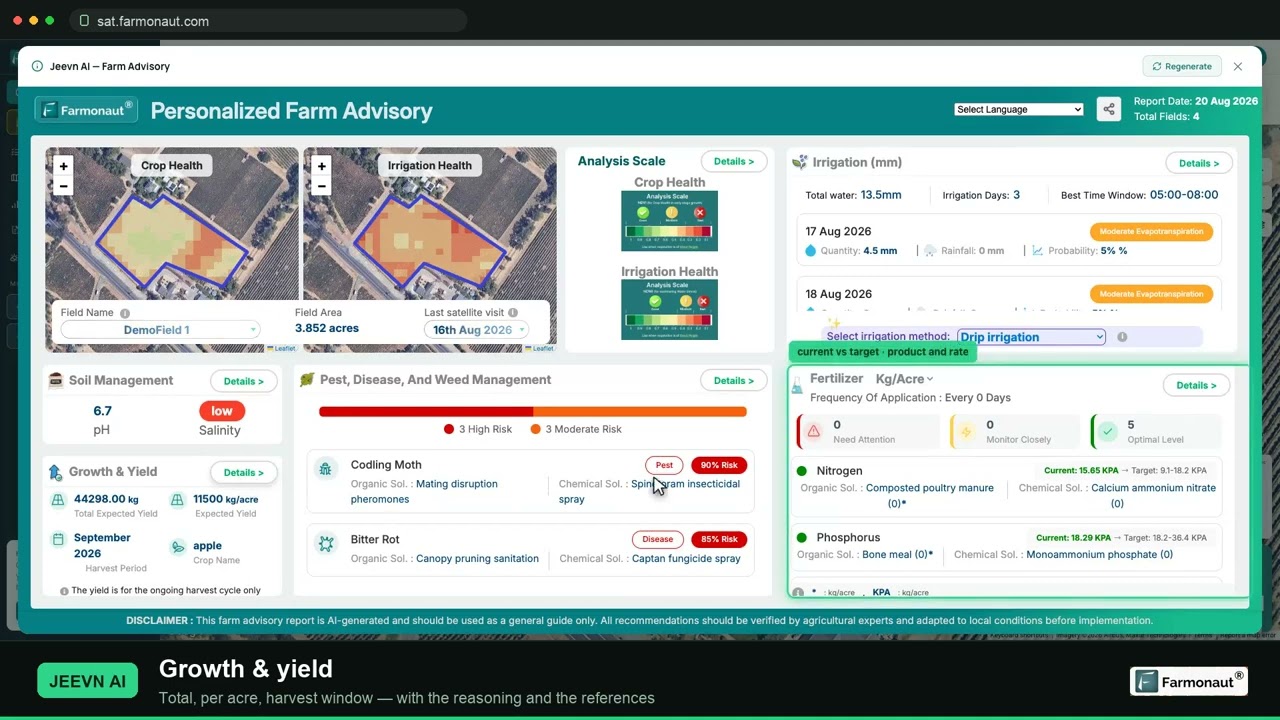
▶ A full walkthrough of satellite crop monitoring: reading NDVI and pulling a report for your own field. · 19:36
Related pages on our site: large-farm management dashboard, monitoring app download, satellite and weather API documentation, farm carbon footprinting, farm fleet management and produce traceability.
FAQ
How far apart should lemon trees be planted in an orchard?
Commercial groves use about 12 to 14 feet between trees and 20 to 24 feet between rows, or about 3.7-4.3 m by 6.1-7.3 m. Trees on dwarfing rootstock can go as close as 6 x 12 feet.
How many lemon trees fit per hectare?
At 14 x 20 feet (4.3 x 6.1 m), about 384 trees per hectare, or 155 per acre. At 12 x 24 feet, about 373 per hectare.
How long until a lemon orchard bears fruit?
Grafted trees in the Ventura model bear a first crop in year three and reach full yield around year eight.
How far do lemon tree roots spread?
Most citrus feeder roots sit in the top 6 to 8 inches of soil, the UC guide says, and fertilizer is spread under the canopy and 1 to 2 feet past the drip line. Wetting the soil about three feet deep covers the main root zone.
What is the biggest threat to a lemon orchard?
In the US, huanglongbing spread by the Asian citrus psyllid. It has no cure, so controlling the psyllid and using certified trees are vital. Frost is the main weather risk.
Farmonaut crop monitoring
See your orchard blocks from space
Draw your orchard blocks once and Farmonaut shows satellite vegetation maps for them through the season, on web, Android or iOS.




Sources
- UC Cooperative Extension and UC Davis, Sample Costs to Establish an Orchard and Produce Lemons, Ventura County (2020): ccfruitandnuts.ucanr.edu
- USDA NASS, Citrus Fruits 2026 Summary (August 2026): esmis.nal.usda.gov
- USDA ERS, Fruit and Tree Nuts Outlook FTS-384 (March 2026): ers.usda.gov
- UC Cooperative Extension, Questions and Answers to Citrus Management, third edition: ccfruitandnuts.ucanr.edu
- UC Master Gardeners, Know What You Grow: Lemon fact sheet (2022): ccfruitandnuts.ucanr.edu
- Royal Horticultural Society, How to grow citrus: rhs.org.uk
- UF/IFAS, HS876: Citrus Problems in the Home Landscape: edis.ifas.ufl.edu
- UC IPM, Asian Citrus Psyllid and Huanglongbing Disease (home and landscape): ipm.ucanr.edu
- UC IPM, Citrus Leafminer pest management guidelines: ipm.ucanr.edu
- UC IPM, Citrus Thrips pest management guidelines: ipm.ucanr.edu
- EPPO Global Database, Closterovirus tristezae (citrus tristeza virus) datasheet: gd.eppo.int
- EPPO Global Database, Plenodomus tracheiphilus (mal secco) datasheet: gd.eppo.int
Discussion
Questions, corrections or field experience? Share them below. First-time comments are reviewed before they appear, and your email is never published.
No comments yet. Be the first to add a question or your experience.

 Tucor
 Saraswati Agro
 Geno
 Hayleys Agriculture
 Linx Agritech
 Adinet
 Save Your Soils
 Grandstream Algérie
 XOS Realty
 Geospatial Lab Africa
 Agro La Gándara
 HIPSAC
 ZOL Zimbabwe
 Juligerm
 MISE Maroc
 NWNS

 Licence holder · Niger · Gold
 Client · Somalia · Gold
 Client & affiliate partner · Ghana · Gold










